
 Worksheets
Zoo 1st Semester Exam
Total questions: 115
Worksheet time: 1hrs 21mins
Cladistics show evolutionary relationships in a diagram called a __________.
cladagram
graph
family tree
c-map
What scientific name is correct?
Quercus Alba
Quercus alba
quercus Alba
quercus alba
Canis lupus, the scientific name for a wolf, is in which genus?
Canis
lupus
Animalia
Mammalia
Which is the best prediction regarding the current classification system?
The system may change as new information and organisms are discovered.
Scientists will become bored with the current system and develop a new one.
Over time, organisms will become extinct, so classification will become simpler.
The system is set in stone and most likely will not change.

An organism identified with binomial nomenclature includes which two taxa?
class and order
family and genus
genus and species
kingdom and phylum

Carl Linnaeus developed a binomial classification system for living things. Why is this contribution important?
because it created new species for identification
because it created specific scientific names for living things
because it created the taxonomy system as it is known today
because it created common names for species with existing scientific names
Scientists currently classify organisms based on features they share. How will this most likely change in the future?
They will be classified based on DNA analysis.
They will be classified based on similar organs.
They will be classified based on common descent.
They will be classified based on protein production.



Name of D (opening at top)
Osculum
Ostia
Choanocytes
Incurrent Pore
The sponge has no organs, tissues, and no nervous system.
True
False
Flagella inside a sponge keep water moving through its body. Why is this necessary?
It prevents the sponge from floating away
It allows the sponge to feed
It allows the sponge to absorb carbon dioxide
It maintains the water pressure inside the sponge
Sponges are primarily sessile organisms. What does this mean?
They live permanently in one palce
They move around their whole life
Water enters a sponge through the dermal pores or _______.
Osculum
Ostia
Collar cells
It doesn't
The class of sponges with spicules made of silica, a cup or vase shape, and are referred to as glass sponges.
Calcarea
Hexactinellida
Demospongiae
Homoscleromorpha
The class of sponges with brilliant colors, spicules made of silica, spongin, or both, and can be 1m in height and diameter.
Calcarea
Hexactinellida
Demospongiae
Homoscleromorpha
The class of sponges with spicules made of calcium carbonate. Includes all marine members such as the Grantia.
Calcarea
Hexactinellida
Demospongiae
Homoscleromorpha
A structure made by some sponges that allow it to survive harsh conditions of winter.
gemmule
spicule
collar cell
cell wall
What kind of worm is a platyhelminthes?
Flat worm
Round worm
Special ed worm
School worm
Which Class has Tapeworms
Cestoda
Monogenea
Trematoda
Nematoda
True or False: Platyhelminthes have hard bodies
True
False
All worms are ____.
Vertebrates
Invertebrates
All worms have ____.
Asymmetry
Radial symmetry
Bilateral symmetry
What is the main characteristic of annelids that gives them their name?
Feathery gills
Jointed legs
Segmented body
Hard exoskeleton
What is the purpose of the clitellum in earthworms?
The purpose of the clitellum in earthworms is to store excess water.
The purpose of the clitellum in earthworms is to aid in digestion.
The purpose of the clitellum in earthworms is to secrete a mucus cocoon during reproduction.
The purpose of the clitellum in earthworms is to protect against predators.
Which part of an earthworm's body helps it move through the soil?
muscles
gills
setae
antennae
What is the function of the crop in earthworms?
Storing food temporarily before it moves to the gizzard for further digestion.
Filtering waste from the blood
Producing digestive enzymes
Regulating body temperature
How do leeches obtain their food?
By hunting and capturing small prey
By sucking blood from animals or humans
By scavenging for dead animals
By photosynthesis
How do annelids reproduce?
Asexually
Through spores
Sexually
By laying eggs
Earthworms are considered to be beneficial to the environment because
These make up about half of the phylum Annelida. These worms usually have few setae (chaetae) or "bristles" on their outer body surfaces, and lack parapodia. They are found in terrestrial and aquatic ecosystems.
Which of the following is an example of an Annelida?
Earthworm
Tapeworm
Pinworm
Hookworm
Exoskeleton
Endoskeleton
Cephalization
Coelom
What is the circulatory system?
It works to transport oxygen and nutrients. It also works to remove carbon dioxide and other waste products.
It works to excrete waste products.
The network of organs and tissues that help you breathe.
Breaks nutrients into parts small enough for your body to absorb and use for energy, growth, and cell repair.
What is the organ used to accomplish excretion?
Clitellum
Nephridia
Septa
Setae
Which is a similarity between worms and mollusks?
Some have gills
They are invertebrates
Land dwelling organisms must stay moist to survive
All of the above
Earthworms don't have teeth to grind their food so they use another organ to do so. It is called a
Setae
Crop
Gizzard
Clitellum
Annelids that have the ability to seek out warm-blooded prey; either fluid-feeders/blood suckers or eat small invertebrates
leeches
marine polychaetes
earthworms
tube worms
Which group of worms are considered to be the most complex?
flatworms
roundworms
segmented worms

Jellyfish have what type of body structure
Medusa
Polyp
Hydra
Branched

Sea anemones have what type of body structure?
Medusa
Polyp
Down
Sessile
T/F: Cnidarians have a complex nervous system.
True
False
Hydra reproduce asexually by
budding
nematocysts
gland cells
gametes
Which other cnidarian is closet related to coral?
Jellyfish
Hydroids
Sea Anemone
Comb jellies
Corals and jellyfish are classified together mainly because they
share the same habitat
have stinging tentacles
are tropical
are planktonic
Jellyfish have ______ symmetry
radial
assymetrical
bilateral
quad
Cnidaria means ____ cells.
shelter
stinging
polyp
medussa
What is an invertebrate?
An animal that has a shell
An animal that lives in the water
An animal with no backbone
An animal that can fly
Jellyfish belong to the Class ________.
Hydrozoa
Scyphozoa
Anthozoa
Cubozoa
Coral belong to the Class ________.
Hydrozoa
Scyphozoa
Anthozoa
Cubozoa
Sea anenomes belong to the Class ________.
Hydrozoa
Scyphozoa
Anthozoa
Cubozoa
Box jellyfish belong to the Class ________.
Hydrozoa
Scyphozoa
Anthozoa
Cubozoa
The mouth of cnidarians is located
on the tentacles.
on top of the medusa.
on the bottom of the polyp.
in the middle of the tentacles.
Dioecious means
separate sexes.
it has both sexes.
it is asexual.
The biggest threat that cnidarians pose to humans is
eating us.
attacking our boat.
stinging a person if stepped on.
killing all of the fish in the ocean.
The cnidarian made famous for being Nemo's house is the
hydra
coral reef
sea anenome
jellyfish
Which species of mollusk does not have a shell?
snail
limpet
conch
slug

What is the meaning of Gastropod?
Soft-bodied
Stomach-footed
Head-footed
Two-shelled
The shell of a mollusc is made out of what compound?
Calcium Carbonate
Calcium Phosphate
Calcium
Iron Phosphate
Strontium Chloride
How do bivalves eat?
Filter feeders
Radula
Tentacles
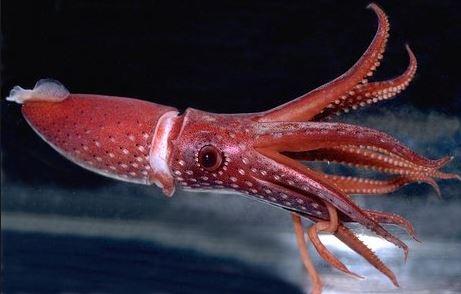
These molluscs have a head and a modified foot that are now arms or tentacles.
Cephalopods
Nudibranches
Gastropods
Bivalves
Ctenidia

Cells containing pigment that, through contraction and expansion, produce temporary color changes.
RADULA
CHROMATAPHORE
PEN
MANTLE

An elongated, boneless, flexible organ or limb of some animals, such as the octopus and squid.
CUTTLEBONE
TENTACLE
CHROMATOPHORE
BIVALVE

What TYPE of mollusk is this?
Bivalve
Gastropod
Cephalopod

An echinoderm with five arms arranged around a center point.
sea cucumber
sea star
sand dollar
tube feet
An echinoderm with soft body and a leathery covering.
sea star
sand dollar
sea urchin
sea cucumber
Echinoderms have no head or brain.
True
False
Echinodermata means...
stomach foot
spiny skin
segmented body
jointed foot


______ are appendages used for locomotion in echinoderms.
tube feet
madreporite
stone canal
axial organ

Organ in sea star that can turn itself inside out when feeding
intestine
stomach
Which is the correct description of an arthropod's body?
A furry coat with large fangs
An interior skeleton with leathery skin
Two or more separate segments that have a hard outer cover with appendages
An eight legged animal with mandibals
Which three characteristics do arthropods have
Fur, Eyes, and Paws
Jointed segments, an exoskeleton, and body cavities
Claws, Leathery Skin, and Gills
Eat, Breath, and Sleep
What is molting?
Melting with an "o"
The shedding of an exoskeleton
When an arthropod loses it's legs
A way to make chocolate
Venom is a poisonous substance secreted by animals such as snakes, spiders, and scorpions and typically injected into prey or aggressors by biting or stinging.
True
False
Phylum Arthropoda includes
clams, snails, squid, octopus
segmented worms
flatworms
roundworms
insects, spiders, & crabs
Centipedes have how many pairs of legs per segment?
4
3
2
1
How many legs do millipedes have per segment?
4
1
2
3
Match the following organisms with the correct Class: Spider
Chilopoda
Insecta
Arachnida
Diplopoda
Match the following organisms with the correct Subphyla: Spiders
Crustacea
Chelicerata
Hexapoda
Trilobita
Myriapoda
Which of the following is the closest relative to the horseshoe crab?
blue crab
spider
oyster
fiddler crab

What extinct group?
Eurypterids
Ammonites
Trilobites
Brachiopods

