
 Worksheets
2023 Final Review Biology
Total questions: 80
Worksheet time: 3hrs 32mins
Name
Class
Date
1.

Which is Metaphase?
a)
A
b)
E
c)
C
d)
F
2.

In mitosis, the two resulting cells are
a)
different from the starting cell and identical to each other.
b)
different from the starting cell and different from each other.
c)
identical to the starting cell and different from each other.
d)
identical to the starting cell and identical to each other.
3.
DNA is replicated during ______ of the cell cycle.
a)
G1
b)
S
c)
G2
d)
G0
4.

Fruit fly body cells have 8 chromosomes. After mitosis, you would expect a resulting fruit fly daughter cell to have -
a)
16 chromosomes.
b)
46 chromosomes.
c)
8 chromosomes.
d)
4 chromosomes.
5.

Which process and type of resulting cells are represented?
a)
mitosis, gametes
b)
mitosis, body cells
c)
meiosis, gametes
d)
meiosis, body cells
6.

Which best describes the process shown?
a)
mutation in which the DNA content of the gene is ltered
b)
segregation of sister chromatids
c)
condensation and segregation of the alleles
d)
crossing-over which alleles are exchanged
7.
If an intestinal cell in a butterfly contains 24 chromosomes, a butterfly egg would contain
a)
3
b)
6
c)
12
d)
24
8.
A haploid cell has
a)
one-half of a set of chromosomes
b)
one set of chromosomes
c)
two sets of chromosomes
d)
four sets of chromosomes
9.
Mutations:
a)
are permanent changes in the DNA sequence or structure
b)
produce allelic variation
c)
are more likely to be harmful than beneficial
d)
all of the above
10.
A mutation that does NOT alter the protein production is called a
a)
deletion mutation
b)
inversion mutation
c)
silent mutation
d)
transverse mutation
11.
Original: ATC CAT
Mutation: ATC GCAT
What mutation occurred?
Mutation: ATC GCAT
What mutation occurred?
a)
deletion
b)
insertion
c)
silent
d)
transverse
12.
Gene: ABC
New Gene: BBC
What mutation occurred?
New Gene: BBC
What mutation occurred?
a)
deletion
b)
insertion
c)
substitution
d)
transversion
13.
Carries the genetic code to the ribosome
a)
mRNA
b)
tRNA
c)
rRNA
d)
DNA
14.
Where are the proteins made?
a)
DNA
b)
nucleus
c)
ribosome
d)
mitochondria
15.
Which organelle is DNA usually found in?
a)
cell membrane
b)
vacuole
c)
chloroplast
d)
nucleus
16.
Guanine bonds with ______________.
a)
Adenine
b)
Guanine
c)
Cytosine
d)
Thymine
17.

In a molecule of double-stranded DNA, the amount of Adenine present is always equal to the amount of
a)
cytosine
b)
guanine
c)
thymine
d)
uracil
18.
Which sequence of DNA bases would pair with this partiaal strand
ATG TGA CAG
ATG TGA CAG
a)
ATG TGA CAG
b)
TAC ACT GTC
c)
UAC ACU GUC
d)
CAT TCA CTG
19.

which process is shown?
a)
diffusion
b)
repiration
c)
recombination
d)
translation
20.
A sugar, a phosphate group, and a nitrogen base form the building blocks of which organic compound?
a)
carbohydrates
b)
nucleic acids
c)
lipids
d)
proteins
21.

What is occurring in this picture?
a)
Translation
b)
DNA Replication
c)
Polymerase is unzipping the DNA
d)
Transcription
22.
An enzyme that breaks the hydrogen bonds holding the base pairs together as it UNWINDS and UNZIPS the double helix, allowing new nucleotides to bind to the single strands by base pairing.
a)
ligase
b)
RNA polymerase
c)
DNA Helicase
d)
DNA polymerase
23.
Having two of the same genes for the trait (TT, tt); Both dominant or both recessive.
a)
homozygous or purebred
b)
heterozygous or hybrid
c)
twin offspring
d)
pairs of chromosomes
24.
Which of the following alleles is homozygous (purebred) recessive?
a)
Tt
b)
tt
c)
TT
d)
t
25.
Dominant alleles are represented by a:
a)
Male gene
b)
lowercase letter
c)
recessive trait
d)
capital letter
26.
Two brown eyed parents (Bb) have a baby. What is the chance the baby is blue eyed?
a)
0 %
b)
25%
c)
50%
d)
75%
27.
Which of the following is a phenotype?
a)
Aa
b)
red hair
c)
heterozygous genes
d)
mutated DNA
28.
B=brown eyes
b= blue eyes
What is true about these two brothers that have brown eyes:
One has genotype BB the other Bb.
b= blue eyes
What is true about these two brothers that have brown eyes:
One has genotype BB the other Bb.
a)
they have same phenotype and genotype
b)
they have different genotypes and phenotypes
c)
they have same phenotype but different genotypes
d)
they have same genotype but different phenotypes
29.
What gender has an X and a Y chromosome?
a)
male
b)
female
c)
transgender
d)
all of the above
30.

What type of heredity is shown in the pedigree?
(hint: check your notes - "modes of inheritance")
(hint: check your notes - "modes of inheritance")
a)
Sex-Linked Dominant
b)
Sex-Linked Recessive
c)
Autosomal Dominant
d)
Autosomal Recessive
31.

In a pedigree, what shape represents a male?
a)
circle
b)
square
c)
triangle
d)
diamond
32.

What ratio of the offspring from the cross shown will be homozygous recessive for the trait of tallness?
a)
0 in 4
b)
1 in 4
c)
2 in 4
d)
4 in 4
33.

This picture shows which process?
a)
mitosis
b)
meiosis
c)
the cell cycle
34.

Colorblindness is a recessive, X chromosome sex-link disorder. Cross the parents to figure out which percentage of their offspring will be colorblind.
a)
25%
b)
0%
c)
75%
d)
50%
35.
Enzymes are considered to be
a)
Lipids
b)
Carbohydrate
c)
Protein
d)
Nucleic Acid
36.
What is the purpose of an enzyme?
a)
give permission for the reaction
b)
raise activation energy
c)
speed up reactions
d)
control how many reactions occur
37.
Where do substrates bind on an enzyme?
a)
voltage-gated channels
b)
surface receptor
c)
calcium channels
d)
active site
38.
Enzymes are capable of increasing the rate of a chemical reaction within a living cell. Enzymes accomplish this through which of the following means?
a)
reducing the number of products
b)
reducing the activation energy
c)
increasing the temperature of the cell
d)
increasing the concentration of reactants
39.

Which of the following conclusions can be drawn from this graph?
a)
The optimum pH of the enzyme is 6.6.
b)
The optimum pH of the enzyme is 5.8
c)
The enzyme’s activity increases as pH increases 5.0 to 9.0
d)
The enzyme’s activity is greater around pH of 8.0 .
40.
Which of these is NOT true.
a)
Enzymes can denature (change shape) when the temperature gets too high.
b)
Enzymes can only be used once in a chemical reaction.
c)
Enzymes can denature when the pH changes.
d)
Enzymes speed up chemical reactions.
41.

Which biomolecule is this a picture of?
a)
Protein
b)
Nucleic Acid
c)
Lipid
d)
Carbohydrate
42.

Which biomolecule is this a picture of?
a)
Protein
b)
Nucleic Acid
c)
Lipid
d)
Carbohydrate
43.

Which biomolecule is this a picture of?
a)
Protein
b)
Nucleic Acid
c)
Lipid
d)
Carbohydrate
44.

Which biomolecule is this a picture of?
a)
Protein
b)
Nucleic Acid
c)
Lipid
d)
Carbohydrate
45.
What is the functions of lipids?
a)
Quick source of energy
b)
Builds muscles, skin, enzymes
c)
Stores genetic information
d)
Stores energy, insulation, protection
46.
If you are looking for the quickest source of energy, you should eat a food that contains a high percentage of
a)
carbohydrates
b)
fat
c)
proteins
d)
sodium
47.
Many plants have waxy coatings on some surfaces. This coating reduces water loss because it's not water-permeable. What type of organicmolecule is it?
a)
carbohydrate
b)
lipid
c)
nucleic acid
d)
protein
48.
What are the substances needed for photosynthesis
a)
water and oxygen
b)
water and sugar
c)
water and carbon dioxide
49.
What are the products of Photosynthesis?
a)
Carbon Dioxide & Water
b)
Sunlight & Water
c)
Glucose & Oxygen
d)
Nitrogen & Oxygen
50.
A student is collecting the gas given off from a plant in bright sunlight at a temperature of 27°C (80oF). The gas being collected is probably ________.
a)
oxygen
b)
carbon dioxide
c)
ATP
d)
glucose
51.
How can photosynthesis be related to cellular respiration?
a)
What's produced (made) by one is needed (the reactants) for the other
b)
They both produce the same products
c)
They both have the same reactants (need the same things)
d)
These 2 processes have nothing in common
52.
In Andalusian fowls, black individuals (BB) and white individuals (bb) are homozygous. Heterozygous individuals are grey (Bb).
What is the genotype ratio for a cross between a grey fowl and a white fowl?
What is the genotype ratio for a cross between a grey fowl and a white fowl?
a)
2 BB: 2 Bb: 0 bb
b)
0 BB: 4 Bb: 0 bb
c)
0 BB: 2 Bb: 2 b
d)
1 BB: 2 Bb: 1 bb
53.
In rabbits, there are four different versions of the gene for coat color. What pattern of inheritance is this?
a)
incomplete dominance
b)
co-dominance
c)
polygenic inheritance
d)
multiple alleles
54.
In which situation does the environment play a significant role in gene expression?
a)
An Arctic fox has a gray coat in summer and a thick, white coat
in winter.
b)
Two pea plants with yellow seeds produce some offspring with
green seeds.
c)
A cross between red flowers and yellow flowers produces
offspring with orange flowers.
d)
None of the other answers are correct.
55.
There are genetic crosses in which neither of two alleles is dominant over the other. In these crosses, the phenotype is a blend of the two alleles. These crosses are described as
a)
Codominant
b)
Incomplete dominance
c)
Polygenic inheritance
d)
Multiple alleles
56.
A man has blood type A (heterozygous) and a woman has blood type B (heterozygous). What are the possible blood types of their kids?
a)
A or B only
b)
AB only
c)
A, B, AB only
d)
A, B, AB, or O
57.
If a woman is a carrier for a sex linked recessive trait of hemophilia and her husband has hemophilia, which of the following is true? Make a punnett square!
a)
All sons will have hemophilia
b)
all daughters will have hemophilia
c)
50% of daughters and 50% of sons have hemophilia
d)
100% of sons have hemophilia and 100% of daughters are carriers
58.
In pea plants, gray seed color (G ) is dominant over white seed color (g) and smooth pod shape (S) is dominant over constricted pod shape (s). A plant that has the genotype GGss is crossed with a plant that has the genotype GgSs. What is the probability of having offspring with the genotype Ggss?
a)
0%
b)
10%
c)
25%
d)
50%
59.

The Punnett square shown here shows two of the possible offspring from a cross between two individuals for a simple autosomal trait where (A) is the dominant allele and (a) is the recessive allele. The offspring in boxes 1 and 2 will have what genotypes?
a)
1 is AA and 2 is aa.
b)
Both 1 and 2 are Aa.
c)
1 is Aa and 2 is aa.
d)
It is not possible to determine the genotypes.
60.
A recessive trait is defined as
a)
one that is always expressed.
b)
one that is never expressed.
c)
one that is expressed whenever it is present.
d)
one that is expressed when the dominant allele is not present.
61.
What trait, dominant or recessive, will be expressed if an organism has one dominant allele and one recessive allele?
a)
Dominant
b)
Recessive
c)
Both dominant and recessive will be expressed.
d)
The organism will lack the trait completely.
62.
A F1 plant that is homozygous for tallness is crossed with a heterozygous F1 plant. What ratio of tall to short plants (tall:short) represents the possible offspring?
a)
1:1
b)
1:3
c)
3:1
d)
4:0
63.

What is the phenotype ratio of the cross shown in this punnet square?
a)
9:3:3:1
b)
16:0
c)
3:1
d)
4:4:4:4
64.

In the Punnett square shown, which of the following is true about the offspring resulting from the cross?
a)
About half are expected to be short.
b)
All are expected to be short.
c)
About three fourths are expected to be tall.
d)
All are expected to be tall.
65.
The physical characteristics of an organism are called its ____________, whereas the genetic characteristics of an organism are called its ____________.
a)
alleles; phenotype
b)
genotype; phenotype
c)
heredity; genotype
d)
phenotype; genotype
66.
A breed of chicken shows codominance for feather color. One allele codes for black feathers, another codes for white feathers. The feathers of heterozygous chickens of this breed will be
a)
Black
b)
White
c)
Gray
d)
Speckled
67.
In fruit flies, eye color is a sex linked trait. Red is dominant to white. What would be the percentages of offspring of a cross of a white eyed female with a red-eyed male?
a)
1 female white eyes, 1 female red-eyes, 1 male white eyes, 1 male red-eyes
b)
2 female red eyes, 2 males white eyes
c)
2 female white eyes, 2 males red eyes
d)
2 female red eyes, 1 male red eyes, 1 male white eyes
68.
A distinguishing characteristic can be inherited as a(n)
a)
gene
b)
allele
c)
trait
d)
characteristic
69.
Recessive alleles may not be expressed because they are
a)
masked by the dominant allele
b)
the least common allele in the population
c)
the most common allele in the population
d)
less likely to having crossing over
70.
An experiment crosses an F1 generation of red-flowered (RR) plants and white-flowered (WW) plants. What is the color of the F2 generation if the allele for color is characteristic of incomplete dominance?
a)
Blue
b)
White and Blue stripes
c)
Red and White spots
d)
Pink
71.

Why does individual IV-7 have colorblindness?
a)
Because his mom is a carrier.
b)
Because his dad has it.
c)
Because his siblings have it.
d)
Because his uncle has it.
72.

What is the mode of inheritance shown here?
a)
Recessive
b)
Sex Linked
c)
Dominant
73.

A calico cat shows both the traits for orange fur and black fur. What kind of allele expression is this?
a)
Incomplete Dominance
b)
Co dominance
c)
Dihybrid cross
d)
Epigenetics
74.
Which of the following is purebred?
a)
AA
b)
aa
c)
Aa
d)
Both AA and aa
75.

Based off this punnett square, what fraction of the offspring will have wrinkled, yellow seeds?
a)
9/16
b)
3/16
c)
1/16
d)
16/16
76.
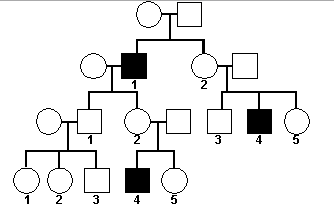
What type of heredity is shown in the pedigree?
a)
Sex-Linked Dominant
b)
Sex-Linked Recessive
c)
Autosomal Dominant
d)
Autosomal Recessive
77.
What are the gametes for Aabb?
(USE FOIL)
(USE FOIL)
a)
A, a, b, b
b)
Ab, ab, Ab, ab
c)
Ab, ab, ab, ab
d)
aB, aB, ab, ab
78.
Y for yellow body is dominant over y for blue body. What alleles would produce yellow bodies?
a)
YY,yy
b)
Yy,yy
c)
YY only
d)
YY,Yy
79.

In hippos, red is dominant to blue and fat is dominant to skinny. What fraction of offspring would be blue and skinny hippos?
a)
8/16
b)
4/16
c)
1/16
d)
3/16
80.

What type of disorder is running in this family?
a)
Autosomal Dominant
b)
Autosomal Recessive
c)
X-linked recessive
100 %

