wayground logo

Free Printable Worksheets

Font size

S
M
L
XL
Worksheets

Physical Science Midterm

Total questions: 150

Worksheet time: 6hrs 18mins

Name
Class
Date
1.

What is this science tool?

a)

jar

b)

beaker

c)

thermometer

d)

ruler

2.

What does this science tool do?

a)

used for heating a liquid

b)

used for measuring volume of a liquid

c)

used for measuring mass

d)

used for measuring volume of a sound

3.
What tool would you use to check the temperature of the water?
a)
ruler
b)
microscope
c)
thermometer
d)
ruler
4.

Which of the following is a test tube?

a)
b)
c)
d)
5.

What is this?

a)

A Beaker

b)

An Erlenmeyer Flask

c)

A Test Tube

d)

A Vial

6.

What is this?

a)

A Graduated Cylainder

b)

A Spot plate

c)

A Triple Beam Balance

d)

A Test Tube Rack

7.
The summary at the end of an experiment that explains the results is... 
a)
conclusion
b)
procedures
c)
materials
d)
responding variable
8.
A testable prediction about a scientific investigation is a(n)
a)
Question
b)
Observation
c)
Hypothesis
d)
Experiment
9.
A series of steps used by scientists to solve a problem or answer a question. 
a)
scientific method
b)
recipe
c)
data collection
d)
metric system
10.
If I ride my bike to school instead of walking, then I will get to school faster. What is the dependent variable?
a)
True
b)
How fast you get to school
c)
Riding a bike or walking
d)
False
11.

The variable that is being measured or observed is called the _______________. Hint: this is the variable that is the result or effect

a)

independent variable

b)

dependent variable

c)

control variable

12.

The independent variable is

a)

The variable that you change in an investigation

b)

The variable that you measure in an investigation

c)

A variable that you keep the same in an investigation

13.

The process of obtaining information by using the senses is called a/an

a)

Conclusion

b)

Observation

c)

Inquiry

d)

Scientific method

14.

A general statement that describes a patterns that are often observed in nature.

a)

logical law

b)

civil law

c)

moral law

d)

scientific law

15.

To make observations you use your _______.

a)

Feet

b)

Experience

c)

Senses

d)

Smile

16.

Performing a test or experiment allows you to test your ___________.

a)

Conclusions

b)

Hypothesis

c)

Data

d)

Question

17.

What should you do if there is lab equipment in the room when you enter?

a)

Do not touch anything.

b)

Start an independent experiment.

c)

Immediately start playing with everything.

18.

If you spill something in a lab, what should you do first?

a)

Tell the teacher

b)

Do nothing

c)

Clean it up 

19.

If something catches fire, what should you do?

a)

Throw water on the fire.

b)

Put it out with the fire extinguisher.

c)

Tell the teacher.

20.

Match the pieces of glassware to their name.

a)

1.

Test tube

b)

2.

Beaker

c)

3.

Flask

d)

4.

Graduated cylinder

21.

Say whether each behavior is safe or unsafe.

Categorize the following

Drinking from lab equipment.

Tying hair back when in the lab.

Walking away from a fire.

Double-checking that you turned the burner off before leaving.

Piggyback rides

Safe
Unsafe
22.
What should you do with substances after an experiment?
a)
throw them in the trash
b)
wash them down the sink
c)
leave them on the table
d)
follow the directions from the teacher
23.
The SI unit for temperature is __?__.
a)
degree fahrenheit  (° F)
b)
degree celsius  (° C)
c)
kelvin  (K)
d)
degree centigrade  (°C)
24.

The SI unit for time is the __?__.

a)

hours (h)

b)

liter (L)

c)

gram (g)

d)

second (s)

25.

What SI unit is used to measure length?

a)

meters

b)

liters

c)

centimeters

d)

kilograms

26.
What prefix is represented by the following symbol:  k
a)
hecto
b)
kilo
c)
deci
d)
deka
27.
Convert from meters to cm:  9 meters
a)
900 cm
b)
90 cm
c)
0.9 cm
d)
0.09 cm
28.
Convert 17 m to cm:
a)
0.17 cm
b)
0.017 cm
c)
1,700 cm
d)
170 cm
29.
240 cm = ___________ m
a)
2400
b)
24
c)
2.4
d)
0.24
30.
15.6 L = ___________ mL
a)
15,600
b)
156,000
c)
1,560,000
d)
15,600,000
31.
490,000 g =____ kg
a)
490
b)
49
c)
4,900
d)
0.49
32.
42 L = ___mL
a)
4,200
b)
.0042
c)
4.20
d)
42,000
33.
If an eraser is 25 millimeters long, how many centimeters long is it?
a)
2
b)
2.5
c)
25
d)
250
34.

What SI Unit is used for Length?

a)

Gram

b)

Foot

c)

Meter

d)

Liter

35.

What SI Unit is used for Volume

a)

Ounce

b)

Liter

c)

Cup

d)

Gram

36.

What SI Unit is used for Mass

a)

Pound

b)

Ounce

c)

Meter

d)

Gram

37.

How many millimeters are in 1 cm?

a)

1

b)

10

c)

100

d)

1000

38.

What is 78.5 rounded to one significant figure?

a)

79

b)

78.5

c)

70

d)

80

39.

What is 7.555 rounded to two significant figures?

a)

7.6

b)

7.5

c)

70

d)

76

e)

7.60

40.
Round 52689 to 3 significant figures.
a)
526
b)
527
c)
52600
d)
52700
41.

Round the following value to one significant figure...


8291

a)

8000

b)

9000

c)

7000

d)

8300

42.

How many significant figures?

7945

a)

1

b)

2

c)

3

d)

4

43.

How many significant figures?

0.150

a)

1

b)

2

c)

3

d)

4

44.

How many significant figures?

76400.0

a)

3

b)

4

c)

5

d)

6

45.
How many significant figures does the following number have?
0.00345
a)
6
b)
5
c)
3
d)
Ambiguous: 3,4,5, or 6
46.
How many significant figures does the following number have: 0.00204
a)
6
b)
4
c)
3
d)
2
47.
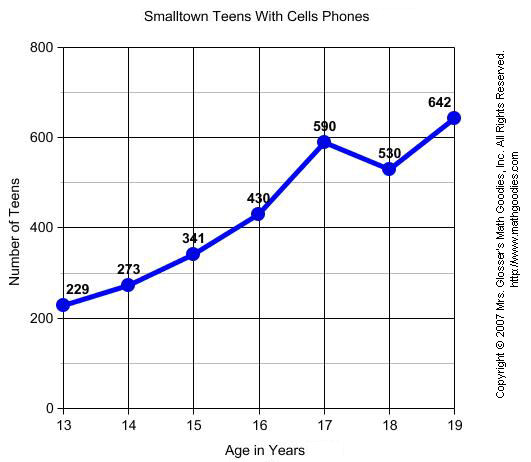
What is the name of this graph?
a)
line plot
b)
line graph
c)
bar graph
d)
frequency table
48.
What is the main purpose of a line graph?
a)
to compare two things
b)
to show trends over time
c)
to have an independent variable
d)
so you don't have to read words
49.
What label is along the y-axis in this graph?
a)
Copyright 2007
b)
Lines
c)
Age in Years
d)
Number of Teens
50.
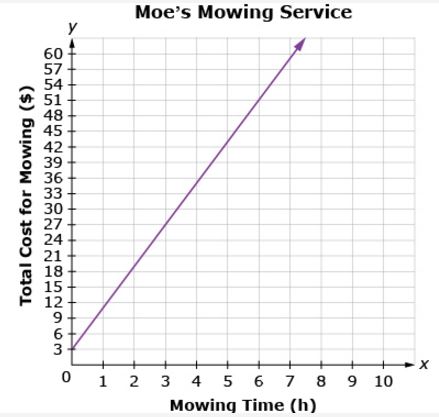
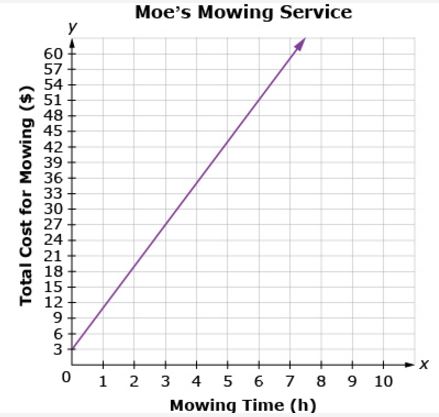
What is the general trend of this line graph?
a)
The more you mow, the less money you make.
b)
You make the same amount of money regardless of how long you mow.
c)
The more you mow, the more money you make.
d)
Mowing is dangerous.
51.
How much does it cost to have your lawn mowed for 2 hours?
a)
$16
b)
$17
c)
$18
d)
$19
52.
The Y axis is _______?
a)
Vertical
b)
Horizontal
c)
criss-cross
d)
diagonal
53.
The X axis is _______?
a)
vertical
b)
diagonal
c)
criss-cross
d)
horizontal
54.

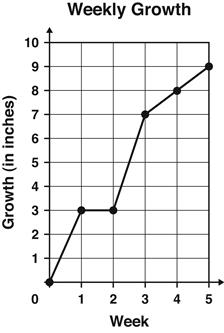
The graph shows the number of inches a plant grew each week.

Between which 2 weeks did the plant grow the MOST?

a)

Week 1 and Week 2

b)

Week 2 and Week 3

c)

Week 3 and Week 4

d)

Week 4 and Week 5

55.

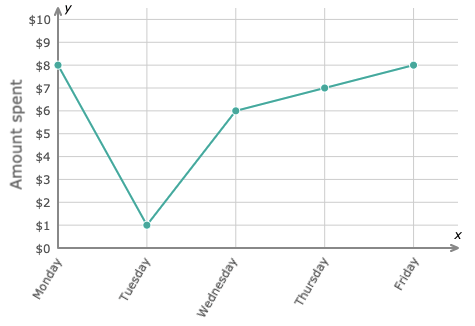
How much money was spent on Thursday?

a)

1

b)

6

c)

7

d)

8

56.
Volume is __________.
a)
how many atoms
b)
how much matter is in an object
c)
how  much something weighs
d)
how much space an object takes up
57.
The metric unit used to measure the volume of a solid objects.
a)
grams
b)
miliLiter
c)
cm3
d)
Liter (L)
58.
What is the formula for density?
a)
density = mass x volume
b)
density = mass ÷ volume 
c)
density = mass + volume
d)
density = mass - volume
59.

How much liquid is represented?

a)

24 mL

b)

20.4 mL

c)

29 mL

d)

35 mL

60.

instrument used to find liquid volume

a)

triple beam balance

b)

graduated cylinder

c)

beaker

d)

thermometer

61.

The temperature at which water freezes

a)

32°C

b)

212°C

c)

100°C

d)

0°C

62.

The amount of matter in an object; measured by grams, milligrams, or kilograms.

a)

Matter

b)

Mass

c)

Weight

d)

Volume

63.

Anything that has mass and takes up space.

a)

Mass

b)

Matter

c)

Weight

d)

Volume

64.

What is volume measure in?

a)

Cubic Units

b)

mL

c)

All of the above

65.

The formula for finding volume of a REGULAR shaped object.

a)

Length x Width x Height

b)

Water Displacement

c)

A + B

66.

A measure of how tightly packed matter is in an object.

a)

Matter

b)

Mass

c)

Volume

d)

Density

67.

The formula for calculating density.

a)

D= M/V

b)

L x W x H

68.

What units are used to measure Density?

a)

cm3/g

b)

ml/g

c)

g/cm3

d)

cm3

69.
Volume is ...
a)
Mass/Volume
b)
The amount of matter in an object.
c)
The amount of space an object occupies.
d)
Anything that has mass and occupies space.
70.

Density is...

a)

the amount of mass in an object

b)

the amount of space an object takes up

c)

Mass per unit of volume (the amount of mass in a given space)

d)

the weight of an object

71.

A crayon has a mass of 10g and volume of 5 ml. What is the density?

a)

30 g/ml

b)

15 g/ml

c)

1 g/ml

d)

2 g/ml

72.
Find the density of a 2 cm x 2 cm x 2 cm cube with a mass of 64 g.  (Hint: find the volume first!)
a)
6 cm3
b)
12 g/cm3
c)
128 g/cm3
d)
8  g/cm3
73.

Which cup of water has a bigger volume?

a)

Left Cup

b)

Right Cup

74.

Which animal has more mass?

a)

Elephant

b)

Mouse

75.

The amount of matter in an object; measured by grams, milligrams, or kilograms.

a)

Matter

b)

Mass

c)

Weight

d)

Volume

76.

Using a calculator and the formula, M=DV, sulfur is a nonmetallic mineral that has a density of 2 g/cm³. The volume of a sample of sulfur was measured to be 5.0 cm³. What is the mass of the sample?

a)

2.5 g

b)

0.4 g

c)

10 g

77.

Using a calculator and the formula, V=M/D, pure honey has a density of 1.42 g/ml. If you have a sample of honey that has a mass of 20 grams, what is the volume of your sample?

a)

14.1 ml

b)

0.07 ml

c)

28.4 ml

78.
What is a pure substance made of two or more elements that are chemically combined?
a)
element
b)
compound
c)
mixture 
d)
solution
79.
If a spoonful of salt is mixed in a glass of water, what is the water called?
a)
solute
b)
solution
c)
solvent
d)
element
80.
Combination of two or more substances that are not chemically combined.
a)
mixture
b)
solution
c)
solvent
d)
solute
81.
Water.
a)
colloid
b)
solution
c)
element
d)
compound
82.
If an unknow substance cannot be broken down into simpiler substances, it is ...
a)
a compound
b)
an element
c)
a suspension
d)
a solution
83.
If a mixture has components you can see it is a...
a)
solution
b)
compound
c)
homogeneous mixture
d)
heterogeneous mixture
84.
Italian Salad Dressing
a)
heterogeneous mixture
b)
homogeneous mixture
85.
What is Kool-aid?
a)
element
b)
Heterogeneous Mixture
c)
Homogeneous Mixture
d)
Compound
86.
Substance that consists of one type of atom.  It is a pure substance. Found on the Periodic Table. 
a)
Element
b)
Compound
c)
Mixture
d)
I don't know
87.
A type of substance containing atoms of two or more elements chemically bonded together is a mixture.
a)
Ture
b)
False
88.
Combinations of 2 or more substances (elements and compounds) that are physically blended together. 
a)
Compound
b)
Mixture
c)
Element
d)
Substance
89.
Salad is an example of...
a)
a mixutre
b)
an element
c)
a compound
90.
Pure oxygen (O) is an example of...
a)
an element
b)
a mixture
c)
a compound
91.
An example of ...
a)
A mixture
b)
A compound
c)
An element 
92.
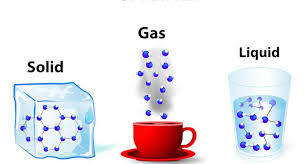
Of these three states of matter, which one has the most kinetic energy? 
a)
Solid 
b)
Liquid 
c)
Gas
93.
Solids are described as having a 
a)
definite shape and indefinite volume
b)
indefinite shape and indefinite volume
c)
definite shape and definite volume
d)
indefinite shape and definite volume
94.
What state of matter consists of tightly packed atoms?
a)
Solid
b)
liquid
c)
gas
d)
plasma
95.
Liquid has a definite ___________, but a variable _____________.
a)
shape, volume
b)
mass, area
c)
smell, taste
d)
volume, shape
96.
Which of the following states of matter has the lowest kinetic energy? 
a)
solid
b)
liquid 
c)
gas
97.
To make a solid become a liquid, you must increase its________________.
a)
mass
b)
density
c)
kinetic energy
d)
potential energy
98.
Gas particles move around at __________ speeds. 
a)
low
b)
slow
c)
high
d)
unknown
99.

The more energy that particles have, the ___ they move.

a)

slower

b)

faster

100.

These properties describe a ___.

a)

solid

b)

liquid

c)

gas

101.

These properties describe a ___.

a)

solid

b)

liquid

c)

gas

102.

Liquid particles have more energy than ___ particles.

a)

solid

b)

gas

103.
Is water melting a physical or chemical change?
a)
Physical
b)
Chemical
104.
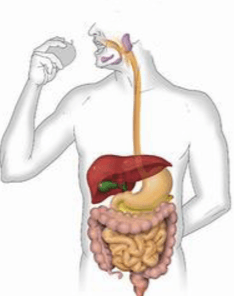
Is digesting your food a physical or chemical change?
a)
Physical
b)
Chemical
105.
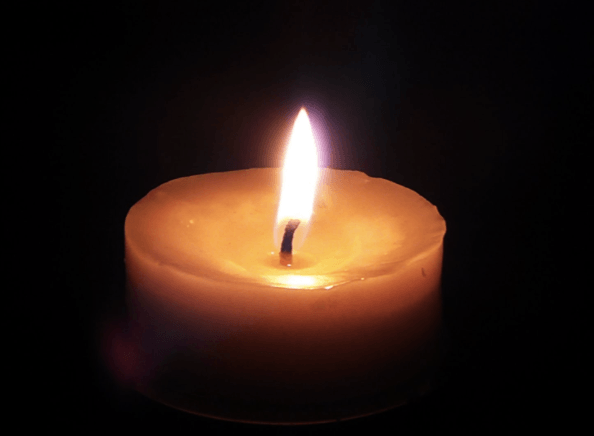
Is a burning candle a physical or chemical change?
a)
Physical
b)
Chemical
106.
Is melting iron a physical or chemical change?
a)
Physical
b)
Chemical
107.
Is a car using fuel a physical or chemical change?
a)
Physical
b)
Chemical
108.
Is sour milk a physical or chemical change?
a)
Physical
b)
Chemical
109.
Isotopes are elements with a different amount of
a)
protons
b)
neutrons
c)
electrons
d)
atoms
110.
an element will always have the same number of 
a)
neutrons
b)
protons
c)
isotopes
d)
atoms
111.
An ______________ is the same element, with the same number of protons, but different numbers of neutrons
a)
Atom
b)
Isotope
c)
Atomic Number
d)
Mass Number
112.
The smallest particle into which an element can be divided and still be the same substance
a)
neutron
b)
atom
c)
electron
113.
Niels Bohr suggested that electrons.......
a)
are found in specific orbits
b)
electrons are scattered throughout the atom
c)
electrons move according to their energy level
d)
electrons are positive
114.
In a correctly written symbol what would be located in the "A" position?
a)
number of neutrons
b)
atomic number
c)
number of electrons 
d)
mass number
115.
How many protons are in this element?
a)
79
b)
196
c)
117
d)
Cannot be determined
116.
What is the atomic mass (rounded to the nearest whole number) of this element
a)
196
b)
196.95
c)
197
d)
79
117.
Because atoms are neutral, the number of protons will be equal to the number of __________ in an atom.
a)
Positrons
b)
Neutrons
c)
Electrons
d)
Nuclei
118.
The three main subatomic particles are electrons, protons and ____________.
a)
photons
b)
neurons
c)
neutrons
d)
quarks
119.
What are the two main parts of the atom?
a)
nucleus and cytoplasm
b)
nucleus and electron cloud
c)
core and electron cloud
d)
protons and neutrons
120.
Identify letter A
a)
Nucleus
b)
Neutrons
c)
Protons
d)
Electrons
121.
Identify letter B
a)
Nucleus
b)
Neutrons
c)
Protons
d)
Electrons
122.
Identify letter C
a)
Nucleus
b)
Neutrons
c)
Protons
d)
Electrons
123.
What scientist is best known for his "Plum Pudding" model of the atom?
a)
J.J. Thomson
b)
Ernest Rutherford
c)
John Dalton
d)
Democritus
124.
The first person to propose a theory about an atom called the Atomos Theory was
a)
Democritus
b)
Rutherford
c)
Dalton
d)
Aristotle
125.

The nucleus of an atom contains which subatomic particles?

a)

protons and neutrons

b)

protons and electrons

c)

neutrons only

d)

neutrons and electrons

126.

What is the name of group number 1?

a)

halogens

b)

noble gases

c)

alkali metals

d)

alkaline earth metals

127.

What is the name of group number 2?

a)

transition metals

b)

halogens

c)

metaloids

d)

alkaline earth metals

128.

What group number are the halogens found?

a)

18 (8A)

b)

1

c)

2

d)

17 (7A)

129.

A row on the Periodic Table of Elements

a)

family

b)

period

c)

row

d)

isotope

130.

Which element is found in group 2, period 6?

a)

Oxygen (O)

b)

Barium (Ba)

c)

Selenium (Se)

d)

Carbon (C)

131.

Which halogen is found in period 4?

a)

Krypton (Kr)

b)

Xenon (Xe)

c)

Bromine (Br)

d)

Iodine (I)

132.

Which element has similar chemical properties as sodium but has 7 energy levels?

a)

Francium (Fr)

b)

Cesium (Cs)

c)

Rubidium (Rb)

d)

Potassium (K)

133.

Elements that have the same number of energy levels are said to be in the same ______.

a)

group

b)

period

c)

family

d)

classification

134.

an arrangement of the elements according to their atomic numbers so that elements with similar properties are in the same column and properties repeat from row to row

a)

Periodic Table of Elements

b)

Atomic Theory

c)

Isotopes

d)

Subatomic Particles

135.

one or two letters that represent the name of an element

a)

element name

b)

element symbol

c)

atomic number

d)

atomic mass

136.

a unique number for each element that equals the number of protons in an atom of that element

a)

element name

b)

element symbol

c)

atomic number

d)

atomic mass

137.

a grouping of elements based on similar properties, arranged by columns in the periodic table; also known as a group

a)

family

b)

period

c)

row

d)

isotope

138.

The letter, C, is a ... of carbon.

a)

Name

b)

Nickname

c)

Chemical Symbol

d)

Pseudonym

139.
Which of the following atomic symbols for bromine is written correctly?
a)
bR
b)
BR
c)
Br
d)
br
140.

On the periodic table, the vertical columns are called

a)

Periods

b)

Groups

c)

Elements

d)

Compounds

141.

Noble gases are extremely reactive

a)

True

b)

False

142.

Who is credited with organizing the first periodic table by arranging the element's by mass?

a)

Dalton

b)

Einstein

c)

Mendeleev

d)

Moseley

143.

Who is credited with creating the first periodic table by arranging the element's by atomic number?

a)

Dalton

b)

Einstein

c)

Mendeleev

d)

Moseley

144.

Hydrogen would be best classified as

a)

Metal

b)

Non-metal

c)

Noble gas

d)

Alkali metal

145.

What type of elements fall along the "staircase"

a)

Metalloids

b)

Metals

c)

Non-metals

d)

Noble gases

146.

What are the three main groups of the periodic table?

a)

groups

b)

metal

c)

nonmetals

d)

metalloids

e)

periods

147.

What do the vertical columns on the periodic table tell us?

a)

The number of orbitals

b)

The number of valence electrons (electrons on the outer most shell)

148.

What do the horizontal rows on the periodic table tell us?

a)

The number of orbitals

b)

The number of valence electrons (the electrons on the outer most shell)

149.

What is the name of the element? (Periodic table will be needed)

a)

sodium

b)

magnesium

c)

vanadium

150.

What group and period does this element belong in? *

a)

period 1 and group 3

b)

period 3 and group 1

c)

period 2 and group 3

d)

period 3 and group 2