
 Worksheets
AP Biology Midterm Review
Total questions: 101
Worksheet time: 2hrs 41mins


What is difference between saturated and unsaturated hydrocarbon?
saturated has double bonds, unsaturated does not
saturated has no double bonds, unsaturated does
there is no difference, they are the same
saturated has oxygen, unsaturated does not
What type of reaction builds macromolecules? What is the byproduct?
dehydration ; water
dehydration ; no byproduct
hydrolysis ; water
hydrolysis ; no byproduct
What reaction allows for macromolecules to be broken apart?
hydrolysis
dehydration
hydrogen bonds
solventing
What molecule is responsible for lowering activation energy for a reaction?
enzyme
starch
triglyceride
phospholipid
What is the difference between bonds responsible for primary structure and secondary structure in proteins?
primary is peptide bonds ; secondary is hydrogen bonds
primary is hydrogen bonds ; secondary is peptide bonds
no difference - they are both peptide bonds
no difference - they are both hydrogen bonds
What type of macromolecule is ribose, the sugar found in RNA?
carbohydrate
lipid
protein
nucleic acid
What is the difference between the forces that lead to secondary and tertiary structures in proteins?
secondary is due to hydrogen bonding of backbone ; tertiary is interactions of side chains
secondary is due to interactions of side chains ; tertiary is due to hydrogen bonding of backbone
no difference - they are both caused by hydrogen bonding
no difference - they are both caused by interactions of side chains
If the structure of a protein is modified, what is the likely result?
the protein will no longer function as intended
the protein will remain the same.
the protein will become a lipid
the secondary and tertiary structure remain the same while the primary is changed
Which of the following can cause a protein to denature?
pH
heat
radiation
all answers listed
What is the main function of ATP?
When the body breaks down proteins, carbohydrates, and lipids to create energy for our body to function.
Copies DNA
Transports Molecules
Carrier of genetic information
Which base is ONLY found in DNA?
Cytosine
Guanine
Thymine
Adenine
Which base is only found in RNA?
Uracil
Thymine
Adenine
Guanine
Which of the following organelles digests damaged proteins?
Mitochondria
Ribosomes
Lysosomes
Golgi Apparatus
Which of the following organelles is found in both prokaryotes and eukaryotes?
Mitochondria
Ribosomes
Lysosomes
Golgi Apparatus
Which organelle sorts out mixtures of substances and sends them to their proper destinations?
Mitochondria
Ribosomes
Lysosomes
Golgi Apparatus
Which organelle contains its own DNA?
Mitochondria
Ribosomes
Lysosomes
Golgi Apparatus
Contains a large and a small subunit as well as binding sites for amino acids. May be free floating or bound to the endoplasmic reticulum
Ribosome
Lysosome
Nucleus
Endoplasmic Reticulum
A network of membranous tubules continuous with the Nuclear Envelope. Functions in synthesizing lipids, detoxification, and storage of calcium ions.
Smooth ER
Rough ER
Lysosome
Mitochondria
Cell Membrane
Contains hydrolytic enzymes which work best at an acid pH. Leakage of these organelles can cause cell death "self digestion." Used to break down old molecules.
Lysosome
Mitochondria
Chloroplast
Smooth Endoplasmic Reticulum
Formed from a double membrane. Organized internally in cristae. Internal compartment called the matrix. Has its own DNA. The site of cellular respiration and the production of Adenosine Triphosphate.
Mitochondria
Chloroplast
Nucleus
Cytoplasm
Which of the following are found in Plant cells and not Animal cells?
Cell Wall
Centrioles
Vacuoles
Chloroplasts
Mitochondria
Contains a double membrane, cytoplasm, thylakoids and stroma. Converts light energy into chemical energy.
Chloroplast
Mitochondria
Nucleus
Rough ER
A membrane-bound organelle that removes hydrogens from various substrates and adds them to oxygen creating hydrogen peroxide. Can aid in detoxification and conversion of fatty acids into energy.
peroxisome
glyoxysome
lysosome
endoplasmic reticulum
A membrane-bound organelle that removes hydrogens from various substrates and adds them to oxygen creating hydrogen peroxide. Can aid in detoxification and conversion of fatty acids into energy.
peroxisome
glyoxysome
lysosome
endoplasmic reticulum
Composed of cellulose. The outermost layer of a plant cell.
Cell Wall
Cell Membrane
Cytoplasm
Cholroplast
Which of the following produces the energy needed for protein synthesis in the endomembrane system?
Endoplasmic reticulum
Golgi apparatus
Lysosomes
Mitochondria

Which of the following is a difference between smooth and rough endoplasmic reticulum (ER)?
Smooth ER exists in a part of the cell near the cell membrane, while rough ER exists in a part of the cell near the nucleus.
Smooth ER is not studded by ribosomes, while rough ER is studded by ribosomes.
Smooth ER is meant to compartmentalize the cell, while rough ER detoxifies and synthesizes lipids.
Smooth ER is made without the additional help of proteins, whereas rough ER is made with the help of special proteins called reticuloproteins.
Which of the following is a reason that cells are so small?
Cells are small because they want to maximize their surface area-to-volume ratio.
Cells are small because they want to maximize their volume-to-surface area ratio.
Cells are small because they need to produce extremely small macromolecules.
Cells are small because they prefer to work together in clusters of many thousands that wouldn't otherwise fit anywhere.
Which of the following is one way that cells increase their surface area without increasing their size?
Cells will often include perfectly spherical membranes.
Cells will often include folds in their membranes.
Cells will often include holes in their membranes.
Cells will maximize their volume.
What happens to cells as they increase in volume?
Their radius decreases.
Their surface area increases.
Their surface area decreases.
Their circumference decreases.
Which of the following is the correct name of the model that describes the structure of the cell membrane?
The Fluid Molecular Model
The Free Molecular Model
The Fluid Mosaic Model
The Free Mosaic Model
Major component of the lipid bilayer cell membrane.
Cholesterol
Channel Proteins
Phospholipids
Glycolipid/glycoprotein complexes
1.) They act like gatekeepers, only let certain things in.
2.) Enzyme receptors embedded in the membrane.
when some molecules can cross the membrane while others cannot.
Stores water, nutrients and waste.
Centriole
Cytoplasm
Large central vacuole
Nucleolus

Which organelle is represented in the image?
chloroplast
nucleus
cell membrane
mitochondria
A thin, flexible layer that is found in all cells and separates the inside of the cell from the outside environment.
protein coat
protein membrane
cell membrane
nucleolus
What is the difference between mitochondria and chloroplast?
Mitochondria produces energy and chloroplasts breaks down energy
There is no difference. They are the same.
Mitochondria breaks down energy from food and chloroplasts produce energy from sunlight.
Mitochondria contains DNA and chloroplasts are green
Which plasma membrane component can be either found on its surface or embedded in the membrane structure?
carbohydrates
cholesterol
glycolipid
protein
The use of a protein pump (ions like Na+, K+, H+, etc.) is an example of ___ because ___.
exocytosis; ions are moved out of the cell
active transport; ATP is required
facilitated diffusion; a protein is needed for transport
endocytosis; ions are moved into the cell
What type of transport requires the assistance of special transport proteins to help some molecules, like glucose, into the cell without the use of energy?
Facilitated Diffusion
Osmosis
Active Transport
Diffusion
Endocytosis and Exocytosis are both classified as what type of transport?
Active Transport
Passive Transport
Energy
Neutral Transport


Since eukaryotic cells are big, how do they get nutrients to the center efficiently?
compartmentilization
specialization
They have your mom in there to help them
Cell cycle control
The prokaryotic strategy is:
To be bigger so that surface area increases.
To be smaller so that surface area increases.
Have a faster cell cycle
Have more transcription factors.
Why does compartmentalization exist?
Make certain areas that are fit for the cell to function the best.
Increase Surface area and allow for unspecialization
Decrease Surface area and allow for specialization
Membrane-bound organelles have been an
important component in the evolution of complex,
multicellular organisms. Which of the following
best summarizes an advantage of eukaryotic cells
having internal membranes?
Eukaryotic cells are able to reproduce faster because of the presence of organelles.
Some organelles, such as mitochondria and chloroplasts, are similar to prokaryotic cells in structure.
Organelles isolate specific reactions, increasing metabolic efficiency.
Compartmentalization leads to a higher mutation rate in DNA, which leads to more new species.
What are cells made of?
Your mom
Organelles
Other cells
Mitochondria
Researchers have proposed a model of chloroplast evolution. According to the model, chloroplasts evolved from a small prokaryotic organism that was engulfed by an ancestral eukaryote. The engulfed prokaryote then formed an endosymbiotic relationship with the eukaryotic host.
Which of the following observations best supports the model?
Chloroplasts are separated from other subcellular compartments by semipermeable membranes.
Prokaryotic and eukaryotic organisms both acquire nutrients from the surrounding environment.
Eukaryotes evolved after prokaryotes and have more complex structures.
Chloroplasts and some prokaryotes share similar photosynthetic reactions.
Which of the following observations best supports the claim that mitochondria evolved from once-free-living prokaryotic cells by the process of endocytosis?
Mitochondria produce ATP
Mitochondria contain proteins
Mitochondria exchange substances with the cytosol.
Mitochondria are surrounded by a double membrane.

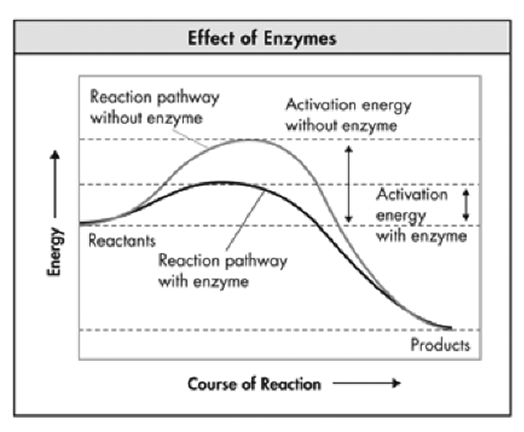
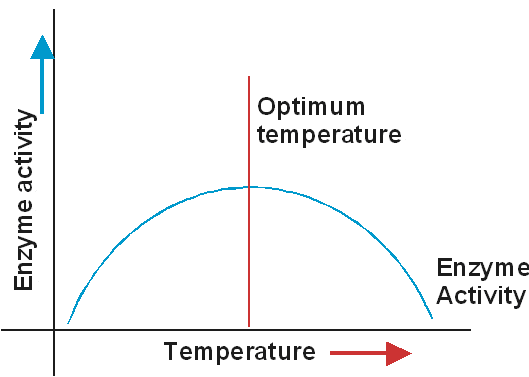
In order to increase the rate of reaction using an enzyme a scientist could.... (Choose all that apply)
Increase the amount of substrate
Decrease the temperature
Increase the temperature toward its optimal temperature.
Introduce a competitive inhibitor
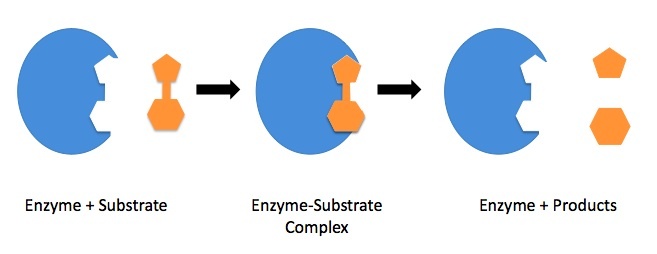
A molecule that binds to the enzyme at a site other than the active site, causing the enzyme to change shape and be unable to bind substrate
Allosteric Inhibition
Feedback Inhibition
Competitive Inhibition
Noncompetitive Inhibition
What happens to the reaction rate if an enzyme is denatured or nonfunctional?
No change in the reaction rate
Increase in reaction rate
Decrease in reaction rate
Decrease then increase in reaction rate
How does a noncompetitive inhibitor decrease reaction rates?
Binds to the active site
Binds to the allosteric site
Increases the free energy
Increases the substrate concentration
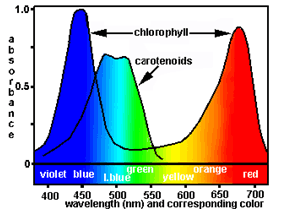
What structure in the chloroplast captures sunlight?
chlorophyll
Xanthrophyll
hemoblobin
electron transport chain
What molecules carry electrons?
ATP
NADPH
NADH
ADP
Which generate more ATP?
Oxidative phosphorylation
Substrate level phosphorylation
Glycolysis
Kreb's Cycle
What are the net products of photosynthesis?
6 CO2, 6 H2O, Energy
6 O2 and 6 H2O
C6H12O6 and 6 O2
6 CO2 and C6H12O6
What is ATP synthase responsible for?
Creating ATP in chemiosmosis
Breaking down NADPH
Creating NADPH
Breaking down ATP
What powers the ATP synthase enzymes in mitochondria and chloroplasts?
The energy absorbed during the light reactions.
The electronegativity of oxygen
Energy released by breaking the chemical bonds in glucose
The diffusion of hydrogen
How are the ATP synthase enzymes in photosynthesis and cellular respiration similar?
They both rely on chemiosmosis of hydrogens down a gradient to power phosphorylation
They are both located in the cytoplasm of the cell
They both use oxygen to create a concentration gradient
They both receive hydrogen ions from FADH2
Which of the following describes the endosymbiotic theory?
A prokaryotic cell engulfed several other types of smaller prokaryotic cells, and eventually its compartmentalization made the cell eukaryotic.
A eukaryotic cell engulfed several other types of smaller prokaryotic cells, and eventually its compartmentalization made the cell prokaryotic.
A prokaryotic cell engulfed several other types of smaller eukaryotic cells, and eventually its compartmentalization made the cell eukaryotic.
A eukaryotic cell engulfed several other types of smaller eukaryotic cells, and eventually its compartmentalization made the cell prokaryotic.
Which statement explains why water molecules stick together?
Both sides are negative
One side has a positive charge and the other side has a negative charge
One side has a negative charge and the other side has a neutral charge
Both sides are positive
Which of the following statements are false?
Glycolysis does not require oxygen
Glycolysis is the first step in both anaerobic and aerobic respiration
Glycolysis occurs in the mitochondria
Glycolysis produces 2 ATP, 2 Pyruvates, and 2 NADH
What process is found in both aerobic and anaerobic metabolism?
the Kreb's cycle
oxidative phosphorylation
the citric acid cycle
glycolysis
During chemiosmosis
H+ ions serve as the final electron acceptor
a concentration gradient is generated when H+ ions are passively transported from the matrix to the inner mitochondrial membrane
energy is released as H+ ions move freely across the mitochondrial membrane
ATP is synthesized when H+ ions move through a channel in ATP synthase

