
 Worksheets
Unit 3 Changes in Matter Test Bank Quizizz
Total questions: 154
Worksheet time: 3hrs 6mins
How many main states of matter are there?
2
3
4
5
Which of the following is a property of matter?
Matter has no mass.
Matter occupies no space.
Matter has mass.
Matter is invisible
Ice is a _______________.
Fluid
Liquid
Gas
solid
Burning of fire crackers ________________.
releases heat only
absorbs heat
releases heat and light
absorbs light
Conversion of water into water vapor is called _______________.
condensation
evaporation
sublimation
filtration
Which of the following is generally an irreversible process?
Chemical change
Physical change
Freezing
Boiling
In which of the following reactions, is a new substance is formed?
Sugar crystals are dissolved in hot water.
Boiling of water and formation of steam.
Cutting of an apple into two pieces.
Burning of wood and formation of ash and fumes.
Water solidifies to form ___________________.
steam
ice
fog
hail
Water converts into steam in the presence of heat. This process is called ________________________.
solidification
freezing
evaporation
condensation
In a chemical change, the reactants and products are the same.
True
False
Water absorbs heat to form steam.
True
False
Separating individual substances from a mixture or suspension is called filtration.
True
False
During a chemical change only the appearance of the substance changes.
True
False
Rusting of a nail
Chemical change
Physical change
Breaking a plate
Chemical change
Physical change
Baking bread
Chemical change
Physical change
A boiled egg
Chemical change
Physical change
process of photosynthesis
Chemical change
Physical change
Making orange juice
Chemical change
Physical change
Souring of milk
Chemical change
Physical change
Tearing of paper into several pieces
Chemical change
Physical change
Mixing of two transparent liquids form a cloudy precipitation
Chemical change
Physical change
_________ are ingredients of a chemical reaction.
Reactants
Products
Reagents
Enzymes
A + B → C + D. In the given reaction, what are C and D?
Reactants
Products
Reagents
Enzymes
A + B → C + D. In the given reaction, what are C and D?
Reactants
Products
Reagents
Enzymes
Nitrogen reacts with oxygen to produce Nitrogen Oxide. In this reaction, oxygen is a ____________.
Reactants
Products
Reagents
Enzymes
Which of the following is/are chemical changes during a chemical reaction?
Change in color
Formation of precipitate
Release of heat and light
All the above
A chemical reaction is a process in which ____________ are converted into ______________.
atoms, molecules
reactants, products
acids, bases
energy, matter
What is present during combustion reaction?
Only energy
Only oxygen
Only fuel
All the above
During a chemical reaction, ________________ are formed and broken down.
chemical bonds
reactants
products
atoms
The formation of a chemical bond, releases energy into the surroundings.
True
False
Energy is stored in a chemical bond.
True
False
Burning of something is called ________________________.
solidification
combustion
evaporation
condensation
Which of the following is an example of an exothermic reaction?
Freezing of water into ice
Melting of water
Photosynthesis
Combustion
Which of the following is an example of an endothermic reaction?
Freezing of water into ice
Melting of water
Photosynthesis
Combustion
Any reaction involving burning is an ____________________ reaction.
exothermic
endothermic
endergonic
none of the above
If more energy is produced during a chemical reaction than utilized in the reaction, it is a/an _____________________ reaction.
endothermic
exothermic
endergonic
evaporation
In an exothermic reaction, energy is released in the environment.
True
False
In a combustion reaction, carbon dioxide and water are the products.
True
False
In a combustion reaction, carbon dioxide and water are the reactants.
True
False
A chemical reaction can be both exothermic and endothermic.
True
False
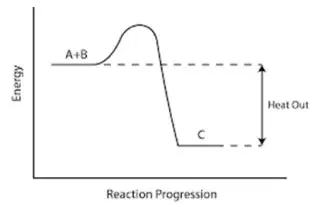
According to the graph, what type of reaction is this?
Endothermic
Exothermic
Isothermic
Hyperthermic
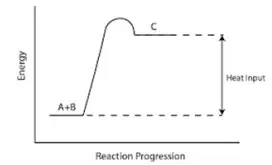
According to the graph, what type of reaction is this?
Endothermic
Exothermic
Isothermic
Hyperthermic
According to the graph, what are A and B?
Reactants
Products
Catalysts
Bank Robbers
According to the graph, what is C?
Reactants
Products
Catalysts
Bank Robber
According to the graph, what contains more stored energy in their bonds?
Reactants
Products
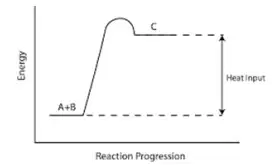
According to the graph, what contains more stored energy in their bonds?
Reactants
Products
Which of the following is an exothermic reaction?
Switching on a bulb
Melting of ice
Evaporation of water
Respiration
Fission means ______________
absorption
splitting
burning
expanding
Reactants are formed during a chemical reaction.
True
False
Heat energy is always released from a chemical reaction
True
False
Chemical bonds are broken and formed in a chemical reaction.
True
False
During photosynthesis, heat energy is supplied from outside
True
False
In an exothermic reaction, heat is ___________________________.
released
absorbed
gained
neither released nor absorbed
In an endothermic reaction, heat is ___________________________.
released
absorbed
not changed
neither released nor absorbed
State whether the given reactions are endothermic or exothermic.
Freezing of water
Endothermic
Exothermic
Isothermic
State whether the given reactions are endothermic or exothermic.
Melting of water
Endothermic
Exothermic
Isothermic
State whether the given reactions are endothermic or exothermic.
Combustion
Endothermic
Exothermic
Isothermic
State whether the given reactions are endothermic or exothermic.
Respiration
Endothermic
Exothermic
Isothermic
State whether the given reactions are endothermic or exothermic.
Photosynthesis
Endothermic
Exothermic
Isothermic
A campfire is an example of
Exothermic reaction
Endothermic reaction
Physical change
Sublimation
Baking bread is a(an) ____________.
Exothermic reaction
Endothermic reaction
Physical change
Sublimation
Evaporation of water in a puddle is a/an ____________________ reaction
exothermic
endothermic
exergonic
none of the above
If more energy is required to make the chemical bonds than to break them, it is a/an _____________________ reaction.
endothermic
exothermic
endergonic
evaporation
Reactants in endothermic reaction have less energy than that of the products formed.
True
False
When an endothermic reaction takes place in a test tube, the test tube feels warmer.
True
False
During rusting of iron, heat is absorbed from the environment
True
False
Endothermic reactions are a type of endergonic process.
True
False
Which of the following equations observes the law of conservation of mass?
H2 + Cl2 --> HCl
4Na + O2 --> 2Na2O
Fe + Cl2 --> FeCl3
C3H8 + O2 --> CO2 +H2O
Which of the following equations does not observe the law of conservation of mass?
2H2 + O2 --> 2H2O
N2 + 3H2 --> 2NH3
Fe + Cl2 --> FeCl3
2PbO + C --> 2Pb + CO2
12g of carbon completely reacts with 32g oxygen to form ______ g of carbon dioxide
12
24
32
44
24.6g of lithium oxide is formed from 5.7g oxygen and ______g lithium
5.7
18
18.9
24.6
The law of conservation of mass states...
The total mass of the reactants is equal to half the products
The total mass of the reactants is equal to the total mass of the products
Half the mass of the reactants is equal to the total mass of the products
Half the mass of the reactants is equal to half the products
18.02g of water are separated by electrolysis into hydrogen and oxygen gas.
If 16.00g of oxygen gas are obtained, how much hydrogen gas is obtained?
16.00g
1.01g
8.00g
2.02g
Iron reacts with oxygen to form ferrous oxide, commonly known as rust.
If 55.85g of iron reacts with 24.00g oxygen. What is the mass of the rust formed?
79.85g
55.85g
24.00g
111.70g
If 21.6g of mercury (II) sulfide is used and 20.0g of mercury is made,
how many grams of sulfur must have been made?
21.6g b. 20.0g c. 1.6g d. 18.4g
20.0g
1.6g
18.4g
The composition of pure substances can be described as...
Equal
Definite
Constant
Absolute
How do elements combine?
In whole numbers
By halves
Randomly
In portions
Which of the following would affect the composition of a pure compound?
Its source
How its prepared
Its country of origin
None of these
Find the mass ratio of nitrogen dioxide (NO2)
1:1
1:2
2:1
2:2
7:16
Find the mass ratio of ammonia (NH3)
3:1
1:3
3:14
14:3
Classify the following reactions as either a synthesis (S) or decomposition (D) reaction.
Iron and sulfur forming iron sulfide
Synthesis (S)
Decomposition (D)
Classify the following reactions as either a synthesis (S) or decomposition (D) reaction.
The electrolysis of water into hydrogen and oxygen
Synthesis (S)
Decomposition (D)
Classify the following reactions as either a synthesis (S) or decomposition (D) reaction.
Nitric oxide and oxygen gas forming nitrogen dioxide
Synthesis (S)
Decomposition (D)
Classify the following reactions as either a synthesis (S) or decomposition (D) reaction.
Calcium carbonate becoming calcium oxide and carbon dioxide.
Synthesis (S)
Decomposition (D)
Classify the following reactions as either a synthesis (S) or decomposition (D) reaction.
The formation of potassium chloride from potassium metal and chlorine gas.
Synthesis (S)
Decomposition (D)
A synthesis reaction is...
Small molecules combining into a larger more complex product.
A large reactant breaks down into smaller products.
When one reactant is exchanged for an ion in another reactant
When two cations exchange places
Which of the following is an example of a synthesis reaction?
C + O2 --> CO2
MgCO3 --> MgO + CO2
2AgNO3 + Ni --> Ni(NO3)2 + 2Ag
d. H2SO4 --> H2O + SO3
A decomposition reaction is...
Small molecules combining into a larger more complex product.
A large reactant breaks down into smaller products.
When one reactant is exchanged for an ion in another reactant.
When two cations exchange places
Which of the following is an example of a decomposition reaction?
CaO + H2O --> Ca(OH)2
BaCl2 + F2 --> BaF2 + Cl2
BaCO3 --> BaO + CO2
2S + 3O2 --> 2SO3
Complete combustion forms the products carbon monoxide, carbon water and carbon dioxide.
True
False
In combustion reactions, one of the reactants is oxygen.
True
False
Clean combustion results in the complete oxidation of the hydrocarbon
True
False
Burning fossils fuels such as coal usually occurs as an incomplete combustion reaction.
True
False
Dirty combustion produces the products carbon dioxide and water.
True
False
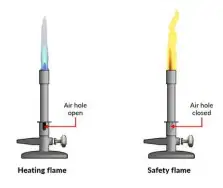
Which picture demonstrates complete combustion?
Heating Flame (Blue)
Safety Flame (Yellow)
Which picture demonstrates the airhole is closed?
Heating Flame (Blue)
Safety Flame (Yellow)
Classify the following word equations as Synthesis (S), Decomposition (D), Combustion (C) or Single Displacement (SD), or Double Displacement (DD).
Zinc and copper sulfate forming copper and zinc sulfate
Synthesis (S)
Decomposition (D)
Combustion (C)
Single Displacement (SD)
Double Displacement (DD)
Classify the following word equations as Synthesis (S), Decomposition (D), Combustion (C) or Single Displacement (SD), or Double Displacement (DD).
Ammonium hydroxide becoming water and ammonia
Synthesis (S)
Decomposition (D)
Combustion (C)
Single Displacement (SD)
Double Displacement (DD)
Classify the following word equations as Synthesis (S), Decomposition (D), Combustion (C) or Single Displacement (SD), or Double Displacement (DD).
Zinc and oxygen gas forming zinc oxide
Synthesis (S)
Decomposition (D)
Combustion (C)
Single Displacement (SD)
Double Displacement (DD)
Classify the following word equations as Synthesis (S), Decomposition (D), Combustion (C) or Single Displacement (SD), or Double Displacement (DD).
Magnesium and nitric acid forming magnesium nitrate and hydrogen gas
Synthesis (S)
Decomposition (D)
Combustion (C)
Single Displacement (SD)
Double Displacement (DD)
Classify the following word equations as Synthesis (S), Decomposition (D), Combustion (C) or Single Displacement (SD), or Double Displacement (DD).
Butane reacts with oxygen to give carbon dioxide and water.
Synthesis (S)
Decomposition (D)
Combustion (C)
Single Displacement (SD)
Double Displacement (DD)
Classify the following word equations as Synthesis (S), Decomposition (D), Combustion (C) or Single Displacement (SD), or Double Displacement (DD).
Lead (II) Nitrate reacts with Sodium Sulfate to produce Lead (II) Sulfate and Sodium Nitrate
Synthesis (S)
Decomposition (D)
Combustion (C)
Single Displacement (SD)
Double Displacement (DD)

Use the reactivity series to help you determine which of the following is more reactive.
Choose the most reactive metal in each case.
Zn
Mg
Use the reactivity series to help you determine which of the following is more reactive.
Choose the most reactive metal in each case.
Sn
Al
Use the reactivity series to help you determine which of the following is more reactive.
Choose the most reactive metal in each case.
Pb
Ag
Use the reactivity series to help you determine which of the following is more reactive.
Choose the most reactive metal in each case.
Au
Pt
Predict if these Single Displacement reactions will occur or not.
Calcium + lead (II) nitrate -->
React
No Reaction
Predict if these Single Displacement reactions will occur or not.
Sodium + hydrochloric acid -->
React
No Reaction
Predict if these Single Displacement reactions will occur or not.
Gold + hydrochloric acid -->
React
No Reaction
Predict if these Single Displacement reactions will occur or not.
Chlorine + lithium iodide -->
React
No Reaction
Decide which of the following statements regarding single displacement reactions are true and which are false.
Single displacement reactions when the cations of two chemical compounds exchange places.
True
False
Decide which of the following statements regarding single displacement reactions are true and which are false.
Single replacement reactions more reactive elements replace less reactive elements.
True
False
Decide which of the following statements regarding single displacement reactions are true and which are false.
The most reactive anion is fluorine
True
False
Decide which of the following statements regarding single displacement reactions are true and which are false.
One of the reactants in a single displacement must be oxygen.
True
False
Decide which of the following statements regarding single displacement reactions are true and which are false.
The reactants in a single replacement become one product.
True
False
Which of the following is the most likely description of the product or products of a double-displacement reaction?
one new compound and an element
one new compound
two new compounds
oxygen and energy
If calcium bromide (CaBr2) is added to silver nitrate (AgNO3), what products will form?
AgBr + Ca(NO3)2
AgCa + Br(NO3)2
AgBr2 + CaNO3
AgBr2 + Ca(NO3)2

If calcium bromide (CaBr2) is added to silver nitrate (AgNO3), what precipitate will form?
AgBr
CaBr2
AgNO3
CaO3
When iron sulfide (FeS) is combined with hydrogen chloride (HCl), which products are formed?
FeS + HCl
H2Fe + SCl2
FeCl2 + H2S
FeH + SCl
When iron sulfide (FeS) is combined with hydrogen chloride (HCl), a gas is formed in the double-displacement reaction. Which gas would it be? (Hint: Use what you've learned about types of atoms and compounds and their properties in Semester 1 along with your ability to predict double-displacement products to correctly answer this question!)
FeS
H2Fe
H 2S
FeH
For each of the following products decide if they are soluble (S) or insoluble (I).
Use the solubility table in your guided notes to help you.
PbCl2
Soluble
Insoluble
For each of the following products decide if they are soluble (S) or insoluble (I).
Use the solubility table in your guided notes to help you.
KCl
Soluble
Insoluble
For each of the following products decide if they are soluble (S) or insoluble (I).
Use the solubility table in your guided notes to help you.
Mg(OH)2
Soluble
Insoluble
For each of the following products decide if they are soluble (S) or insoluble (I).
Use the solubility table in your guided notes to help you.
CuCO3
Soluble
Insoluble
For each of the following products decide if they are soluble (S) or insoluble (I).
Use the solubility table in your guided notes to help you.
Ba(NO3)2
Soluble
Insoluble
For each of the following products decide if they are soluble (S) or insoluble (I).
Use the solubility table in your guided notes to help you.
NH4Cl
Soluble
Insoluble
Identify the precipitate.
Pb(NO3)2 + 2KCl → 2KNO3 + PbCl2
Pb(NO3)2
KCl
KNO3
PbCl2
No Precipitate
Identify the precipitate.
H2SO4 + 2 LiOH --> Li2SO4 + 2H2O
H2SO4
LiOH
Li2SO4
H2O
No Precipitate
Zn(OH)2 + HNO3 ---> H2O + Zn(NO3)2
Complete the following reaction:
HCl + Mg(OH)2 -->
MgCl2 + H2O
Mg +H2O
MgCl2 + H2
MgCl2 + H2O + CO2
Complete the following reaction:
H3PO4 + NaOH -->
Na3PO4 + H2O
Na +H2O
Na3PO4 + H2
Na3PO4 + H2O + CO2
Complete the following reaction:
HNO3 + Ca(OH)2 -->
Ca(NO3)2 + H2O
Ca +H2O
Ca(NO3)2 + H2
Ca(NO3)2 + H2O + CO2
HCl + NaOH → NaCl + H2O
Single Displacement
Synthesis
Neutralization reactions most resemble ________ reactions.
Double Displacement
Single Displacement
Synthesis
In a neutralization reaction, what are almost always the products of a reaction between an acid and a base?
HOH is another way or writing what?
water
sodium chloride
salt
neutralization reaction
What is the right ratio of chemicals for the BCE (Balanced Chemical Equation)?
__Ca + __H2O --> __Ca(OH)2 + __H2
Balance the following:
Dicarbon hexahydride and Oxygen react to produce
Carbon dioxide and Dihydrogen monoxide
Balance the following:
Aluminum nitrate and Carbonic acid react to form
Aluminum carbonate and Nitric acid
PCl5 + ___ H2O → ___ HCl + H3PO4
4, 5
1, 6
3, 8
2,2

Iron reacts with solid sulfur to produce iron(II) sulfide powder.
Remember to think about the charges of these and then criss-cross to find the correct compound formula
Fe + S → Fe2S
Fe + S → FeS
Fe2 + S→ Fe2S2
Fe + S2 → Fe2S
_CF4 + _Br2 -- _CBr4 + _F2

