
Font size
 Worksheets
Nervous System Review
Total questions: 91
Worksheet time: 2hrs 17mins
When your get scared, your nervous system goes into
walk and talk mode
fight or flight mode
sit and lounge mode
chill mode
When you need to use the bathroom, your excretory system sends a signal to your ________ system to let your body know that it's time....
Skeletal
Nervous
Circulatory
Respiratory
When you want to go for a run, your nervous system tells your ________ system what to do.
Respiratory
Digestive
Skeletal
Muscular
When you smash your finger, it takes your brain a ________ time to process the pain signal and tell your hand to move.
long
very long
Short
very short
The left side of your brain controls the _______ side of your body.
Right
Left
Front
Back
The nervous system includes sensory organs (eyes, ears, skin)
True
False
The nervous system is broken into 2 major parts, the
Central Nervous System
Pedestrian Nervous System
Peripheral Nervous System
Whole Nervous System
The nervous system is made up of all the following EXCEPT
Brain
Nerves
Muscles
Spinal Cord

What is the function of the nervous system?
to control and coordinate body functions and systems.
to protect the body from harm.
to identify pain and begin healing.
to break down food.
The basic unit of structure and function in the nervous system is a nerve cell. Nerve cells are also called-
Osteocytes
Dendrites
Neurons
Spinal Cords

brain stem
cerebrum
what controls your involuntary muscles (digestion, heart, breathing)?
cerebrum

cerebrum
cerebellum
brain stem

brain stem
cerebrum

What is the number 1 pointing to?
Spinal Cord
Brain Stem
Cerebellum
Cerebrum

What is the number 3 pointing to?
brain stem
cerebrum
cerebellum
spinal cord
What is the number 2 pointing to?
brain stem
cerebrum
cerebellum
spinal cord

cerebrum
The long, fiber like part of a neuron which the cell sends information to receiving neurons
axon
dendrite
myelin
Node of Ranvier
This releases neurotransmitters which are sent into the synaptic cleft for receptors on the post-synaptic neuron to receive
dendrite
axon terminal
Scwann cells
myelin
The part of the neuron that receives messages from adjacent neurons
axon
axon terminal
dendrite
neuron
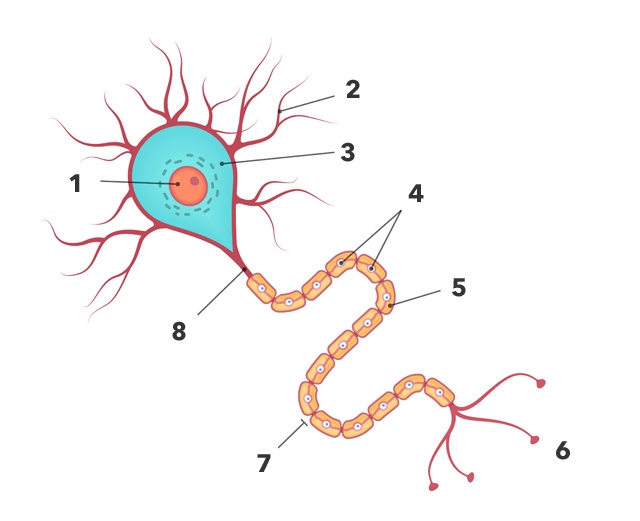
Identify #1
axon
cell body
myelin sheath
nucleus
Identify #2
axon
cell body
dendrite
myelin sheath
Identify #3
axon
cell body
dendrite
myelin sheath
Identify #6
axon terminals
dendrites
dendrite
schwann cells
Which nervous system disease results from the immune system attacking and damaging the central nervous system?
Alzheimer's Disease
Parkinson's Disease
Huntington's Disease
Multiple Sclerosis
Amyotrophic lateral sclerosis (ALS) leads to a gradual loss of higher brain functions.
True
False
Which neurological disorder is characterized by abnormal brain activity causing seizures?
Cerebral Palsy
Epilepsy
Encephalitis
Parkinson's Disease
Which disease is caused by injury to the developing brain?
Cerebral Palsy
Epilepsy
Encephalitis
Meningitis
Meningitis may cause
brain cancer.
the brain to swell and lead to brain damage and death.
a slow, gradual loss of memories.
All of the above can be caused by Meningitis.
Which nervous system disease is associated with uncontrolled shaking, slowed movements, and problems with speaking?
Multiple Sclerosis
Parkinson's Disease
Alzheimer's Disease
Huntington's Disease
A stroke may cause
brain cells to die
paralysis
loss of normal functions
all of the above can be caused by a stroke
Which nervous system disease is characterized by memory loss, confustion, and the gradual loss of control over mental and physical abilities?
Multiple Sclerosis
Alzheimer's Disease
Huntington's Disease
Parkinson's Disease
With which part of the nervous system is meningitis associated?
The tissues covering the brain
Neurons
The axon
The spinal cord

What is a Neuron?
A cell
A transmitter to transmit messages to cells
A receiver for information
a gland
What does the axon carry?
Impulses away from the cell body
Impulses to the cell body
chemicals
messages
What do the motor neurons do?
carry messages from the brain and spinal cord to muscles and glands
carry impulses from skin and sends to organs the to spinal cord and brain
carry impulses from sensory neurons to motor neurons
store messages
An example of a reflex action includes
Touching a butterfly
Brushing your hand against the side of your body
Touching a hot stove
Your legs moving as you walk
An effector is also known as a ____________ to an action
Stimulus
Sensory neuron
Motor neuron
Response
An effector is also known as a ____________ to an action
Stimulus
Sensory neuron
Motor neuron
Response
In a reflex arc, the sensory neuron leads to the ___________ and the motor neuron leads to the __________
Spinal cord, CNS
CNS, muscle
Spinal cord, muscle
Muscle, CNS
If you pick up a hot plate _____________ receptors in your ___________ detect this change
Sensory, skin
Sensory, muscle
Motor, skin
Intermediate, muscle
Reflex actions are important because
They provide a quick, involuntary response
They prevent injury
They are essential to the survival of organisms
All of the above

Name an effector in this diagram.
A
B
D
E
F

Select two examples of effectors.
Neuron
Gland
Muscle
Receptor
How is a reflex arc different than other voluntary movements?
A reflex arc takes the same path as a voluntary action
A reflex a travels from a sensory neuron to the spinal cord then to a motor neuron, skipping the brain
A reflex arc takes longer than a voluntary action
There is no difference between a reflex arc and a voluntary action
what are the 2 parts of the nervous system
brain/heart
brain/spinal cord
spinal cord/heart
heart/liver
what is a stimulus
something you are born with
something that causes a response/reaction
basic unit of life
traits that you receive
what is homeostasis
a learned response
balance between internal/external
causes a response
born with
What is the function of receptors
keep a balance between internal/external
learned by being tricked
respond to the stimulus
learning by repetition

What type of neuron is A?
Sensory
Inter
Motor
What type of neuron is C?
Sensory
Inter
Motor
Name an effector in this diagram.
A
B
D
E
F
Select two examples of effectors.
Neuron
Gland
Muscle
Receptor
Which statement best describes a reflex?
Slow response that you have to think about
Rapid response to protect body from harm

_____ neurons carry messages away from the central nervous system and out to muscles or glands. The RED neuron in diagram.
sensory
motor
inter
central
Which type of neuron causes a muscle to contract in a reflex arc?
Motor Neuron
Sensory Neuron
Interneuron
Effector

Where would the nerve impulse start in this reflex arc?
A
C
D
E
What type of neuron is A?
Sensory
Inter
Motor
Which is the correct order of neurons in a reflex arc?
Sensory neuron, motor neuron, relay neuron
Relay neuron, sensory neuron, motor neuron
Sensory neuron, relay neuron, motor neuron
What is the final component of a reflex arc?
Effector
Receptor
Afferent Pathway

Which number represents the stimulus?
1
2
3
4
Which number represents the effector?
4
5
6
7
Which number represents the sensory neuron?
3
4
5
7
Which numbers represents the neurons in a reflex arc?
3
4
5
7
In a reflex arc, the sensory neuron leads to the ___________ and the motor neuron leads to the __________
Spinal cord, CNS
CNS, muscle
Spinal cord, muscle
Muscle, CNS
Reflex actions are important because
They provide a quick, involuntary response
They prevent injury
They are essential to the survival of organisms
All of the above



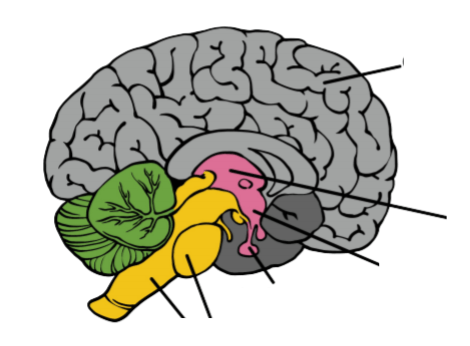
What structure is grey in this picture?
Cerebrum
Cerebellum
Brain Stem

