
NEW
Font size
 Worksheets
WKU Biochemistry Ch.2 Quiz
Total questions: 67
Worksheet time: 34mins
What are proteins polymers of?
Nucleic acids
α-amino acids
Fatty acids
Monosaccharides
What functional group is represented by -COOH?
Amino group
Hydroxyl group
Carboxylic acid group
Phosphate group
Which of the following is a characteristic of α-amino acids?
They contain only an amino group.
They contain only a carboxylic acid group.
They contain both an amino group and a carboxylic acid group attached to the same carbon.
They contain neither an amino group nor a carboxylic acid group.
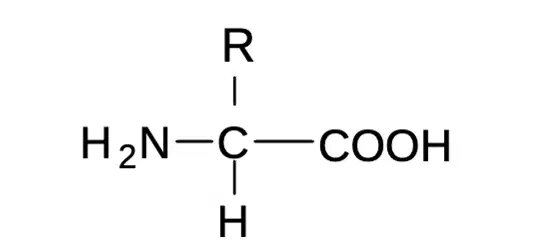
What is the general structure of an α-amino acid as depicted in the image?
R-CH(NH2)-COOH
R-CH2-COOH
R-CH(OH)-COOH
R-CH3-COOH
What is the standard designation used in organic chemistry to differentiate amino acids like cysteine?
L/D designation
R/S designation
A/B designation
E/Z designation
How many chiral amino acids are designated as L in biochemistry?
18
19
20
21
Which amino acid is an exception by having an R designation in the standard R/S system?
Glycine
Alanine
Cysteine
Lysine
What does the Henderson-Hasselbalch equation relate to in chemistry?
The ratio of the concentration of an acid to its conjugate base
The rate of a chemical reaction
The energy change in a thermodynamic process
The equilibrium constant for a gas-phase reaction
In the Henderson-Hasselbalch equation, what does "p" represent?
The power of the concentration
The negative logarithm
The pressure of the system
The product of the concentrations
Which of the following is the correct expression for the Henderson-Hasselbalch equation?
pH = pK_a + log([A-]/[HA])
pH = pK_a - log([A-]/[HA])
pH = pK_a / log([A-]/[HA])
pH = pK_a * log([A-]/[HA])
If you know the pH and pK_a of a solution, what can you determine?
The temperature of the solution
The ratio of [A-] to [HA]
The molecular weight of the solute
The viscosity of the solution
What happens to the ratio of [A-] to [HA] when the pH is equal to the pKa of the amino acid group?
[A-]/[HA] = 10
[A-]/[HA] = 100
[A-]/[HA] = 1
[A-]/[HA] = 0
If the pH is one unit above the pKa of an amino acid group, approximately what percentage of the amino acid exists in the deprotonated [A-] form?
50%
91%
99%
99.9%
What is the ratio of [A-] to [HA] if the pH is two units above the pKa of the amino acid group?
[A-]/[HA] = 1
[A-]/[HA] = 10
[A-]/[HA] = 100
[A-]/[HA] = 1000
At a pH three units above the pKa, what is the approximate percentage of the amino acid in the [A-] form?
50%
91%
99%
99.9%
What is the dominant form of an amino acid group when the pH is below its pKa?
Deprotonated form
Protonated form
Neutral form
Zwitterionic form
If the pH is 2 units below the pKa of an amino acid group, approximately what percentage of the group is in the protonated [HA] form?
91%
99%
50%
99.9%
For a basic amino acid group such as –NH2, what should be used instead of pKa to determine the ionization state?
pKb of the conjugate acid
pKa of the conjugate base
pKa of the conjugate acid
pKb of the conjugate base
What is the approximate pKa value of the -COOH group on an alpha carbon?
9.8
7.0
2.3
3.0
At pH 7, the -COOH group on an alpha carbon is predominantly in what state?
Protonated (-COOH) form
Deprotonated (-COO-) form
Neutral
Protonated (-NH3+) form
What is the approximate pKa value of the -NH2 group on an alpha carbon?
2.3
7.0
9.8
4.0
At pH 7, the -NH2 group on an alpha carbon is nearly how many units below the pKa?
4 units
2 units
3 units
5 units
At pH 7, the -NH2 group on an alpha carbon is predominantly in what state?
Deprotonated (-NH2) form
Protonated (-NH3+) form
Neutral
Deprotonated (-COO-) form
How many unique R groups are commonly observed in most proteins?
10
20
30
40
What is the common form of abbreviation for most amino acids?
2-letter abbreviations
1-letter abbreviations
3-letter abbreviations
Full names only
Which of the following amino acids is an exception to the rule where the 3-letter abbreviation is the first three letters of its name?
Val
Leu
Ile
Met
1-letter abbreviations for amino acids typically represent what?
The least abundant amino acids
The most abundant amino acids
The amino acids with the simplest structures
The amino acids with the most complex structures
What characteristic defines aliphatic amino acids?
They contain aromatic hydrocarbon chains.
They are non-aromatic hydrocarbon chains.
They are only found in essential amino acids.
They include a ring structure in their side chains.
Which of the following amino acids is the simplest in structure?
Alanine
Valine
Glycine
Leucine
What is the one-letter abbreviation for Alanine?
G
A
V
L
Which amino acid has a β carbon in its side chain?
Glycine
Alanine
Valine
All of the above
Which of the following amino acids is classified as an aliphatic amino acid?
Tyrosine
Leucine
Phenylalanine
Tryptophan
What is the one-letter abbreviation for Isoleucine?
A
I
L
M
Which amino acid has a sulfur atom in its side chain?
Proline
Leucine
Methionine
Isoleucine
Proline is unique among the amino acids shown because its side chain is linked to the:
Amino group
Carboxyl group
Alpha carbon
Nitrogen in the amino group
Which of the following amino acids is not considered an aromatic amino acid?
Phenylalanine
Tyrosine
Tryptophan
Lysine
At what wavelength do aromatic amino acids typically absorb ultraviolet radiation?
~250 nm
~280 nm
~300 nm
~350 nm
What is the one-letter abbreviation for Tyrosine?
F
Y
W
T
Which aromatic amino acid contains a hydroxyl group (-OH) in its side chain?
Phenylalanine
Tyrosine
Tryptophan
Methionine
What is the approximate pKa value of tyrosine?
2
10
7.4
12
The acidity of tyrosine is due to which of the following factors?
Resonance stability of positive charge
Inductive effect of the amino group
Resonance stability of negative charge
Hydrophobic interaction
Which amino acid is represented by the one-letter code 'S'?
Threonine
Cysteine
Serine
Alanine
What functional group is present in the side chain of Cysteine?
Hydroxyl (-OH)
Methyl (-CH3)
Sulfhydryl (-SH)
Carboxyl (-COOH)
Which amino acid has a side chain with a methyl group (CH3) as part of its structure?
Serine
Threonine
Cysteine
Glycine
Which amino acid is represented by the abbreviation 'Tyr' in phosphorylation diagrams?
Threonine
Serine
Tyrosine
Tryptophan
What is the abbreviation for Threonine as shown in the phosphorylation diagram?
Ser
Thr
Tyr
Trp
Which amino acid is represented by the abbreviation 'Ser' in phosphorylation diagrams?
Serine
Threonine
Tyrosine
Tryptophan
What is the approximate pKa value of Cysteine (Cys) as compared to Serine (Ser)?
5.5
8.5
10.5
12.5
Which amino acid is capable of forming disulfide bonds?
Serine (Ser)
Glycine (Gly)
Alanine (Ala)
Cysteine (Cys)
Between Serine (Ser) and Cysteine (Cys), which is more nucleophilic?
Serine (Ser)
Cysteine (Cys)
Both are equally nucleophilic
Neither is nucleophilic
What is formed when two cysteine molecules become oxidized to form a covalent bond between their sulfur atoms?
Hydrogen bond
Ionic bond
Disulfide bond
Peptide bond
In the formation of a disulfide bond, what happens to the cysteine molecules?
They gain electrons (are reduced)
They lose protons (are deprotonated)
They gain protons (are protonated)
They lose electrons (are oxidized)
What is the name of the molecule formed when two cysteine molecules are linked by a disulfide bond?
Cysteine
Methionine
Cystine
Alanine
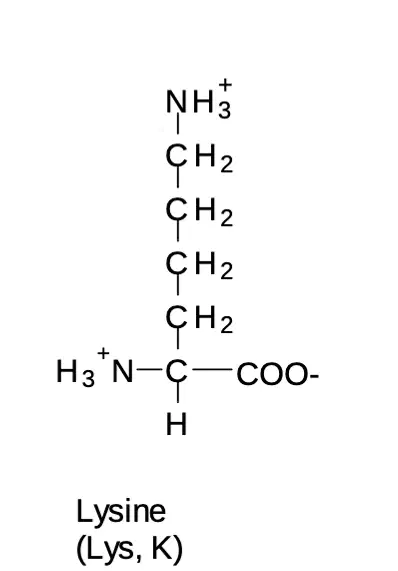
What is the pKa value of Lysine as shown in the image?
~10.8
~12.5
~6
~9.5
Which basic amino acid has a pKa value of approximately 12.5?
Lysine
Arginine
Histidine
Aspartic acid
What is the one-letter abbreviation for Histidine?
K
R
H
L
Which basic amino acid is represented by the one-letter abbreviation 'K'?
Lysine
Arginine
Histidine
Glutamine
What is the approximate pKa value of Aspartate (Asp) and Glutamate (Glu)?
2
4
7
9
Which amino acid is represented by the single-letter code 'D'?
Asparagine
Glutamine
Aspartate
Glutamate
Which of the following amino acids is NOT acidic?
Aspartate (Asp)
Glutamate (Glu)
Asparagine (Asn)
Glutamine (Gln)
What is the single-letter code for Glutamine?
A
E
N
Q
What do pK_a values refer to in the context of amino acids?
The strength of an amino acid as an acid or base when it is part of a protein
The strength of an amino acid as an acid or base when it is in its "free" form, not in a protein
The pH level at which an amino acid becomes neutral
The temperature at which an amino acid changes its structure
How much can pK_a values vary in a protein due to factors like hydrogen bonding and hydrophobicity?
1-2 units
3-4 units
5-6 units
7-8 units
What effect does a hydrophobic environment have on the pK_a of amino acids in proteins?
It does not affect the pK_a values
It lowers the pK_a of acidic and raises the pK_a of basic amino acids
It raises the pK_a of acidic and lowers the pK_a of basic amino acids
It equalizes the pK_a values of all amino acids
What is the pKa value of the carboxyl group of lysine?
2.2
9.1
10.5
10.0
At pH 10.0, which group on lysine is most likely to be deprotonated?
Carboxyl group
Amino group (backbone)
Amino group (side chain)
All of the above
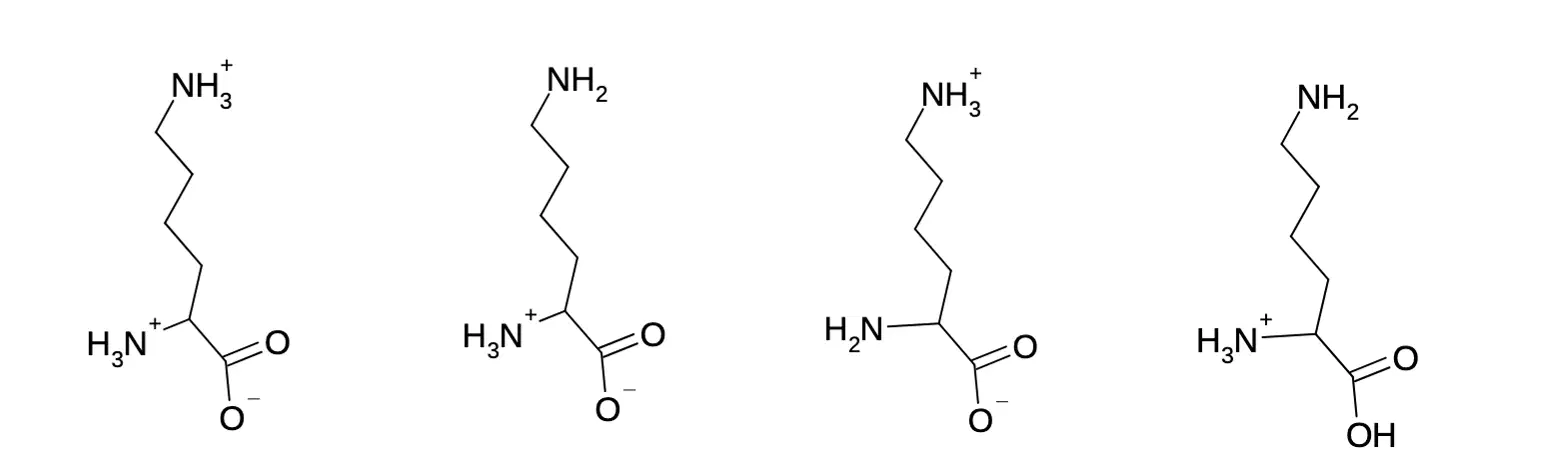
Which of the following represents the dominant form of lysine at pH 10.0?
Carboxyl Group = 2.2
Backbone = 9.1
SideChain = 10.5
Normal pH is 7.0
A
B
C
D

