
 Worksheets
Plate Tectonics Master Set of Questions Spring 2024
Total questions: 115
Worksheet time: 6hrs 45mins
The name for the actual lithospheric plates
Tectonic Plates
Plate Tectonics
Pangaea
Continental Drift
Alfred Wegener's theory stating the continents were once joined in a large mass that broke apart is ___________.
Continental Drift
Seafloor Spreading
Plate Tectonics
Pangaea
The Mid-Atlantic Ridge is formed at this type of boundary.
Divergent
Convergent
Normal
Transform


The presence of the same ________ on several continents supports the idea of continental drift.
rocks
fossils
fossils and rocks
neither fossils nor rocks


The theory of _______ states that Earth’s crust and upper mantle are broken into pieces (or plates) that are in constant, slow motion.
plate tectonics
continental drift
seafloor spreading
divergent boundaries

Matching ________ on different continents are evidence for continental drift.
weather systems
river systems
mountain systems
wind systems


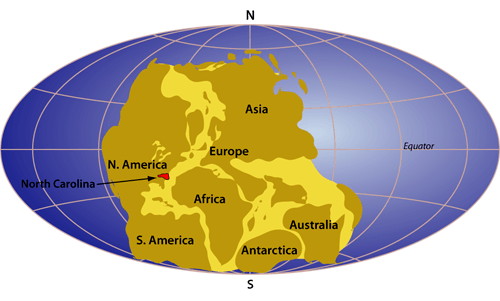
What is this a picture of?
plate tectonics
continental drift
Pangaea
glacier scaring
What happens when subduction occurs?
Parts of the crust fall into the mantle
Parts of the crust fall into the core
Parts of the crust fall into space
None of the Above
Which of the following supports the theory of seafloor spreading?
Fossils
Crustal Age
Magnetic Reversal
Continuous Mountain Chains
What geologic feature/event would you most likely to find at a divergent boundary between two pieces of continental crust?
Mid-Ocean Ridge
Mountain
Rift Valley
Island Arc

(Orca Hurricane)
The stress that occurs when two plates pull apart
Tension
Shearing
Compression
Ring of Fire
The stress that occurs when two plates slip past each other
Compression
Shearing
Tension
A stress force that occurs when two plates come together
Tension
Shearing
Compression

Why are convection currents able to move through Earth's mantle?
Solid materials conduct heat best.
It's warm deep inside the Earth.
The mantle is not solid. Its state is between a solid and a liquid.
The inner core is liquid iron and nickel.
The Atlantic Ocean is slowly getting wider because new crust is being formed at the Mid-Atlantic Ridge.
True
False
The area around the Pacific plate where boundaries form is called...
death ring
fire zone
ring of fire
zone of fire

Which of the following did NOT support the Continental Drift Theory?
Magnetic striping in the ocean floor
identical fossils found in different continents
Mountains that extend over continents
Coastlines of continents such as South America and Africa fit like a puzzle

What type of event is most likely to happen at a TRANSFORM fault boundary, such as the San Andreas Fault in California?
earthquake
hot spot
mountain building
volcano

________ are created by all 3 types of plate boundaries.
Earthquakes
Mountains
Subduction Zones
Volcanoes
What is the correct order (starting from the surface) of Earth’s layers?
mantle, outer core, inner core, crust
crust, mantle, outer core, inner core
outer core, inner core, crust, mantle
crust, outer core, inner core, mantle
Colliding tectonic plates caused sedimentary rock layers in
which province of Virginia to become folded and faulted?
Coastal Plain
Ridge and Valley
Blue Ridge
Piedmont
Virginia has gone through many geologic changes throughout the last 200 million years. When Pangaea ripped apart into the current continents on Earth today, Virginia was at the center of the breakup. What feature most likely formed along Virginia when Pangaea ripped apart?
Island Arc
Rift Valley
Transform Plate Movement
Convergent Plate movement
Extend your thinking: Which is the most likely map of Earth 300 million years from now?


Choose TWO: Which force and characteristic of matter are most likely to be part of correct answers on the Virginia Earth Science SOL? (according to your teacher)
density
gravity
inertia
mass
volume

Since tectonic plates are continuing to move, the continents will once again form a single supercontinent in the future.
True
False

Earth is approximately 4.5 billion years old, and
Pangaea is the only supercontinent to have existed. Before Pangaea, the Earth was all ocean.
True
False

Which of these is evidence that North America and Africa collided as Pangea formed about 270 million years ago.
Chesapeake Bay
Florida Peninsula
Appalachian Mountains
Great Dismal Swamp


Magnets point south when Earth's magnetic field has this
magnetic reversal
mid-ocean ridge
normal polarity
reversed polarity
seafloor spreading

Magnets point north when Earth's magnetic field has this?
magnetic reversal
mid-ocean ridge
normal polarity
reversed polarity
seafloor spreading

The area of magnetic force, around a magnet is known as its _________ ________
magnetic fan lines
magnetic declination
magnet tan lines
magnetic field

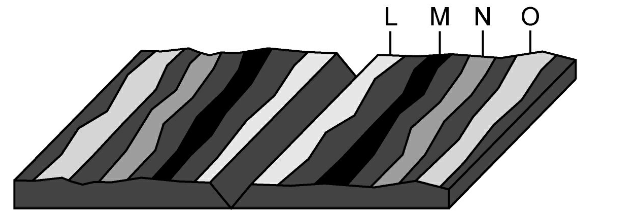
The rocks on the ocean floor show evidence that the magnetism alternates North and South as you move along the sea-floor. This evidence of sea-floor spreading is reflected in the rocks on the ocean floor. The name for this evidence is called?
Crustal subtraction
Magnetic Reversals
plate motion
magnetic soldification

seafloor spreading is occuring at the boundary between
Nazca Plate and South American Plate
Australian Plate and the Eurasian Plate
North American Plate and the Eurasion Plate.
China Plate and the Philippine Plate

The magnetic pattern or stripes of rocks on one side of the mid-ocean ridge are_____________.
the same as the rocks on the other side
younger than other side
much different pattern
at right angles to the ridge
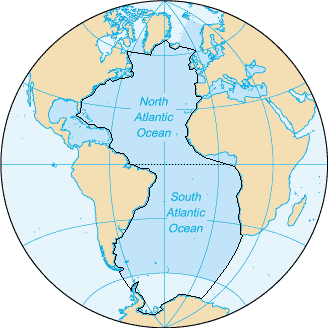

The process of seafloor spreading...
creates new oceanic crust
destroys or recycles crust
creates new continental crust
creates old crust

The Hawaiian islands have formed as the Pacific plate moves over...
a subduction zone
an ocean ridge
the Aleutian plate
a hot spot

Why is it important to be aware of places prone to earthquakes?
to identify what crop must be stored
to identify when to evacuate
to locate where to go on vacation
to be ready for emergencies and build safer buildings
The Marianas Trench, where the Pacific Plate descends under the leading edge of the Eurasian Plate, is the deepest sea floor in the world. These ocean trenches form when two oceanic plates collide
and the older, less dense of the two plates rides over the edge of the older plate.
when convection currents in the mantle force the older plate downward.
and the younger, denser of the two plates, rides over the edge of the older plate.
and the plates are approximately the same age and density.
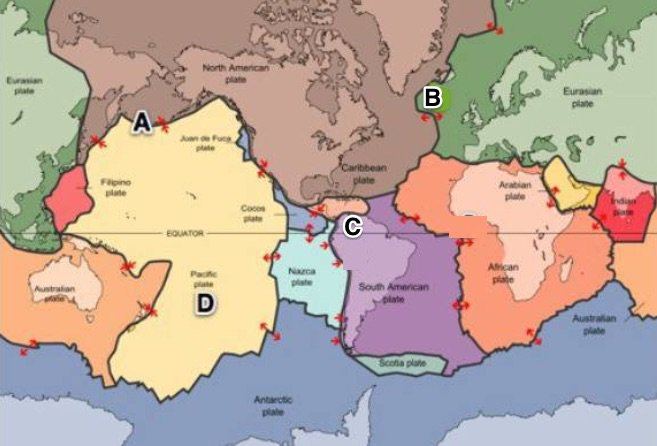
Where would sea floor spreading most likely occur?
At convergent boundaries (oceanic vs. oceanic)
At convergent boundaries (oceanic vs. continental)
At divergent plate boundaries (oceanic vs. oceanic)
At transform plate boundaries
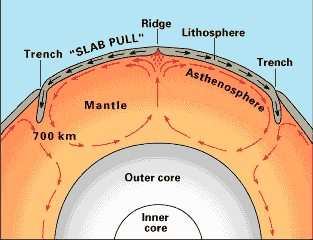
What is the source of energy that drives plate movement?
the subducton of the sea floor
the different densities of the oceanic and crustal plates
convection currents in the asthenosphere
the friction force between the plates that move past each other
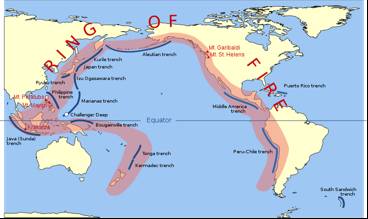
The image shows the Pacific Ring of Fire, a region of high tectonic activity. What evidence supports the theory that the tectonic activity of the region is due to the subduction of tectonic plates?

The 2004 Indian Ocean tsunami was caused by a shift in two plates that pushed one section of the sea floor under another section of the sea floor by 5 meters. What type of boundary is this?
divergent
convergent
transform
metamorphic
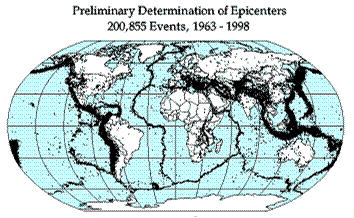
Earthquake epicenters (center of where the earthquakes started) were mapped for a 35 year period in the diagram above. The black dots indicate these epicenters. The black dots appear along what feature on Earth?
hot spots
plate boundaries
rift zones
sea floor spreading
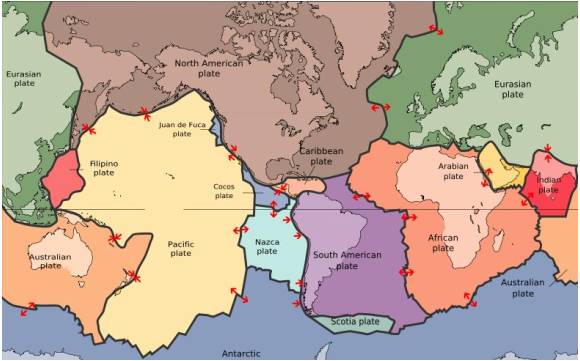
The map in the picture shows tectonic plate boundaries. This map would be useful in predicting the location of future
droughts (no rain)
hurricanes
earthquakes
tornadoes

In some areas of the world, like California and Japan, earthquakes are a common occurrence. How can this best be explained?
The strong ocean currents are undermining both areas causing earthquakes.
Both areas are located near the edge of the Pacific Ocean, the unstable sand causes earthquakes.
Both areas are subjected to strong ocean wind and waves that causes earthquakes.
Both areas are on the boundary of active plates, the motion of the plates causes earthquakes.


How is it possible for new crust to be formed without increasing the surface area of the Earth?
Look at the picture carefully.
Where would the oldest rock be found?

The San Andreas Fault in California is known as an active earthquake area. What type of
boundary is it?
Converging
Diverging
Transform
Sea Floor Spreading
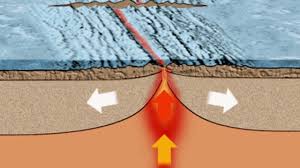
In sea-floor spreading, molten material rises from the mantle and erupts
along the edges of all the continents.
along mid-ocean ridges.
in deep-ocean trenches.
at the north and south poles.
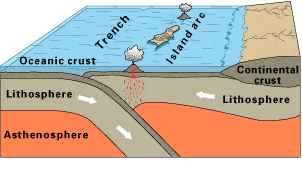
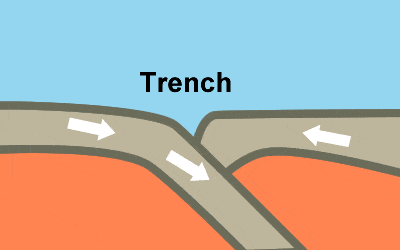
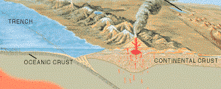
Look at this diagram of a plate boundary. Which statement BEST describes what is happening?
Tthe oceanic crust is melting.
The denser oceanic crust is subducting under the less dense oceanic crust.
Volcanic islands are forming.
The tectonic plates are moving away from each other.
The outermost, rigid layer of the earth, consisting of the earth's crust and upper part of the mantle is known as the ________________.
lithosphere
Pangaea
subduction zone
tectonic
Wegener
These are NOT plate boundary features. They are areas where hot mantle plumes push up through the lithospheric plates to create volcanic islands such as Hawaii.
Hotspots
Convergent Boundary
Divergent Boundary
Transform Boundary
The only type of crust that will subduct if two plates converge is...
Oceanic
Continental
What is the only event associated with ALL plate boundaries?
Volcanoes
Earthquakes
Subduction
Deep Trenches
Aside from Earthquakes, what is the only thing you will find at transform boundaries?
Volcanoes
Subduction Zones
Folded Mountains
Fault lines
If an earthquake occurs at the bottom of the ocean floor what could form as result?
Volcano
Tsumani
Tidal Wave
Hurricane
The process that occurs at a divergent oceanic boundary that creates new crust (sea floor) is called?
Subduction
Seafloor Spreading
Continental Drift
Volcanism
The process that occurs at a divergent oceanic boundary that creates new crust (sea floor) is called?
Subduction
Seafloor Spreading
Continental Drift
Volcanism
When two continental plates converge (collide) what type of crustal feature is formed?
Mid Ocean Ridge
Subduction Zone
Rift Valley
Folded Mountains

What two crustal features occur near every subduction zone?
Volcanoes and Trenches
Rift Valleys and Mid Ocean Ridges
Volcanoes and Rift Valleys
Mid Ocean Ridges and Trenches

The process where oceanic crust slides under another plate and is melted is called ___________.
seafloor spreading
subduction
continental drift
recycling
The process where oceanic crust slides under another plate and is melted is called ___________.
seafloor spreading
subduction
continental drift
recycling

Oceanic crust (sea floor) is destroyed at this boundary.
Convergent Oceanic
Divergent Oceanic
Convergent Continental-Continental
Divergent Continental
Oceanic crust (sea floor) is destroyed at this boundary.
Convergent Oceanic
Divergent Oceanic
Convergent Continental-Continental
Divergent Continental

New oceanic crust (sea floor) is created at this boundary.
Divergent Oceanic
Divergent Continental
Convergent Oceanic
Transform

