wayground logo

Free Printable Worksheets

Font size

S
M
L
XL
Worksheets

Rock and Mineral Review

Total questions: 122

Worksheet time: 2hrs 28mins

Name
Class
Date
1.

Which of the following is a characteristic of all minerals?

a)

Crystalline structure

b)

Fills the shape of its container

c)

Usually organic

d)

Random chemical composition

2.

Which of the following is NOT a way to identify a mineral?

a)

Streak

b)

Denisty

c)

Luster

d)

Crumble

3.

What is fracture?

a)

Ability to reflect light

b)

A break in parallel planes

c)

Uneven break

4.

Igneous rocks are formed from geysers in the Earth's crust.

a)

True

b)

False

5.

Two types of igneous rocks are:

a)

Interior and exterior

b)

Intrusive and extrusive

c)

Inside and outside

d)

Enter and exit

6.

Lava is found...

a)

after a volcano erupts.

b)

on the inside of a volcano.

c)

both inside and outside a volcano.

7.

The process for sedimentary rocks DO NOT include:

a)

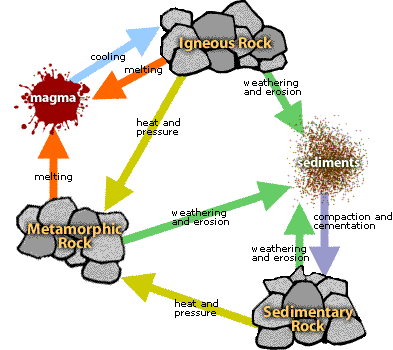
Cementation

b)

Cooling

c)

Deposition

d)

Erosion

8.

Which is a type of sedimentary rock:

a)

inorganic

b)

intrusive

c)

clastic

d)

mineral

9.

Fossils are a form of:

a)

mineral

b)

igneous rock

c)

sedimentary rock

10.
Means that a mineral cannot come from something that was once living.
a)
Inorganic
b)
Organic
c)
Naturally Occurring
d)
Not Living
11.
This is measured on  the Mohs Scale.
a)
Cleavage
b)
Density
c)
Hardness
d)
Luster
12.
The _________ of a mineral is a physical property that is easy to observe.
a)
Chemical Composition
b)
Color
c)
Hardness
d)
Streak
13.
_______ is found by rubbing the mineral against an unglazed tile called a plate.
a)
Cleavage
b)
Color
c)
Luster
d)
Streak
14.
This is how a mineral reflects light.
a)
Cleavage
b)
Density
c)
Hardness
d)
Luster
15.
_______ is a property that describes a mineral  that splits evenly along flat surfaces.
a)
Cleavage
b)
Fracture
c)
Inorganic
d)
Organic
16.
The three major rock groups are:
a)
Inorganic, Metamorphic, and  Sedimentary
b)
Inorganic, Metamorphosis, and Sediment
c)
Igneous, Metamorphic, and Sediment
d)
Igneous, Metamorphic, and Sedimentary
17.
This rock  is formed from molten rock (magma/lava) that has cooled.
a)
Igneous
b)
Inorganic
c)
Metamorphic
d)
Sedimentary
18.
This rock is formed by extreme heat and/or pressure that alters the chemical composition into a new form of rock.
a)
Inorganic
b)
Igneous
c)
Metamorphic
d)
Sedimentary
19.
This rock is formed by erosion (continuously broken down into small fragments) and  then is compressed and  cemented together.
a)
Inorganic
b)
Igneous
c)
Metamorphic
d)
Sedimentary
20.
When identifying minerals, _______ can be tested by scratching the surface with different materials such as your fingernail or a coin.
a)
Cleavage
b)
Density
c)
Hardness
d)
Streak
21.

Minerals break in different ways. Some break into thin sheets while others break into squares. What property of minerals is this?

a)

cleavage

b)

hardness

c)

luster

d)

streak

22.

Which of these observations describes a minerals luster?

a)

brittle

b)

shiny

c)

brown

d)

hard

23.

Which rock is formed by lava that has cooled quickly?

a)

sedimentary

b)

metamorphic

c)

igneous

d)

sandstone

24.

Which rock is formed by layers of material that settled on the bottom of an ocean?

a)

sedimentary

b)

igneous

c)

metamorphic

d)

obsidian

25.

Paolo wanted to identify a mineral. He rubbed a corner of the mineral across a white tile and recorded the color of the mark. What property was Paolo measuring?

a)

cleavage

b)

color

c)

streak

d)

luster

26.

Minerals and rocks are not exactly the same. How are minerals and rocks related to each other?

a)

Minerals are groups of related rocks.

b)

Minerals have crystals, but rocks do not.

c)

Rocks are made up of one or more minerals.

d)

Rocks contain different chemical compounds than minerals.

27.

Minerals are identified and sorted by different characteristics. Luster is one way to sort minerals into different types. What is a mineral’s luster?

a)

the way that light reflects from its surface

b)

the mineral’s elements and their arrangement

c)

the color that it makes when rubbed on a tile

d)

the way that it breaks when you strike it with a wedge

28.

Sheila is classifying the rocks in her collection. She knows that limestone often contains fossils. In which category of rock should she classify these rocks?

a)

igneous

b)

granite

c)

metamorphic

d)

sedimentary

29.

Both igneous rock and sedimentary rock can turn into metamorphic rock. What two conditions are necessary for this to happen?

a)

heat and erosion

b)

heat and pressure

c)

weathering and erosion

d)

weathering and pressure

30.
How do you test the hardness of a mineral? 
a)
Throw it against a wall
b)
Step on it
c)
Scratch Test
d)
Kick it until it breaks
31.
Which minerals would all scratch apatite?
a)
diamond, topaz, quartz
b)
quartz, calcite, gypsum
c)
fluorite, talc, calcite
d)
diamond, fluorite, corundum
32.
Which mineral would scratch calcite but not scratch apatite?
a)
fluorite
b)
gypsum
c)
talc
d)
topaz
33.
Which mineral is number 6 on the hardness scale?
a)
Conrundum
b)
Topaz
c)
Quartz
d)
Orthoclase
34.
What can you infer about graphite from the fact that you can scratch it with just your fingernail?
a)
It's not very lustrous.
b)
It's not very hard.
c)
Its streak is black colored.
d)
It has fracture.
35.
What do all rocks have in common?
a)
same size
b)
same color
c)
contain minerals
d)
same shape
36.
Hardness is a property that helps identify minerals.  Scientists use a scale of 1-10 to show the hardness of a mineral. 
a)
true
b)
false
37.
What mineral is the softest?
a)
quartz (7)
b)
mica (2)
c)
feldspar (6)
d)
talc (1)
38.
What was the purpose of the scratch test?
a)
to find if the rock contained calcite
b)
to find the hardness of the mineral 
c)
to find the color
39.
A rock is...
a)
made of 2 or more minerals
b)
something found in nature
c)
something that can be broken with a hammer or chisel
d)
all answers
40.
A mineral is...
a)
solid material made from many different kinds of rocks
b)
a solid matter formed in nature and found in earth materials (rocks)
c)
made from layers of sediment
d)
formed from heat of magma
41.
Using the Mohs Hardness Scale, what  mineral is the hardest?
a)
Quartz
b)
Diamond
c)
Feldspar
d)
Talc
42.
Using the Mohs Hardness Scale (click the text to see the Scale), name two minerals harder than Fluorite.
a)
Talc and Calcite
b)
Gypsum and Quartz
c)
Quartz and Feldspar
d)
Diamond and Talc
43.

What is the color of a mineral's POWDER called?

a)

Streak

b)

Luster

c)

Hardness

44.

What is the "breaking down" of rock called?

a)

Erosion

b)

Deposition

c)

Weathering

45.

Gold is a shiny mineral that reflects light. What property of gold does the word shiny describe?

a)

Hardness

b)

Luster

c)

Streak

46.

What process describes the gluing of sediments to make sedimentary rock?

a)

Weathering

b)

Cementation

c)

Erosion

47.

What process describes the "movement" of rocks to a new place?

a)

Erosion

b)

Weathering

c)

Deposition

48.

Calcite is a 3 on the hardness scale and Quarts is an 8. Which is harder, Calcite or Quartz?

a)

Calcite

b)

Quartz

49.

When sediments settle into one place, it is called __________.

a)

Weathering

b)

Erosion

c)

Deposition

50.

This is a beautiful piece of clear quartz. When you hit quartz with a small hammer it breaks in a rough, jagged way. What type of breakage does quartz have?

a)

Cleavage

b)

Fracture

51.

Sulfur has a dull yellow mineral. What property does the word dull describe?

a)

Streak

b)

Luster

c)

Hardness

52.

After sediments deposit in a new area, they begin to pile up and be pressed together. What process does the word press describe?

a)

Compaction

b)

Deposition

c)

Weathering

53.

What property of minerals is the easiest to determine?

a)

Color

b)

Streak

c)

Hardness

54.
The five characteristics that all minerals share are:
a)
Definite Chemical Composition, Color, Density, Igneous, and Solid
b)
Definite Chemical Composition,  Crystal Structure, Inorganic, Naturally Occurring, and Solid
c)
Cleavage, Faces, Hardness, Metamorphic, and Streak
d)
Cleavage, Crystal Structure, Density, Igneous, and Solid
55.
Means that the substance must occur in nature, it cannot be created or manufactured by people
a)
Inorganic
b)
Organic
c)
Naturally Occurring
d)
Not Living
56.
This has a definite volume and shape, its particles are tightly packed together and cannot move easily.
a)
Chemical Composition
b)
Crystal Structure
c)
Density
d)
Streak
57.
This means the particles that make a mineral line up in a pattern that repeats over and over again.
a)
Chemical Composition
b)
Crystal Structure
c)
Fracture
d)
Solid
58.
Definite ___________ means that a mineral always contains certain elements in definite, or exact, proportions.
a)
Chemical Composition
b)
Crystal Structure
c)
Crystal System
d)
Naturally Occurring
59.
________ is the mass per unit volume.
a)
Crystal Structure
b)
Density
c)
Hardness
d)
Solid
60.
_______ is a property that describes a mineral  that splits evenly along flat surfaces.
a)
Cleavage
b)
Fracture
c)
Inorganic
d)
Organic
61.
This describes how a mineral looks if it breaks in an irregular way.
a)
Cleavage
b)
Fracture
c)
Inorganic
d)
Organic
62.
This rock is formed from lava on  the earth's  surface
a)
Inorganic
b)
Igneous
c)
Metamorphic
d)
Sedimentary
63.
This rock is formed by erosion (continuously broken down into small fragments) and  then is compressed and  cemented together.
a)
Inorganic
b)
Igneous
c)
Metamorphic
d)
Sedimentary
64.
A mineral is a living object
a)
True
b)
False
65.
All rocks contain at least one mineral.
a)
True
b)
False
66.
Minerals have different properties to help scientists identify them.  Which is NOT a property used to identify minerals?
a)
color
b)
hardness
c)
size
d)
luster
67.
A rock is a naturally formed solid made of one or more ________.
a)
elements
b)
chemicals
c)
minerals
68.

Can rocks contain fossils?

a)

yes

b)

no

69.
The process by which igneous rocks are formed...
a)

heat and pressure

b)

melting and cooling

c)

compaction and cementation

70.

Igneous rocks form from

a)

Heat and Pressure

b)

Melting and Solidification

c)

Compaction and Cementation

d)

Weathering and Erosion

71.

Sedimentary rocks form from

a)

Compaction and Cementation

b)

Melting and Solidifcation

c)

Weathering and Erosion

d)

Heat and Pressure

72.

Sediments are formed from

a)

Compaction and Cementation

b)

Weathering and Erosion

c)

Melting and Solification

d)

Heat and Pressure

73.
What is the LEAST useful way to identify a mineral?
a)

luster

b)

streak

c)

color

d)

density

74.
Which type of rock most likely contains fossils?
a)

igneous

b)

sedimentary

c)

metamorphic

75.

What is one way that is NOT a way to identify a mineral?

a)

Color

b)

Taste

c)

Using the MOHS hardness scale

76.

Which type of igneous rock has small, fine grains?

a)

Extrusive

b)

Intrusive

c)

Crystals

77.

What type of rock is formed from the transformation of existing rocks due to heat and pressure?

a)

volcanic rock

b)

igneous rock

c)

sedimentary rock

d)

metamorphic rock

78.

​ ​ (a)   hardens in the ground

​ (b)   hardens on the surface​ ​ ​

Choose from the below words
Intrusive
Extrusive
79.

A rock deep within the Earth experiences extreme temperature and pressure. After a long period of time it becomes which rock?

a)

Magma

b)

Igneous

c)

Metamorphic

d)

Sedimentary

80.

Rocks and sediment change as they move through the rock cycle. Which change involves turning into melting?

a)

Lava to rock

b)

magma to lava

c)

rock to magma

d)

rock to sediment

81.

What must happen to a metamorphic rock before it becomes a sedimentary rock rock?

a)

It must be broken down into sediment

b)

It must be melted into magma

c)

Its minerals must dissolve in water

d)

It must be exposed to high temperature and pressure

82.

These rocks are often foliated, meaning they have layers.

a)

Sedimantary

b)

Sediment

c)

Metamorphic

d)

Igneous

83.

As a result of cooling slowly, these rocks develop air pockets and are often very lightweight.

a)

Sedimentary

b)

Metamorpic

c)

Intrusive Igneous

d)

Extrusive Igneous

84.

Fossils are often found in this rock.

a)

Sedimentary

b)

Igneous

c)

Metamorphic

85.

This rock is often found near water.

a)

Sedimentary

b)

Igneous

c)

Metamorphic

86.

You would most likely find this rock near a volcano.

a)

Sedimentary

b)

Igneous

c)

Metamorphic

87.

This rock is usually made up of pieces of rock called sediments that have been pressed and cemented together.

a)

Sedimentary

b)

Igneous

c)

Metamorphic

88.
A __________ is a natural, nonliving substance that makes up rocks. 
a)
Sedimentary rock
b)
Igneous Rock
c)
Mineral
d)
Sediment
89.

What is underground molten rock?

a)

Lava

b)

Magma

c)

Soil

d)

Intrusive

90.

What is aboveground molten rock?

a)

Extrusive

b)

Magma

c)

Lava

d)

Sedimentary

91.

Clastic & non-clastic are 2 types of.....

a)

Sedimentary

b)

Igneous

c)

Metamorphic

92.

Intrusive & extrusive are 2 types of...

a)

sedimentary

b)

metamorphic

c)

Igneous

93.

Foliated & non-foliated are 2 types of...

a)

Sedimentary

b)

Metamorphic

c)

Igneous

94.

According to the diagram, what process is shown by letter B?

a)

compaction & cementation

b)

weather & erosion

c)

heat & pressure

d)

melting

95.
This rock started as molten magma. What type of rock is this?
a)
Sedimentary
b)
Igneous
c)
Metamorphic
96.
This rock was formed by smaller pieces of rock that settled at the bottom of a lake millions of years ago. What type of rock is this?
a)
Sedimentary
b)
Igneous
c)
Metamorphic
97.
The name rock is given when it is broken down into smaller pieces.
a)
texture
b)
weathering
c)
sediment
d)
erosion
98.

Which rock is formed form the cooling of volcanic ash on Earth's surface?

a)

intrusive igneous

b)

foliated metamorphic

c)

extrusive igneous

d)

organic sedimentary

99.

Rocks that form from colling magma inside Earth?

a)

Igneous intrusive

b)

Igneous extrusive

c)

Metamorphic foliated

d)

Metamorphic nonfoliated

100.
True/False: Igneous rocks can only turn into metamorphic rocks.
a)
True
b)
False
101.

What type of rock might contain evidence of past life?

a)

Sedimentary Rock

b)

Igneous Rock

c)

Metamorphic Rock

102.

Which of the following lists the steps an igneous rock undergoes in order to become a sedimentary rock, in the correct order?

a)

Deposition, erosion, melting, cooling

b)

Erosion, weathering, eruption, cooling

c)

Dissolving, deposition, cooling, fracture

d)

Weathering, erosion, deposition, cementation

103.

Limestone is a sedimentary rock. During the rock cycle, limestone is changed into marble, a metamorphic rock. The processes that act on limestone and change it into marble are

a)

weather and erosion

b)

heat and pressure

c)

compacting and cementing

d)

melting, cooling, and hardening

104.

According to the diagram, what process is shown by letter A?

a)

extrusion

b)

erosion

c)

crystallization

d)

intrusion

105.

If a lot of heat is applied to a rock, it will turn into

a)

magma

b)

rocks

c)

sediment

d)

metamorphic rocks

106.
Formed by cooling & solidification of lava
a)
Sedimentary
b)
Metamorphic
c)
Extrusive Igneous
d)
Intrusive Igneous
107.
Formed by cooling & solidification of magma
a)
Sedimentary
b)
Metamorphic
c)
Extrusive Igneous
d)
Intrusive Igneous
108.
Formed by compacting & cementing of sediments
a)
Sedimentary
b)
Metamorphic
c)
Extrusive Igneous
d)
Intrusive Igneous
109.
Has large crystals because of slow cooling
a)
sedimentary rock
b)
metamorphic rock
c)
intrusive igneous rock
d)
extrusive igneous rock
110.
Has small or no crystals because of rapid cooling
a)
sedimentary
b)
metamorphic
c)
extrusive igneous
d)
intrusive igneous
111.
Has wavy bands.
a)
sedimentary rock
b)
metamorphic rock
c)
extrusive igneous rock
d)
intrusive igneous rock
112.

How are clastic sedimentary rocks formed?

a)

minerals dissolve in a solution & then crystallize

b)

rock fragments are squeezed together

c)

remains of plants & animals are deposited in thick layers

113.

This rock is made of large bits of gravel cemented together.

What type of sedimentary rock is it?

a)
Clastic
b)
Chemical
c)
Organic
114.

Chemical sedimentary rocks are...

a)

Made from heat

b)

Made when water evaporates and minerals crystallize

c)

Made from dead animals/plants

d)

Made from pieces of other rocks

115.

Organic sedimentary rocks are...

a)

Made from heat

b)

Made when water evaporates and minerals crystallize

c)

Made from the remains of dead animals/plants

d)

Made from pieces of other rocks

116.
The igneous rock texture that is characterized by two distinctly different crystal sizes is called
a)
Coarse grained
b)
Fine grained
c)
Glassy
d)
Porphyritic
117.
The three groups of rocks are classified by
a)
How they form
b)
Color
c)
Grain size
d)
Chemical Composition
118.
Which of the following is not a rock
a)
Pumice
b)
Lava
c)
Halite
d)
Sandstone
119.
When minerals line up in bands within a metamorphic rock, this rock is...
a)
Nonfoliated
b)
Foliated
c)
Igneous
d)
Sedimentary
120.
As lava cools and crystallizes, what type of rock will form?
a)
Sedimentary
b)
Metamorphic
c)
Extrusive Igneous
d)
Intrusive Igneous
121.
You find a rock in which the grains are arranged in parallel bands of white and black crystals.  The rock is probably a(n)
a)
Igneous rock
b)
Sedimentary rock
c)
Metamorphic rock
d)
Extrusive rock
122.
An igneous rock containing large crystals is most likely a(n)
a)
Chemical Rock
b)
Foliated Rock
c)
Extrusive Rock
d)
Intrusive Rock