wayground logo

Free Printable Worksheets

Font size

S
M
L
XL
Worksheets

Biology Benchmark Review

Total questions: 100

Worksheet time: 2hrs 40mins

Name
Class
Date
1.
Which organic macromolecules are composed of chains of amino acids that join to form the structural components of organisms?
a)
carbohydrates
b)
nucleic acids
c)
proteins
d)
lipids
2.
Which is the only structure you would expect to see when examining a prokaryotic cell with a compound microscope?
a)
nucleus
b)
chloroplast
c)
cell membrane
d)
mitochondria
3.
Which cell part is present in eukaryotic cells, but not in prokaryotic cells?
a)
cell membrane
b)
cell wall
c)
cytoplasm
d)
nucleus
4.

The ability to maintain a stable internal environment is called ________________.

a)

Metabolism

b)

Mitosis

c)

Heterozygous

d)

Homeostasis

5.
What is the capsid of a virus?
a)
the disease it causes
b)
the receptors to which it binds
c)
the genetic material
d)
its protein coat
6.
What is one way that a lysogenic infection differs from a lytic infection?
a)
A lysogenic virus does not act on bacteria as a lytic virus does.
b)
A lysogenic virus can remain in the host DNA for a longer period without becoming active.
c)
A lysogenic virus contains RNA instead of DNA.
d)
A lysogenic virus directs the production of new viruses right away.
7.
Which of the following is a possible result of a disruption in the cell cycle?
a)
cancer
b)
photosynthesis
c)
cellular respiration
d)
protein synthesis
8.

Cell have several mechanisms for regulating their internal environments. Which of these mechanisms involved in maintaining homeostasis requires energy?

a)

osmosis

b)

diffusion

c)

active transport

d)

passive transport

9.
Which of the following is the only characteristic shared by living cells and viruses?
a)
the presence of carbohydrates
b)
the ability to reproduce
c)
the presence of the nucleic acid
d)
a cell membrane
10.
This cell is undergoing mitosis.  What stage of mitosis is shown?
a)
prophase
b)
metaphase
c)
anaphase
d)
telophase
11.
This diagram shows the cell cycle.

Which of the following activities occur in the S phase?
a)
Replication of the DNA
b)
Growth of the cell
c)
Formation of the mitotic spindle
d)
Breakdown of the nuclear membrane
12.
Meiosis is the process by which gametes are produced. In which of the following human organs would meiosis occur?
a)
Liver
b)
Stomach
c)
Testis
d)
Lungs
13.
Which of the following macromolecules are a prominent part of animal tissues that function in insulation, helping animals conserve heat?
a)
Carbohydrates
b)
Lipids
c)
Proteins
d)
Nucleic acids
14.
a)

Prophase

b)

Anaphase

c)

Telophase

d)

Interphase

15.
The diffusion of water through a semi-permeable membrane is called?
a)
Osmosis
b)
Cell wall
c)
Diffusion
d)
Respiration
16.
An animal cell placed in a hypertonic (salty) solution will
a)
Shrink
b)
Swell
c)
Stay the same
17.
What are the nucleotides made of?
a)
Sugar, Phosphate, nitrogen base
b)
Phosphate, Adenine, nitrogen base
c)
Thymine, Adenine, Cytomine
d)
Phosphate, Nitrogen, Adenine
18.
Adenine bonds with ______________.
a)
Guanine
b)
Thymine
c)
Cytosine
d)
Adenine
19.
Guanine bonds with ______________.
a)
Adenine
b)
Guanine
c)
Cytosine
d)
Thymine
20.
Which sequence of DNA bases would pair with this partial strand
ATG TGA CAG
a)
ATG TGA CAG
b)
TAC ACT GTC
c)
GTA AGT GAC
d)
CAT TCA CTG
21.
Which 2 molecules forms the sides (backbone) of the DNA ladder?
a)
deoxyribose and adenine
b)
deoxyribose and a hydrogen bond
c)
sugar and the nucleus
d)
deoxyribose (sugar) and phosphate
22.
The two strands of nitrogenous bases in DNA are joined by which type of bond?
a)
polar bonds
b)
ionic bonds
c)
covalent bonds
d)
hydrogen bonds
23.
What determines the code, or information, of a DNA molecule?
a)
the shape (structure) of the nitrogen bases
b)
the order (sequence) of the nitrogen bases
c)
the color of the nitrogen bases
d)
the frequency (number) of nitrogen bases
24.

When going from DNA to mRNA, this process is called?

a)

Transcription

b)

Translation

c)

Replication

25.

When going from mRNA to Amino Acids, this process is called?

a)

Transcription

b)

Translation

c)

Replication

26.

What is the process to code for protein?

a)

DNA --> mRNA --> Protein

b)

mRNA--> DNA--Protein

c)

Protein-->DNA-->mRNA

d)

DNA--> Protein -m-RNA

27.

TAGACG could be the code for?

a)

DNA

b)

mRNA

c)

Protein

28.

UUACUACG could be the code for?

a)

DNA

b)

mRNA

c)

Protein

29.
What scientific process is being shown?
a)
Mixing
b)
Crossing under
c)
Crossing over
d)
square dancing
30.

During which of the following stages are the chromosomes aligned at the midpoint of the nuclei?

a)

metaphase

b)

anaphase

c)

telophase

d)

prophase

31.
Name the phase:
a)
Anaphase
b)
Telophase
c)
Metaphase
d)
Prophase
32.

What is the end product of meiosis?

a)

4 haploid cells.

b)

2 diploid cells.

c)

2 haploid cells.

d)

4 diploid cells.

33.

What process results in the division of 1 cell into 2 identical daughter cells?

a)

Mitosis

b)

Meiosis

c)

G1

d)

Cross-Over

34.

What is the correct order of the stages of Mitosis?

a)

Telophase, Anaphase, Metaphase, Prophase

b)

Prophase, Telophase, Metaphase, Anaphase.

c)

Prophase, Metaphase, Anaphase, Telophase.

d)

Anaphase, Metaphase, Prophase, Telophase.

35.
In what phase of the cell cycle does DNA replication take place?
a)
G1
b)
S
c)
G2
d)
M
36.

MEIOSIS IS NEEDED BECAUSE...

a)

IT ACTUALLY ISN'T, BUT CAN BE HELPFUL IN SOME ORGANISMS

b)

TO REDUCE THE CHROMOSOME NUMBER BY HALF

c)

SO THAT EVERY CELL IS EXACTLY IDENTICAL

d)

TO MAKE SURE EVERY HUMAN CELL HAS 92 CHROMOSOMES

37.

THE END RESULT OF MEIOSIS IS...

a)

FOUR UNIDENTICAL GAMETES

b)

FOUR IDENTICAL GAMETES

c)

TWO IDENTICAL GAMETES

d)

TWO UNIDENTICAL GAMETES

38.

A mutation is defined as:

a)

A change in the cell's structure

b)

Anything that changes in an embryo

c)

Any change in the physical features of a human

d)

A change in the DNA sequence

39.

Why are insertion and deletion (frameshift) mutations so harmful?

a)

They change all of the codons from the mutation on down the line, which changes the amino acid sequence

b)

They insert things that an organism doesn't need.

c)

They often delete things that organisms need.

d)

Insertion and deletions are not any more harmful than substitution mutations.

40.

Which type of mutation does the model demonstrate?

a)

Deletion

b)

Substitution

c)

Insertion

d)

Translocation

41.

Which reason explains why nerve cells function differently than muscle cells?

a)

In nerve cells all the genes are expressed.

b)

In muscle cells all the genes are expressed.

c)

In both kinds of cells the same genes are expressed.

d)

In both kinds of cells different genes are expressed.

42.

DNA is considered a "universal" molecule, which allows scientists to insert genes from one animal into another, this is made possible because...

a)

DNA, is not universal, it is in fact radically different between species.

b)

all organisms have a nucleus which stores DNA

c)

all organisms have the same sequence of nucleotides of DNA

d)

all organisms have the same components or nucleotides of DNA

43.

Homologous structures are defined as anatomical structures originating from the same structure in ancestral form. For instance, a bird's wing and the front flippers of a seal are examples of homologous structures. Which of the following does the presence of homologous structures in vertebrates suggest?

a)

All vertebrates developed at the same rate.

b)

All vertebrates developed internally.

c)

All vertebrates evolved from different animals.

d)

All vertebrates have a common ancestor.

44.

Scientists compared the fossil remains of a species that lived 5,000 years ago to members of the same species living today. Scientists concluded that the species changed very little over this period of time. Which statement best accounts for this lack of change?

a)

The environment did not change significantly, and those offspring expressing new characteristics survived their natural enemies.

b)

The environment changed significantly, but the species had no natural enemies for a long period of time.

c)

The environment did not change significantly, and those offspring expressing new characteristics did not survive.

d)

The environment changed significantly, and those offspring without favorable characteristics did not survive.

45.

Scientists can determine relatedness among organisms by comparing partial amino acid sequences. The table shows four partial amino acid sequences from four organisms. Which organism is the LEAST related to the other three organisms?

a)

Organism 1

b)

Organism 2

c)

Organism 3

d)

Organism 4

46.

A student used a microscope to study four members of the phylum Ciliophora. Members of this phylum move when propelled by hundreds of tiny cilia. Although these organisms belong to the same phylum, they are classified as different —

a)

families

b)

species

c)

kingdoms

d)

orders

47.

Which list correctly identifies characteristics that protists share with animals?

a)

F

b)

G

c)

H

d)

J

48.

The diagram shows light- and dark-colored beetles that live on a tree. Which result is most likely to occur to the beetle population due to predation over time?

a)

The number of light-colored beetles in the population will increase.

b)

There will be more dark-colored beetles than light-colored beetles.

c)

The number of light-colored beetles will decrease.

d)

The dark-colored beetles will move to a different type of tree.

49.

The image shows part of the humerus bone in different genera of primates. Which statement is best supported by the observable structures of the different humerus

bones?

a)

The primates lived in similar environments

b)

The primates shared a common ancestor.

c)

The primates interbreed with similar organisms in a population.

d)

The primates had diets that consisted of similar types of foods.

50.
A cladogram is shown below.
All the animals to the right of the hagfish would have the common characteristic of -
a)
Fur
b)
claws or nails
c)
lungs
d)
jaws
51.
The scientific name for an organism is made from the:
a)
class and family name
b)
genus and species name
c)
domain and kingdom name
d)
kingdom and phylum name
52.
The 8 levels of classification, broadest to most specific.
a)
Domain, Genus, Family, Order, Class, Phylum, Kingdom, Species
b)
Domain, Species, Kingdom, Genus, Phylum, Family, Class, Order
c)
Domain, Kingdom, Phylum, Class, Order, Family, Genus, Species
d)
Order, Kingdom, Species, Domain, Phylum, Family, Class, Genus
53.
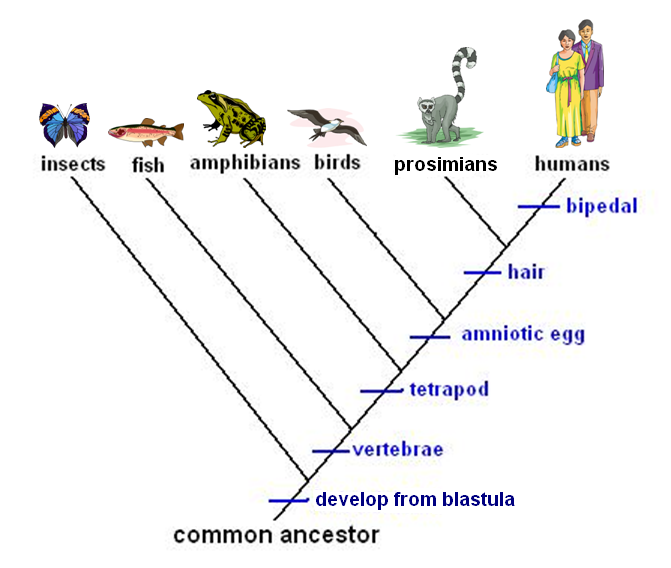
Which organisms pictured on the cladogram have hair?
a)
prosimians only
b)
prosimians and humans
c)
humans only
d)
prosimians and birds
54.
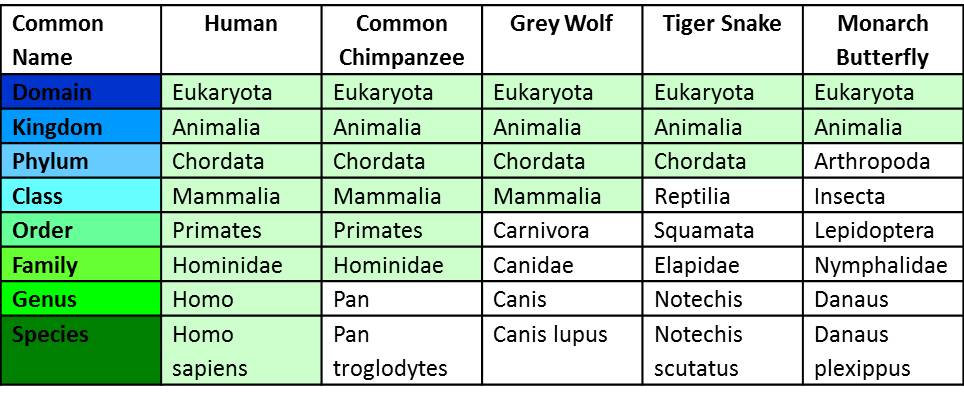
Which organism in the table is least closely related to the chimpanzee?
a)
human
b)
grey wolf
c)
tiger snake
d)
monarch butterfly
55.
An illustration and a dichotomous key are given. What is the correct classification for this organism?
a)
Class Insecta
b)
Order Amblygygi
c)
Order Araneae
d)
Order Scorpiones
56.
Organisms in this smallest taxonomic group share many characteristics.
a)
domain
b)
kingdom
c)
species
d)
class
57.
This organism is multicellular, heterotroph, that has a cell wall made of chitin.  What kingdom does it belong in?
a)
fungi
b)
plantae
c)
animalia
d)
eubacteria
58.
Mutations are important because they bring about
a)
death of the organism in which they develop
b)
genetic variation needed for a population to evolve
c)
benefits for the individual, not for the population
d)
Hardey-Weinberg equilibrium within a population
59.
Some organisms that share a common ancestor have features that have different functions, but similar structures.  These are known as
a)
vestigial structures
b)
analogous structures
c)
homologous structures
d)
fossil structures
60.
Ostrich wings are examples of
a)
homologous structures
b)
vestigial structures
c)
adaptations
d)
traits
61.
What do scientists generally find when comparing the relationship of living things in different geographic areas?
a)
Species living further apart geographically typically share a more recent common ancestral species than those living closer together
b)
Species living closer geographically typically share a more recent common ancestral species than those living further apart
c)
The location of where an organism lives gives no insight into their evolutionary relationships to other species
d)
Their protein sequences depend on the protein intake from the local watering hole.
62.
Which of the following does NOT describe a beneficial use of fungi to humans?
a)
Fungi provide humans with oxygen during photosynthesis.
b)
Fungi are nature's "recyclers" and return nutrients to the environment.
c)
Fungi are used to create many medicines.
d)
Fungi are used for food for making certain foods.
63.

Positive thigmotropism is a response in plants in which they move and grow toward an object the plant comes into physical contact with, usually curling around the object.

This response of the shoot system benefits the plant by allowing the plant to --

a)

produce more pollen for pollinators

b)

take in more carbon dioxide to convert into glucose

c)

absorb more water to transport to the leaves

d)

reach more sunlight for photosynthesis

64.

Water, sugar, and other important nutrients need to be transported from one part of a plant to another. Which statement correctly describes the interaction of the root and shoot systems during nutrient transport?

a)

The leaves take in water and sugar, which are then transported to the rest of the plant through vascular tissues.

b)

The roots take in water and sugar, which are then transported to the rest of the plant through vascular tissues.

c)

The leaves take in water and the roots produce sugar that are transported to the rest of the plant through vascular tissues.

d)

The roots take in water and the leaves produce sugar that are transported to the rest of the plant through vascular tissues.

65.

Which sequence represents the levels of organization found in a multicellular organism, from smallest to largest?

a)

cell --> tissue --> organ --> organ system

b)

organ system --> organ --> tissue --> cell

c)

tissue --> organ --> organ system --> cell

d)

cell --> organ system --> organ --> tissue

66.

Which answer choice best describes a community?

a)

praying mantises caring for their young

b)

three-spined sticklebacks living in estuaries

c)

different specifies of lizards occupying the same niche (area) in a desert

d)

roosting mother bats recognizing their offspring

67.

What cellular function do carbohydrates and lipids share?

a)

hormone production

b)

structural support of cell walls

c)

energy storage

d)

catalyst for chemical reactions

68.

An advertisement for a health supplement for dogs claims to build lean muscle and strengthen tendons and ligaments, as well as provide energy. Which two biomolecules must the supplement contain to provide these benefits?

a)

carbohydrates and lipids

b)

proteins and carbohydrates

c)

nucleic acids and carbohydrates

d)

lipids and nucleic acids

69.

A model of two structures that perform cellular processes is shown.

What are the products of the cellular processes in these organelles?

a)

I: glucose and carbon dioxide

II: oxygen and water

b)

I: carbon dioxide and oxygen

II: glucose and water

c)

I: oxygen and glucose

II: water and carbon dioxide

d)

I: carbon dioxide and water

II: glucose and oxygen

70.

What type of energy is needed for photosynthesis?

a)

chemical energy

b)

thermal energy

c)

light/solar energy

71.

What type of energy is needed for cellular respiration?

a)

chemical energy

b)

thermal energy

c)

light energy/ solar energy

72.

For an enzyme to be able to catalyze a reaction, the active site must --

a)

be occupied by an inhibitor

b)

increase the activation energy level

c)

have a complementary shape to the substrate

d)

cause the enzyme to be destroyed in the reaction

73.

Enzymes are proteins that have a three-dimensional shape that is specific to a particular substrate. Environmental conditions can change the shape of the protein.

What is the most likely result if the shape of the enzyme changes?

a)

The substrate will change its shape to match the enzyme.

b)

The enzyme will no longer be able to catalyze the reaction with the substrate.

c)

The products made from the enzyme and the substrate will be changed.

d)

The enzyme will be able to bind to more diverse substrates than before.

74.
A living relationship between two species in which one organism is harmed is called...
a)
mutualism
b)
commensalism
c)
parasitism
d)
niche
75.
symbiotic relationship in which both organisms benefit
a)
competition
b)
Mutualism
c)
nitrogen fixation
d)
energy pyramid
76.
A collection of organisms that belong to different populations but all live in the same area and interact with one another.
a)
Population
b)
Ecosystem
c)
Community
d)
Ecosphere
77.
A collection of organisms that make up a community as well as all of the nonliving aspects of the environment.
a)
Population
b)
Community
c)
Habitat
d)
Ecosystem
78.
A pond ecosystem is shown in the diagram below. Which statement describes an interaction that helps maintain the dynamic equilibrium of this ecosystem?
Which statement describes an interaction that helps maintain the dynamic equilibrium of this ecosystem?
a)
The frogs make energy available to this ecosystem through the process of photosynthesis.
b)
The algae directly provide food for both the rotifers and the catfish.
c)
The green-backed heron provides energy for the mosquito larvae.
d)
The catfish population helps control the populations of water boatman and waterfleas.
79.
According to the food web, which of these supply energy for all the other organisms?     
a)
snakes
b)
insects
c)
grasses
d)
cougars
80.
Striped fish are affected by abiotic and biotic factors in the environment.  Which of these factors is biotic?
a)
water temperature
b)
mineral nutrients
c)
algae
d)
sediment
81.
Refer to the illustration above. Level “A” is composed of
a)
secondary consumers
b)
primary consumers
c)
producers
d)
predators
82.
When an organism dies, the nitrogen in its body
a)
can never be reused by other living things.
b)
is immediately released into the atmosphere.
c)
is released by the action of decomposers.
d)
None of the above
83.
In going from one trophic level to the next higher level,
a)
the number of organisms increases.
b)
the amount of usable energy increases.
c)
the amount of usable energy decreases.
d)
diversity of organisms increases.
84.
The diagram represents a food chain. The arrows in the diagram indicate the  
a)

return of chemical substances to the
environment
b)
order of importance of the various organisms.  
c)
direction of energy flow through a series of organisms
d)
direction in which organisms move in the environment. 
85.
Deforestation by burning has been described as a "double whammy" to the environment, meaning it has 2 negative impacts. Why is this description accurate? 
a)
Forest burning releases CO2 while decreasing oxygen, which disrupts cycles
b)
Deforestation reduces the amount of oxygen in the atmosphere, which depletes the ozone layer
c)
Forest clearing is often followed by land development, which often leads to increased noise pollution
d)
Deforestation increases the number of plant and animal species by destroying habitat
86.
The amount of energy that usually transfers from one trophic level to the next...
a)
10%
b)
20%
c)
80%
d)
50%
87.
The fox in this food web would be considered a:
a)
Tertiary Consumer
b)
Producer
c)
Secondary Consumer
d)
Primary Consumer
88.
largest number of individuals of a population that the environment can support  
a)
carrying capacity
b)
primary succession 
c)
denitrification
d)
mutualism
89.
A fox stalks a duck and eats it.  This is an example of ?
a)
competition
b)
predation
c)
parasitism
d)
mutualism
90.
What type of succession would first develop on a newly formed volcanic island?
a)
primary 
b)
secondary
c)
tertiary
d)
climax
91.
Water lilies cannot grow in the desert because the amount of water is a?
a)
limiting factor
b)
competitive factor
c)
carrying factor
d)
none of these
92.
A certain bird eats the parasites off of an antelope.  This is ?
a)
mutualism
b)
commensalism 
c)
predation
d)
parasitism
93.
All energy originates from ?
a)
food
b)
the sun
c)
mitochondria
d)
consumers
94.
Area with all living (biotic) and non living (abiotic) entities.  
a)
population
b)
ecosystem
c)
communities
d)
biome
95.
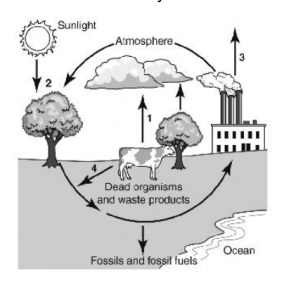
What is happening at 1?
a)
respiration: releasing CO2
b)
decomposing CO2 in the soil
c)
photosynthesis: absorbing CO2
d)
turning CO2 from the atmosphere into organic molecules
96.
Photosynthesis
a)
absorbs CO2
b)
releases CO2
97.
In a food chain or energy pyramid, there are different feeding levels (producer, primary consumer...). What do we call these feeding steps?
a)
communities
b)
levels of energy
c)
trophic levels
d)
food web
98.

Which binomial nomenclature is written correctly?

a)

Marmota Monax

b)

Marmota monax

c)

marmota monax

d)

marmota Monax

e)

none of the answers are correct

99.

According to the dichotomous key below, what is the name of the pink creature?


1a. mouth open………….go to 2

1b. mouth not open……..go to 4

2a. Arms…………………….go to 3

2b. No arms….Alienus quadlegicus

3a. Hairy……………..Alienus haircus

3b. Not hairy…..Alienus tritoothicus

4a. No horns………………..go to 5

4b. Horns…………...Alienus stripicus

5a. No legs…….…..Alienus biobicus

5b. Legs………………Alienus fuzzicus

a)

Alienus quadalegicus

b)

Alienus tritoothicus

c)

Alienus stripicus

d)

Alienus fuzzicis

100.

What are the 8 levels of classification of living things from most general to most specific?

a)

domain, kingdom, phylum, class, order, family, genus, species

b)

kingdom, domain, phylum, class, order, family, species, genius

c)

domain, phylum ,kingdom, class, order, family, genus, species

d)

domain, king, phillip, class, order, family, genus, species