
 Worksheets
Biology Chapter 5
Total questions: 55
Worksheet time: 50mins
A cellular membrane consists of five layers,
• The first layer in red is the Aqueous environment - composed of water.
• The second layer in yellow is the glycerol group – Hydrophilic side.
• The third layer, which is the largest, in green is hydrocarbon tails – Hydrophobic side.
• The fourth layer in yellow with bits of swirly blue is Aquaporin protein – which functions as a water transporter.
• The fifth layer in red is the Aqueous environment - composed of water.
What is the largest layer in green in the cellular membrane layers?
Protein layer
Carbohydrate layer
Hydrocarbon tails - Hydrophobic side
Cholesterol layer
How many layers does a cellular membrane consist of?
Three layers
Five layers
Seven layers
Ten layers
What is the Aqueous environment composed of?
What are the Cellular membrane two main layers known as?
What does a polar molecules mean?
What does it a nonpolar molecule mean?
What are the main differences between polar and nonpolar molecules?
Is it true polar molecules like water?
True
False
Is it true nonpolar molecules like water?
Is it true membrane is fluidic because of kinks in the unsaturated fatty acid tails
False
True
Are membranes a lipid bilayer? (true or false)
Which of the following is not true about the lipid bilayer?
It is selectively permeable
It restricts the free movement of large polar molecules
It allows the passage of small nonpolar molecules
What is the difference between the cellular membrane and the plasma membrane?
Biologists use the fluid mosaic model to describe a membrane’s structure— diverse protein molecules suspended in a fluid phospholipid bilayer.
• The plasma membrane exhibits selective permeability.
• The proteins perform various functions below.
• Diffusion
• Enzyme
• Glycoprotein
• Junction protein
• Active transport protein
• Channel transport protein
• Receptor protein
• Attachment protein
What characteristic does the plasma membrane exhibit?
Impermeability
Selective permeability
Complete permeability
Random permeability
What role do proteins play in the membrane's functionality?
Transporting molecules across the membrane
Providing structural support to the membrane
Facilitating cell communication
Regulating membrane permeability
What are some functions performed by proteins in the membrane?
Diffusion
Photosynthesis
Respiration
Excretion
What does the fluid mosaic model describe?
The structure of a cell's nucleus
The structure of a membrane with diverse protein molecules in a fluid phospholipid bilayer
The process of photosynthesis in plants
The function of ribosomes in protein synthesis
What are some types of membrane proteins mentioned in the text?
Enzymes
Lipids
Carbohydrates
Nucleic Acids
What is the function of Transport proteins?
What forms intercellular junctions that attach adjacent cells?
Junction proteins
what protein signals molecules in the cellular membrane?
What serve as ID tags in a cellular membrane?
In a plasma membrane what may be group to carry out sequential reactions?
What protein allows specific ions or molecules to enter or exit the cell
Phospholipids spontaneously ____ into simply membranes
self-assemble
combine with transport proteins
In the origin of a cell, the formation of a simple lipid bilayer membrane are?
Not Sufficient
Sufficient
What is passive transport in a plasma membrane?
What is active transport in a plasma membrane?
What is ATP?
What are the three forms on ATP?
What is the difference between ATP and GTP
ATP and GTP are the same. they just take place in different location within the cell
Net diffusion occurs when molecules of dye are on one side of one membrane and not the other.
• The molecules of dye diffuse through the pores in the membrane from the side where all the molecules of dye are, to the side where there are no molecules of dye
• Net diffusion occurs until both sides of the membrane have an equal concentration of dye molecules, and equilibrium is reached.
What happens when both sides of the membrane have an equal concentration of dye molecules?
The molecules stop diffusing
The molecules continue to diffuse
The molecules reverse direction
The molecules evaporate
What happens when equilibrium is reached in terms of net diffusion and concentration?
Net diffusion increases
Net diffusion decreases
Net diffusion stops
Concentration becomes uneven
What is net diffusion?
Movement of molecules from low to high concentration
Movement of molecules from high to low concentration
No movement of molecules
Movement of molecules in random directions
What is Osmosis?
What is Tonicity?
Tonicity is the ability of a surrounding solution to cause a cell to gain or lose water
What is facilitated transport?
what is Co-transportation?
What process is used to take in large molecules in the plasma membrane?
What is used to export bulky molecules, such as proteins or polysaccharides?
Exocytosis
Endocytosis
Phagocytosis is the engulfment of a particle by the cell wrapping the cell membrane around it, forming a vacuole. Also called cell eating it engulfs bacteria, debris, and other objects cells.
Eg. Macrophages, Neutrophils and other white blood cells. Vacuoles fuse with lysozymes containing hydrolytic enzymes to degrade the engulfed materials.
Receptor-mediated endocytosis uses membrane receptors for specific solutes. Triggered when membrane receptors bind to external cellular molecules.
Eg. Protein cholesterol complex or Proteins bound to iron
What is phagocytosis?
The engulfment of particles by cells, forming vacuoles
The process of cell division
The breakdown of glucose in cells
The synthesis of proteins in cells
What do vacuoles fuse with to degrade engulfed materials?
Ribosomes
Golgi apparatus
Lysozymes
Mitochondria
What is the main mechanism used in receptor-mediated endocytosis?
Phagocytosis
Pinocytosis
Receptor-mediated endocytosis
Exocytosis
What is Energy?
Energy is the limit of an object heat
Energy is the color of light
Energy is the capacity to cause change
What is kinetic energy
What is potential energy?
Potential energy is the energy stored in the location or structure of matter and includes chemical energy
Potential energy is the energy stored in the location or structure of matter and does not include chemical energy
Potential energy is energy in the location of structure of non-matter and includes chemical energy
What is heat energy?
Heat energy is a very disordered form of energy and has a high entropy
What is the first law of thermodynamics?
What is the second law of thermodynamics?
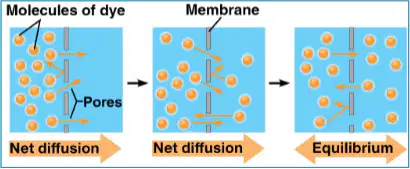
Diffusion across a membrane occurs when a more
disordered arrangement (higher entropy) of a high
concentration is on one side and a low concentration is
on the other, to result in equal concentrations of solute.
What is the main cause of diffusion across a membrane?
Osmosis
Active transport
Differences in concentration
Facilitated diffusion
What is the main goal of the process of diffusion?
To increase solute concentrations
To decrease solute concentrations
To achieve equilibrium in solute concentrations
To prevent solute movement
What is chemical energy?
What is kinetic energy?
What is heat energy?
Is it true that Exergonic reactions release energy?
False
True
Is it true that Endergonic reactions do require energy and yield products rich in potential energy?
Yes, They do the following question above

The Graph above illustrates a reaction with and Without an enzyme.
The red curve is the enzyme-catalyzed reaction.
The black curve is the non-enzyme catalyzed reaction
Line a: The activation energy without enzyme
Line b: The activation energy with enzyme;
Line c: The change in energy between reactants and
products, which is the same for both the catalyzed and
uncatalyzed reactions
Is the change in energy between reactants and products the same for both catalyzed and uncatalyzed reactions?
Yes
No
It depends on the specific reaction
Not enough information provided
What goes on the active site?
where is the active site located at?
are competitive inhibitors temporary or permanent
Are noncompetitive inhibitor completive temporary or permanent
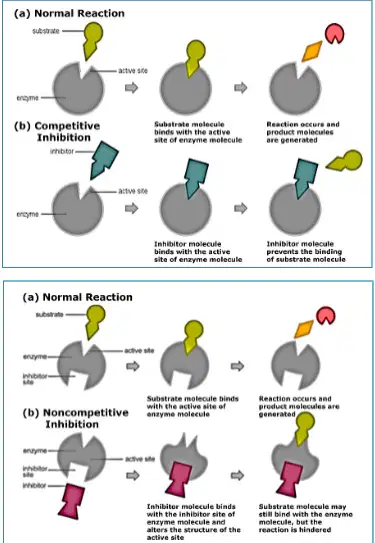
• A competitive inhibitor reduces an enzyme’s
productivity by blocking substrate molecules from
entering the active site.
• A noncompetitive inhibitor does not enter the active
site. Instead, it binds to a site elsewhere on the
enzyme, and its binding changes the enzyme’s shape
so that the active site no longer fits the substrate.
How does a noncompetitive inhibitor affect the enzyme's active site?
It binds to the active site, preventing the substrate from binding
It enhances the enzyme's activity by increasing the substrate affinity
It binds to a site elsewhere on the enzyme, changing its shape
It promotes the release of the product from the active site
How does a competitive inhibitor reduce an enzyme's productivity?
By increasing the enzyme's activity
By blocking substrate molecules from entering the active site
By enhancing the binding of substrate molecules to the active site
By changing the enzyme's structure
What is a coenzyme?
A coenzyme are small organic molecules that can be loosely or tightly bound to an enzyme.
what are Cofactors?
What are reversible inhibitors?
What are covalent inhibitors?

