
 Worksheets
Nervous system (with Patti)
Total questions: 106
Worksheet time: 2hrs 50mins


The main function of the nervous system
send messages to and from the brain and spinal cord to and from the body
break down food to be used by the body
remove wastes from the body
all of these
The part of the brain in charge of involuntary actions such as breathing and heartbeat.
cerebrum
medulla
cerebellum
neuron
The part of the brain in charge of thinking and memory.
cerebrum
medulla
cerebellum
neuron
The part of the neuron that receives stimulus is the (a)
Which part of the neuron transmits impulses to other neurons?
axon
cell body
dendrite
node
The part of the brain that controls all voluntary activities of the body is the (a)
Which of the following is a function of the nervous system?
gathers information
processes information
transmits information
all of the above
The major set of large set of nerves running down the spinal column or vertebrae.
axon
spinal cord
dendrite
cell body
The part of the body that integrates the information it receives from all over the body in order to make decisions is called the __________________
peripheral nervous system
sympathetic nervous system
central nervous system
parasympathetic nervous system
Which of the following is not the basic function of the nervous system?
detects and senses stimuli
responds to sensory stimulation
sends signal rapidly between body parts
produces fluids such as plasma and intestinal fluid
Which lobe of the brain is the main decision maker of the brain and controls voluntary movement?
Frontal
Temporal
Parietal
Occipital
Which lobe of the brain primarily processes auditory information?
Frontal
Temporal
Parietal
Occipital
Which lobe of the brain processes somatosensory information such as touch, pain, temperature, and limb location?
Frontal
Temporal
Parietal
Occipital
Which lobe of the brain is primarily responsible for visual information?
Frontal
Temporal
Parietal
Occipital
In which lobe of the brain is Broca's area located?
Frontal
Temporal
Parietal
Occipital
In which lobe of the brain is Wernicke's area located?
Frontal
Temporal
Parietal
Occipital
Which of the following is not a component of the diencephalon?
Midbrain
Thalamus
Hypothalamus
Epithalamus
Which part of the diencephalon relays sensory impulses to the sensory cortex and helps with memory?
Thalamus
Hypothalamus
Epithalamus
Which part of the diencephalon is the chief integration center for the autonomic NS?
Thalamus
Hypothalamus
Epithalamus
Which part of the diencephalon forms the posterior side of the diencephalon and is composed of the pineal gland?
Thalamus
Hypothalamus
Epithalamus
Which of the following is not a component of the brain stem?
Midbrain
Pons
Medulla oblongata
Thalamus
Which part of the brain stem contains visual and auditory reflex centers?
Midbrain
Pons
Medulla oblongata
Thalamus
Which part of the brain stem relays information from the cerebrum to the cerebellum and is also called the bridge?
Midbrain
Pons
Medulla oblongata
Thalamus
Which part of the brain stem merges into the spinal cord?
Midbrain
Pons
Medulla oblongata
Which major part of the brain controls balance and equilibrium?
Cerebrum
Cerebellum
Diencephalon
Brain Stem
Which part of the brain is known as the language comprehension center?
Broca's
Wernicke's
Which part of the brain controls the physical ability to speak?
Broca's
Wernicke's

Identify the structure labeled as A.
Cerebrum
Frontal Lobes
Parietal Lobes
Occipital Lobes

Identify the structure labeled as B.
Parietal Lobes
Occipital Lobes
Cerebrum
Frontal Lobes

Identify the structure labeled as C.
Occipital Lobes
Cerebrum
Frontal Lobes
Parietal Lobes

Identify the structure labeled as D.
Frontal Lobes
Occipital Lobes
Parietal Lobes
Cerebrum

Identify the structure labeled as A.
Pons
Temporal Lobes
Parietal Lobes
Cerebellum

Identify the structure labeled as B.
Brain Stem
Frontal Lobes
Occipital Lobes
Pons

Identify the structure labeled as C.
Cerebellum
Occipital Lobes
Brain Stem
Temporal Lobes

Identify the structure labeled as D.
Medulla Oblongata
Temporal Lobes
Frontal Lobes
Brain Stem

Identify the structure labeled as E.
Temporal Lobes
Brain Stem
Parietal Lobes
Cerebellum

Identify the structure labeled as H.
Cerebellum
Frontal Lobes
Temporal Lobes
Brain Stem

Which letter represents the Frontal Lobes?
A
G
F
E

Which letter represents the Cerebellum?
D
A
B
C

Which letter represents the Occipital Lobes?
F
D
E
G

Which letter represents the Temporal Lobes?
F
E
B
A

Which letter represents the Medulla Oblongata?
A
B
C
D

Which letter represents the Pons?
A
B
C
D

Which letter represents the Parietal Lobes?
D
E
F
G

Which letter represents the Cerebellum?
A
B
C
D

Which letter represents the Occipital Lobes?
A
B
C
D

Which letter represents the Medulla Oblongata?
A
B
C
D

Which letter represents the Pons?
A
B
C
D
Which of the following is NOT a function of the MOTOR division?
Rest and Digest
Controls voluntary movements
Conducts signals to effectors
Interpret signals
Which of these best describes glial cells?
The cells that send signals to the brain
Cells that support the neurons
Any cell in the nervous system
Cells that make muscles move
If we did not have this type of cell, bacteria could more easily infiltrate our brain tissue:
Satellite cells
Oligodendrocytes
Microglia
Schwann cells
Which type of cell is located between neurons and capillaries to control what enters the cells from the blood?
Astrocytes
Oligodendrocytes
Schwann cells
Satellite cells

Which type of cell is circled?
Schwann cells
Astrocytes
Microglia
Ependymal cells

Which type of cell is circled?
Microglia
Astrocytes
Oligodendrocytes
Satellite cells
Which type of glial cells form a protective barrier around the brain and spinal cord tissues?
Microglia
Oligodendrocytes
Schwann cells
Ependymal cells
Which two types of cells produce myelin coverings around the nerves?
Microglia and astrocytes
Schwann cells and satellite cells
Schwann cells and oligodendrocytes
Oligodendrocytes and astrocytes

Which type of cell is circled?
Satellite cells
Microglia
Ependymal cells
Neural cells

Which type of cell is circled?
Oligodendrocytes
Satellite cells
Astrocytes
Ependymal cells
Which type of cells provide protective cushioning around the neuron cell body?
Microglia
Satellite cells
Neural cells
Ependymal cells
Which type of glial cells are found in the Peripheral Nervous System (PNS)?
Astrocytes
Microglia
Schwann cells
Oligodendrocytes
Which type of cells are found in the Central Nervous System (CNS)?
Astrocytes
Microglia
Ependymal cells
All of these

Which neuron structure is indicated by #7 ?
Dendrite
Nodes of Ranvier
Axon terminal
Myelin sheath
Which neuron structure is indicated by #1 ?
Dendrite
Axon
Axon terminal
Myelin sheath


sensory neurons on afferent pathways
motor neurons on efferent pathways
inter neurons on spinal pathways
sensory neurons on efferent pathways
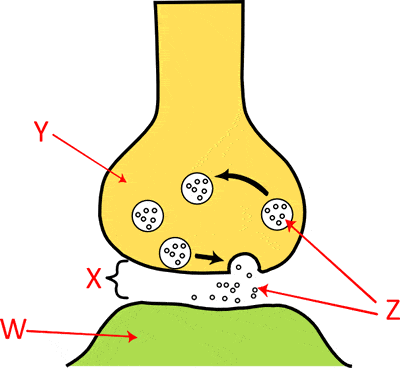
What is the name of structure Z and Y.
Neurotransmitters:Dendrite
Neurotransmitters: Axon terminal
Synapse: Axon terminal
Synapse: Neurotransmitters

W is the
Axon Terminal Button of presynaptic neuron
Neurotransmitters
Dendrite of postsynaptic neuron
Synapse on post synaptic neruon

neurotransmitter
Which glial cells support and anchor neurons in the PNS?
Satellite cells

The ______________ is the largest part of the brain
cerebrum
cerebellum
thalamus
hypothalamus

This part of the brain coordinates movement and balance.
Cerebrum
Cerebellum
Brain stem
Spinal Cord
The function of the thalamus is ______.
a balance center
a thermostat
a relay station to other brain parts
to regulate sleep
This structure allows the left and right hemisphere of the brain to communicate.
thalamus
cerebral cortex
hypothalamus
corpus callosum
The part of the brain that is most associated with sleep.
thalamus
medulla oblongata
reticular formation
pons


Which part of the brain controls feelings, personality, and complex thought?
Cerebellum
Frontal Lobe
Brain Stem
Parietal Lobe
Which part of the brain connects to the spinal cord?
Brain Stem
Cerebrum
Cerebellum
Occipital Lobe
If you were having trouble balancing, what part of your brain might be affected?
Occipital Lobe
Brain Stem
Cerebellum
Frontal Lobe
You actually do 'have eyes in the back of your head' because this region of the brain responsible for visual processing is right above the cerebellum!
temporal lobe
parietal lobe
occipital lobe
frontal lobe
This part of the brain makes us unique and is our control information processing center?
Cerebellum
Corpus Collosum
Cerebrum
Hypothalamus
What is the function of the PARIETAL LOBE?
Processes memory
Processes sense of touch and pain
Processes your hearing
Processes your vision
What is the function of the TEMPORAL LOBE?
Processes movement
Contains memory and planning
Processes your hearing and smell
Processes visual information
What are the three parts of the Brainstem?
Medulla Oblongata, Frontal Lobe, Spinal cord
Medulla Oblongata, Cerebellum, Cerebrum
Medulla Oblongata, Pons, Midbrain
medulla oblongata, spinal cord, thalamus



