
Font size
 Worksheets
Biology 101 Exam 3 Review (Spring 2024)
Total questions: 108
Worksheet time: 1hrs 28mins
What is the first step of DNA transcription?
Translation of mRNA
DNA replication
Initiation, where RNA polymerase binds to DNA
Termination of the mRNA strand
During translation, what is the role of mRNA?
To replicate DNA
To carry genetic information from DNA to the ribosome
To synthesize proteins directly
To bind amino acids together
Which of the following is NOT a component of the genetic code?
Codons
Anticodons
Introns
Start and stop signals
What is the primary function of ribosomes in protein synthesis?
To replicate DNA
To modify mRNA
To catalyze the formation of peptide bonds between amino acids
To transport proteins to the Golgi apparatus
Which molecule initiates the translation process by binding to the mRNA's start codon?
tRNA
rRNA
mRNA
DNA
What is the significance of the start codon AUG in the process of translation?
It signals the ribosome to stop translation.
It codes for the amino acid methionine and signals the start of protein synthesis.
It indicates the site of DNA replication.
It is the only codon that does not code for any amino acid.
In the context of ribosome structure, what are the two subunits called?
Alpha and beta
Large and small
Heavy and light
A and B
During the elongation step of translation, what happens to the polypeptide chain?
It is broken down into amino acids.
It is transported out of the nucleus.
It is synthesized as tRNAs bring amino acids to the ribosome.
It is folded into its secondary structure.
Which enzyme is responsible for unwinding the DNA double helix during transcription?
DNA polymerase
Helicase
RNA polymerase
Ligase
What is the role of the promoter region in transcription?
It signals the end of the gene.
It is the site where RNA polymerase binds to initiate transcription.
It codes for the start codon.
It adds a poly-A tail to the mRNA.
How many nucleotides make up a codon?
1
2
3
4
What is the process by which mRNA is decoded into a protein called?
Replication
Transcription
Translation
Modification
Which of the following best describes the function of transfer RNA (tRNA) in protein synthesis?
It replicates the DNA sequence.
It carries amino acids to the ribosome.
It synthesizes new strands of DNA.
It transports proteins to different parts of the cell.
What happens during the termination phase of transcription?
RNA polymerase binds to the promoter.
The ribosome assembles on the mRNA.
RNA polymerase detaches from the DNA when it reaches a stop signal.
Amino acids are linked together to form a polypeptide chain.
In the genetic code, how many codons act as stop signals for translation?
1
2
3
4
Where does DNA replication occur?
(a)
DNA replication occurs during (a) .
Polymerase
builds the complimentary DNA strand
Ligase
bonds DNA fragments together
Primase
Indicates whee DNA replication begins
Helicase
"unzips" the DNA
DNA is unzipped
Primase marks region to begin replication
Polymerase builds complimentary DNA strand
Ligase bonds DNA fragments
After replication, each strand has (a) new strand(s) and (b) old strand(s).
ATG TGA CAG
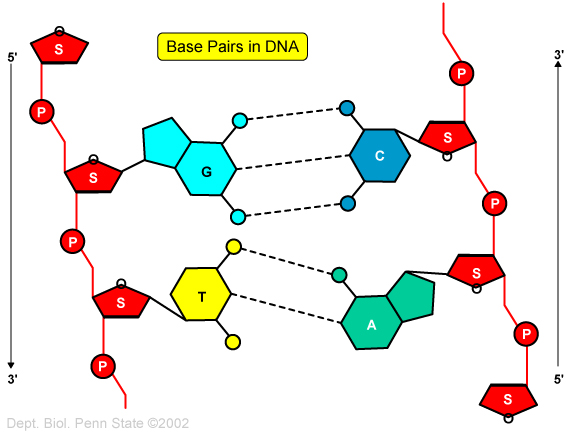
What is the complementary base pairing for the following sequence?
A T A T C G C G
(a)
Pair the following using the Base Pairing Rule
Adenine
Thymine
Cytosine
Guanine
Thymine
Adenine
Guanine
Cytosine
Purines consist of
A, G
C, U, T
G, A, U
T, C
Pyrimidines consist of
C, U, T
A, G
A, G, U
G, C
Double ring structure
purines
pyrimidines
single ring structure
purines
pyrimidines
DNA is a
double stranded helix
single stranded helix
parallel
made of amino acids
DNA is
single stranded helix
antiparallel
parallel
made of amino acids


The picture below shows the steps of DNA replication beginning with step one and ending with step three.
Because you are reusing the old, or parent, DNA strand DNA replication is said to be
Semi- Conservative
Semi-discontinuous
Continuous
Fully-Conserveative

Which letter in the picture below depicts the leading strand in DNA replication?
A
C
B
None of the above
Which letter in the picture below depicts the lagging strand in DNA replication?
Letter A since it is copied from 5' to 3'
Letter A since it is copied from 3' to 5'
Letter B since it is copied from 3' to 5
Letter B since it is copied from 5' to 3'
Which letter in the given picture depicts the okazaki fragments?
A - lagging strand
C - leading strand
B - lagging strand
C - replication fork
Which of the following is the SUGAR in DNA? (remember what the D stands for...)


Which of the following is the phosphate group found in nucleotides?
Which of the following is an example of a nitrogen base?


(a) is the process of creating a small messenger (b) that can leave the (c) and reach the ribosome to make (d) .
Uracil
Thymine
one backbone
double-backbone
ribose
deoxyribose
inside nucleus
inside / outside nucleus
What enzyme does transcription use?
DNA polymerase
ligase
RNA polymerase
helicase
Which amino acid will be added to a protein chain if the codon is UAA?
Ser
Lys
Ala
STOP
Where does Translation occur?
Nucleus
Ribosome
ER
Chloroplast
What is an anticodon?
rRNA
an amino acid
Three nucleotide sequence found on mRNA
Three nucleotide sequence found on tRNA

Using the 'codon table' in the image. What amino acid would the mRNA codon shown below translate to?
CAG
Gln
Val
Met
Glu
None of these is correct
Using the 'codon table' in the image. What amino acid would the mRNA codon shown below translate to?
UCA
Ser
Try
Stop
Ala
None of these is correct
Using the 'codon table' in the image. What amino acid would the mRNA codon shown below translate to?
GAC
Asp
Leu
Glu
Ala
None of these is correct

Using the 'codon table' in the image. What amino acid would the mRNA codon shown below translate to?
CUU
Leu
Glu
Trp
Arg
None of these is correct
Using the 'codon table' in the image. What amino acid would the mRNA codon shown below translate to?
UAG
Ile
Glu
Trp
Stop
None of these is correct

The DNA Triplet shown below will code for which amino acid (provide the three letter abbreviation).
CAT
(a)
ATTGAGCC - Mutated
The example above is an example of a

A point mutation where one base replaces an original base. What would happen because of this mutation (circled)?
the same amino acid would be made
a different amino acid would be made
no amino acid would be made

A nucleotide base is inserted or deleted shifting the entire DNA sequence. Entire protein will be changed.
Substitution Mutation
Silent Mutation
Frameshift Mutation
Translocation

A substitution mutation that has no effect
on an amino acid's sequence would be best categorized as:
Insertion Mutation
Translocation
Silent Mutation
Deletion Mutation

The image shown depicts a point mutation. Which of the following categories best describes this mutation?
Missense
Nonsense
Silent
Neutral
Which of the following types of mutations will impact the FEWEST codons?
Substitution
Insertion
Deletion
Frameshift

Which phase is this in?
Interphase
Metaphase
Anaphase
Telephase

Which phase is this in?
Prophase
Metaphase
Anaphase
Telephase

Which phase is this in?
Prophase
Metaphase
Anaphase
Telephase
Prophase
Metaphase
Anaphase
Telephase
cytokenises
What phase is anaphase?


Nuclear membrane breaks down, spindle fibers form describes:
Prophase
Anaphase
Metaphase
Telophase


In which phase of Mitosis do the Chromosomes pull Apart
Metaphase
Prophase
Anaphase
Telophase
Which of the following are CORRECT observations about MITOSIS and MEIOSIS? (Check all that apply.)
Mitosis produces cells that identical to the parent cell.
Meiosis produces cells that have half the number of chromosomes as the parent cell.
All cells go through INTERPHASE as part of the cell cycle, whether it goes to mitosis or meiosis next.
In both types of cell division, the chromosomes are only duplicated once.
Only in Mitosis, do you see chromosomes pair up to form a tetrad.
In Anaphase II, the _________ separate.
Homologues
Sister Chromatids
Tetrads
Centrioles
how many chromosomes do human gametes have?
46
23
18
36

Crossing over usually occurs between:
Sister Chromatids
Homologous Chromosomes
Alleles
Non-Homologous Chromosomes
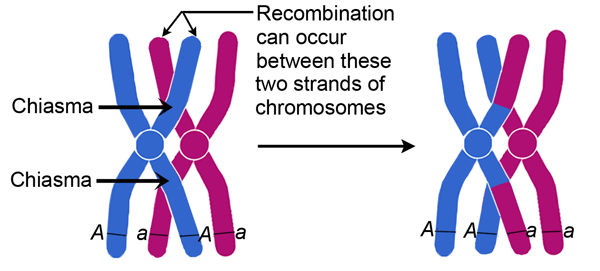

Name the phase:
Telophase I
Metaphase I
Anaphase II
Metaphase II
Which part of MEIOSIS is more similar to MITOSIS?
Meiosis I
Meiosis II

Name this phase of Meiosis
Anaphase II
Anaphase I
Metaphase I
Metaphase II

In which stage of MEIOSIS does crossing over occur? (The exchange of genetic material between chromosomes in a tetrad.)
Anaphase I
Metaphase I
Prophase I
Telophase I
In which cell(s) will meiosis occur? (Check all that apply)
muscle cell
gamete
sperm cell
skin cell
True or False: Meiosis results in identical cells.
True
False
True or False: Meiosis produces haploid gametes.
True
False
What is the purpose of mitosis?
growth and repair
reproduction
genetic diversity
to create unique cells
What is the purpose of meiosis?
growth
repair
reproduction
to create identical cells
A diploid pea plant cell contains 14 chromosomes. How many chromsomes would be in a haploid pea plant cell?
28
14
7
21

During which phase are sister chromatids lined up in a single file along the center of the cell?
Metaphase I
Metaphase II
Telophase I
Telophase II
Which of the following is an example of a somatic cell?
egg cells
stomach cells
sperm cells
gametes
How many chromosomes are in the somatic cells of humans?
46
23
42
26
When does "crossing over" of genes occur during meiosis?
Prophase I
Metaphase I
Anaphase I
Telophase I
The matching pair of chromosomes you inherit from your genetic parents are called
sister chromatids
autosomes
homologous chromosomes
sex chromosomes
Somatic cells are formed during what process?
meiosis
mitosis
DNA replication
interphase
How many chromosomes does a sex cell have compared to a body cell?
twice as many
the same amount
the same, but replicated
half as many
What is a gamete?
a body cell (ex. skin or heart cell)
an autosome
a sex cell (ex. sperm or egg)
a somatic cell
If an egg cell of an organism contains 12 chromosomes, how many chromosomes should be present in a heart cell of the same organism?
12
24
6
48

What process is being represented in this diagram?
sexual reproduction
mitosis
meiosis
DNA replication

What process is being represented in this diagram?
asexual reproduction
mitosis
meiosis
DNA replication
Use your codon chart to answer the following question:
AUG AGA ACG CCG
What is the amino acid sequence from the mRNA above?
methionine - arginine - proline - threoinine
methionine - alanine - threoinine - proline
methionine - arginine - threoinine - proline
methionine - proline- arginine - threoinine
What amino sequence would eventually be translated from the DNA sequence AAAGGCGTAATC
Phenylalanine-Proline-Histidine-Stop
Lysine-Glycine-Valine-Isoleucine
Phenylalanine-Histidine-Proline-Stop
Lysine-Isoleucine-Valine-Glycine
What anticodon sequence would used for the amino acid sequence Glutamic Acid-Tyrosine-Threonine
GAG-UAU-ACA
CUC-AUA-UGU
GAG-TAT-ACA
CTC-ATA-TGT

