wayground logo

Free Printable Worksheets

Font size

S
M
L
XL
Worksheets

Quiz #4 - Review Topics

Total questions: 112

Worksheet time: 2hrs 44mins

Name
Class
Date
1.

How does Newton's Third Law apply when designing a solution for the motion of two colliding objects?

a)

It states that objects in motion stay in motion unless acted upon by an external force.

b)

It suggests that for every action, there is an equal and opposite reaction.

c)

It defines the relationship between the mass of an object and its acceleration.

d)

It calculates the gravitational force between two objects.

2.

What is the purpose of developing a model for iterative testing and modification of a proposed object, tool, or process?

a)

To comply with industry standards.

b)

To achieve an optimal design through continuous improvement.

c)

To ensure the object can withstand extreme temperatures.

d)

To reduce the cost of production.

3.

Which factor is NOT typically considered when determining the strength of electrical and magnetic forces?

a)

The distance between the objects.

b)

The color of the objects involved.

c)

The magnetic field strength.

d)

The charge of the objects.

4.

How do genetic variations of traits in a population affect an individual's probability of surviving and reproducing in a specific environment?

a)

They ensure all individuals have an equal chance of survival.

b)

They increase some individual's probability by providing advantageous traits.

c)

They decrease the probability due to increased competition.

d)

They have no significant impact.

5.

What does the Earth-sun-moon system model explain?

a)

The formation of galaxies.

b)

The mechanism of global warming.

c)

The cyclic patterns of lunar phases, eclipses, and seasons.

d)

The process of photosynthesis.

6.

What is the primary cause of ocean tides on Earth?

a)

The Moon's gravitational pull on the Earth

b)

The Sun's gravitational pull on the Earth

c)

The Earth's rotation on its axis

d)

The Earth's orbit around the Sun

7.
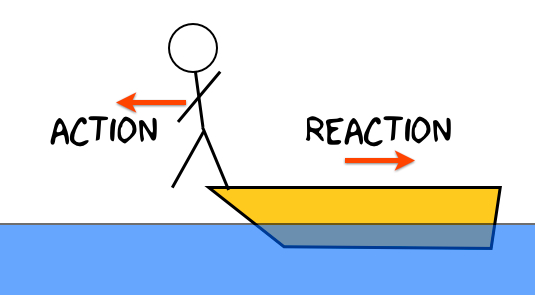
What law of motion does this picture represent?
a)
Newtons 1st law
b)
Newtons 4th law 
c)
Newtons 3rd law 
d)
Newtons 2nd law
8.

You push against a wall and the wall is pushing back on you.

a)

Newton's 1st Law

b)

Newton's 2nd Law

c)

Newton's 3rd Law

9.

A skater pushes another skater forward, but the one pushing moves backwards.

a)

Newton's 1st Law

b)

Newton's 2nd Law

c)

Newton's 3rd Law

10.
Newton's third law states that any action will have a(n) _______ and ______ reaction
a)
Equal and similar
b)
Equal and opposite
c)
Equal and different
d)
Greater and opposite
11.
Rockets are launched into space using jet propulsion where exhaust accelerates out from the rocket and the rocket accelerates in an opposite direction.
a)
Newton's 1st Law
b)
Newton's 2nd Law
c)
Newton's 3rd Law
d)
None of them
12.
An explanation a scientist makes that we can test to see if it is true or not is a _________.
a)
hypothesis
b)
theory
c)
law
d)
question
13.

We all have two alleles, or versions, of each gene. Being ​ (a)   for a particular gene means you inherited two identical versions. It's the opposite of a ​ (b)   genotype, where the alleles are different. People who have recessive traits, like blue eyes or red hair, are always homozygous for that gene.

Choose from the below words
homozygous
heterozygous
14.
A giraffe has a long neck in order to better reach leaves to eat.  This is an example of _____. 
a)
an adaptation
b)
environment
c)
response
d)
stimulus
15.

Variation

a)

a change or difference in condition, amount, or level, typically with certain limits.

b)

a different or distinct form or version of something.

c)

Color

d)

Physical things

16.

What can increase the force produced by the motor effect on a wire?

Select ALL the correct answers

a)

Increasing the current

b)

Increasing the magnetic field strength

c)

Increasing the temperature

17.

The strongest parts of the magnet are ...

a)

fronts

b)

backs

c)

poles

d)

middle

18.
A compass needle responds to a magnetic field, because the compass needle is a
a)
A. generator.
b)
B. motor.   
c)
C. magnet.
d)
D. transformer.
19.

When running a current through a wire, what do the blue lines represent?

a)

The wire spinning

b)

A magnetic field that was created

c)

Electrons leaving

d)

Electricity

20.
Are the magnetic field lines in the picture correct?
a)
Yes, because they point from north to south.
b)
No, because they point from north to south (they're supposed to go the other way).
c)
Yes, because the North pole is on the left in all pictures.
d)
No, because the North pole is on the left in all pictures (it's supposed to be on the right).
21.

Which one represents the magnetic field lines of magnets repelling?

a)

A

b)

B

22.

Which one represents the magnetic field lines of magnets attracting?

a)

A

b)

B

23.
What type of force causes these balloons to move toward or away from each other?
a)
Gravitational
b)
Applied
c)
Magnetic
d)
Electrical
24.

When the N and S end of two different magnets come together they...

a)

attract

b)

repel

25.

When the S and S of two different magnets come together they...

a)

attract

b)

repel

26.
Day & night are caused by the ______________ of earth on its axis
a)
revolution
b)
orbit
c)
rotation
d)
tilt of the axis
27.
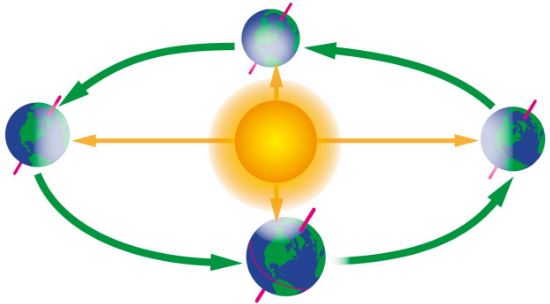
Which season is taking place in the Northern Hemisphere in Position 4?
a)
Winter
b)
Spring
c)
Summer
d)
Fall
28.
At position A, which hemisphere would have summer?
a)
Northern hemisphere
b)
Southern hemisphere
29.

In spring or fall, the axis of the Earth is pointed:

a)

towards

b)

Neither away or toward

c)

away

30.
Which season is taking place in the Southern Hemisphere in Position 1?
a)
Winter
b)
Spring
c)
Summer
d)
Fall
31.
Which type of eclipse occurs when the Moon comes directly between Earth and the Sun?
a)
Lunar eclipse
b)
Solar eclipse
32.
Which type of eclipse occurs when the Earth comes directly between the Sun and Moon?
a)
Lunar eclipse
b)
Solar eclipse
33.
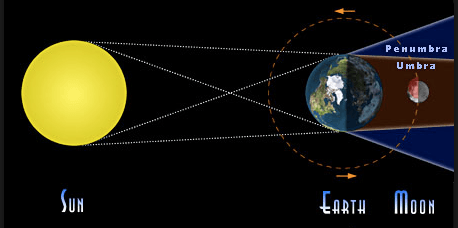
What does number 1 in the image to the left represent?
a)
Umbra
b)
Penumbra
34.
What does number 2 in the image to the left represent?
a)
Umbra
b)
Penumbra
35.
During what phase of the moon can a lunar eclipse occur?
a)
3rd Quarter
b)
1st Quarter
c)
New Moon
d)
Full Moon
36.
What type of tide occurs during the first or third quarter moon?
a)
Neap tides
b)
Spring tides
c)
Normal tides
37.
If the Sun, Earth, and Moon are in perfect alignment, the Earth would have a _______ tide.
a)
Spring
b)
Neap
c)
Normal
38.
If the Sun, Earth, and Moon create a 90 degree angle, the Earth would have __________.
a)
Spring tides
b)
Neap tides
c)
Normal tides
39.
Neap tides occur once a month. 
a)
True
b)
False. Neap tides occur twice a month
c)
False. Neap tides occur twice a day.
d)
False. Neap tides occur 4 tides a month
40.
Most places on Earth experience about how many high and low tides in 24 hours?
a)
3 high and 3 low tides
b)
4 high and 4 low tides
c)
1 high and 1 low tides
d)
2 high and 2 low tides
41.
The Moon has a greater influence on Earth's tides than the Sun because...
a)
the moon is smaller than the Sun
b)
the moon revolves around the earth
c)
the moon is closer to the earth
d)
the moon is farther from the earth
42.
What type of tide would this arrangement of earth-moon-sun create?
a)
full moon tide
b)
new moon tide
c)
neap tide
d)
spring tide
43.

What happens when there is a spring tide

a)

minimum tidal range

b)

maximum tidal range

c)

average tidal range

d)

no change in tidal range

44.
Why isn't there an eclipse every month?
a)

Because the moon orbits the sun differently than Earth does.

b)

Because the Earth's orbit and the moon's orbit are at the same angle, flat plane.

c)

Because the moon's orbit is offset 5 degrees from Earth's orbit.

d)

Because the lunar cycle is longer than a month.
45.
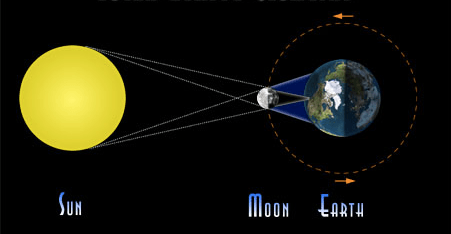
Which type of eclipse is shown in this picture?
a)
Solar Eclipse
b)
Orbit
c)
Lunar Eclipse
d)
Total Moon Eclipse
46.
Which type of eclipse is shown in the diagram?
a)
Solar Eclipse
b)
Lunar Eclipse
c)
Total Solar Eclipse
d)
Partial New Moon Eclipse
47.
You visited the beach at 12 pm (noon) and it is high tide. If you return 6 hours later what tide will you see? 
a)

high 

b)

low 

c)

no

d)

spring 

48.
What type of tides would this arrangement of earth-moon-sun create?
a)
neap tide
b)
spring tide
c)
new moon tide
d)
full moon tide
49.
The term equinox means....
a)
equal amount of day light and equal amount of night
b)
Equal amount of winter and summer
c)
The hottest day of the year.
d)
The longest day of the year
50.
Why is the Equator warmest?
a)
Because it is closest to the sun.
b)
Because it receives the most direct sunlight
c)
Because no clouds form here.
d)
Because it is far from the sun
51.
How long does it take earth to make one revolution around the sun?
a)
12 hours
b)
24 hours 
c)
365 1/4 days
d)
30 days
52.
What is the darkest inner part of the shadow cone called, where a total eclipse can be viewed.
a)
Total
b)
Umbra
c)
Penumbra
d)
Partial
53.
What is the larger outer lighter part of the shadow cone called, where a partial eclipse can be viewed?
a)
Partial
b)
Umbra
c)
Penumbra
d)
Total
54.
Which season is taking place in the Northern Hemisphere in Position 3?
a)
Winter
b)
Spring
c)
Summer
d)
Fall
55.

The spinning of the Earth on its axis is called...

a)

revolution

b)

rotation

56.

The moon appears lit because...

a)

it glows from inside.

b)

it is on fire.

c)

it reflects the sun's light.

d)

it is hot.

57.

An ​ (a)   line that goes through the ​ (b)   so that it can ​ (c)   is called the ​ (d)   .

Choose from the below words
imaginary
Earth
spin
axis
58.

The movement of the Earth around the sun is called...

a)

revolution

b)

rotation

59.

When the Earth makes one complete turn in 24 hours....

a)

revolution

b)

rotation

60.

When the Earth makes one complete circle around the Sun in 365 days...

a)

revolution

b)

rotation

61.

This causes day and night:

a)

revolution

b)

rotation

62.

This causes seasons to change:

a)

revolution

b)

rotation

63.

When the moon appears to change shape during each day of the month... it is called "moon phases".

a)

true

b)

false

64.

Match the following

a)

orbit

1.

"path"

b)

moon

2.

"satellite"

c)

sun

3.

"star"

d)

earth

4.

"planet"

e)

crater

5.

"dent"

65.

Match the following

a)

1.

rotation (1 day)

b)

2.

revolution (1 year)

c)

3.

axis (imaginary line)

66.

Organize these options into the right categories

Categorize the following

Sun

Earth

Moon

star
planet
natural satellite
67.

Reorder the following moon phases INCREASING in size...

a)

new moon (0%)

b)

waxing crescent (25%)

c)

first quarter (50%)

d)

waxing crescent (75%)

e)

full moon (100%)

1)
2)
3)
4)
5)
68.

Reorder the following moon phases DECREASING in size...

a)

full moon (100%)

b)

waxing crescent (75%)

c)

last quarter (50%)

d)

waxing crescent (25%)

e)

new moon (0%)

1)
2)
3)
4)
5)
69.

Match the following

a)

1.

science tool that gives directions

b)

2.

tool that measures the time of day

c)

3.

Earth faces the Sun

d)

4.

Earth faces away from the Sun

70.

Match the following

a)

1.

pathway that an object travels

b)

2.

bowl-shaped dent caused by a collision

c)

3.

natural satellite that orbits a planet

d)

4.

medium-sized star

e)

5.

3rd planet from the Sun

71.

A ​ (a)   that pulls objects to the ​ (b)   of the Earth is called ​ (c)   .

Choose from the below words
force
center
gravity
72.

Law of Inertia is

a)

Newton's 1st law

b)

Newton's 2nd law

c)

Newton's 3rd law

d)

Law of conservation of momentum

73.

"Forces come in pairs" represents

a)

Newton's 1st law

b)

Newton's 2nd law

c)

Newton's 3rd law

d)

Law of conservation of momentum

74.

"For every action, there is an equal and opposite reaction" represents

a)

Newton's 1st law

b)

Newton's 2nd law

c)

Newton's 3rd law

d)

Law of conservation of momentum

75.

F=ma represents

a)

Newton's 1st law

b)

Newton's 2nd law

c)

Newton's 3rd law

d)

Law of conservation of momentum

76.

A net force of 15 N is exerted on an encyclopedia to cause it to accelerate at a rate of 5 m/s^2. Determine the mass of the encyclopedia.

a)

m = 30 Hg

b)

m = 30 kg

c)

m = 3.0 ml

d)

m = 30.0 g

77.

Determine the accelerations that result when a 12-N net force is applied to a 3-kg object.

a)

3 ft/s

b)

4 ft/s

c)

26 m/s

d)

4 m/s

78.

A unbalanced force means that an object is

a)

zero net force

b)

changing its motion

c)

sitting still

d)

object at rest

79.
What is the tendency of an object to resist a change in motion?
a)
coffee
b)
motion
c)
inertia
d)
gravity
80.

Which car is accelerating?

a)

A car that is not moving

b)

A car that rounds a curve at a constant speed

c)

A car traveling at a constant speed

d)

A car that has a set speed of 60mph

81.
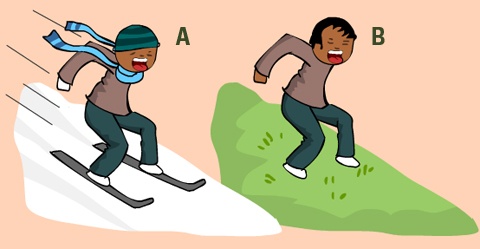
Why is it harder for the boy in Image B to get down the hill?
a)
Motion
b)
Friction
c)
Work
d)
Displacement
82.
What is motion?
a)
It's like the ocean
b)
Any change in an animal or person's position.
c)
Motion is like acting
d)
Any change in an object or person's position.
83.
Swimming fish experience-
a)
Rolling Friction
b)
Sliding Friction
c)
Fluid Friction
d)
Static Friction
84.
Friction is a force that acts in an ___________ direction of movement.
a)
similar
b)
opposite
c)
parallel
d)
west
85.
A type of friction that occurs when air pushes against a moving object causing it to negatively accelerate
a)
surface area
b)
air resistance
c)
descent velocity
d)
gravity 
86.
The amount of friction depends on the weight of the objects pressing together.
a)
True
b)
False
87.
What are 2 factors that determine the amount of friction between 2 objects?
a)
Force and roughness between surfaces
b)
hills and valleys and how smooth or rough the surface is
c)
Amount of force and amount of surface the comes in contact
d)
The force and the weight exerted on the surfaces
88.
How does friction affect speed?
a)
more friction decreases speed
b)
more friction increases speed
c)
less friction decreases speed
d)
less friction doesn't affect speed
89.

A 10 kg, 15 kg, and 20 kg rock are rolling down a hill. Which rock will require the most force to stop?

a)

10 kg rock

b)

15 kg rock

c)

20 kg rock

d)

All 3 rocks will require the same force

90.
Objects with greater _________ also have greater inertia.
a)
speed
b)
mass
c)
temperature
d)
friction
91.
What is the unit of measurement for force?
a)
AMP
b)
Seconds
c)
Newtons
d)
Miles
92.
The carrier of genetic information
a)
DNA
b)
RNA
c)
phenotype
d)
nucleus
93.
A characteristic that an organism can pass on to its offspring
a)
heredity
b)
punnett square
c)
trait
d)
phenotype
94.
the study of heredity
a)
hair studies
b)
genetics
c)
heredetics
d)
biology
95.
Survival of the Fittest and Evolution were proposed by what scientist?
a)
Charles Darwin
b)
Albert Einstein
c)
Steven Hawking
d)
Isaac Newton
96.
Where the better adapted organisms survive to pass traits along to offspring.
a)
Evolution
b)
Natural Selection
c)
Extinction
d)
Artifical Selection
97.
Why are advantageous traits more likely to be passed onto offspring?
a)
Because they are more likely to survive and reproduce.
b)
Because they come from dominant alleles.
c)
Because they come from recessive alleles.
d)
Because the trait is an acquired phenotype.
98.

What word describes a trait that helps an organism survive in its environment?

a)

natural selection

b)

mutation

c)

camouflage

d)

adaptation

99.
Which organisms are most likely to survive?
a)
the best adapted
b)
the fastest
c)
the strongest
d)
the most domesticated (tamed)
100.
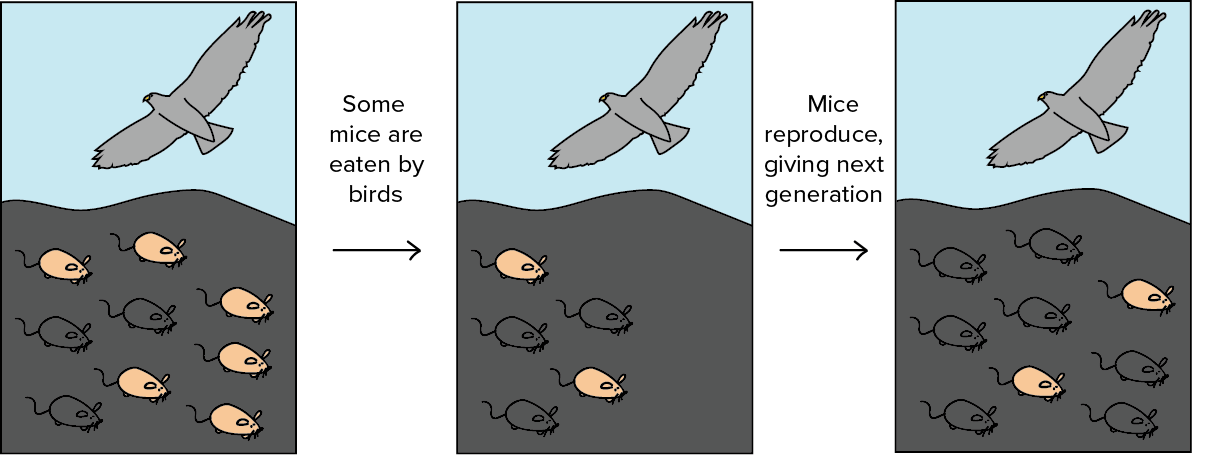
Why is the mouse population changing over time?
a)
The light mice can reproduce more successfully than the dark mice
b)
The hawks eat more dark mice than light mice because the dark mice taste better
c)
The hawks eat more light mice than dark mice because they can see the light mice more easily
d)
The hawks eat more dark mice than light mice because they can see the dark mice more easily
101.
What is the advantage of having different shaped beaks?
a)
To look different from other species.
b)
To be able to eat the food readily available in the environment.
c)
To protect itself against predators.
d)
To protect itself against prey.
102.
In recent years "SuperBugs" (bacteria that aren't effected by antibiotics) are becoming more and more common. How could natural selection explain this?
a)
Superbugs survive antibiotics and reproduce
b)
Antibiotics cause bacteria to become superbugs
c)
We have always had the same amount of superbugs; modern media just discusses them more.
d)
There is no reliable data on the origin of super bugs.
103.
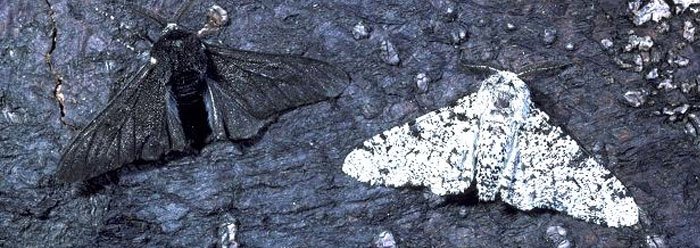
Since the 1800s humans have stopped burning coal, and the trees have returned to their original color. Which moth will be more successful in this environment?
a)
Dark moth
b)
Light moth
c)
Both will be equally successful
d)
Neither will be successful
104.
The trees these moths used to live on were white, but have been covered in soot from coal factories. Which moth will be more successful in this environment?
a)
Dark moth
b)
Light moth
c)
Both will be equally successful
d)
Neither will be successful
105.

Hollow, light weight bones is an adaptation that...

a)

is an internal structure that helps birds fly

b)

is an external structure that helps birds fly

c)

disables birds ability to fly

d)

helps birds walk

106.

The squirrel in the picture is using an adaptation called

a)

camouflage

b)

hibernation

c)

migration

d)

retention

107.
Over time, the climate of an island became drier, which resulted in changes to the populations of various island finch species. Finch populations with a certain beak shape thrived, while those not having that beak shape decreased. Which of the following describes a necessary condition for these changes in the finch populations to occur?
a)
fewer mutations
b)
limited food resources
c)
limited beak variations
d)
overproduction of offspring
108.
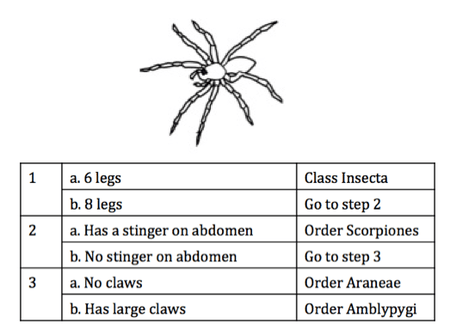
An illustration and a dichotomous key are given. What is the correct classification for this organism?
a)
Class Insecta
b)
Order Amblygygi
c)
Order Araneae
d)
Order Scorpiones
109.
A dichotomous key for trees is provided. Hikers found a tree that has large brown cones and single sharp needles. What species of tree have the hikers found?
a)
Juniper
b)
Pine
c)
Spruce
d)
Fir
110.
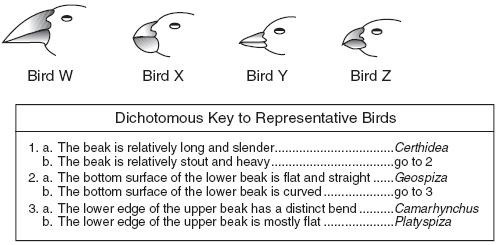
What is the name of bird W?
a)
Certhidea
b)
Geospiza
c)
Camarhynchus
d)
Platyspiza
111.
A student discovers an arachnid with a segmented abdomen, long legs, and a tail with no stinger. The student uses the dichotomous key below to identify it. Which arachnid has the student found?
a)
Whip Scorpion
b)
Wind Scorpion
c)
Daddy long legs
d)
Scorpion
112.
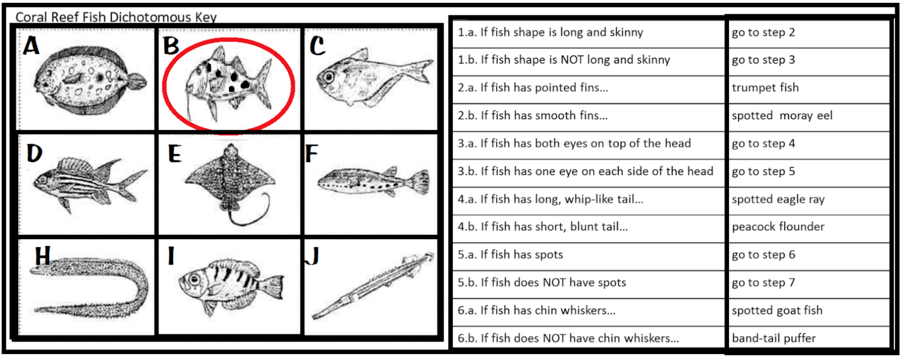
Using this dichotomous key, identity the name of the circled fish.
a)
band-tail puffer
b)
spotted goat fish
c)
peacock flounder
d)
trumpet fish