
 Worksheets
Q3 Ultimate 8th Grade Review Part 2_2025
Total questions: 109
Worksheet time: 3hrs 25mins
Which configuration will result in the greatest gravitational force?
Objects with low masses, far apart
Objects with large masses, far apart
Objects with low masses, close together
Objects with large masses, close together
Which of the following best describes the geocentric model of the Sun and planets?
the belief that Sun and planets revolve around Earth
the belief that planets revolve around the Sun
the belief that planets and the moon revolve around Earth
the belief that Moon and planets revolve around the Sun
Which of the models of the solar system (Geocentric or Heliocentric) is most similar to what we know today and why?
Geocentric, because only the Moon is shown orbiting the Earth
Heliocentric, because it includes all nine planets and 2 stars
Geocentric, because it includes all eight planets orbiting the Earth
Heliocentric, because the planets are orbiting the Sun
What is the biggest difference between the geocentric and heliocentric models of the solar system?
The shape of the planets’ orbits
The center of the solar system
The movement of the Moon
If you created a venn diagram comparing the geocentric and heliocentric models of the solar system, which of the following statements would go in the center section?
Both show the planets orbiting the Sun
Both show the Sun and planets orbiting the Earth
Both are models of the solar system
Both are well-received ideas in ancient times
Which approach is primarily used by geologists to explain the formation of Earth’s layers?
Observing the stars
Performing chemical reactions
Studying rock samples
Conducting animal behavior studies
In biology, what method is typically used to understand the relationship between two species in an ecosystem?
Conducting field observations
Calculating chemical equations
Studying distant galaxies
Testing physical properties of minerals
In the field of chemistry, how do scientists generally develop explanations for chemical reactions?
By conducting controlled experiments
By analyzing literature
By collecting historical data
By observing wildlife
Scientists use different types of investigations to develop scientific explanations. In which scenario did a scientist conduct an experiment with a control?
A scientist determined the relative age of a fossil based on its position in a rock layer.
A scientist concluded that a new fertilizer doubled the growth of corn plants in a study.
A scientist identified and classified a new species of fish in the Amazon River in South America.
A scientist discovered a new galaxy in space after analyzing images from the Hubble Space telescope.
There are many different types of scientific investigations. In one type of investigation, all variables are kept the same except for one. What is this type of scientific investigation called?
model
field study
controlled experiment
systematic observation
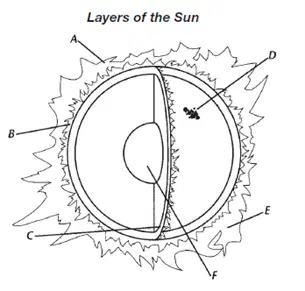
Which of the following points is identifying the Sun’s corona?
A
B
C
D

Using the diagram, which of the following is pointing to a solar flare?
C
D
E
F

Using the diagram, which of the following is pointing to a sunspot?
B
C
D
E
Which of the following statements best describes a solar flare?
collapsed areas on the sun’s surface
massive gas eruptions on the sun
fires caused by the sun’s rays
areas of cool gas on the sun’s surface
Which of the sun’s layers is the hottest?
the corona
the photosphere
the core
the convection zone
The solar system consists of the Sun, several kinds of smaller objects such as comets and asteroids, and
eight planets and their moons.
the star Proxima Centauri.
six planets and their moons.
more than 100 planets.
What do all of the inner planets have in common?
They have the same period of revolution.
They have the same period of rotation.
They have the same diameter.
They are relatively small and have rocky surfaces.
Small rocky bodies that have entered Earth’s atmosphere, producing a streak of light are called
meteoroids
meteors
meteorites
comets
Why do temperatures on Mercury’s surface vary more than temperatures on Earth’s surface?
Mercury has a lower density than Earth.
Mercury has patches of ice.
Mercury’s surface has many craters.
Mercury has an extremely thin atmosphere.
The four large outer planets share which of the following characteristics?
small and dense
sets of rings
no atmospheres
rocky surfaces
What method do physicists often use to validate their theories about forces and motion?
Analyzing weather patterns
Observing plant growth
Studying fossils
Creating models and conducting experiments
In environmental science, which method is most commonly used to assess the health of an ecosystem?
Monitoring species populations
Calculating pH of the soil
Measuring temperature changes in metals
Studying ancient artifacts
How is science using technology to help us make new discoveries? Choose all that are correct.
Technology is getting better, more accessible, cheaper and easier to use.
Technology like drones has allowed us to watch animal populations without disturbing their natural behaviors.
Scientists are learning to use technology in new ways.
Technology like drones allow us to investigate areas we couldn't before as it was too dangerous.
Why might a scientist choose to do fieldwork instead of a laboratory experiment?
She needs a large amount of control.
He needs to change one or more variables at a time.
She needs test conditions that replicate those found in nature.
He needs to make exact measurements using large equipment.
Anton is a geologist. He wants to get the best possible information about lava flows from eruptions that are happening at some specific locations around the world. He wants to be able to vary what he studies based on his initial findings. Which type of investigation should Anton conduct?
a survey
fieldwork
library research
a laboratory investigation
The Andromeda Galaxy is the nearest spiral galaxy to the Milky Way Galaxy. Which unit would best be used to represent the distance between the Milky Way Galaxy and the Andromeda Galaxy?
astronomical unit
kilometer
light year
mile
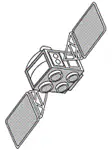
Satellites such as the one shown are a very important technological advancement. Which of the following is NOT an example of the use of satellites in science?
studying Earth’s features
collecting weather information
wireless communication
collecting samples on other planets
Sarah and her father used their telescope to look at Venus and various stars. The stars looked like tiny points of light while Venus looked much larger. Which of the following best explains why?
There are more stars than planets in our solar system.
Stars are much smaller than planets.
Venus is much closer to Earth than are the stars.
Stars reflect less light than planets.
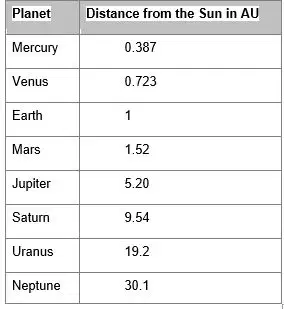
The chart below shows the average distance in astronomical units (AU) between each planet and the Sun. Which planet would make the closest approach to Earth as the planet orbits the Sun?
Mars
Mercury
Jupiter
Venus
Rachel is learning about electromagnetic radiation that comes from the Sun. What types of electromagnetic radiation does the Sun emit?
gamma rays and ultraviolet radiation
ultraviolet radiation only
infrared, visible, and ultraviolet radiation
all types of electromagnetic radiation
As part of his job at the U.S. Forestry Service, Scott uses satellite images to identify forest areas that have been cleared due to logging. The satellite images, which show forests appearing cooler and cleared areas appearing warmer, are produced using electromagnetic radiation. Which part of the electromagnetic spectrum does Scott’s technology most likely use?
infrared radiation
gamma rays
radio waves
visible light
Carla is learning about types of electromagnetic waves. What is the difference between a microwave and a gamma wave?
Microwaves are common and gamma waves are rare.
Microwaves are silent and gamma rays are audible (you can hear them).
Microwaves were invented by humans and gamma waves were not.
Microwaves and gamma waves have different wavelengths.
Wavelength and frequency are related. Gamma rays, microwaves, visible light, and infrared rays all have different frequencies. Which of the following lists them in the correct order from longest wavelength to shortest wavelength?
visible light, microwaves, infrared rays, gamma rays
infrared rays, microwaves, visible light, gamma rays
gamma rays, infrared rays, microwaves, visible light
microwaves, infrared, visible light, gamma rays
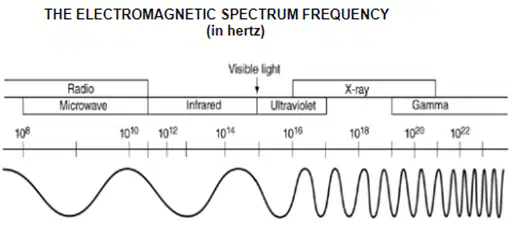
Sam looks at the chart below of the electromagnetic spectrum. Sam describes what he notices as he looks from left to right at the diagram. Which of Sam’s descriptions is TRUE?
The wavelength increases and the frequency increases.
The wavelength decreases and the frequency increases.
The wavelength decreases and the frequency decreases.
The wavelength increases and the frequency decreases.
The side of the Moon facing away from Earth is called the dark side of the moon. Which of the following would be most useful for studying features of the dark side of the Moon?
a telescope on Earth’s surface
a telescope orbiting Earth
a satellite orbiting the Moon
a satellite orbiting Earth
Which statement best describes a scientific hypothesis?
a testable scientific explanation based on observations
a scientific fact
a scientific theory
an inference based on scientific data
Cicadas are insects that spend most of their lives developing underground, then emerge after a period of time. As part of their life cycle, cicadas molt and leave behind a shell, or exoskeleton, on tree trunks and shrubs. How could a student use empirical evidence to determine the population of cicadas in an area?
The student could watch a video of insects in the wild.
The student could take a poll to find how many people have heard about cicadas.
The student could count the number of cicada shells left behind over a period of time.
The student could predict how many cicada shells would be collected in a particular forest

The picture shows a type of technology used in space exploration. This type of technology is most useful for investigating which of the following?
solar radiation on Earth’s surface
weather patterns on a planet
satellite motion around an object
collecting rock and soil samples
The universe contains billions of galaxies. Which one of these is TRUE of galaxies?
they contain few stars
they have uniform structures
they are made of mainly rocky objects
they come in different shapes and sizes
The universe is made of many different bodies. Which of the following is ordered from largest to smallest?
galaxy, solar system, universe, star
universe, galaxy, solar system, star
star, solar system, universe, galaxy
solar system, galaxy, star, universe
A galaxy includes billions of different objects. Which of the following objects in our galaxy is the largest?
asteroid
meteor
planet
star
Jamal made a model of the universe using common objects to represent the universe, the Milky Way, the solar system, and the Sun. He used his classroom, an extra-large pizza, a tennis ball, and a grape to represent objects in his model. Which object represented the universe?
the pizza
the tennis ball
the grape
the classroom
Marlee uses a telescope to observe a red star. What does its color tell her most directly about the star?
the star’s age
the star’s temperature
the star’s distance from Earth
the star’s location relative to other stars
Liam notices a star in the sky that is brighter than any other star he sees. What is Liam noticing about the star?
its composition
its temperature
its apparent brightness
its absolute brightness
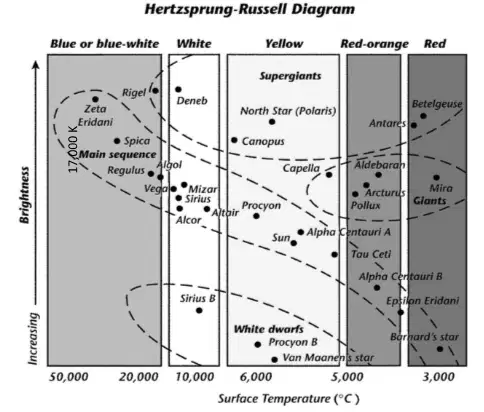
Using the diagram, which of the following is the best comparison between our Sun and Polaris?
Our Sun is brighter and hotter than Polaris.
Our Sun is brighter and cooler than Polaris.
Polaris is brighter and hotter than our Sun.
Polaris is brighter and cooler than our Sun.
Gloria wants to determine how bright a star actually is rather than how bright it appears to be when viewed from Earth with a telescope. Which of the following information will help her determine the absolute brightness of the star?
color of the star
composition of the star
temperature of the star
distance of the star from Earth
The Andromeda Galaxy is 2.5 million light years away and over 200,000 light years across. It appears as a fuzzy patch of light in the night sky, but telescopes show it to be disc-shaped. Which most accurately describes the number of stars in the Andromeda Galaxy?
The Andromeda Galaxy is made up of hundreds of stars that give it a disc shape.
The Andromeda Galaxy is made up of thousands of stars that make it so large in size.
The Andromeda Galaxy is made up of millions of stars that are not visible because of its distance.
The Andromeda Galaxy is made up of billions of stars that produce enough light to be seen from far away.
The universe is composed of many astronomical objects including planets, stars, star systems, galaxies and galaxy clusters. Which of the following statements BEST describes the relationship between stars and galaxies?
Galaxies are composed of stars, star clusters and solar systems.
Stars are composed of galaxies, galaxy clusters and solar systems.
Over time, stars gain energy and size to become galaxies.
Over time, galaxies will cool down and shrink to become stars.
The shape of our Milky Way Galaxy is:
Elliptical
Spiral
Irregular
Spherical
Two stars are the same size and the same temperature, but one of the stars appears brighter in the night sky. What must be TRUE of the brighter star?
it’s blue in color
it’s closer to Earth
it’s younger
it’s older
Which statement is TRUE about our universe?
Objects in our universe only give off light and heat energy.
The universe contains only a few galaxies such as our own called the Milky way galaxy.
All objects in our universe revolve around our Sun.
The universe contains many billions of galaxies and that each galaxy contains billions of stars.
The Sun is much larger than the Moon, but when viewed from Earth, they both appear to be the same size. Which of the following statements is the best reason why they appear the same when viewed from Earth?
Even though the Sun is much larger than the Moon, they seem to be the same size due to the distance between Earth and each object.
The Sun and the Moon appear the same size because they are the same size.
The Sun and the Moon appear to be the same size from Earth because the Sun is much bigger and farther away from Earth than the Moon.
The Sun and the Moon appear the same size because of an optical illusion, not because of their distance from Earth.
What type of galaxy has no special shape or form?
a spiral galaxy
an irregular galaxy
an elliptical galaxy
What type of galaxy is egg-shaped?
a spiral galaxy
an irregular galaxy
an elliptical galaxy
How are galaxies alike?
They are all the same temperature
They all have billions of stars, gas, and dust
They have the same amount of stars
They are all the same shape

What type of galaxy is depicted in this image?
spiral
irregular
elliptical
Which of the following answers ranks the objects in the correct order from smallest to largest?
Galaxy, solar system, universe
Universe, solar system, galaxy
Solar system, universe, galaxy
Solar system, galaxy, universe
The color of a star depends on its:
shape
brightness
size
temperature
A supernova is the explosion of a dying:
low-mass star
protostar
medium-mass star
high-mass star
About 90 percent of the stars in the universe, including the Sun, are main sequence stars. What do all main sequence stars have in common?
They are all either smaller than white dwarfs or larger than giant stars.
All main sequence stars are yellow like our Sun.
They are undergoing fusion of hydrogen into helium within their cores.
All main sequence stars are brighter than our Sun.
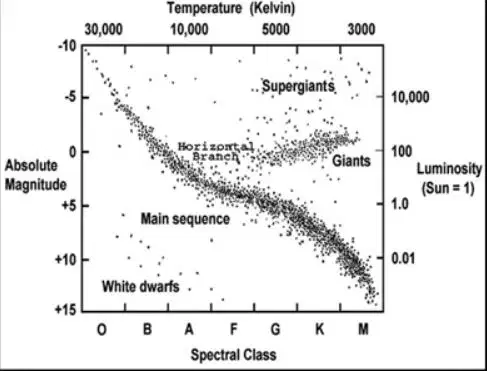
On an HR diagram, stars at the same temperature are found...
aligned vertically (one above the other)
spread through the diagram
aligned horizontally (next to each other)
along the main sequence
A large group of billions of stars, gas, and dust is called:
a cluster
a universe
a galaxy
a solar system
A star is born in a cloud of gas and dust called a ______.
black hole
asteroid
nebula
What color are the hottest stars?
Red
Orange
Yellow
Blue
The H-R diagram is a graph that shows the relationship between________and_______ for stars.
brightness & color
distance & brightness
temperature & color
temperature & brightness
What color are the coolest stars?
Yellow
Red
White
Blue
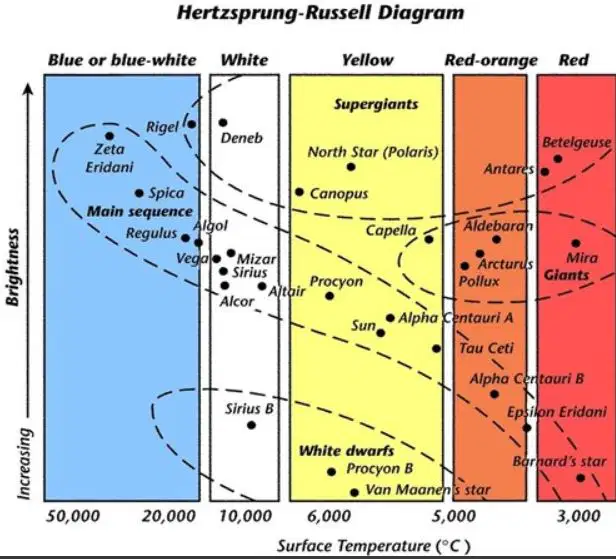
In the HR diagram, what happens as you move from the right side of the diagram to the left?
Stars get larger
Stars get colder
Stars get hotter
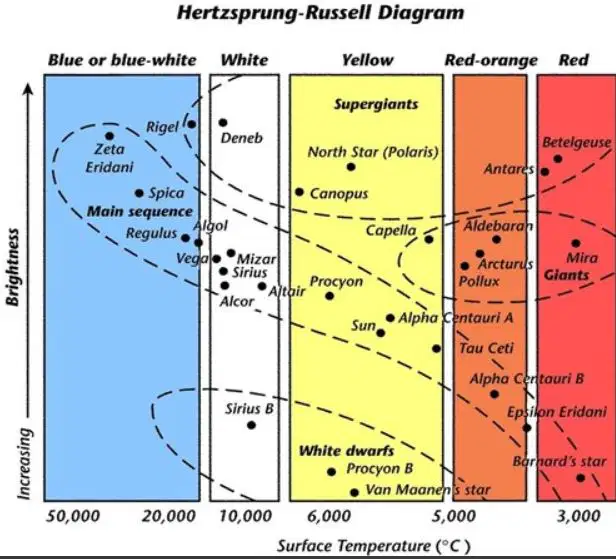
In the HR diagram, what happens as you move from the bottom to the top of the diagram?
Stars get larger
Stars get colder
Stars get hotter
Stars get brighter
Why is technology essential for collecting data during space missions?
Technology makes space travel unnecessary.
Technology allows for remote sampling and accurate data collection.
Technology is only useful for communication.
Space missions do not require any data collection.
Which technology is commonly used to communicate information from space back to Earth?
Balloons
Satellites
Underwater drones
Walkie-talkies
How does technology enhance the capability to measure environmental conditions on distant planets?
By relying on human observation from Earth.
By using only robotic arms to collect samples.
By using sensors and instruments designed for remote analysis.
By simplifying the measurements to basic tools.
How does technology facilitate sample collection in challenging environments, like outer space?
By relying solely on satellite imagery.
By using remotely operated, robotic explorers.
By sending humans down without equipment.
By using basic nets and manual tools.
What is one advantage of using technology for communication in space missions?
It eliminates the need for data collection.
It allows instant transmission of data from space back to Earth.
It only works when astronauts are on the Moon.
It makes all communication voice-only.
In the electromagnetic spectrum, which of the following is true of waves with long wavelengths?
They have high frequencies
They have moderate frequencies
They have low frequencies
They have inconsistent frequencies
Electromagnetic radiation from the sun comes in all forms. Scientists have found ways to use the electromagnetic waves to study different characteristics of objects in space. Which of the following correctly pairs an electromagnetic wave with a way that it is used in space exploration?
Radio waves are used to evaluate the sound qualities of planets throughout our Solar System.
Visible light waves are used to evaluate the mountain height of planets throughout our Solar System.
Infrared waves are used to evaluate the temperature of planets throughout our Solar System.
Gamma rays are used to evaluate the thickness of atmospheres of planets throughout our Solar System.
The electromagnetic spectrum is made up of bands of waves with different _______________.
frequencies
amplitudes
wavelengths
intensities

Which wave has a higher frequency?
1
2
3
4
The different types of electromagnetic radiation are usually organized on the EM spectrum from radio waves to gamma waves. Which of the following statements best describes why they are arranged in this order?
They are arranged in order of increasing energy.
They are arranged in order of decreasing frequency.
They are arranged in order of how useful the light is.
They are arranged in order of decreasing wavelength.
Electromagnetic radiation is energy that travels in waves. Which of these statements is true?
Gamma rays travel faster than microwaves.
Gamma rays have more energy than microwaves.
Gamma rays have a lower frequency than microwaves.
Gamma rays, but not microwaves, can travel in space.
What information do scientists collect when they observe the natural world?
Experimental design
Details
Explanations/observations
Investigation
Meg is barbecuing hamburgers on the grill. She notices that the coals are ready for cooking
because she feels the warmth of the coals and sees that they are glowing red. What types of
electromagnetic waves is she detecting?
Infrared & light waves
Gamma rays & infrared waves
Visible light & ultraviolet waves
Ultraviolet waves & microwaves
Which of the following statements does not correctly describe empirical evidence?
Evidence is used to make a logical conclusion.
Evidence includes scientists’ opinions.
Evidence is collected using my 5 senses.
Evidence that many scientists observe/collect and record.
Scientific knowledge may change as new evidence or information is discovered. Which of the following would NOT be a result of new scientific research and information?
A new scientific name is assigned to a recently identified plant species.
An endangered monkey species is put in a reserve for protection from extinction.
A newly discovered chemical element will be added to the periodic table of the elements.
A nonnative plant species will begin to reproduce rapidly after being introduced into a swamp ecosystem.
Which of the following statements best describe how collecting empirical evidence impacts scientific models?
It allows models to be tested and refined
It complicates the modeling process
It has no effect on models
It makes models outdated
Why is it important for scientific investigations to follow logical reasoning?
To make the process more interesting
To promote creativity over analysis
To avoid the use of data
To ensure conclusions are based on evidence and sound thinking
Scientific investigation involves more than one element in devising a hypothesis. Which of these best describes the necessary elements in devising a hypothesis?
observation, experiments and data
observation, experiments and experience
observation, experiments and imagination
observation, experiments and empirical evidence
Scientific knowledge is based on empirical evidence. Which of the following is the best description of empirical evidence?
evidence that can be tested
evidence that comes from observation or experiment
evidence that comes from a hunch or intuition
evidence that can be measured
Which properties would be most useful for the classification of a star recently discovered by an astronomer?
apparent magnitude, temperature, distance from the Milky Way, and presence of dark spots
apparent magnitude, temperature, absolute brightness, and size
temperature, solar flare activity, number of surrounding planets, and size
temperature, size comparison to our sun, solar flare activity, and absolute brightness
Which type of electromagnetic radiation has the longest wavelength?
x-rays
microwaves
ultraviolet light
visible light
Scientists use the light-year to describe the relationships between objects in space. What does a light-year measure?
The distance light can travel in one year
The number of years it takes light to travel to Earth
The brightness of light that travels through space
The time it takes light to travel 1 million km
Which two objects are located farthest apart?
Mars and Pluto
Earth and the Sun
The Moon and Jupiter’s moon, Europa
The Milky Way Galaxy and the next closest galaxy
What is the main purpose of a scientific investigation?
To collect random observations
to answer a specific question or solve a problem
to test a hypothesis without gathering data
To prove that a theory is correct
Which of the following BEST describes a hypothesis?
A conclusion drawn after data analysis
A testable prediction about the relationship between variables
A proven fact that cannot change
An observation made during an experiment
Which of the following is an important characteristic of scientific knowledge?
It is determined by personal beliefs
It is based on empirical evidence
It remains unchanged over time

An image of the Earth-moon-sun system is shown. The moon remains in orbit around Earth because of the force of —
Earth’s rotation
the moon’s rotation
Earth’s gravity
the sun’s gravity

The diagram below represents a simple geocentric model. Which object is represented by the letter X?
Earth
Sun
Moon
Polaris
What does "geo-" mean?
Earth
sun
Center
Moon
What is the closest star to the Earth
SY scuty
Moon
Sun
Regel
The system consisting of the sun and the planets and other objects that revolve around it
solar system
comets
nebula
light-year
What is the biggest difference between the Geocentric Model and the Heliocentric Model?
the shape of the planets' orbits
the movement of the moon
the center of the solar system

The table shows the distances of planets from the sun.
What can you infer about the planets?
The planets are relatively the same distance from the sun.
The planets are relatively the same distance from each other.
The farthest planet is about 30 times as far from the sun as the closest planet.
Unlike the outer planets, the inner planets are far apart.
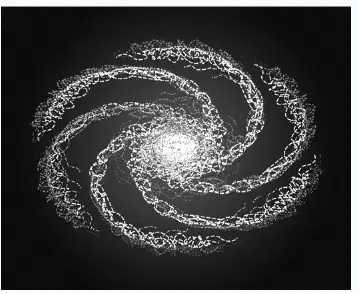
Planets, stars, and galaxies are made of different forms of matter. Which of the following BEST describes the composition of the Milky Way (shown below)?
billions of black holes
billions of moons
billions of planets
billions of stars

The graph compares the surface temperature and color of stars.
What would be the color of a star that has a surface temperature of approximately 15,000 K?
blue
white
orange
red
The brightness of a star as seen from Earth is its apparent magnitude. How is apparent magnitude different from absolute magnitude?
Apparent magnitude depends on the distance of a star from Earth; absolute magnitude does not.
Apparent magnitude depends on the color of a star; absolute magnitude does not.
Apparent magnitude depends on the temperature of a star; absolute magnitude does not.
Apparent magnitude depends on the size of a star; absolute magnitude does not.
Lee made a model of the solar system using common objects to represent Earth, its moon, the sun, and the planet Jupiter. She used a large pizza, a basketball, a ping-pong ball, and a marble. Which object represented Earth?
the pizza
the basketball
the ping-pong ball
the marble
Susan is making a model to represent a universe, a galaxy, and a star. She places a bowl inside a shoe box. She places a ball inside the bowl. What do the shoe box, bowl, and ball represent?
The shoe box represents a universe, the bowl represents a galaxy, and the ball represents a star.
The shoe box represents a universe, the bowl represents a star, and the ball represents a galaxy.
The shoe box represents a galaxy, the bowl represents a universe, and the ball represents a star.
The shoe box represents a star, the bowl represents a galaxy, and the ball represents a universe.
Which sentence is a TRUE statement about the relationship between galaxies and stars?
A galaxy contains only one star.
A star contains only one galaxy.
A galaxy contains many stars.
A star contains many galaxies.
The sun has a layered structure. Which layer is MOST visible to an observer on Earth?
core
chromosphere
radiation zone
photosphere
Galileo discovered sunspots and noticed that they moved across the face of the sun. Why do sunspots move across the face of the sun?
The sun rotates, carrying sunspots as it turns.
They are blown by the solar wind.
They are blown along by solar flares.
They do not actually move, but only seem to move as Earth moves around the sun.

