wayground logo

Free Printable Worksheets

Font size

S
M
L
XL
Worksheets

EOC Review

Total questions: 160

Worksheet time: 3hrs 34mins

Name
Class
Date
1.

Maintaining a stable internal

environment is called

a)

homeostasis

b)

equilibrium

c)

balance

d)

evenness

2.
An organism that makes its own food is 
a)
an omnivore
b)
a heterotroph
c)
an autotroph
d)
a carnivore
3.

Identify the characteristic: when you step out into the cold, your body shivers in order to keep its temperature at 98.6oF.

a)

All living things use energy

b)

All living things contain cells

c)

All living things maintain homeostasis

d)

All living things grow and develop

4.
Your body shivers when you are cold. This is because of the concept of...
a)
homeostasis
b)
heredity
c)
energy metabolism
d)
cellular organization
5.
Provides usable energy for other life functions
a)
growth
b)
cellular respiration
c)
digestion
d)
excretion
6.
A camel has eyelashes that work to keep the dust and sand out of its eyes.
a)
All living things adapt to their environment
b)
All living things grow
c)
All living things have cells
d)
All living things use energy
7.
Over three years, Tim's height has increased from 5'4" to 5'11".
a)
All living things contain cells
b)
All living things maintain homeostasis
c)
All living things use energy
d)
All living things grow
8.
YOU are a multi-celled organism but an amoeba is a single celled organism.
a)
All living things have cells
b)
All living things grow
c)
All living things use energy
d)
All living things respond to their environment
9.
What can only be found in plant cells?
a)
Cell membrane
b)
Vacuole
c)
Chloroplast
d)
Mitochondrion
10.
Where are proteins made?
a)
Golgi body
b)
Mitoichondrion
c)
Chromosomes
d)
Ribosomes
11.
The _________ are the power houses of the cell. They are in both plants and animals.
a)
Chloroplasts
b)
Mitochondria
c)
Nucleus
d)
Endoplasmic Reticulum
12.
This is the cell's "control center."
a)
Endoplasmic Reticulum
b)
Golgi Body
c)
Nucleus
d)
Cell Wall
13.
This structure is a storage area for the cell.
a)
Lysosome
b)
Vacuole
c)
Ribosome
d)
Golgi Body
14.
I am located in the nucleus – I’m the genetic material of a cell
a)
cytoplasm
b)
membrane
c)
chromosomes/DNA
d)
vacuole
15.
I am found in plant cells. I am rigid, strong & stiff. I give support to the plant cell.  I give the cell it's box shape
a)
cell membrane
b)
cell wall
c)
chlorophyll
d)
mitochondria
16.

Both prokaryotic and eukaryotic cells have all of the following EXCEPT:

a)

Cytoplasm

b)

Ribosomes

c)

DNA

d)

Cell Wall

17.

The function of flagella is:

a)

Movement

b)

Provide Energy

c)

Protection

d)

Make Proteins

18.

If the lysosome were a part of the city it would be the:

a)

Mayor - controls the cell

b)

Waste management - digests cell waste and cleans up

c)

Farms- synthesizes proteins

d)

Water tower - stores water

19.

The function of the Golgi apparatus is to

a)

Sort, package and modify macromolecules produced by the cell.

b)

Produce proteins

c)

Produce lipids

d)

Produce RNA

20.

The function of the smooth ER is to:

a)

Make proteins

b)

Make lipids

c)

Make carbohydrates

d)

Make nucleic acids

21.

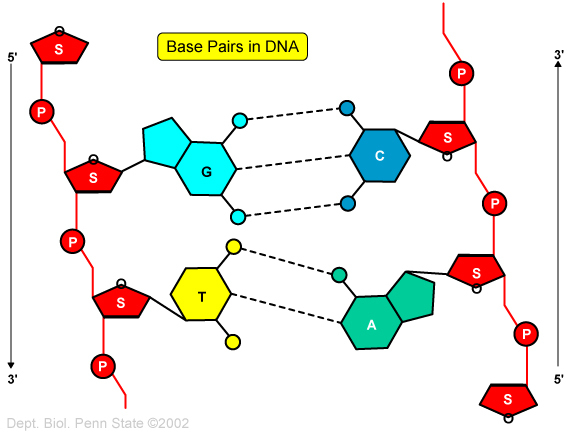
What is "A"?

a)

Nucleotide

b)

Deoxyribose Sugar

c)

Nitrogenous base

d)

Phosphate

22.

What is "B"?

a)

Nucleotide

b)

Deoxyribose Sugar

c)

Nitrogenous base

d)

Phosphate

23.

What is "C"?

a)

Nucleotide

b)

Deoxyribose Sugar

c)

Nitrogenous base

d)

Phosphate

24.

What is the molecule in the image?

a)

Nucleotide

b)

Deoxyribose Sugar

c)

Nitrogenous base

d)

Phosphate

25.

What is the complimentary sequence of the following sequence:

GATCAG

a)

TGACAT

b)

GACATG

c)

CTAGTC

d)

CGACTA

26.
Which 2 molecules form the sides (backbone) of the DNA ladder?
a)
deoxyribose sugar and adenine
b)
deoxyribose sugar and a hydrogen bond
c)
deoxyribose sugar and the nucleus
d)
deoxyribose sugar and phosphate
27.
Nitrogenous bases are joined by which type of bond?
a)
polar bonds
b)
ionic bonds
c)
covalent bonds
d)
hydrogen bonds
28.
Cytosine always pairs with
a)
Adenine
b)
Thymine
c)
Uracil
d)
Guanine
29.
Adenine bonds with ______________.
a)
Guanine
b)
Thymine
c)
Cytosine
d)
Adenine
30.

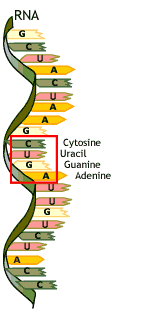
What is the role of mRNA

a)

Carry an amino acid to the ribosome

b)

Copy the instructions from DNA and carry it out of the nucleus

c)

Make up the ribosomes

31.

Where does Transcription occur

a)

Nucleus

b)

Ribosome

c)

ER

d)

Mitochondria

32.

What is the mRNA for the following DNA strand?

TAC GTA

a)

GCT AGC

b)

ATG CAT

c)

AUG CAU

33.

Where does Translation occur?

a)

Nucleus

b)

Ribosome

c)

ER

d)

Chloroplast

34.

What is the end product of translation?

a)

mRNA that can leave the nucleus

b)

Amino acid chain

c)

monosaccharide chain

d)

Anticodon

35.

During translation, this type of ribonucleic acid is responsible for delivering amino acids to help make a protein.

a)

mRNA

b)

rRNA

c)

tRNA

d)

dRNA

36.

mRNA occurs during this process

a)

Translation

b)

Transcription

c)

Replication

d)

Delivery

37.
The process where mRNA is read and made into an amino acid chain.
a)
Transcription
b)
Translation
c)
Transportation
d)
Transient
38.
What is the three base sequence of mRNA that codes for a single amino acid?
a)
Anticodon
b)
Codon
c)
Protein
39.
Which of these nitrogenous bases is NOT in RNA?
a)
Uracil
b)
Thymine
c)
Cytosine
d)
Guanine
40.
In RNA, Uracil pairs with ______. 
a)
cytosine
b)
adenine
c)
guanine
d)
thymine
41.
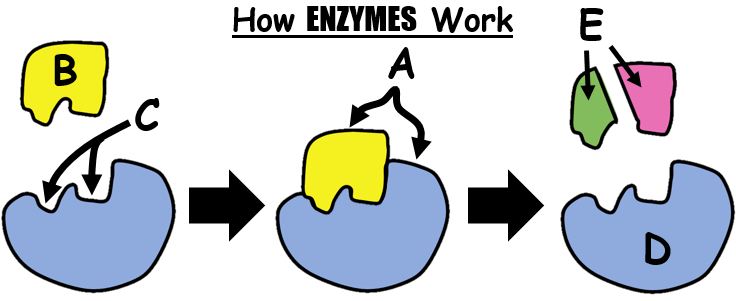
In the diagram, what is letter A? 
a)
product
b)
substrate
c)
enzyme-substrate complex
d)
active site
42.
Any substance that is acted upon by an enzyme is called a(n)?
a)
Coenzyme
b)
Substrate
c)
Vitamin
d)
Polypeptide
43.
What is a substance called if it speeds up a chemical reaction?
a)
reusable
b)
catalyst
c)
specific
d)
fragile
44.
What will most likely happen if an appropriate enzyme is added to a chemical reaction? 
a)
The reaction rate will increase.
b)
The equilibrium of the reaction will be maintained. 
c)
The reaction rate will decrease.
d)
The reaction will stop. 
45.
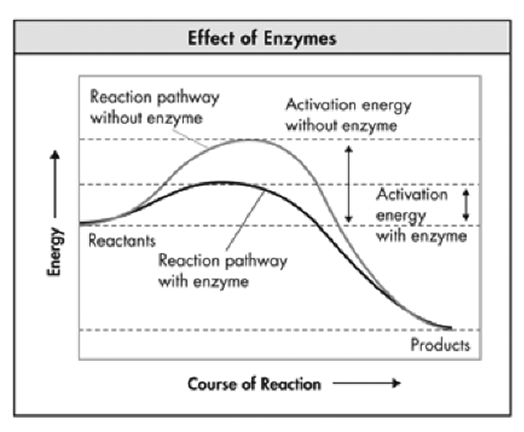
The graph shows how enzymes affect reactions in cells. Which statement best summarizes the information shown in the graph?
a)
Enzymes increase the energy of the reactants.
b)
Enzymes decrease the energy level of the products.
c)
Enzyme decrease the activation energy of the reaction.
d)
Enzymes reverse the direction of the reaction.
46.
Which enzyme is most efficient in a basic solution?
a)
A
b)
B
47.
What happens when enzymes are heated to a high temperature?
a)
The enzymes die.
b)
The shapes of the enzyme are altered denature
c)
The enzymes' amino acid sequence changes.
d)
The enzymes remain the same
48.

Which of these is most likely an enzyme?  

a)

Sucrose

b)

Galactose

c)

Fructose

d)

Amylase

49.

Where does photosynthesis occur?

a)

mitochondria

b)

chloroplast

c)

animal cells

d)

ribosomes

50.

What is the name of the pigment molecule that absorbs light energy and makes plants green?

a)

chloroplast

b)

glucose

c)

mitochondria

d)

chlorophyll

51.

Which of the following are products of photosynthesis? (Select 2)

a)

glucose

b)

light

c)

water

d)

oxygen

52.

What two things are the product (end result) of photosynthesis?

a)

chloroplast

b)

glucose

c)

oxygen

d)

carbon dioxide

53.
Which organisms perform Photosynthesis?
a)
Only Autotrophs
b)
Only Heterotrophs
c)
Autotrophs and Heterotrophs
54.
Where do the light-dependent reactions occur? 
a)
thylakoid membrane
b)
stroma
c)
mesophyll
d)
mitochondria
55.
Where does the Calvin Cycle occur?
a)
thylakoid
b)
stroma
c)
lumen
d)
mitochondria
56.
What are the reactants (what's needed) for photosynthesis?
a)
glucose and oxygen
b)
light, water, and carbon dioxide
57.
What gas is released by plants during photosynthesis?
a)
sulfur
b)
carbon dioxide
c)
oxygen
d)
hydrogen
58.
Which of the following is the correct equation for PHOTOSYNTHESIS?
a)
carbon dioxide + water --> oxygen + glucose
b)
carbon dioxide + glucose + water --> oxygen 
c)
oxygen + water --> carbon dioxide + glucose
d)
glucose+ oxygen ---> water + carbon dioxide 
59.
This image shows the process of _____.
a)
Respiration
b)
Photosystem I
c)
Dark Reactions
d)
Photosynthesis
60.
What are the products of photosynthesis?
a)
water and carbon dioxide
b)
oxygen and glucose
c)
oxygen and carbon dioxide
d)
oxygen and water
61.
What is the name of the 1st step of cellular respiration?
a)
Glycolysis
b)
Kreb's Cycle
c)
ETC
d)
Anaerobic respiration
62.
Where does glycolysis take place?
a)
Cytoplasm
b)
Stroma
c)
Thylakoid
d)
Mitochondria
63.
This process releases chemical energy from sugars and other carbon-based molecules to make ATP when oxygen is present.
a)
photosynthesis
b)
light-independent reaction
c)
cellular respiration
d)
light-dependent reaction
64.
Glucose is broken down during which process
a)
Krebs cycle
b)
Calvin cycle
c)
Glycolysis
d)
Photosynthesis
65.
What is cellular respiration?
a)
the breakdown of glucose  to release ATP
b)
the breakdown of glucose to release NADH
c)
the breakdown of glucose to release FADH
d)
the breakdown of glucose to release carbon
66.

Which organisms perform cellular respiration?

a)

only autotrophs

b)

both autotrophs and heterotrophs

c)

only heterotrophs

67.

Cellular respiration occurs in what cell organelle?

a)

chloroplast

b)

cytoplasm

c)

mitochondria

d)

nucleus

68.
What are the reactants of cellular respiration?
a)
glucose & carbon dioxide
b)
glucose & oxygen
c)
water & oxygen
d)
water & carbon dioxide
69.

What are the products in cellular respiration?

a)

H20 and CO2

b)

H20 and C6H1206

c)

O2 and H20

d)

C6H12O6 and CO2

70.

How can energy from the sun be transferred to animals?

a)

The sun's energy is transformed into food by plants, and animals eat plants so that they can transform that food into energy.

b)

Plants produce energy using the sun's energy, and animals then eat that energy.

c)

Plans transform the sun's energy into gases that animals can breath in to use as energy.

d)

Animals produce their own food using energy from the sun. They don't need plants.

71.

Photosynthesis and cellular respiration are basically the opposite.

a)

true

b)

false

72.
Identify the stage of mitosis. 
a)
interphase
b)
prophase
c)
anaphase
d)
cytokinesis
73.
Identify the stage of mitosis.
a)
interphase
b)
prophase
c)
metaphase
d)
anaphase
74.
Identify the stage.
a)
interphase
b)
metaphase
c)
anaphase
d)
telophase
75.
a)
Cytokinesis
b)
Anaphase
c)
Telophase
d)
Prophase
76.
a)
Anaphase
b)
Cytonkinesis
c)
Interphase
d)
Prophase
77.
a)
Cytokinesis
b)
Interphase
c)
Anaphase
d)
Metaphase
78.
What phase of mitosis is pictured?
a)
Metaphase
b)
Telophase
c)
Prophase
d)
Anaphase
79.
A process where one cell forms two identical daughter cells is called...
a)
cell cycle
b)
cell division (mitosis)
c)
interphase
d)
cytokinesis
80.
During interphase the cell ___________.
a)
divides into two cells
b)
divides its nucleus
c)
replicates its DNA
d)
replicates the organelles within the cell
81.

In Anaphase I, the _________ are separated by the pulling of the spindle fibers to opposite poles of the cell.

a)

homologous pairs of chromosomes

b)

sister chromatids

c)

centromeres

d)

centrosomes

82.

In Metaphase II, _________ line up on equatorial plane.

a)

homologous pairs of chromosomes

b)

single chromosomes (made up of 2 sister chromatids)

c)

tetrads

d)

centrosomes

83.

How many cells are formed at the end of Meiosis II?

a)

2

b)

3

c)

4

d)

8

84.

Which part of MEIOSIS is identical to MITOSIS?

a)

Meiosis I

b)

Meiosis II

85.

The products of MEIOSIS have _______ number of chromosomes.

a)

haploid

b)

diploid

86.

Which part of meiosis produces diversity in gametes?

a)

DNA replication

b)

Prophase

c)

Crossing-over

d)

Cytokinesis

87.

Meiosis produces daughter cells that are genetically _________ each other.

a)

identical to

b)

different from

c)

superior to

d)

inferior to

88.

The daughter cells produced by meiosis are also called __________.

a)

somatic cells

b)

stem cells

c)

germ cells

d)

gametes

89.
water moves from
a)
higher conc. H20 => lower conc H20
b)
lower conc. H20 => higher conc. H20
90.
Cells use energy to move materials across a membrane (low to high concentration).
a)
Active transport
b)
Passive transport
c)
Diffusion
d)
Osmosis
91.
In this situation, where the solute is illustrated by red dots, predict if will WATER move into or out of the cell, and how that will affect the cell.
a)
Water will move into the cell and the cell will expand.
b)
Water will move into the cell and the cell will shrink.
c)
Water will move out of the cell and the cell will expand.
d)
Water will move out of the cell and the cell will shrink.
92.

The two broad categories of cell transport are ...........

(select all correct answers)

a)

passive transport

b)

road transport

c)

food transport

d)

active transport

93.

In passive transport, .............

a)

energy is required

b)

energy is not required

94.

In active transport, .............

a)

energy is required

b)

energy is not required

95.
Facilitated diffusion is the movement of materials into and out of the cell
a)
with the use of energy
b)
with the use of proteins but no energy
c)
by moving water
d)
by using ATP
96.
The  movement of water from a high concentration to a low concentration is called
a)
diffusion
b)
osmosis
c)
facilitated diffusion
d)
active transport
97.
Genotype refers to the ...
a)
physical expression of the genes
b)
the possible combination of alleles in a gene
c)
whether an allele is dominant or recessive
d)
how an organism will appear
98.
An offspring will receive how many alleles from each parent to determine a specific trait?
a)
one
b)
two
c)
three
d)
five
99.
What is a phenotype
a)
The genetic make up (code)
b)
The physical trait
100.
having two of the same genes for the trait (sometimes called purebred).
a)
homozygous
b)
hetrozygous
c)
protein
d)
chromosome
101.
having two different genes for a trait (sometimes called hybrid).
a)
protein
b)
homozygous
c)
heterozygous
d)
genotype
102.
An allele whose trait only shows up when no dominant allele is present.
a)
hidden allele
b)
dominant allele
c)
recessive allele
d)
present allele
103.
One form of a gene is called_______________
a)
a DNA
b)
a Phenotype
c)
a trait
d)
an allele
104.
 Dominant alleles are-
a)
capital
b)
lowercase
c)
both
d)
neither
105.
 Recessive alleles are-
a)
capital
b)
lowercase
c)
both
d)
neither
106.

What does A indicate?

a)

A male that has the trait.

b)

A female that has the trait.

c)

A female that does not have the trait.

d)

A male that does not have the trait.

107.

In the diagram, individual II-1 indicates

a)

a female with no freckles

b)

a male with no freckles

c)

a male with freckles

d)

a female with freckles

108.

How many alleles does a person carry for a trait?

a)

1

b)

2

c)

3

d)

4

109.

In a pedigree, which shape represents a male?

a)

circle

b)

square

110.

On a pedigree, this symbol represents a ----

a)

not affected male.

b)

not affected female.

c)

affected male.

d)

affected female.

111.

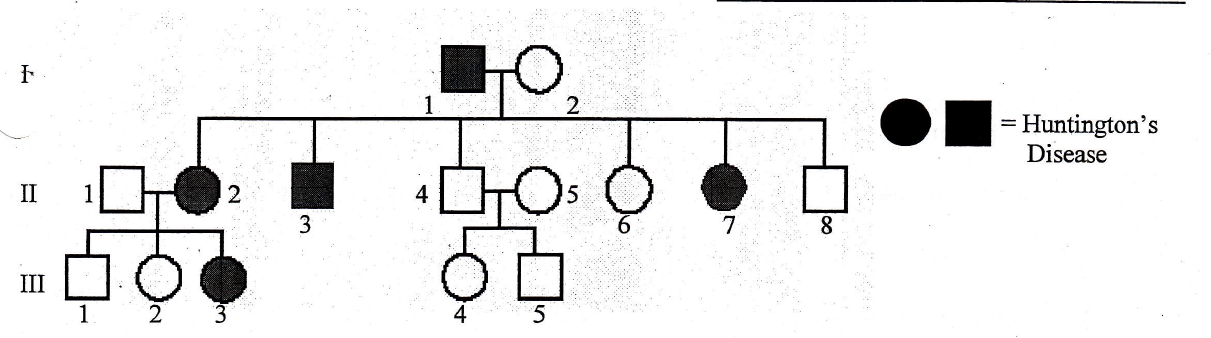
If this pedigree shows a recessive disorder, what MUST the genotype of individual 4 be?

a)

HH

b)

Hh

c)

hh

112.
There are no carriers for Huntington's Disease- you either have it or you don't. Is Huntington's disease caused by a dominant or recessive trait?
a)
Dominant
b)
Recessive
113.
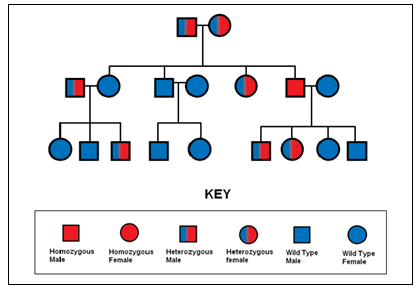
What do half colored symbols represent?
a)
The individual is a carrier (heterozygous).
b)
The individual expresses the trait.
c)
The individual has both recessive alleles.
d)
The individual has both dominant alleles.
114.

What is the mode of inheritance shown here?

a)

Recessive because it "skips" a generation

b)

Dominant because it shows up in every generation

115.
Why do all the daughters in Generation II carry the colorblind gene?
a)
Because mom passed on the gene.
b)
Because dad passed on the X chromosome.
c)
Because their brother has it.
d)
Because their brother gave it to them.
116.

Which pedigree is showing a RECESSIVE inheritance pattern?

a)
b)
117.

plants are called _________ because they produce food for us.

a)

consumers

b)

producers

c)

prey

118.

humans and animals are _________ because we need to eat food for energy.

a)

producers

b)

prey

c)

consumers

d)

population

119.

an animal that hunts other animals is called a ____________

a)

prey

b)

predator

c)

producer

d)

herbivore

120.

an animal that is hunted and eaten by other animals is called ________

a)

prey

b)

predator

c)

producer

121.
Which of the following is another word for a plant?
a)
autotroph
b)
heterotroph
c)
consumer
122.
Which is an example of a parasitic relationship?
a)
a bee pollinates a flower
b)
a tapeworm takes nutrients from a dog
c)
an orchid lives in a tree but does not harm the tree
123.
In which type of relationship do both species benefit?
a)
parasitism
b)
mutualism
c)
commensalism
124.
What does every food chain start with? (Even if it's not drawn or written there!)
a)
producers
b)
sun
c)
consumer
d)
decomposers
125.
The rabbit in this food web would be considered a:
a)
Decomposer
b)
Producer
c)
Secondary Consumer
d)
Primary Consumer
126.
What is the term for each step in the transfer of energy and matter within a biological community?
a)
energy path
b)
food web
c)
trophic level
d)
food pyramid
127.
The amount of energy that usually transfers from one trophic level to the next...
a)
10%
b)
20%
c)
80%
d)
50%
128.
A graphic illustration that shows each trophic level and the amount of useable energy contained within.
a)
Food chain
b)
Food web
c)
Energy Pyramid
d)
All of these
129.
As you move upward, from level to level, in an energy pyramid, energy _____.
a)
increases
b)
decreases
c)
stays the same
d)
increases exponentially
130.

In an ecosystem, there are populations of moose, rabbits, grass, and pine trees. Suddenly, a fire blazes through the area, which kills all of the populations. As the months go on, new species of grass begin to take root. This attracts animals, and eventually the ecosystem is restored.


What type of ecological succession happened?

a)

Primary succession

b)

Secondary succession

c)

Tertiary succession

d)

None of the above

131.
If these organisms were arranged in a food pyramid, which organism would have the least amount of total energy available?
a)
coyote
b)
insect
c)
lizard
d)
shrub
132.
Which organism recieves the least amount of energy from the producer?
a)
Owl
b)
Grasshopper
c)
Lilypad
d)
Mouse
133.

How does the energy flow in an energy pyramids?

a)

up the pyramid

b)

down the pyramid

134.
This scientist came up with the idea of natural selection.
a)
Jean Baptiste Lamarck
b)
Gregor Mendel
c)
Charles Darwin
d)
Thomas Malthus
135.
Inherited trait that helps an organism survive is a(n) __________.
a)
Fossil
b)
Adaptation
c)
Ancestor
d)
Natural selection
136.
Survival of the fittest or when favorable adaptations reproduce faster is called what?
a)
Evolution
b)
Adaptation
c)
Natural selection
d)
Fossilization
137.
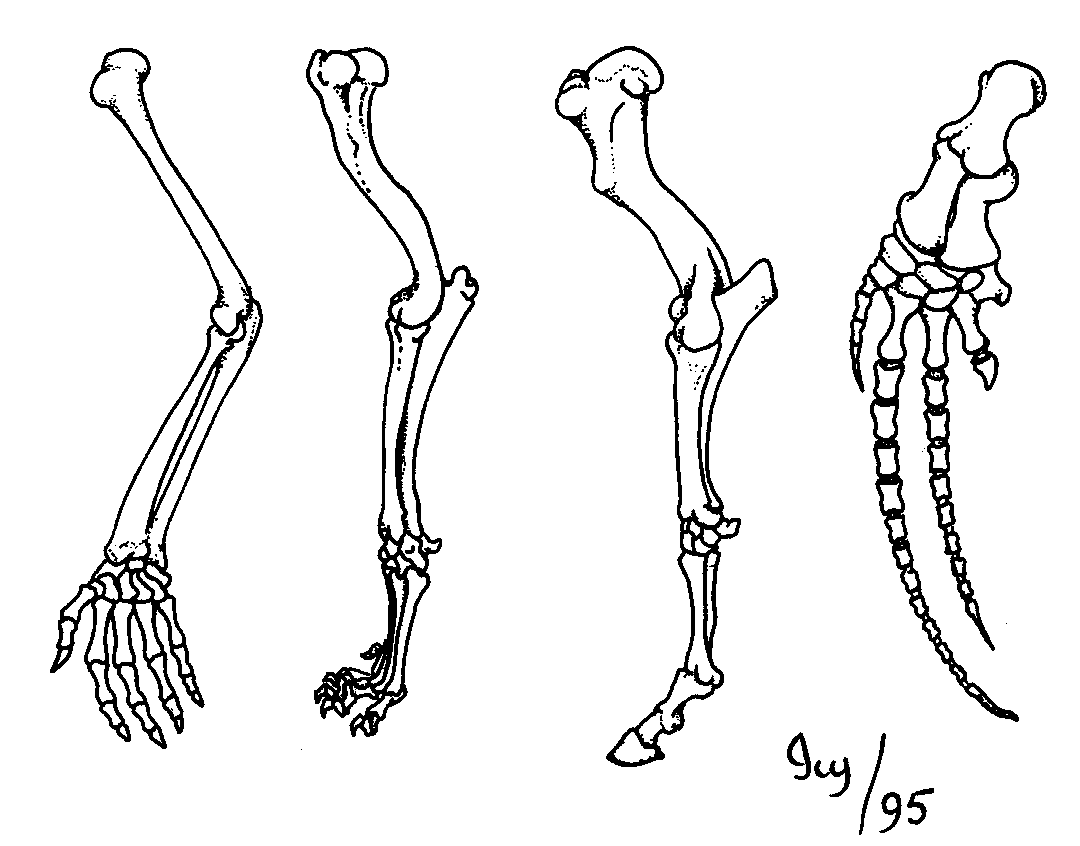
Structures with the same parts have different functions; suggests that organisms share a common ancestry
a)
vestigial structures
b)
homologous structures
c)
adaptive radiation
d)
fossil
138.
Which of the following is an example of a vestigial structure?
a)
the wings of a red-tailed hawk
b)
the hind limbs of a house cat
c)
the fins of sharks
d)
the tailbone of a human
139.

What do we call a change in a species over time?

a)

Adaptation

b)

Evolution

c)

Extinction

d)

Environmental influences

140.
Ostrich wings are examples of
a)
homologous structures
b)
vestigial structures
c)
adaptations
d)
traits
141.
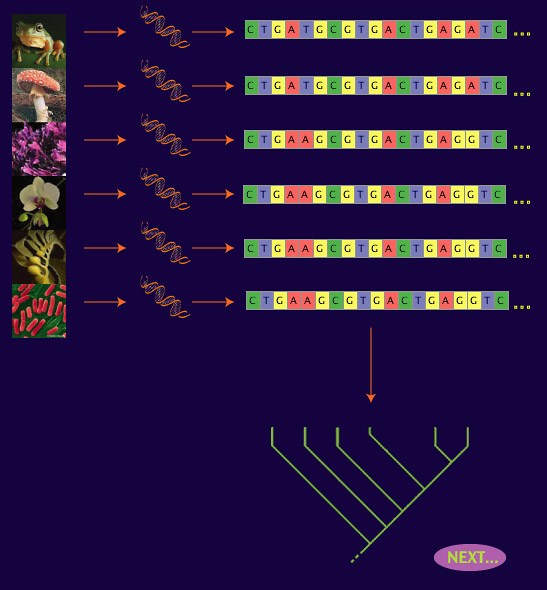
Two organisms that are closely related would have
a)
very similar DNA sequence
b)
exactly the same DNA sequences
c)
no proteins in common
d)
completely different DNA sequence
142.
Comparing human hemoglobin of chimpanzees, horses, kangaroos, and chickens, reveal that humans have the fewest amino acid differences with 
a)
Kangaroos
b)
Horses
c)
chickens
d)
chimpanzees
143.
Why are advantageous traits more likely to be passed onto offspring?
a)
Because they are more likely to survive and reproduce.
b)
Because they come from dominant alleles.
c)
Because they come from recessive alleles.
d)
Because the trait is an acquired phenotype.
144.
Study of embryos of various organisms to show a common ancestor because of similarities in development
a)
natural selection
b)
embryology
c)
speciation
d)
evolution
145.

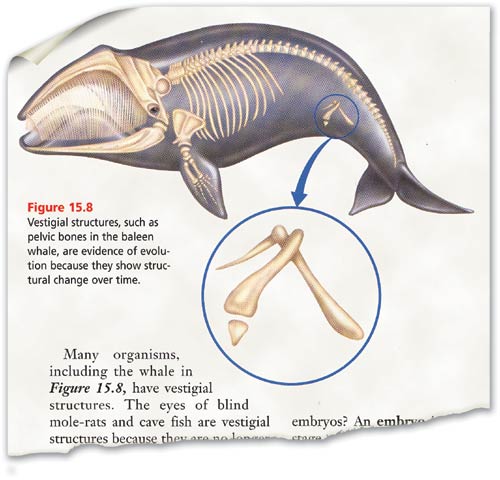
Whales are aquatic mammals that contain a pelvis (hip) bone. Even though it does not aid in its movement, the function must have been used by a common ancestor of the whale. Thus, the pelvis is referred to as a(n)

a)

vestigial structure

b)

analogous structure

c)

homologous structure

146.
Genetic differences between organisms of the same species
a)
Variation
b)
Adaptation
c)
Behavior
d)
Environment
147.
An error in DNA copying that results in a new trait
a)
Homeostasis
b)
Mutation
c)
Natural Selection
d)
Selective Breeding
148.
Structures that are inherited from a common ancestor are homologous.
a)
True
b)
False
149.
Humans, birds, whales, and lizards all have similar arm bones. What is the reason for this?
a)
The function of these bones is the same in all animals
b)
They live in similar environments
c)
They have a common ancestor
d)
All organisms resemble humans
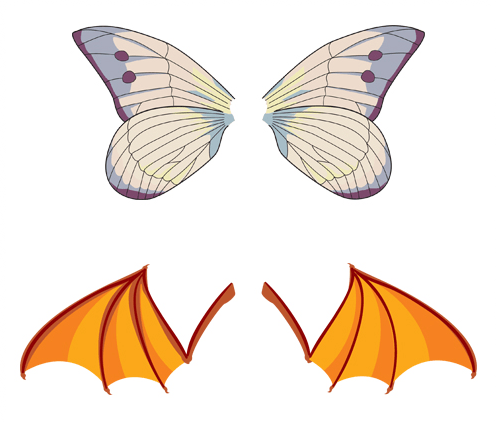
150.
Bird wings and butterfly wings are an example of
a)
Homologous structure
b)
Analogous structure
c)
Mimicry
d)
Camoflague
151.
Analogous structures show common ancestry.
a)
True
b)
False
152.
Which of the following pieces of evolution evidence deals with aged and identified fossils?
a)
fossil record
b)
comparative embryology
c)
comparative biochemistry
d)
comparative anatomy
153.
Which of the following pieces of evolution evidence deals with comparing similar structures in various species?
a)
fossil record
b)
comparing embryology
c)
comparing biochemistry
d)
comparing anatomy
154.
Which of the following pieces of evolution evidence deals with structures common in embryos that form differently or for different purposes in adult form?
a)
fossil record
b)
comparing embryology
c)
comparing biochemistry
d)
comparing anatomy
155.
How would you describe this evolution?
a)
Homologous structure
b)
Analogous structure
c)
Structural adaption
d)
Functional adaption
156.

Which suspect left the blood stain?

a)

Bob

b)

Sue

c)

John

d)

Lisa

157.

Which best describes a controversial issue associated with the use of genetically modified crops?

a)

the use of genetically modified crops to increase potential yield

b)

the short term use of genetically modified crops in famine stricken countries

c)

the development of genetically modified crops which are resistant to herbicides

d)

the long term effects which may arise from the use of genetically modified crops

158.

Which area of biotechnology would most likely create ethical issues within human society?

a)

insulin production by bacteria

b)

organ cloning for use in transplants

c)

genetic engineering to improve agricultural yields

d)

DNA and forensic testing of crime scene evidence

159.

A farmer is considering the advantages of cloning a herd of cattle from a single cow. What is one advantage of a cloned herd?

a)

All cattle in the herd would have the most desired traits.

b)

All cattle in the herd would have more genetic variation.

c)

All cattle in the herd would have more resistance to diseases.

d)

All cattle in the herd would have much longer life spans.

160.

Which is a concern of scientists when genetically modifying plants?

a)

Plants will pass on diseases to animals.

b)

There will be a decrease in biodiversity.

c)

Plants will have a longer growing season.

d)

There will be a decrease in revenue for pesticide manufacturers.