
Font size
 Worksheets
AP Bio Unit 7: Evolution
Total questions: 76
Worksheet time: 49mins

Based on the data given in the table, which two are most closely related?
Human & Gorilla
Gorilla & Orangutan
Human & Chimpanzee
Chimpanzee & Orangutan

Based on the given cladogram, which organism is the outgroup?
Human
Chimpanzee
Gorilla
Orangutan
Gibbon

Based on the figure, which organism is most closely related to the polar bear?
Black Bear
European Brown Bear
Western North American Brown Bear
Asian Brown Bear

Based on the figure, how long ago was the common ancestor of the European Brown Bear and the Asian Brown Bear?
4.5 hundreds of thousands of years ago
3.5 hundreds of thousands of years ago
2.2 hundreds of thousands of years ago
1.4 hundreds of thousands of years ago
Which evidence would be the most accurate when developing a cladogram?
Morphological
Molecular
Ecological
Fossil

Based on the figure, which organism is most closely related to A. forsteri?
E. ferus
D. Polylepis
G. gallus
E. africanus
Choosing a trait we like and breeding for it is called
artificial selection
natural selection
evolution
Natural selection acts on
phenotypes
genotypes
Differences observed between males and females of the same species is the result of
sexual selection
natural selection
A strong wind, blowing pollen further than normal is an example of
bottleneck effect
mutations
founder effect
gene flow

Occurs when one extreme phenotype is selected.
Example: Individuals may be tall, med, or short
Only the short ones survive
Directional selection
Stabilizing selection
Disruptive selection

Selection against BOTH extreme phenotypes
Example: Individuals can be tall, med, or short
Only the medium ones survive
Directional selection
Disruptive selection
Stabilizing selection

Selection FOR both extreme phenotypes
Example: Individuals can be tall, med, or short
Only the tall and short survive. The mediums die out
Directional selection
Disruptive selection
Stabilizing selection
A natural event that separates a population, usually decreasing its diversity represents the
bottleneck effect
founder effect
natural selection
gene flow
Mutations can be
helpful
harmful
neutral
all of these
A mechanism for evolution -
gradual change over time seen in the fossil record
descent with modification
natural selection
gene flow
bottleneck effect
In order for a population to reach Hardy-Weinberg equilibrium, it must have:
No mutations or gene flow
No natural selection
Random mating
Extremely large population size
all of these
The fossil record gives us a complete vision of evolutionary history
TRUE
We can see every evolutionary descendent of an organism
FALSE
We are missing some pieces
A similarity that was inherited from the most recent common ancestor is called a
derived characteristic
primitive characteristic
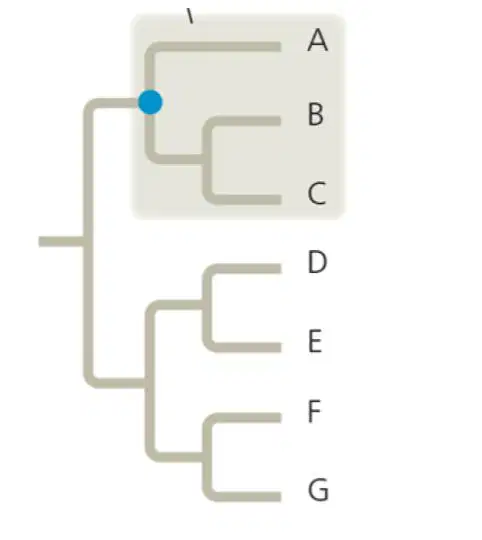
A ____ group includes an ancestral taxon and all its decendants
monophyletic
paraphyletic
polyphyletic
How are cladograms different from phylogenetic trees?
Cladograms show change in fossils
Phylogenetic trees show change in fossils

Two clades that emerge from the same node such as B and C, or E and F
sister taxa
basal taxa
clade

Structures that we have evolved out of using (like whale leg bones) are called
vestigial structures
homologous structures
analogous structures
The geographical distribution of animals and plants
biogeography
biogeology
taxonomy
biology
Fossils can be dated by measuring the decay of __
Carbon
Hydrogen
Oxygen
Nitrogen
The science of naming and classifying a species
taxonomy
genetics
biogeography

A lineage that is least related to the others is called a(n)
Example: Letter E
out group
synapomorphy
basal taxon
sister taxa

Characteristics that are similar between 2 species that share a common ancestor
Homologous structures
Analogous Structures
Vestigial structures

Characteristics that are similar between 2 species but they do NOT have a common ancestor
analogous structures
homologous structures
vestigial structures
What factors would increase the frequency of a genotype in a population over time?
Increased reproduction rates in a population
Selective pressures that make the trait favorable
Genetic drift
Mutations in the population
Why would the presence of a particular genotype or phenotype decrease in a population over time?
Due to increased competition
Reproductive isolation
Changes in the environment that now make the trait less favorable
Gene flow
What are selection pressures?
Conditions that prevent a population from evolving
Organisms that shape and influence the ecosystem
Random changes in allele frequencies in a population
Any changes in biotic or abiotic factors that influence survivability
What is the founder effect?
When survivors of a natural disaster repopulate the environment
When a small population breaks off of an existing population
Changes in the genetic makeup of a population over time
The migration of organisms between two similar populations
How does genetic drift usually affect a population?
Usually it increases the size of a population
Usually it increases the selective pressures on a population
Usually it decreases the genetic variation of the population
Usually it introduces new genes into a population
In mice brown fur (B) is dominant over white fur (b). Scientists observed a population of 2000 mice, and found the frequency of the B allele to be 0.7. 10 years later the scientists revisited the population and found the frequency of the B allele to be 0.4.
In the original study, what percentage of the mice would have white fur?
70%
49%
9%
30%
If a recessive disorder is found to affect 1 in 500 live births, what is the frequency of the recessive allele in the population?
0.002
0.9553
0.9125
0.0447
How are biomolecular homologies used to determine phylogeny?
By comparing the similarities in DNA or amino acid sequences
By comparing the behaviors and environments of organisms
By comparing the morphological similarities in organisms
By estimating and comparing the relative ages of the organisms
What do homologous structures tell scientists about species who share them?
That the organisms lived during the same time period
That the organisms were exposed to the same selective pressures
That they have undergone convergent evolution
That the organisms share a common ancestor
What is an ancestral trait in a cladogram?
Traits that are new for a recent species
A trait that is shared by more than one lineage
A trait that has disappeared over time
The trait that is present in only one organism
What are the universal conserved processes that support the theory that all life originated from prokaryotic cells?
Protein expression
Glycolysis
DNA replication
All of the above
What are prezygotic barriers to reproduction?
Any barrier that reproductively isolates species
Barriers that prevent the production of a fertilized egg
When the offspring of two organisms are sterile
Barriers that prevent a zygote from developing into a viable offspring
Darwin’s finches on the Galapagos Islands were separated by what kind of reproductive barrier?
Temporal isolation
Behavioral isolation
Geographic isolation
Gamete isolation
What is the difference between allopatric and sympatric speciation?
Sympatric - populations are geographically separated ; Allopatric - populations live together but are reproductively isolated
Allopatric - populations are geographically separated ; Sympatric - populations live together but are reproductively isolated
How can mass extinctions lead to adaptive radiation?
By introducing new post-zygotic barriers
By opening many niches for survivors to fill
By rapidly increasing the reproduction rates to repopulate the Earth
By introducing new selective pressures on populations
What is the difference between punctuated equilibrium and gradualism?
Gradualism believes evolution happens in rapid bursts as environments gradually change
Punctuated equilibrium believes evolution happens in rapid bursts followed by long periods of stability
Gradualism believes evolution occurs continuously and slowly
Punctuated equilibrium believes evolution occurs slowly as environments recover from disasters
How can geographic isolation lead to speciation?
These prevent species from reproducing due to different mating seasons
By preventing the mixing of populations and exposing them to different selective pressures
These make the offspring of two species sterile and/or inviable
By changing the courtship rituals of organisms so that they no longer match
What does background extinction rate mean?
The total number of extinctions that have occurred in Earth's history
How many organisms are going extinct without us knowing
The average number of extinctions observed in the fossil record during periods of stability
How many extinctions are currently happening
Which of these is a condition that must be met for Hardy-Weinberg equilibrium?
Extremely small population size
No natural selection
Gene flow
Nonrandom mating
What does p stand for?
Dominant allele
Recessive allele
Homozygous dominant
Homozygous recessive
Heterozygous
Which of the following is the equation that you would use for Hardy-Weinberg?
p + 2q = 1
2p + 2q = 1
2p + q = 1
p + q = 1
If a population is suffering from genetic drift, which of the Hardy-Weinberg conditions is not being met?
No gene flow
Random mating
Extremely large population size
No mutations
If the frequency of recessive alleles is 0.2, what is the frequency of the homozygous recessive individuals?
0.04
0.16
0.4
0.8
A small number of lizards from a mainland population have been deposited on four isolated islands because of the effects of a rare strong storm.
Which of the following best predicts the outcome of these lizards reproducing for many generations on the islands?
Courtship rituals specific to each island lizard species prevent the lizards from interbreeding.
Speciation results from bottleneck events that happened before the ancestral species reached the islands.
The different species that currently exist are the result of hybridization between lizards from different islands.
The isolation prevents gene flow; thus, the lizards on different islands experience prezygotic isolation.

Five new species of bacteria were discovered in Antarctic ice core samples. The nucleotide (base) sequences of rRNA subunits were determined for the new species. The table below shows the number of nucleotide differences between the species.


Members of a species can breed with other members of the same species.
True
False
Which best describes punctuated equilibrium?
Speciation occurs due to natural selection
Speciation occurs due to isolation
Speciation occurs slowly in geologic time, followed by long periods with very fast evolutionary change.
Speciation occurs suddenly and rapidly in geologic time, followed by long periods with little evolutionary change.
The large-scale events of speciation are called...
macroevolution
simplification
adaptation
microevolution
Which of the following is required for a population to diverge into two separate species?
The two populations must have evolved different physical appearances.
The two populations must have mutated at least 10 times.
The two populations must have become reproductively isolated.
The two populations must have evolved analogous structures.
A new river forms and splits two populations, causing ______________ speciation
Sympatric
Allopatric
Extreme
Convergent
A speciation in which new species evolve from a single ancestral species while inhabiting the SAME geographic region.
Sympatric speciation
Allopatric speciation
Complex speciation
Divergent speciation
The emergence of new rivers or streams is a type of ____________ isolation.
Temporal
Mechanical
Behavioral
Geographic

Speciation that caused by breeding occurring at different time of the day is called
behavioral isolation
temporal isolation
ecological isolation
habitat isolation

Two unrelated species evolve in a way that makes them more similar.
adaptive radiation
microevolution
coevolution
convergent evolution
divergent evolution

Finches on the Galapagos Islands share similar characteristics because they share a common ancestor but have evolved into many different types of species to eat different foods in order to survive. What type of macroevolution is being described?
adaptive radiation
microevolution
coevolution
convergent evolution
divergent evolution

