
 Worksheets
EOC Review PBS Unit 3
Total questions: 51
Worksheet time: 26mins
The branch of medical science that deals with causes and control of health problems in the population is called:
Pathology
Epidemiology
Entomology
Histology
True or False: Nosocomial infection is another term for a hospital-acquired infection.
True
False
In 2020, as the number of cases of COVID-19 increased and spread across the world, it became considered:
Epidemic
Endemic
Outbreak
Pandemic
When initially researching a nosocomial outbreak, epidemiologists should record which of the following:
Similarities in the symptoms of affected patients
Timeline for when infection symptoms developed
Locations affected patients visited in the hospital
All of the above
Pathogen is defined as:
An organism in which another organism lives
The establishment of a disease-causing organism within a host
A disease-causing organism
A disorder of function in an organism that results in symptoms
This non-living infectious agent, which causes the flu, cannot replicate on its own & infects healthy cells as hosts.
Prions
Viruses
Bacteria
Fungi
Helminths
This living infectious agent, also known as worms, is acquired through consumption of contaminated food or water and often causes rapid weight loss.
Prions
Viruses
Bacteria
Fungi
Helminths
This non-living infectious protein causes normal brain proteins to fold abnormally, leading to neurological symptoms (confusion, hallucinations).
Prions
Viruses
Bacteria
Fungi
Helminths
This living, animal-like infectious agent thrives in the digestive tract of a host, depriving the host of nutrients from food and can sometimes be treated with antiprotozoal medication.
Prions
Viruses
Bacteria
Fungi
Protists
This common living infectious agent, which cause tuberculosis (TB), can be acquired in a variety of ways and can be treated with antibiotics.
Prions
Viruses
Bacteria
Fungi
Protists
This living, multicellular infectious agent, which causes athlete's foot, includes mildews, molds, and mushrooms.
Prions
Viruses
Bacteria
Fungi
Protists
An infected individual hugs an uninfected individual, depositing the pathogen on the new person. This form of disease transmission is an example of:
Direct Contact
Indirect Contact
Droplet Transmission
Vector Transmission
An infected individual pays at the grocery store with infected cash, spreading the pathogen to the cashier. This form of disease transmission is an example of:
Direct Contact
Indirect Contact
Droplet Transmission
Vector Transmission
West Nile Virus is spread through in intermediate insect that carries the pathogen: mosquitos. This form of disease transmission is an example of:
Direct Contact
Indirect Contact
Droplet Transmission
Vector Transmission
An infected individual coughs into the air, then an uninfected individual inhales the particles, acquiring the pathogen. This form of disease transmission is an example of:
Direct Contact
Indirect Contact
Droplet Transmission
Vector Transmission
When infectious pathogens enters the body, white blood cells (B-cells), produce THESE molecules to attack or impair the pathogens:
Antigens
Antibodies
Toxins
Vaccines
Vaccinations are an example of:
Innate immunity
Acquired immunity
These components of our innate, or nonspecific, immune system are found in our nose, trachea, and lungs and work with mucus to trap foreign invaders:
Digestive Enzymes
Secretions
Cilia
Phagocytes
These components of our innate, or nonspecific, immune system are found in digestive tract and on our skin to prevent foreign invaders from attaching.
Normal flora
Secretions
Cilia
Phagocytes
The disease etiology of the flu is a/an ______.
bacteria
virus
fungus
protist
When streaking the plate, you must ...
flame the loop or use a new loop in between each quadrant.
only lift the lid part way off the petri dish.
use a zig-zag motion to drag bacteria.
All of the other options.
Why should petri dishes be stored upside down?
The bacteria will grow best that way.
To allow the label to dry.
To prevent condensation from dripping on the bacteria.
To keep the bacteria covered.
The growth medium that is poured into the petri dish is called (the) ____.
agar
aseptic
loop
incubator
Bacteria that are rod-shaped are called _____.
cocci
spirilla
bacilli
All of the other options.
The cell wall of bacteria is made of a sugar and amino acid-rich substance called ____.
glycoprotein
phospholipid bilayer
peptidoglycan
flagellum
Gram + bacteria stains _____ and gram - bacteria stains _____.
purple, pink
pink, purple
pink, pink
purple, purple
The purpose the gram stain test is to determine the thickness of the peptidoglycan layer. ______ bacteria has the thicker layer.
Gram -
Gram +

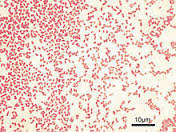
Look at the image. This bacteria is ______.
Gram + cocci in chains
Gram + bacilli
Gram - bacilli
Gram - cocci in clusters
_______ bacteria are often more dangerous because they have an extra layer called the LPS (lipopolysaccharide) after the peptidoglycan layer. This layer can induce a serious immune response that leads to septic shock.
Gram +
Gram -
Thin peptidoglycan in cell wall
Gram positive bacteria
Gram negative bacteria

what is the form of the colony?
circular
irregular
filamentous
rhizoid

what is the form?
circular
entire
irregular
rhizoid

Identify the cell part.
flagellum
pilus
mesosome
plasmid
Identify the pili.


Identify the plasmid.


Identify the cell part.
ribosomes
plasmids
chloroplasts
nucleoid
The cause of a disease or condition is called
etiology
exposure
mycobacter
treatment
What does MOI stand for?
Measure of Injury
Mechanism of Instance
Mechanism of Injury
Measure of Instance
What does ABC stand for?
Airway, Breathing, Circulation
Allow, Breathing, Circulation
Airway, Breathing,
Circle
Airway, Breathes, Circulation
Bloodborne pathogens
are disease-causing agents carried and transmitted by infection.
are disease-causing agents carried and transmitted by any fluids.
are disease-causing agents carried and transmitted by water.
are disease-causing agents carried and transmitted by blood.
Which type of bleed would typically be more urgent to treat?
Venous
Arterial
Capillary
Femoral
This member of the emergency response team is responsible for determining in what order the patients get care.
Emergency Medicine Physician
Triage Nurse
Paramedic
Emergency Services Coordinator
Signs of life-threatening bleeding include:
Continuous bleeding
Large- volume bleeding
Pooling of blood
All of the above
When packing a wound, pack gauze & lightly in the wound & then hold pressure.
True
False
Where should you apply a tourniquet?
Directly on the wound
2 to 3 inches above the would
Anywhere on the body
None of the above
You should tighten tourniquet until bleeding stops
True
False
Using hospital spaces that normally isn’t used to treat patients (conference rooms, break rooms) and staff who are credentialed, but may not be used to treating il or critically injured patients.
Infrastructure
Conventional Surge Capacity
Contingency Surge Capacity
Crisis Surge Capacity
Regional disaster response plan
Overwhelms the hospital and forces them to use structures outside the hospitals such as tents, nearby buildings; staffing and supplies are based on whatever and whoever is available
Infrastructure
Conventional Surge Capacity
Contingency Surge Capacity
Crisis Surge Capacity
Regional disaster response plan
Using only limited additional space, staff, and supplies; typical “busy day” at the hospital
Infrastructure
Conventional Surge Capacity
Contingency Surge Capacity
Crisis Surge Capacity
Regional disaster response plan
a set of guidelines that describe the resources available to you and protocols for how to respond to situations
Infrastructure
Conventional Surge Capacity
Contingency Surge Capacity
Crisis Surge Capacity
Regional disaster response plan

