
Font size
 Worksheets
Ecology Practice: Terms & Ideas
Total questions: 104
Worksheet time: 1hrs 8mins
What is biodiversity?
individuals of the same species living in the same time and place
the variety of life in a given area
ALL of the LIVING THINGS that interact in the same time and place
the interactions between living and non-living things in the same time and place
What is a population?
individuals of the same species living in the same time and place
the variety of life in a given area
ALL of the LIVING THINGS that interact in the same time and place
the interactions between living and non-living things in the same time and place
What is a community?
individuals of the same species living in the same time and place
the variety of life in a given area
ALL of the LIVING THINGS that interact in the same time and place
the interactions between living and non-living things in the same time and place
What is an ecosystem?
individuals of the same species living in the same time and place
the variety of life in a given area
ALL of the LIVING THINGS that interact in the same time and place
the interactions between living and non-living things in the same time and place
What is parasitism?
one organism
benefits
while the other is
harmed, but
usually doesn’t die.
both species benefit in this
type of interaction
species
interaction
in which
both are
harmed
species
interaction in
which one animal
kills another to
consume them
for energy
What is commensalism?
one organism
benefits
while the other is
harmed, but
usually doesn’t die.
both species benefit in this
type of interaction
species
interaction
in which
both are
harmed
species interaction in which one
benefits and the other is neither
harmed nor helped
What is an invasive species?
one organism
benefits
while the other is
harmed, but
usually doesn’t die.
a non-native
species that
causes harm
to the
environment
species
interaction
in which
both are
harmed
factors that affect the size of a
population, regardless of
population density
What are density-dependent limiting factors?
factors that affect
the size of the
population in
response to the
density of the
population
factors that affect the size of a
population, regardless of
population density
the largest
number of
individuals a
given
environment
can support
large scale
shifts in
climate and
temperature
driven by
human
activities
What are density-independent limiting factors?
factors that affect
the size of the
population in
response to the
density of the
population
factors that affect the size of a
population, regardless of
population density
the largest
number of
individuals a
given
environment
can support
large scale
shifts in
climate and
temperature
driven by
human
activities
What is climate change?
factors that affect
the size of the
population in
response to the
density of the
population
factors that affect the size of a
population, regardless of
population density
the largest
number of
individuals a
given
environment
can support
large scale
shifts in
climate and
temperature
driven by
human
activities
What is carrying capacity?
factors that affect
the size of the
population in
response to the
density of the
population
factors that affect the size of a
population, regardless of
population density
the largest
number of
individuals a
given
environment
can support
large scale
shifts in
climate and
temperature
driven by
human
activities
What is predation?
one organism
benefits
while the other is
harmed, but
usually doesn’t die.
both species benefit in this
type of interaction
species
interaction
in which
both are
harmed
species
interaction in
which one animal
kills another to
consume them
for energy
What is mutualism?
one organism
benefits
while the other is
harmed, but
usually doesn’t die.
both species benefit in this
type of interaction
species
interaction
in which
both are
harmed
species
interaction in
which one animal
kills another to
consume them
for energy
What is competition?
one organism
benefits
while the other is
harmed, but
usually doesn’t die.
both species benefit in this
type of interaction
species
interaction
in which
both are
harmed
species
interaction in
which one animal
kills another to
consume them
for energy
What are abiotic factors?
the living elements in
an ecosystem
the non-living elements in
an ecosystem
animals
plants
What are biotic factors?
the living elements in
an ecosystem
the non-living elements in
an ecosystem
water
rocks
What is exponential growth?
the rate of
growth increases over time,
regardless of
population
size
the rate of growth
slows as the
population
increases,
eventually reaching
carrying capacity
when numbers decline due to limiting factors
a word to explain how populations decrease
What is logistic growth?
the rate of
growth increases over time,
regardless of
population
size
the rate of growth
slows as the
population
increases,
eventually reaching
carrying capacity
when numbers decline due to limiting factors
a word to explain how populations decrease


Ecology is the study of:
only the living things in the environment
only the nonliving things in the environment
how living things interact with each other and the nonliving things in the environment
scientists who perform research on living things
What term do ecologists use to describe where an animal lives (an animal’s home)?
Ecosystem
Ecologist
Habitat
Population
What is a species?
Different animals that compete for the same resources
A group of similar organisms that can reproduce with each other
A group of organisms that live together
A group of organisms that are physically and functionally very different from each other
Which of the following is an example of a living thing?
A bacterium
A shell
Water
Sweat
Which of the following is NOT a nonliving thing? (which one is living?)
Sun
Rocks
Milk
Wood
What type of organism can make its own food?
A producer (an autotroph)
A consumer (a heterotroph)
A decomposer
All of the above
Organisms that can make their own food do so by the process of:
decomposition
respiration
photosynthesis
scavenging
What type of consumer eats plants?
Herbivore
Omnivore
Carnivore
Both herbivore and omnivore
What is a food chain?
A representation of an organism’s life cycle
A way to show the feeding relationships between organisms
The sequence of events that occurs during photosynthesis
A way to show how animals interact with nonliving parts of the environment
The first organism in a food chain is ALWAYS a:
producer
consumer
decomposer
Any of the above
How much energy is transferred between trophic levels?
25%
20%
10%
90%
What is a niche?
The habitat that an organism lives in
An organism’s “role” in an ecosystem
A type of consumer
The relationship between a producer and consumer
What happens when different species try to occupy the same niche?
The species compete with each other
The species cooperate with each other
The species coexist with each other
All of the above
In what type of relationship do both organisms benefit from the relationship?
Parasitism
Mutualism
Commensalism
Predation


What amount of percentage does the energy decrease as it goes up the pyramid?
100%
1000%
10%
1%
What would happen within a few months after the formation of a volcanic island?
pioneer species would grow
no pioneer species would grow
trees and large plants would grow
rich, organic soil would be present

The monkey would be a
decomposer
producer
primary consumer
secondary consumer
Introduced species disrupt ecosystems because they are a/an
Keystone Species
Endemic Species
Invasive Species
Native Species
Which is an example of where primary succession could occur?
a glacier melts and exposes new rocks
natural fire burns a prairie
a corn field is abandoned and left to overgrow
flood covers a piece of land

These organisms are often not shown in a food chain, but are important for recycling nutrients
producers
decomposers
primary consumers
carnivores
A lion that eats a zebra that eats grass is a
primary consumer
secondary consumer
tertiary consumer
quaternary consumer
Which group of algae contains the larges species of seaweed, including kelp and sargasso?
red algae
green algae
purple algae
brown algae
Sea otter fur is the densest fur of any animal
True
False
When otters are removed from an ecosystem..
The urchin population rises
The kelp population drops
The kelp gets eaten more quickly than it can regrow
All of the answers occur
Kelp's role in the ecosystem is a...
producer
primary consumer
secondary consumer
decomposer
An urchin's role in the ecosystem is a...
producer
primary consumer
secondary consumer
decomposer
An otter's role in the ecosystem is a...
producer
primary consumer
secondary consumer
decomposer
Which of the following will destroy a kelp forest if the ecosystem is unbalanced...
kelp
otter
sea urchin
carbon dioxide
A gas plants need to survive, but too much in the Earth's atmosphere can cause global warming...
kelp
otter
sea urchin
carbon dioxide

How do kelp forests help prevent climate change?
Absorb carbon dioxide from the atmosphere
Filter pollutants out of the water
Provide breeding grounds for many species
Absorb oxygen from the atmosphere
What converts nitrogen gas into a usable form for plants and animals?
bacteria
rain
fungi
car exhaust
The process in which nitrogen circulates and is recycled is called
The nitrogen cycle
The carbon cycle
The water cycle
The phosphorus cycle
Organisms that need nitrogen to survive.
only plants
only animals
only bacteria
all living things
How is nitrogen "fixed" into a usable form for plants?
Through action of bacteria only
Through lightning only
Through action of bacteria and lightning
Through photosynthesis
Gas that makes up 78% of our atmosphere.
Oxygen
Nitrogen
Hydrogen
Carbon Dioxide
What is the process of combining nitrogen gas with other elements to make nitrogen into usable compounds?
nitrogen composition
nitrogen fixation
ammonia
denitrification
What is the formula for atmospheric nitrogen?
N
N2
NH3
NO3
Plants and animals cannot use nitrogen directly from the air.
True
False
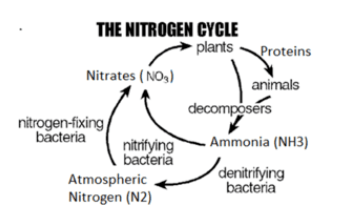
According to this diagram, plants use nitrogen to make _________________________
bacteria
animals
proteins
decomposers
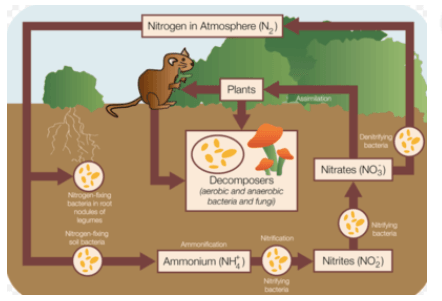
A correct path that nitrogen could take would be
air -> animals -> plants -> bacteria
animals -> air -> bacteria -> plants
bacteria -> air -> plants -> animals
air -> bacteria -> plants -> animals
Bacteria fix nitrogen from the atmosphere into a form plants can use.
True
False
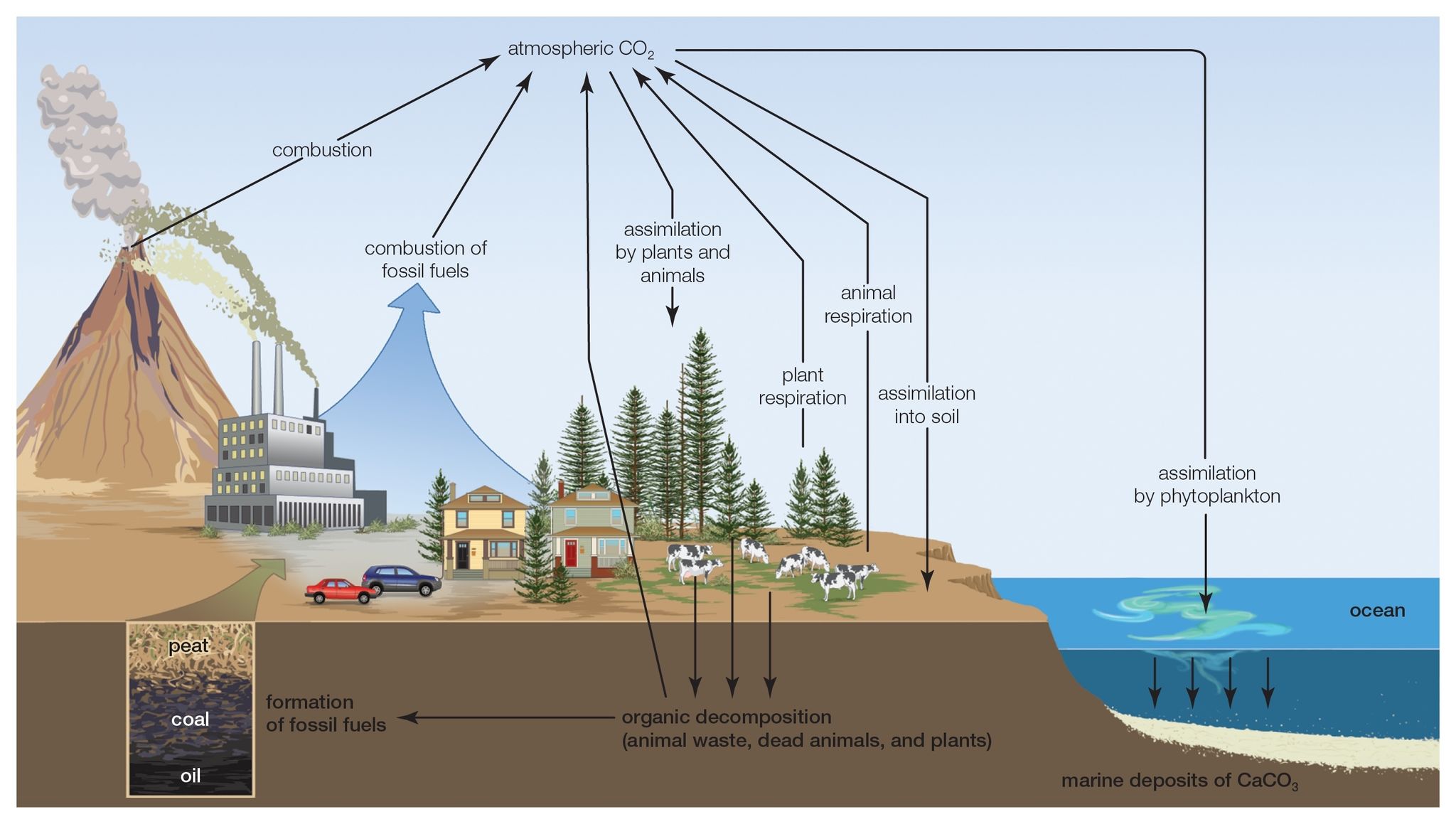
Through food chains, the carbon that is in plants moves to the animals that eat them. When an animal eats another animal, carbon is ___________________.
released
transferred
dissolved
gone
Which process contributes carbon dioxide to the atmosphere?
respiration
photosynthesis
tree farms
Respiration is the process by which animals take in _____ and release _____ to make energy.
CO2 + light + H2O --> O2 + glucose
CO2 + glucose + H2O --> O2 + light
O2 + light + H2O --> CO2 + Glucose
CO2 + O2 + H2O --> light + glucose
Cellular Respiration involves the chemical breakdown of _____ to form ATP Energy
Fats
Fructose
Glucose
Proteins


Philosophical branch that seeks to define what is right, what is wrong, & why.
Equity
Ethics
Economics
Equality
An individual/ company's duties to limit damage to the natural environment.
anthropocentrism
environmental responsibility
biocentrism
moral value
Anthropocentrism:
Human-centered ethics
Life-centered ethics
Ecosystem-centered ethics
Corporate-centered ethics
Ecocentrism:
Human-centered ethics
Life-centered ethics
Ecosystem-centered ethics
Corporate-centered ethics
Biocentrism:
Human-centered ethics
Life-centered ethics
Ecosystem-centered ethics
Corporate-centered ethics
Which one of the following choices involves an ethical decision?
Deciding to buy the cheaper of two similar items.
Determining which one of two pieces of art is the best.
Deciding whether or not to allow trophy hunting of elephants which provides food and income for locals
All of these are ethical decisions.
Stresses a balance between resource use and resource availability.
preservation ethic
conservation ethic
industrial ecology
deep ecology
Which type of symbiosis involves both species benefitting? +/+
Mutualism
Commensalism
Parasitism
Which type of symbiosis involves one species benefitting while the other is harmed? +/-
Mutualism
Commensalism
Parasitism
Which type of symbiosis involves one species benefitting while the other is unaffected? +/0
Mutualism
Commensalism
Parasitism
Form of pollution in which high-level consumers accumulate large concentrations of harmful substances is called:
Biomagnification
Invasive Species
Extinction
Habitat Fragmentation
The collective mass of all living things in a particular area or at a specific trophic level of an ecosystem is known as...
Population Size
Biomagnification
Biomass
Apex Trophism

Which organism in the food web shown to the right would
contain the lowest concentration of chemical pollutants?
producers
primary consumers
secondary consumers
tertiary consumers

The phenomenon by which toxins concentrate in the organisms at higher trophic levels within an ecosystem is known as...
Biotoxicity
Biomagnification
Eutrophication
Predation
Toxin concentrations _____________ as you go up the food chain.
do not change
increase
decrease

Each step or level in a food chain or food web.
trophic level
trophic cascade
food web
food chain

The role or job of an organism in an ecosystem.
Predator
Prey
Predation
Niche

