wayground logo

Free Printable Worksheets

Font size

S
M
L
XL
Worksheets

Physics Final Exam Cumulative Review

Total questions: 65

Worksheet time: 2hrs 45mins

Name
Class
Date
1.

___________ is a vector and is how far away an object is from its starting point.

a)

distance

b)

displacement

c)

velocity

d)

acceleration

2.

__________ is how far an object has traveled

a)

distance

b)

displacement

c)

velocity

d)

acceleration

3.

The motion of an object that travels in a straight line at a constant speed

a)

displacement

b)

relative velocity

c)

uniform motion

d)

frame of reference

4.

A car driving in a circle at 40 miles per hour does not change________ but does change_________

a)

speed, velocity

b)

velocity, speed

5.

Which portion of the graph shows decelerated motion?

a)

A-B

b)

B-C

c)

C-D

d)

D-F

6.

Which portion of the graph shows decelerated motion?

a)

G-H

b)

H-I

c)

I-J

d)

J-K

7.

Which portion of the graph shows uniformly accelerated motion?

a)

G-H

b)

H-I

c)

I-J

d)

J-K

8.

The Road Runner steps off a ledge and drops to the ground in 0.50 seconds. What is the Road Runner's velocity the instant he hits the ground?

a)

3.5m/s

b)

6.4m/s

c)

1.8m/s

d)

4.9m/s

9.

How long will it take to stop a car if its driver starts breaking at a velocity of 32m/s and decelerates the car at 5.0m/s2?

a)

1.8s

b)

6.4s

c)

4.9s

d)

2.1s

10.

It takes 8.75 seconds to stop a car if its driver starts breaking at a velocity of 35m/s and decelerates the car at 4.0m/s2. How far will the car travel before it stops?

a)

153m

b)

307m

c)

86m

d)

215m

11.
If a 10 kilogram object accelerates suddenly at 15 m/s^2, how much force was applied to the object?
a)
150 Newtons
b)
15 Newtons
c)
150 kilograms
d)
100 kilograms
12.
If a force of 50 Newton's was applied to an object with a mass of 500 grams, what will the object's acceleration be?
a)
10 m/s^2
b)
.1 m/s^2
c)
100 m/s^2
d)
1 m/s^2
13.
A 20 kg bike accelerates at 10 m/s2.  what was the force?
a)
25 Newtons
b)
20 Newtons
c)
200 Newtons
d)
10 Newtons
14.
The mass of a car is 1000 kg.  How much force would be required to accelerate the car at a rate of 3 m/s2? 
a)
1000 ÷ 3
b)
3 ÷ 1000
c)
1000 x 3
15.
A force of 250 N is applied to an object that accelerates at a rate of 5 m/s2.  What is the mass of the object? To solve this problem you must do - 
a)
250 ÷ 5
b)
5 ÷ 250
c)
250 x 5
16.

A push or a pull is called a

a)

Gravity

b)

Force

17.

What is Newton's 2nd Law?

a)

For every action there is an equal and opposite reaction.

b)

Acceleration depends on two variables, the mass of the object and the amount of force.

18.

What is Newton's 3rd Law?

a)

For every action there is an equal and opposite reaction.

b)

Acceleration depends on two variables, the mass of the object and the amount of force.

19.

What explains why objects resist changes in their state of motion?

a)

gravity

b)

inertia

c)

force

d)

friction

20.

What does the second part of Newton’s first law say about objects at rest?

a)

They cannot move unless they have a lot of friction.

b)

If they are heavy, they will stay at rest, but if they are light, they will move.

c)

They will stay at rest unless an outside force makes them move.

d)

They have more inertia than objects in motion.

21.

A weightlifter lifts two 300 newton weights 1.5 meters off the ground. How much work has she done?

Work = Force x Distance

a)

600 J

b)

450 J

c)

900 J

d)

1200 J

22.

You do 90 joules of work in 30 seconds. How much power have you generated?

Power = Work/time

a)
30 watts
b)
3 watts
c)
120 watts
d)
270 watts
23.

You move a 8 N object five meters in 4 seconds. How much power have you generated?

Work = Force x Distance

Power = Work/Time

a)

160 watts

b)

10 watts

c)

6.4 watts

d)

17 watts

24.

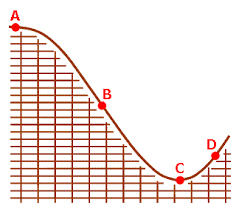
At which point on the roller coaster is the kinetic energy at its maximum?

a)

A

b)

B

c)

C

d)

D

25.

A roller coaster whose average speed is 32 m/s is at the top of a 72m hill and weighs 966N. At the top of the hill the coaster car has ___________________ energy.

a)

almost all kinetic energy

b)

almost all potential energy

c)

mostly kinetic energy

d)

some kinetic and some potential energy

26.

This is energy that is stored for later use.

a)

kinetic energy

b)

potential energy

c)

mechanical energy

d)

radiant energy

27.
Gravitational potential energy depends on the ________ and ________ of the object. 
a)
Height and mass
b)
Friction and movement
c)
Mass and Movement
d)
Height and Friction 
28.
A 60.0 kg person walks from the ground to the roof of a 74.8 m tall building. How much gravitational potential energy does she have at the top of the building?
a)
43982.4 J
b)
63982.3 J
c)
43962.4 J
d)
83942.4 J
29.

A 1600kg car travels at a speed of 12.5m/s. What is its kinetic energy (KE)?

(a)  

30.

Calculate momentum and put them in order from GREATEST to LEAST momentum. (1st one should be the largest)

a)

m = 1000

v = 50

b)

m = 100

v = 100

c)

m = 400

v = 15

d)

m = 2000

v = 2

e)

m = 1500

v = 2

1)
2)
3)
4)
5)
31.
A wrench is used to tighten a nut. A 15N perpendicular force is applied 50cm away from the axis of rotation, and moves a distance of 10 cm as it turns. What is the torque applied to the wrench?
a)

75 Nm

b)
1.5 Nm
c)
750 Nm
d)
150 Nm
32.
The easiest way to open a heavy door  is by applying the force
a)
Near the hinges
b)
In the middle of the door
c)
At the edge of the door far from the hinges
d)
At the top of the door
33.
What is the Unit for Torque
a)
Nm
b)
N
c)
W
d)
J
34.
Does a bridge anchored resting on two pillars have any torque?
a)
No, it isn't moving
b)
Yes, but it is at equilibrium
c)
Yes, but it will soon break because of the torque
d)
No, Bridges can't have torque
35.
If the torque required to loosen a nut on the wheel of a car has a magnitude of 60.0 N• m, what minimum perpendicular force must be exerted by a mechanic at the end of a 45.0 cm wrench to loosen the nut?
a)
.666 Nm
b)
 133.3 N
c)
66.7 N
d)
13.3 Nm
36.

20 kg child is sitting on the end of a seesaw another child with a mass of 26 kg how far from the pivotal point (axis) would the second child need to sit to balance a 2.4 m long seesaw? 2 sig figs

(a)  

37.

10N is applied at a radius of 3 meters from the center of a wheel. What is the magnitude of the torque produced?

a)

10 Nm

b)

30 Nm

c)

30 kg

d)

1000 Nm

38.
The rotational version of force
a)
alpha
b)
moment of inertia
c)
lever arm
d)
torque
39.
Which will produce more torque to loosen the lug nut?
a)
A
b)
B
c)
They are the same
40.

What is the distance the masses on the right of the fulcrum need to be to balance with the two masses on the left?

a)

.65 m

b)

.56 m

c)

.79 m

d)

.39 m

41.

Waves transfer (a)  

Choose from the below words
Matter
Molecules
Energy
Atoms
42.

Which waves require a medium (matter) to travel?

a)

x-ray

b)

microwave

c)

sound 

d)

water

43.

Which letter represents amplitude? (a)  

Choose from the below words
A
B
C
D
E
44.

2. What property of a wave is represented by letter B? (a)  

Choose from the below words
A. Wavelength
B. Amplitude
C. Speed
D. Frequency
45.

8. The lowest part of a transverse wave is known as a (a)   .
Choose from the below words
Trough
Crest
Compression
Rarefaction
Medium
46.
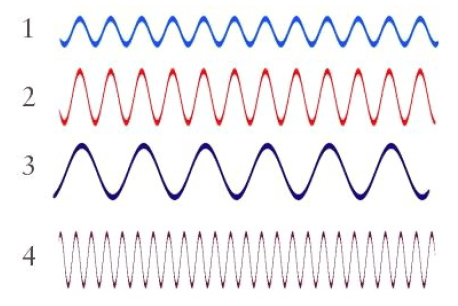
7. Which of the following occurs as the frequency of a wave decreases?
a)
A. The wavelength increases
b)
B. The wavelength decreases
c)
C. The wavelength increases and then decreases
d)
D. The wavelength remains the same
47.
Which wave in the diagram has the greatest frequency?
48.

What types of waves carry energy at a right angle or perpendicular to the direction of the energy flow? (a)  

Choose from the below words
Longitudinal waves
Transverse waves
Sound waves
P-waves
49.
Select the correct order of waves on the EMS 
a)
Radio, Micro, Infra, Visible, Ultra, X-ray, Gamma
b)
Gamma, X-ray, Ultra, Vis, Infra, Micro, Radio
c)
Vis, Micro, Infra, Ultra, X-ray, Gamma, Radio
d)
Micro, Radio, Vis, Infra, Ultra, X-ray, Gamma
50.
Which of the following does sound depend on?
a)
type of medium
b)
distance to the medium
c)
height of the medium
d)
vibration of the medium
51.
When the sound source moves, the frequency changes
ex. police car siren sounding lower pitch after the car passes
a)
pitch
b)
frequency
c)
Doppler Effect
d)
medium
52.

A wave has a frequency of 5 hz and a wave length of 5 m. What is the wave speed (velocity)?

a)

25 m/s

b)

1 m/s

c)

10 m/s

d)

0 m/s

53.

V=fλV=f\lambda  
If the wave velocity is 20 m/s and the wavelength is 2 m, then what is the frequency?

a)

10 Hz

b)

40 Hz

c)

0.1 Hz

54.
Which of the figures represents reflection?
a)
A
b)
B
c)
C
d)
D
55.
As light travels through a lens in causes an object to appear larger, this is due to which behavior?
a)
Transmission
b)
Reflection
c)
Absorption
d)
Refraction
56.

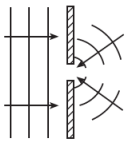
The diagram shows a series of wave fronts approaching an opening in a barrier. Point P is located on the opposite side of the barrier. The wave fronts reach point P as a result of

a)

resonance

b)

refraction

c)

reflection

d)

diffraction

57.

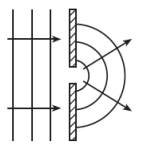
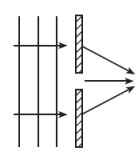
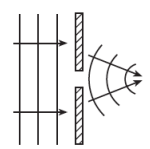
Which diagram best represents the shape and direction of a series of wave fronts after they have passed through a small opening in a barrier?
a)
b)
c)
d)
58.
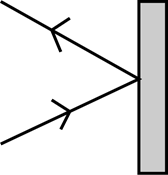
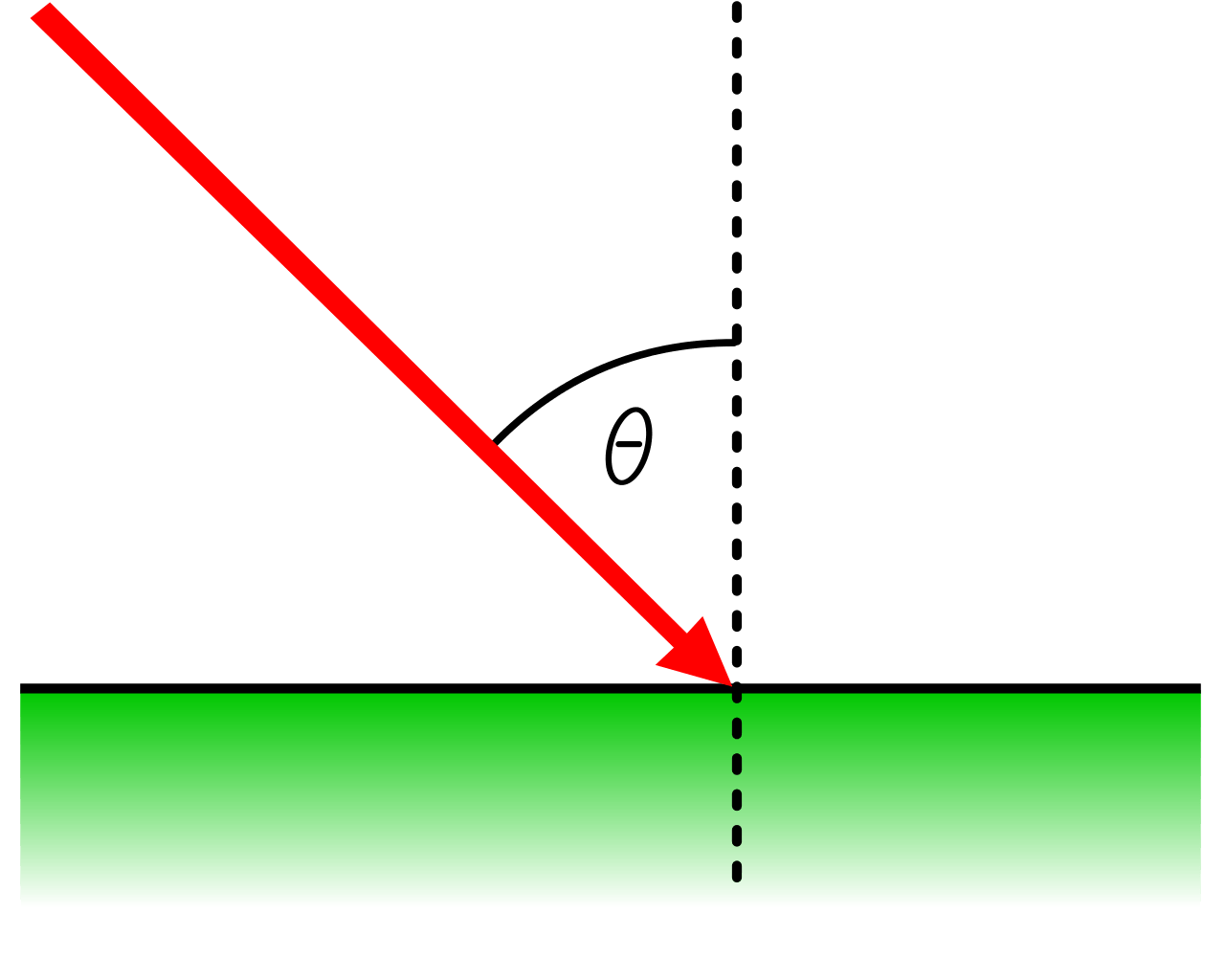
The illustration shows a light ray striking an object.
In the illustration, the light ray striking the object is-
a)
absorbed
b)
stopped
c)
reflected
d)
refracted
59.
According to the Law of reflection, a light ray striking a mirror
a)
continues moving through the mirror in the same direction
b)
moves into the mirror at a slightly different angle
c)
bounces off the mirror toward the direction it came from
d)
bounces off the mirror at the same angle it hits.
60.
This shows the phenomenon known as....
a)
reflection
b)
refraction
c)
mirrors
d)
focal point
61.
Fill in the blank...
SOH ___ TOA
a)
COH
b)
CAH
c)
COA
d)
CHA
62.
What is the ratio for cosine?
a)
H/A
b)
O/A
c)
A/H
d)
A/O
63.
Which Trig function do you use?
a)
Sine
b)
Cosine
c)
Tangent
64.
What is the value of x?
a)
960
b)
30.98
c)
43.91
d)
14.24
65.
What is the value of x?
a)
9.17
b)
98.13
c)
0.11
d)
26.69