
 Worksheets
Ecology (Review Quiz)
Total questions: 116
Worksheet time: 2hrs 49mins
Which is the best description of an ecosystem?
all of the living and nonliving things in an environment
all of the individuals of one species in an area
all of the populations of living things in an area
all of the abiotic factors in an area
Which of the following is an organism?
a herd of sheep
a wolf
a drop of water
a heart
What are the ecological levels of organization from smallest to the largest?
organism, population, community, ecosystem, biome, biosphere
organism, community, population, ecosystem, biome, biosphere
organism, population, community, biome, ecosystem, ecosphere.
organism, community, population, biome, ecosystem, ecosphere
Antonio and Javier are astronauts in space looking back at Earth and discussing how all the life on Earth interacts with each other as well as the nonliving things. What level of organization are they discussing?
A community
A biome
An ecosystem
A biosphere
Jacob is going out to his grandparents fram. On the farm is a stream that he likes to fish at. When he is fishing he sees many differernt speacies of fish as well as maple and oak trees and dragonflies. What Jacob is seeing is an example of what level of organization?
organism
population
community
ecosystem
The largest level of ecological classification
ecosystem
biome
population
biosphere

The study of organisms and how they interact with one another and their environment is best described as
Biology
Ecology
Zoology
Botany
What is the lowest level of ecological hierarchy?
Ecosystem level
Individual organism
Population level
Community level
Give an example of a population in an ecological hierarchy.
A population of fish in a desert ecosystem.
Example: A population of deer in a forest ecosystem.
A population of birds in a marine ecosystem.
A population of insects in a tundra ecosystem.
What do the polar bears, reindeer, and shrubs that live in a single area make up?
organism
population
community
ecosystem
When a scientist is conducting research about all the plants and wildlife in the Mojave Desert as well as the desert’s resources, such as water and soil, the scientist is studying
a community
a population
a species
an ecosystem
The group of polar bears that live along the eastern coast of Russia makes up:
an organism
a community
an ecosystem
a population
Which describes a group of organisms that is considered a species?
They can breed and produce offspring that can breed.
They are members of the same community.
They live in the same ecosystem, community, and biome.
They have similar physical characteristics
The main way nitrogen is removed from the atmosphere and changed into a form plants can use is
Nitrogen Fixation
Nitrification
Ammonification
Denitrification
Biogeochemical Cycles are important because
matter in an ecosystem is finite and must be recycled
living things need Nitrogen, Carbon, and Phosphorus to make the building blocks of cells
they aren't important and it is a waste of time learning about them
If matter didn't cycle, organisms would eventually run out of materials to build new cells

Identify the cycle pictured.
The Water cycle
The Carbon cycle
The Nitrogen cycle
The Phosphorus cycle.

Identify the cycle pictured.
The Water cycle
The Carbon cycle
The Nitrogen cycle
The Phosphorus cycle.

Identify the cycle pictured.
The Water cycle
The Carbon cycle
The Nitrogen cycle
The Phosphorus cycle.

Identify the cycle pictured.
The Water cycle
The Carbon cycle
The Nitrogen cycle
The Phosphorus cycle

Organisms that break down dead plants & animals and release nitrogen back into atmosphere...
bacteria
plants
animals
producers

Which cycle are fossil fuels (oil, coal, natural gas) part of?
carbon
water
nitrogen
phosphorus

Photosynthesis is an important part of the ______ cycle
Carbon
Water
Phosphorus
Nitrogen
Organisms use nitrogen to form
carbohydrates and lipids
proteins and lipids
lipids and nucleic acids
proteins and nucleic acids

What is the process of water droplets or ice crystals falling from the sky?
evaporating
condensing
precipitating
runoff
What are all living things made of?
Phosphorus
Oxygen
Carbon
Nitrogen

The burning of fossil fuels is known as...
Decomposition
Photosynthesis
Combustion
Respiration

Which of the following is an example of a fossil fuel?
Coal
Solar Energy
Hydroelectric Power
Nuclear Power
Animals inhale oxygen and exhale....
CH4
CO2
NH3
N2O
Gases that insulate the atmosphere and keep heat inside are known as
Tollhouse gases
Greenhouse gases
Man-made gases
Fossil gases
Soil bacteria can take N2 gas and break apart its triple covalent bond. This is called...
Ammonification
Nitrification
Nitrogen fixation
Denitrification
Aside from bacteria, another way that nitrogen gas can become "fixed" is through
Thunder
Magic
Lightning
Gravity

Based on the trends of the carrying capacity graph, what is the predicted (estimated) population of organisms, in millions, in 1950?
2.0 million
1.75 million
1.25 million
1.5 million

The data in the graph most strongly support which explanation about the predator-prey relationship of the model?
An increasing predator population acts to increase the prey population.
An increasing prey population acts to decrease the predator population.
A decreasing prey population acts to limit the size of the predator population.
Changes in predator and prey populations act independently, without acting
on one another.
What do we call the variety of life in an ecosystem?
Producer
Biology
Biodiversity
Keystone Species
Describe how human's negatively impact the water cycle (short answer- need detail)
Pollution
Deforestation
Building on and paving areas
All of the above
What is the main thing that carries out Nitrogen Fixation?
Lightning
Bacteria
Plants
Humans
Which of the gases below contributes most to the greenhouse effect?
NO2
CFCs
CO2

The process where rocks are broken down over time by wind and water, releasing phosphorus.
combustion
corrosion
deposition
erosion
Check all of the boxes that show examples of biotic factors.
Rain
Humans hunting
Predators
Wildfire
What is a limiting factor?
Factors that always increase a population
Factors that always decrease a population
Resources that are unlimited
Factors/resources that limit how many organisms can live in an area at the same time
What happens if a population goes over its carrying capacity?
It will continue to grow
It will eventually decrease due to a lack of resources
It will die immediately
It will get unlimited resources
Coyotes cross the winter pack ice and enter Newfoundland. The moose population starts to decline.
Density-Dependent: Competition
Density-Independent: Competition
Density-Dependent: Predator-Prey
Density-Independent: Predator-Prey
A lion and a cheetah attempt to occupy the same niche. The more aggressive lion survives; the cheetah does not.
Density-Dependent: Competition
Density-Independent: Competition
Density-Dependent: Predator-Prey
Density-Independent: Predator-Prey
An environmental factor such as storms and extreme heat or cold that decrease a population are considered to be.
density- dependent factor
population density
dispersion
density- independent factor
Limiting factors which impact the size of a population no matter how large that population is.
Density Independent Limiting Factors
Density Dependent Limiting Factors
Carrying Capacity
Exponential Growth
Natural disasters can be considered limiting factors.
true: density independent limiting factors
false; natural disasters are not limiting factors
true: density dependent limiting factors
false: because Mrs. Schaffer said

If the amount of food or resources available increases, the carrying capacity for an animal:
Stays the same
Increases
Decreases
Fluctuates

The total number of individuals a habitat can survive with the resources it has available.
Carrying capacity
Limiting factors
Resources
Population
The total number of individuals a habitat can survive with the resources it has available.
Carrying capacity
Limiting factors
Resources
Population

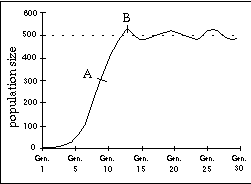
What is the carrying capacity of the following graph?
1000
8000
800
600

Many fish die due to a change in the winds and the appearance of the El Nino ocean current off the coast of Peru and Chile.
Density-Dependent
Density-Independent
Fish on a coral reef stake out their territory and chase away any younger fish that try to live there.
Density-Dependent
Density-Independent
An extensive drought in the Serengeti Plain threatens wildebeest, giraffe, zebra, and springbok populations.
Density-Dependent
Density-Independent
Travelers who visit a crowded African village become infected with a disease caused by parasites.
Density-Dependent
Density-Independent

Describe what is happening in this chart
The population of the species is growing exponentially (lots of birth and immigration)
The population is species is growing but reaches carrying capacity
The population of the species is shrinking
There is not enough information to tell
What does DENSITY DEPENDENT mean?
The ecosystem dynamics is affected by the population
The ecosystem dynamics is not affected by the population
In 1944, 29 reindeer were introduced to St. Matthew Island off the coast of Alaska. With plenty of food the population grew exponentially to 6000 in 1963. There was a bad winter and most of the food resources died. In the spring of 1964, only 50 reindeer remained on the island. What do you believe would have happened to the reindeer herd if the winter had not made foraging so difficult?
Reach carrying capacity
Continue to grow exponentially
Still have a population crash
The reindeer population would disappear
population grows without a limit
Population Density
Carrying Capacity
Limiting Factor
Exponential Growth
population grows quickly, then levels off
Exponential Growth
Logistical Growth
Immigration
Emigration
How does the Earth keep itself warm?
Sunlight keeps the Earth warm.
There are heat lamps orbitting above the Earth's atmosphere.
The greenhouse gases trap the warm air and send it back to the Earth's surface.

The graph shows us that
the earth temperature is always increasing
the earth's temperature has steadily increased since 1900
the earth's temperature has steadily rising since the 1960s
the earth's temperature decreased during the 19th and 20th centuries
What is worsening many types of disasters due to higher temperatures?
More severe weather
Reduced floods
Less frequent heat waves
Decrease in storms
What are some of the effects of global warming that scientists have already observed?
Melting glaciers and ice sheets
Less intense hurricanes
Decrease in heat waves
Increase in sea ice

After a landslide removes all the plants, but leaves the soil behind, what type of succession might occur?
Primary
Secondary
Teritary
What is a climax community? Select 2
The final community in an ecosystem
The first species to appear after a forest fire
Moss and lichen
Tall hardwood trees
Which type of succession reaches the climax community faster?
primary succession
secondary succession
Which type of succession happens when a new island is formed by a volcano erupting?
primary succession
secondary succession
Several years after a building had been torn down and the ground cleared, grasses began to grow in that area. After 10 years, small bushes replaced the grasses. This pattern of plant growth is known as:
Biological
control
Cover cropping
Ecological
succession
Land-use
management
Abandoned railroad tracks are overgrown with weeds. Ten years later there are small aspen trees growing in the middle of the tracks. This change is an example of:
Primary succession
Biological evolution
Secondary succession
Heterotrophic nutrition

Non-native species whose introduction causes, or can cause harm in their new area
Pioneer Species
Invasive Species
Keystone Species
Foundation Species
The first species to populate an area during succession.
Keystone species
Pioneer species
Foundation species
Invasive species

After a volcanic eruption, volcanic rock is present (but no soil). Which of the following states the most likely order of succession that would be seen?
Lichens → Shrubs → Grasses → Trees
Lichens → tree → shrubs→Grasses
Grasses → Lichens → Shrubs → Trees
Lichens → Grasses → Shrubs → Trees

Primary or secondary ecological succession?


When one organism eats another organism.
Competition
Parasitism
Commensalism
Predation
Mutualism
When two organisms fight for the same resource
Competition
Parasitism
Commensalism
Predation
Mutualism
When one organism benefits while the other organism is neither helped or hurt.
Competition
Parasitism
Commensalism
Predation
Mutualism
When both organisms benefits.
Competition
Parasitism
Commensalism
Predation
Mutualism
When one organism benefits while the other organism is hurt.
Competition
Parasitism
Commensalism
Predation
Mutualism

What is the relationship shown?
Predation
Commensalism
Competition
Parasitism
Mutualism

What is the relationship shown?
Predation
Commensalism
Competition
Parasitism
Mutualism

What is the relationship shown?
Predation
Commensalism
Competition
Parasitism
Mutualism

What is the relationship shown?
Predation
Commensalism
Competition
Parasitism
Mutualism
What is the relationship shown?
Predation
Commensalism
Competition
Parasitism
Mutualism

What is the relationship shown?
Predation
Commensalism
Competition
Parasitism
Mutualism

What is the relationship shown?
Predation
Commensalism
Competition
Parasitism
Mutualism

What is the relationship shown?
Predation
Commensalism
Competition
Parasitism
Mutualism

What is the relationship shown?
Predation
Commensalism
Competition
Parasitism
Mutualism

What is the relationship shown?
Predation
Commensalism
Competition
Parasitism
Mutualism

What is the relationship shown?
Predation
Commensalism
Competition
Parasitism
Mutualism

What is the relationship shown?
Predation
Commensalism
Competition
Parasitism
Mutualism
Mimicry means:
A tree that has pink flowers in the spring
When one living thing looks like a different kind of living thing
A way an animal blends in with its environment
Camouflage means:
A special dessert
When an animal looks like another animal
A way an animal can look like its surroundings
Which is NOT an example of camouflage:
a tigers stripes blend in with long grass
A solder's uniform helps him blend in to the background
Sand wasps & yellow jackets are different insects but both have yellow & black stripes
Which is NOT an example of mimicry:
The fur of an arctic fox turns white in winter to match the snow
An alligator snapping turtle's tonge looks like a worm, so he lures fish to his mouth
A bad tasting butterfly & a good tasting butterfly look similar, so birds don't eat either kind
Which picture is NOT an example of camouflage?


Which picture is an example of mimicry?


Which type of adaptation is show in the image?
mimicry
camouflage

