wayground logo

Free Printable Worksheets

Font size

S
M
L
XL
Worksheets

Biology Interim Review

Total questions: 112

Worksheet time: 1hrs 27mins

Name
Class
Date
1.
Proteins are made of monomers called ___________
a)
Nucleotides
b)
Monosaccharides
c)
Amino Acids
d)
Glycerol and fatty acids
2.
DNA and RNA are examples of 
a)
Carbohydrates
b)
Lipids
c)
Proteins
d)
Nucleic Acids
3.
Nucleotides are monomers of
a)
Carbohydrates
b)
Lipids
c)
Proteins
d)
Nucleic Acids
4.
Monosaccharides are monomers of
a)
Carbohydrates
b)
Lipids
c)
Proteins
d)
Nucleic Acids
5.
Waxes, oils and fats are examples of
a)
Carbohydrates
b)
Lipids
c)
Proteins
d)
Nucleic Acids
6.
What is the function of nucleic acids?
a)
store genetic information
b)
store energy (long-term)
c)
store energy (short-term)
d)
build skin, hair, nails, muscles
7.
Which of the following organic compounds is the main source of energy for living things?
a)
carbohydrates
b)
lipids
c)
nucleic acids
d)
proteins
8.
Which macromolecule stores energy, insulates us, and makes up the cell membrane?
a)
lipids
b)
proteins
c)
carbohydrates
d)
nucleic acids
9.
All polymers are made up of...
a)
monosaccharides
b)
monomers
c)
proteins
d)
None of these
10.
Lipids can be digested into what smaller subunits?
a)
nucleic acids
b)
amino acids
c)
fatty acids
d)
glucose
11.

Enzymes belong to which class of macromolecules?

a)

lipids

b)

carbohydrates

c)

proteins

d)

nucleic acids

12.

Which macromolecule is shown?

a)

lipid

b)

protein

c)

nucleic acid

d)

carbohydrate

13.
Is found in the cell membrane as a bilayer. 
a)
lipids
b)
protein
c)
nucleic acid
d)
carbohydrate
14.
What are the single sugars that are the building blocks of carbohydrates?
a)
monosaccharides
b)
disaccharides
c)
polysaccharides
d)
amino acid
15.

What is the key role (function) of carbohydrates?

a)

energy storage

b)

immunity, muscles, structure for tissues, cell metabolism

c)

instant energy for cells and body functions

d)

genetic information (heredity)

16.
Examples of which biological macromolecule include glucose, fructose, starch, and glycogen?
a)
Lipids
b)
Carbohydrates
c)
Nucleic Acids
d)
Proteins
17.
__________________ provide us with quick energy, while _________________ are our secondary energy source.
a)
Lipids, proteins
b)
Carbohydrates, nucleic acids
c)
Proteins, carbohydrates
d)
Carbohydrates, lipids
18.

If this property of a protein is changed, the protein will denature and will no longer function properly

a)

Number of carbon and hydrogen atoms

b)

size

c)

shape

d)

color

19.

Oils are liquid at room temperature because they are...

a)

saturated fats

b)

unsaturated fats

c)

have a high boiling point

d)

they are not liquid

20.
What is a substance called if it speeds up a chemical reaction?
a)
reusable
b)
catalyst
c)
specific
d)
fragile
21.
With what 3 letters do enzymes typically end?
a)
-ose
b)
-ase
c)
-ese
d)
-tic
22.
Each enzyme only has 1 substrate that will fit its active site.  What is this called?
a)
reusable
b)
catalyst
c)
specific
d)
fragile
23.
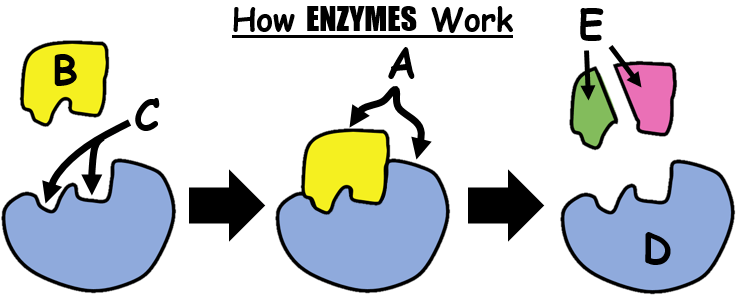
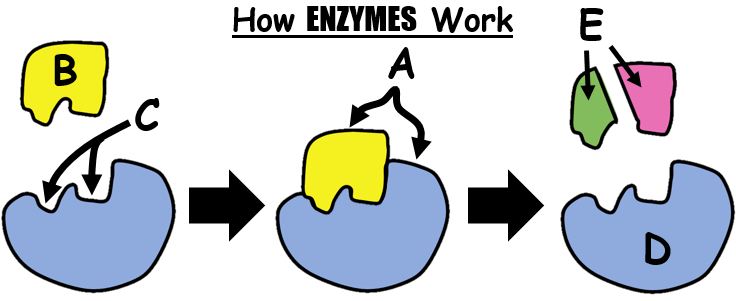
Letter D...
a)
active site
b)
enzyme
c)
substrate
d)
products
24.
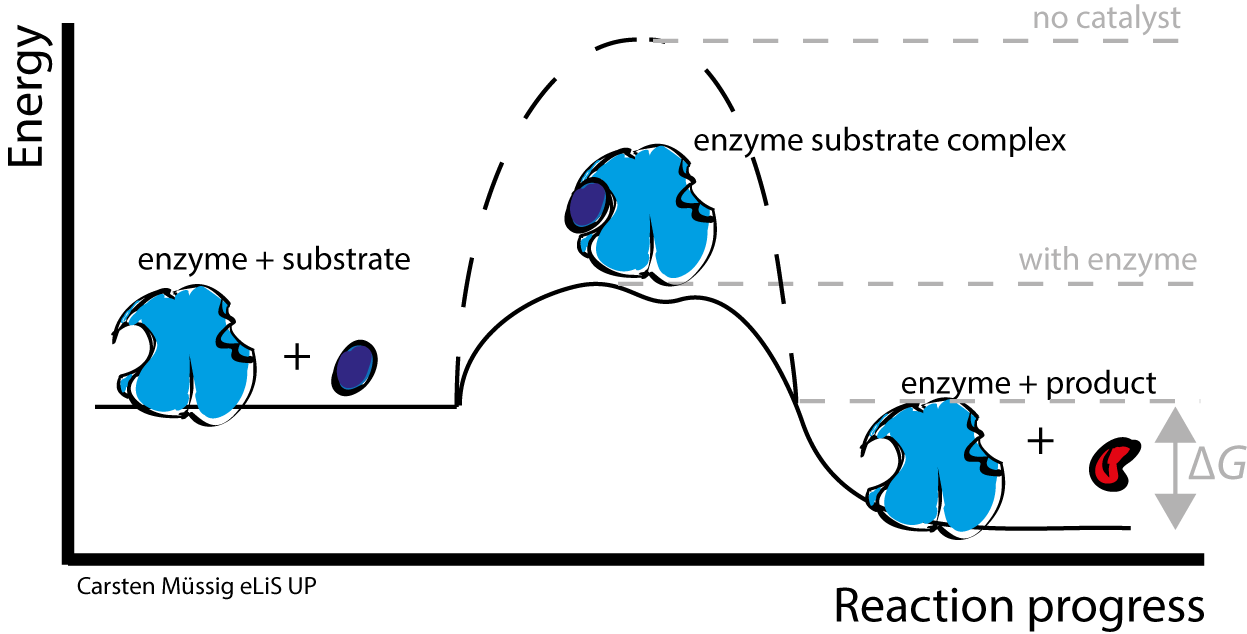
An enzyme speeds up a reaction by
a)
lowering the activation energy.
b)
raising the activation energy.
c)
releasing energy.
d)
absorbing energy.
25.

What happens when enzymes are heated to a high temperature?

a)

The enzymes die.

b)

The shape of the enzyme are changed and it denatures

c)

The enzymes' amino acid sequence changes.

d)

The enzymes remain the same

26.
Which of these is NOT true?
a)
Enzymes can denature (change shape) when the temperature gets too high.
b)
Enzymes can only be used once in a chemical reaction. 
c)
Extreme pH can denature enzymes.
d)
Enzymes speed up chemical reactions. 
27.
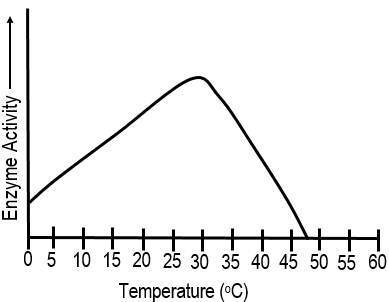
Based on the graph, what temperature does this enzyme work best? 
a)
15 C
b)
40 C
c)
30 C
d)
47 C
28.
Enzymes will make a reaction go _______ and use ______ energy.
a)
faster, less
b)
faster, more
c)
slower, less
d)
slower, more
29.
In the diagram, what is letter A? 
a)
product
b)
substrate
c)
enzyme-substrate complex
d)
active site
30.

REFER TO GRAPH: Which enzyme would function best in the human body?

a)

A (blue)

b)

B (red)

c)

Both

d)

Neither

31.

REFER TO GRAPH: At a pH of 4, what could happen to this enzyme?

a)

It would catalyze the substrate at a faster rate.

b)

It would have no effect.

c)

It would function at its optimum.

d)

It would possibly denature.

32.

REFER TO GRAPH: If the pH of Catalse were altered, it would function better at a pH of ____.

a)

2

b)

4

c)

6

d)

9

33.

Which organelle contains genetic material?

a)

Endoplasmic Reticulum

b)

Golgi Complex

c)

Nucleolus

d)

Nucleus

34.
What is the function of the vacuole?
a)
Sac that stores water, nutrients, and waste products
b)
Sac filled with digestive chemicals
c)
Jelly-like substance within the plasma membrane
d)
stack of membranes that packages chemicals
35.
Where does photosynthesis occur?
a)
mitochondria
b)
stomata
c)
xylem
d)
chloroplast
36.
I make proteins for the cell. What am I?
a)
ribosome
b)
mitochondria
c)
chloroplast
d)
lysosome
37.
What can only be found in plant cells?
a)
Cell membrane
b)
Vacuole
c)
Chloroplast
d)
Mitochondrion
38.
The two kinds of cells are Prokaryotes and Eukaryotes. How are they different?
a)
Prokaryotes have a nucleus.
b)
Eukaryotes have a nucleus.
c)
Prokaryotes are plant cells.
d)
There is no difference.
39.
What cell part is NOT found in all cells?
a)
Cell Wall
b)
Cell Membrane
c)
Cytoplasm
d)
Genetic Material
40.
This organelle eliminates waste. 
a)
Nucleus
b)
ER
c)
Vacuole
d)
Lysosome
41.
This is a double layer of phospholipids that creates a barrier between the cells internal and external environments; it controls what comes in or out of the cell (selective permeable)
a)
Nucleus
b)
Cilia
c)
Cell membrane
d)
Flagella
42.
Produces energy in the form of ATP for the cell.
a)
chloroplast
b)
mitochondria
c)
ribosome 
d)
nucleus
43.
Transports materials throughout the cell.  Acts as an assembly line for proteins.
a)
endoplasmic reticulum
b)
vacuole
c)
nucleus
d)
ribosome
44.

Which organelle receives proteins and materials from the endoplasmic reticulum, packages them, and distributes them?

a)

lysosomes

b)

golgi apparatus

c)

ribosomes

d)

endoplasmic reticulum

45.

Which homeostatic process requires energy to move particles across the plasma membrane?

a)

active transport

b)

passive transport

c)

dynamic equilibrium

d)

osmosis

46.

Which homeostatic process moves particles against a concentration gradient?

a)

dynamic equilibrium

b)

passive transport

c)

osmosis

d)

active transport

47.

Which statement describes the ability of the cell membrane to allow various substance to move through it?

a)

The cell membrane is selectively permeable.

b)

The cell membrane is composed of lipids and phosphates.

c)

The cell membrane is both hydrophilic and hydrophobic.

d)

The cell membrane is a bilayer structure.

48.

Which best describes dynamic equilibrium?

a)

There is a difference in concentration on either side of the cell membrane.

b)

There is an uneven distribution of particles inside and outside the cell.

c)

Particles are moving into and out of the cell, but their concentrations remain stable.

d)

A concentration gradient is forcing water out of the cell and particles into the cell.

49.

In which kind of solution is the concentration of solutes the same inside and outside of the cell?

a)

isotonic

b)

hypertonic

c)

hypotonic

d)

concentrated

50.

Which process is characterized by the movement of particles from an area of high concentration to an area of low concentration across the plasma membrane without the use of energy?

a)

hypertonic transport

b)

active transport

c)

passive transport

d)

dynamic equilibrium

51.

Which motion of particles across a membrane requires energy?

a)

from high concentration to low concentration

b)

from low concentration to high concentration

c)

with no concentration gradient

d)

through dynamic equilibrium

52.

What would most likely happen to a unicellular organism if it was exposed to a hypotonic solution for an extended period of time?

a)

It would shrivel and shrink.

b)

It would swell but never burst.

c)

It would swell and then burst.

d)

It would not be affected.

53.

Which solution would most likely cause a plant placed in it to become firmer and more rigid?

a)

hypertonic

b)

hypotonic

c)

isotonic

d)

osmotic

54.

Water makes up a large percentage of the body’s cells. For a cell to remain in homeostasis, there must be a mechanism to control water changes in the cells. The movement of water from an area of high water concentration to an area of low water concentration is ___________.

a)

diffusion

b)

osmosis

c)

active transport

d)

stable transport

55.
What type of transport is occurring in part A of the diagram?
a)
Facilitated Diffusion
b)
Osmosis
c)
Active Transport
d)
Diffusion
56.
What type of transport is occurring in part B of the diagram?
a)
Osmosis
b)
Diffusion
c)
Facilitated Diffusion
d)
Active Transport
57.
What type of transport is occurring in part C of the diagram?
a)
Passive Transport
b)
Osmosis
c)
Active Transport
d)
Facilitated Diffusion
58.
ATP is synthesized in this organelle during cellular respiration.
a)
Vacuole
b)
Mitochondria
c)
Chloroplast
d)
Ribosome
59.

Osmosis is specifically.....

a)

diffusion of water molecules through a semi-permeable mebrane from an area of low concentration to an area of high concentration
b)

the diffusion of particles from an area of high concentration to an area of low concentration

c)

diffusion of water molecules through a semi-permeable membrane from an area of high concentration to an area of low concentration

d)

the diffusion of particles from an area of low concentration to an area of high concentration

60.
A student noticed that placing wilted lettuce in a bowl of cool water caused the lettuce to become more crisp and firm. What is the best explanation for his observation?
a)
Water moved into the lettuce cells by active transport.
b)
Water moved into the lettuce cells by osmosis.
c)
Salt moved into the lettuce cells by diffusion.
d)
Water moved out of the lettuce cells by osmosis.
61.
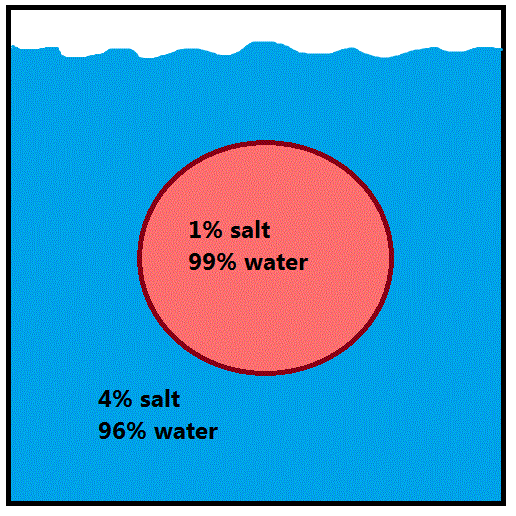
Where will the water go?
a)
Into the cell
b)
Out of the cell
c)
Equally in & out - it's isotonic
d)
There is no water
62.

Nemo and other ocean dwelling fish cannot survive in freshwater because......

a)

freshwater is hypertonic to Nemo's cells and will result in water leaving them causing the cells to shrink

b)

freshwater is hypotonic to Nemo's cells and will result in water leaving them causing the cells to shrink

c)

freshwater is hypertonic to Nemo's cells and will result in water entering them causing the cells to swell and burst

d)

freshwater is hypotonic to Nemo's cells and will result in water enter them causing the cells to swell and burst

63.

In the cell pictured, which way would water move?

a)

Into the cell, causing the cell to swell

b)

Out of the cell, causing the cell to shrink

c)

In and out of the cell equally, keeping the shape the same

64.

In the cell pictured, where would water move? 

a)

Into the cell, causing it to swell

b)

Out of the cell, causing it to shrink

c)

In and out of the cell equally, causing the shape to stay the same

65.
This picture represents what type of cell transport?
a)
endocytosis
b)
exocytosis
c)
osmosis
d)
passive transport
66.
Active transport requires ______, moves materials from __________________, and goes _______ the concentration gradient.
a)
No energy, low to high, against
b)
ATP, high to low, with
c)
ATP, low to high, with
d)
ATP, low to high, against
67.
A type of active transport that releases particles that were enclosed from a cell when the membrane of the vesicle fuses with that of the cell membrane
a)
Exocytosis
b)
Osmosis
c)
Mitosis
d)
Endoyctosis
68.
A type of active transport that brings particles into a cell when the cell membrane encloses a particle to make a vesicle
a)
Diffusion
b)
Passive Transport
c)
Active Transport
d)
Endocytosis
69.
What is this picture showing?
a)
Endocytosis
b)
Mitosis
c)
Photosynthesis
d)
Cellular Respiration
70.
What is the function of ATP in living things?
a)
provides energy for cells
b)
stores genetic information
c)
provides structure in the nucleus
71.
Which structures shown in the Figure make up the ADP molecule?
a)
A and B
b)
A, B and C
c)
A, B, C, and D
d)
C and D
72.
Which of the following can be compared to a battery in need of recharging?  (empty wallet)
a)
ADP
b)
ATP
c)
Ribose
d)
Adenosine
73.
Which bond of the ATP molecule is broken in order to release energy?
a)
A
b)
B
c)
C
d)
D
74.
Using the figure, between which parts of the molecule must the bonds be broken to form an ADP molecule?all of the above
a)
A and B
b)
B and C
c)
C and D
75.
What type of energy is glucose?
a)
carbohydrate
b)
protein
c)
nucleic acid
d)
lipid
76.

What is the name of the low energy molecule of the cell?

a)

ATP

b)

ADP

77.
Which of the following is the correct equation for PHOTOSYNTHESIS?
a)
CO+ light + H2O --> O+ Sugar
b)
CO+ sugar + H2O --> O+ light
c)
O2 + light + H2O --> CO+ Sugar
d)
CO+ O2 + H2O --> Light+ Sugar
78.
What process occurs when light energy is captured in autotrophs and converted into sugar?
a)
Photosynthesis
b)
Cellular Respiration
79.
Which gas is removed from the atmosphere during photosynthesis?
a)
hydrogen
b)
oxygen
c)
nitrogen
d)
carbon dioxide
80.
What are the products of photosynthesis?
a)
water and carbon dioxide
b)
oxygen and glucose
c)
oxygen and carbon dioxide
d)
oxygen and water
81.
Cellular respiration is a cellular process that occurs in the cells of –
a)
plants
b)
Plants and Animals
c)
Animals
d)
None
82.
What are the two reactants of cellular respiration?
a)
C6H12O6 & 6CO2
b)
6 CO2 & 6H2O
c)
C6H12O& 6O2
d)
6CO2 & 6O2
83.
Fermentation involves
a)
aerobic respiration
b)
anaerobic respiration 
84.

Which of the following best explains the affect of cell respiration?

a)

Oxygen is released into the atmosphere

b)

Carbon dioxide is released into the atmosphere

c)

Glucose is released into the atmosphere

d)

ATP is released into the atmosphere

85.

Which of the following best explains the purpose of cell respiration?

a)

In cell respiration, sunlight is used to make sugar

b)

In cell respiration, sunlight is used to make ATP

c)

In cell respiration, glucose is used to make energy

d)

In cell respiration, oxygen is used to make sugar

86.
What is the correct equation for cellular respiration?
a)
6O2 + C6H12O6 -> 6CO2 + 6H2O + Energy
b)
6O2 + C6H12O6 + Energy -> 6CO2 + 6H2O
c)
6CO2 + 6H2O -> 6O2 + C6H12O6 + Energy
d)
6CO2 + 6H2O + Energy -> 6O2 + C6H12O6
87.
Cellular Respiration's goal is to
a)
make water
b)
make ATP
c)
make glucose
d)
make  oxygen
88.

What are the two parts of the cell cycle?

a)

Interphase and Mitosis

b)

Interphase and Cytokinesis

c)

Interphase and Meiosis

d)

Mitosis and Meiosis

89.

In what part of the Cell Cycle does the cell grow and replicate DNA?

a)

Interphase

b)

Mitosis

c)

Meiosis

d)

Cytokinesis

90.

What is the order of the three phases in interphase?

a)

G1, G2, S

b)

S, G1, G2

c)

G1, S, G2

d)

G1, G2, G3

91.

What would happen if you are injured and the cell cycle is stopped in your body?

a)

You would form cancer

b)

The injury wouldn't heal

c)

You would mutate

d)

The injury would get worse

92.

In one phase of mitosis the chromosomes are attached to spindle fibers and line up in the center of the cell – what phase is this?

a)

Anaphase

b)

Telophase

c)

Prophase

d)

Metaphase

93.

How many daughter cells are formed during mitosis?

a)

4

b)

3

c)

2

d)

1

94.

What happens to the chromosomes during anaphase?

a)

they line up

b)

they are pulled apart

c)

they are at either end of the cell

d)

they duplicate

95.

Do the daughter cells formed from mitosis have DNA identical to the parent cells or different to the parent cells?

a)

Identical

b)

Different

c)

Identical but different

96.

Which phase of cell division is different in plant cells verses animal cells?

a)

interphase

b)

mitosis

c)

cytokinesis

d)

telekinesis

97.

What phase of mitosis is shown in D?

a)

Prophase

b)

Telophase

c)

Anaphase

d)

Metaphase

98.

Cells of organisms must replicate for?

a)

Growth

b)

Replacement of dying cells

c)

Repair of damaged cells

d)

All of the above

99.

What is the correct order of the phases of mitosis?

a)

Metaphase, Anaphase, Prophase, Telophase,

b)

Pelophase, Motophase, Anaphase, Trophase

c)

Prophase, Metaphase, Anaphase, Telophase

d)

Telophase, Anaphase, Prophase, Metaphase

100.

Why do cells go through mitosis?

a)

to make food from sunlight

b)

to get air into the cells

c)

to create proteins

d)

to reproduce, grow, and repair/replace cells

101.
Which phase of the cell cycle is #1?
a)
Interphase
b)
Prophase
c)
Anaphase
d)
Metaphase
102.
Which phase of the cell cycle is #2?
a)
Interphase
b)
Prophase
c)
Anaphase
d)
Metaphase
103.
Which cells are more efficient at obtaining nutrients?
a)
Small Cells
b)
Medium Size Cells
c)
Large Cells
d)
X-Large Cells
104.
What is the relationship between the cell size and the cell nutrient absorption rate?
a)
The smaller the cell size the less nutrients are absorbed
b)
The larger the cell size the more nutrients are absorbed
c)
The smaller the cell size the more nutrients are absorbed
d)
The relationship between cell size and nutrient absorption rate cannot be determined
105.
All of these issues can occur if a cell gets too large EXCEPT;
a)
Nutrients take longer to reach the cell
b)
An information overload occurs
c)
a high surface to volume ratio
d)
wastes take longer to remove
106.
What determines the rate of nutrients and waste are exchanged from the cell and the environment?
a)
surface ratio
b)
volume
c)
surface area
d)
surface area to volume ratio
107.
The absorption of nutrients is determined by...
a)
The cell's volume
b)
The cell's surface area
c)
The cell's ribosomes
d)
The cell's DNA
108.
As a cell becomes larger, its
a)
surface area increases faster than its volume.
b)
volume increases faster than its surface area
109.
The larger a cell is, the more difficult it is for the cell to move enough nutrients and wastes across its cell membrane to maintain its normal functions.
a)
True
b)
False
110.
This image shows how materials move into various sized cells in a given amount of time.... why does one square cell have more pink coloring than the others? 
a)
The surface area was too larger to get through
b)
The volume of the other cells was too large for the dye to get through
c)
There was not enough surface area for the dye to get through
d)
The volume was too low for the dye to stay in the square
111.
Microvilli are tiny projections that extend off the cell to increase the Surface Area.  What purpose might that serve? 
a)
Increased absorption
b)
Better communication among cells
c)
Maintain homeostasis 
d)
Decreased oxygen use
112.

High Surface area to volume ratio allows cells to do what quickly?

a)

Move materials around inside the cell

b)

Move materials in and out of the cell

c)

Communicate to other cells

d)

Divide