wayground logo

Free Printable Worksheets

Font size

S
M
L
XL
Worksheets

Biology EOC Review

Total questions: 130

Worksheet time: 2hrs 40mins

Name
Class
Date
1.

The cell theory is...

a)

All living organisms are composed of at least one cell.

b)

building blocks of life. All cells come from

c)

All of the above

d)

Cells arise only from previously existing cells.

2.

A prokaryotic cell is...

a)

Cells that don't contain a nucleus but do contain other membrane-bound organelles.

b)

Cells that contain a nucleus but no other membrane-bound organelles.

c)

Cells that contain a nucleus and other membrane-bound organelles.

d)

Cells that don't contain a nucleus or any other membrane-bound organelles.

3.

A Eukaryotic cell is...

a)

Cell that has no membrane.

b)

Cell with no membrane-bound organelles.

c)

A cell containing a nucleus and other membrane-bound organelles.

d)

A cell containing a nucleus and other nucleus-bound organelle.

4.

The cell membrane main purpose is...

a)

Selective Permeability

b)

Energy Production

c)

Locomotive

d)

Looking good

5.
Which symbiotic relationship is described by one individual benefiting and the other being neither harmed nor benefited?
a)
Mutualism
b)
Commensalism
c)
Parasitism
d)
Competition
6.
Where in the cell does cell respiration occur?
a)
chloroplast 
b)
central vacuole 
c)
mitochondria
d)
cell membrane
7.
This organic molecule is the main component of biological membranes.....
a)
carbohydrates
b)
lipids 
c)
proteins 
d)
nucleic acids
8.
Which of the following is found in plant cells but not in animal cells? 
a)
Cytoplasm
b)
Mitochondria
c)
Cell Wall 
d)
Ribosomes 
9.
What plant organelle is used to make sugars?
a)
Cell wall 
b)
Mitochondria 
c)
Chloroplast 
d)
Vacuole
10.
Which part of the cell is often called "the brain of the cell"?
a)
nuclear membrane
b)
endoplasmic reticulum
c)
nucleus
d)
mitochondria
11.

What is the outer most part of a cell?

a)

cell wall

b)

nucleus

c)

cell membrane

d)

cell skin

12.
Which organelle uses energy from sunlight to make sugar?
a)
mitochondria
b)
nucleus
c)
chloroplasts
d)
vacuoles
13.
Controls what enters/leaves a cell
a)
cell membrane
b)
Nuclear membrane
c)
cell wall
d)
cytoplasm
14.
A mite lives in the base of the eyelashes of people who use mascara. It feeds on the mascara; it does not seem to harm people. What type of symbiotic relationship is this?
a)
mutualism
b)
commensalism
c)
parasitism
d)
predation
15.
A coyote captures, kills, and eats a rabbit. What type of symbiotic relationship is this?
a)
mutualism
b)
commensalism
c)
parasitism
d)
predation
16.
The flower of the yucca plant provides the only location where the yucca moth can lay her eggs. In the process, the moth pollinates the yucca flower. What type of symbiotic relationship is this?
a)
mutualism
b)
commensalism
c)
parasitism
d)
predation
17.
A tapeworm lives in the intestines of a dog. It absorbs food the dog has eaten and grows larger in the process. The dog becomes weaker from malnutrition. What type of symbiotic relationship is this?
a)
mutualism
b)
commensalism
c)
parasitism
d)
predation
18.

True or False: Lipids are insoluble

a)

True

b)

False

19.

True or False: The main function of a lipid is to store energy.

a)

True

b)

False

20.

The units of protein are

a)

Amino acids

b)

Glucose

c)

Fatty acid

d)

Peptides

21.
Which of the following is the smallest unit of life that can carry out all life functions?
a)
the mitochondria
b)
the vacuoles
c)
the nucleus
d)
the cell
22.
Which structures are found in every living cell?
a)
cell membrane and cytoplasm
b)
chloroplasts and mitochondria
c)
a cell wall and nucleus
d)
chloroplasts and cell wall
23.
Which cell structure is found in plant and animals cells and controls what can come into or leave a cell?
a)
cell membrane
b)
cytoplasm
c)
nucleus
d)
vacuole
24.
What is the function of the cell nucleus found in both plant and animal cells?
a)
to produce energy
b)
to control cell activity
c)
to remove waste products
d)
to allow molecules to enter the cell
25.
What is the function of a cell wall?
a)
to protect and support the cell
b)
to perform different functions in each cell
c)
to prevent water from passing through it
d)
to prevent oxygen from entering the cell
26.
In what part of the plant cell does the process of photosynthesis take place?
a)
nucleus
b)
mitochondria
c)
chloroplasts
d)
vacuoles
27.
To convert the energy of glucose into  the  usable form of ATP is a function of _________.
a)
Cell Wall
b)
Cytoplasm
c)
Nucleus
d)
Mitochondria
28.
What is the main function of chloroplast?
a)
Mitosis
b)
Meiosis
c)
Translation
d)
Photosynthesis
29.

A student noticed that the freshwater plant, Elodea, produced bubbles when placed in direct light. What could the student most likely conclude?

a)

Bubbles of carbon dioxide were produced as a result of photosynthesis.

b)

Bubbles of oxygen were produced as a result of photosynthesis.

c)

Bubbles of carbon dioxide were produced as a result of cellular respiration

d)

Bubbles of oxygen were produced as a a result of cellular respiration

30.

Plant cells are able to produce their own food. This process happens in which structure?

a)

cell wall

b)

chloroplast

c)

mitochondrion

d)

vacuole

31.

These diagrams show a variety of cells from the same organism. How can cells from the same organism have such different shapes and functions?

a)

As each cell differentiates, the DNA changes so that each type of cell has different DNA once it reaches maturity.

b)

Mutations in the cells' nuclei lead to new combinations of DNA, resulting in different shapes and functions in the different types of cells.

c)

During differentiation, different parts of the DNA in each type of cell are activated, resulting in the different structure and function of the cells.

d)

During differentiation, different types of cells produce proteins which destroy the nonactive DNA, leading to cell specialization.

32.

Which statement best explains how sweating during exercise maintains homeostasis?

a)

It regulates mineral concentrations in cells.

b)

It regulates body temperature.

c)

It maintains water balance.

d)

It maintains sugar balance in cells.

33.

Which statement best explains why animals are considered heterotrophic?

a)

They are able to produce food through the process of photosynthesis.

b)

They are able to produce food through the process of respiration.

c)

They are able to obtain nutrients by decomposing plant and animal tissue.

d)

They are able to obtain nutrients by consuming other organisms or their products.

34.

Which word equation best represents the process of cellular respiration?

a)

carbon dioxide + glucose --> oxygen + water

b)

carbon dioxide + water --> glucose + oxygen

c)

glucose + oxygen ---> carbon dioxide + water

d)

oxygen + water ---> carbon dioxide + glucose

35.

Which best explains why the rate of a biochemical reaction decreases at high temperatures?

a)

The activation energy increases.

b)

The shape of the enzyme changes.

c)

The enzyme-substrate complex forms.

d)

The bonds between substrates are broken.

36.

A contractile vacuole helps protists eliminate excess liquid. This is a "pumping" process which reduces pressure inside the cell and prevents the cell from bursting. What is most likely the source of energy for this process?

a)

DNA

b)

lipids

c)

ATP

d)

ribosomes

37.

What do both prokaryotic and eukaryotic cells contain?

a)

membrane-bound organelles

b)

linear chromosomes

c)

cytoplasm

d)

a nucleus

38.

Which molecules are joined together to make proteins?

a)

fatty acids

b)

nucleic acids

c)

amino acids

d)

acetic acids

39.
Leaves are part of a plant’s shoot system. The xylem tissue in leaves transports —
a)
the bacteria needed for nitrogen fixation in root nodules
b)
the wax required to coat the surface of actively growing tissue
c)
 the water and minerals that are absorbed by the roots
d)
the oxygen that regulates the rate of carbohydrate production
40.
Enzymes are proteins that help increase the rate of chemical reactions inside cells. These proteins are composed of many simpler molecules called amino acids. Which of the following suggests that the shape of an enzyme determines the enzyme’s function?
a)
Enzymes are specific to a substrate
b)
 Enzymes can operate in a wide range of conditions.
c)
Enzymes are activated by neighboring molecules.
d)
Enzymes can be found in all life-forms.
41.

Which statement best describes the relationship between the products of photosynthesis and the reactants in cellular respiration?

a)

The products of photosynthesis serve as the reactants in cellular respiration to provide chemical energy.

b)

The products of photosynthesis combine with the reactants in cellular respiration to remove ATP from cells.

c)

The products of photosynthesis inhibit the reactants in cellular respiration in the presence of light.

d)

The products of photosynthesis change the structure of the reactants in cellular respiration in the presence of light.

42.

Oxygen and carbon dioxide diffuse in and out of a leaf through the

a)

palisade mesophyll.

b)

guard cells.

c)

phloem.

d)

stomata.

43.

One of the main functions of stems is to

a)

carry out photosynthesis.

b)

transport substances between roots and leaves.

c)

store carbohydrates.

d)

store water.

44.

A plant is a(an)

a)

unicellular prokaryote.

b)

multicellular prokaryote.

c)

unicellular eukaryote.

d)

multicellular eukaryote.

45.

Through which plant cells does water move by capillary action?

a)

phloem cells

b)

guard cells

c)

mesophyll cells

d)

xylem cells

46.
This semi-permeable membrane allows the red molecule to cross through; which way will the red molecule move in diffusion?
a)
--->
b)
<---
c)
It will not move
d)
It will move equally both ways
47.
What type of transport is this?
a)
facilitated diffusion
b)
active transport
c)
diffusion
d)
osmosis
48.
The most important organelle in cell transport
a)
E.R.
b)
cytoplasm
c)
nucleus 
d)
cell membrane
49.
What are two types of passive transport?
a)
endo and exocytosis 
b)
cookies and milk
c)
active and passive 
d)
Osmosis and diffusion
50.
Special proteins help move particles, but NO energy is needed. This is..
a)
facilitated diffusion
b)
exocytosis
c)
active transport
d)
equilibrium
51.
What is NOT TRUE about the cell membrane
a)
It controls what enters and leaves the cell
b)
Semipermeable
c)
Phospholipid bilayer
d)
Contains digestive enzymes
52.
Osmosis is the movement of _____ across a membrane.
a)
food
b)
energy
c)
oxygen
d)
water
53.
Most of the cell membrane is made of...
a)
Lipids
b)
Carbs
c)
Proteins
d)
Nucleic acids
54.
How many layers is the lipid bilayer?
a)
1
b)
2
c)
3
d)
4
55.
Which of the following is the correct equation for PHOTOSYNTHESIS?
a)
CO+ light + H2O --> O+ Sugar
b)
CO+ sugar + H2O --> O+ light
c)
O2 + light + H2O --> CO+ Sugar
d)
CO+ O2 + H2O --> Light+ Sugar
56.
Which organisms perform Photosynthesis?
a)
Only Autotrophs
b)
Only Heterotrophs
c)
Autotrophs and Heterotrophs
57.
Which gas is removed from the atmosphere during photosynthesis?
a)
hydrogen
b)
oxygen
c)
nitrogen
d)
carbon dioxide
58.
Which organelle from the plant cell is primarily responsible for converting sunlight to energy?
a)
Mitochonria
b)
Nucleus
c)
Vacuole
d)
Chloroplast
59.
What is the primary function of the light-dependent reactions of photosynthesis?
a)
To produce glucose
b)
To produce NADPH and ATP
c)
To use ATP
d)
To produce RuBP
60.
This process produces molecules that carry energy to the second part of cellular respiration
a)
Photosynthesis
b)
Kreb's Cycle
c)
Glycolysis
d)
Electron Transport Chain
61.
Where do the light-dependent reactions occur? 
a)
thylakoid membrane
b)
stroma
c)
mesophyll
d)
mitochondria
62.
What pigment absorbs sunlight for photosynthesis?
a)
chloroplast
b)
thylakoid
c)
grana
d)
chlorophyll
63.
The calvin cycle takes place in __________.
a)
stroma
b)
thylakoid membrane
c)
chlorophyll
d)
granum
64.
This molecule contains three phosphate groups
a)
ADP
b)
ATP
c)
Mitochondria
d)
Nucleus
65.
Cellular respiration takes place in the
a)
nucleus
b)
cytoplasm
c)
ribosomes
d)
mitochondria
66.
Glucose is broken down during which process
a)
Krebs cycle
b)
Calvin cycle
c)
Glycolysis
d)
Photosynthesis
67.
Which is not a waste product of cellular respiration?
a)
Water
b)
Heat
c)
Carbon Dioxide
d)
Oxygen
68.
What is the purpose of cellular respiration?
a)
to break down food
b)
to create energy in the body
c)
to release energy from food
d)
there is none; it's a waste of time
69.
What are the products of cellular respiration? 
a)
energy 
b)
carbon dioxide 
c)
water vapor 
d)
all of the other three 
70.
Where in the cell does cell respiration occur?
a)
chloroplast 
b)
central vacuole 
c)
mitochondria
d)
cell membrane
71.
Enzymes, hemoglobin and maltase are all considered to be which organic molecule?
a)
carbohydrates
b)
proteins
c)
nucleic acids
d)
lipids
72.
All carbohydrates end what letters?...
a)
tes
b)
glu
c)
ase
d)
ose
73.
Which main type of cell is large and complex with membrane bound organelles?
a)
prokaryote
b)
eukaryote
c)
plant
d)
animal
74.
This type of fermentation occurs in the presence of oxygen....
a)
aerobic respiration
b)
anaerobic respiration 
c)
fermentation
d)
lactic acid fermentation
75.
Emma believes viruses are not living organisms while Kayla believes viruses are living organisms. Who is correct and why?
a)
Emma, because viruses cannot reproduce on their own.
b)
Emma, because viruses contain nucleic acid and proteins
c)
Kayla, because viruses are considered a type of living cell
d)
Kayla, because viruses grow and replicate
76.
A patient visits the doctor for a checkup and is diagnosed with skin cancer. Which of the following is the MOST likely cause of this disease?
a)
poor eating and sleeping habits
b)
exposure to ultraviolet rays
c)
a defect in the person's immune system
d)
working with plants and animals
77.
Which of the following biomolecules carries genetic information?
a)
Lipids
b)
Carbohydrates
c)
Nucleic Acids
d)
Proteins
78.
What happens in mitosis?
a)
cell divides
b)
DNA replicates
c)
cell multiplies
d)
cell grows
79.
A phospholipid has 2 parts. What are they called? 
a)
Hydrophilic Head, Hydrophobic Tail 
b)
Hydrophobic Head, Hydrophilic Tail 
80.

Hypertonic solutions

a)

make cells shrink

b)

make cells swell

81.

Hypotonic solutions

a)

make cells shrink

b)

make cells swell

82.

Which word describes the cell membrane

a)

impermeable

b)

selectively permeable

83.
Osmosis is the ______
a)
when the smell of the neighbors trash moves through the neighborhood
b)
smell of cookies moving through the kitchen
c)
movement of water across a semi-permeable membrane
d)
movement of gases across a room
84.
What is this image?
a)
a nucleus
b)
proteins
c)
cell membrane
d)
lipids
85.
A cell in an isotonic solution will
a)
swell
b)
shrink
c)
stay the same size
d)
impossible to tell
86.
A person's tongue cells after finishing eating a salty French fry would...
a)
get smaller
b)
get bigger
c)
remain the same
87.
Which sequence of DNA bases would pair with this partial strand
ATG TGA CAG
a)
ATG TGA CAG
b)
TAC ACT GTC
c)
GTA AGT GAC
d)
CAT TCA CTG
88.
Why is DNA important?
a)
it is very small and very complicated
b)
it's in everything
c)
it serves as the blueprint for traits of all living things
d)
because we eat it every day for energy
89.
What is the difference between DNA and RNA in terms of bases?
a)
RNA contains uracil in place of thymine
b)
RNA contains uracil in place of adenine
c)
RNA contains uracil in place of guanine
d)
RNA contains uracil in place of  cytosine
90.

A student observes a dark X-shaped structures in some onion root cells. Based on the observation, which process are these cells most likely performing?

a)

Meiosis

b)

Membrane Transport

c)

Mitosis

d)

Squirrel

91.
The diffusion of water is called
a)
active transport 
b)
osmosis
c)
endocytosis
92.
What part of the cell membrane is the arrow pointing to? 
a)
phospholipid
b)
carbohydrate chain 
c)
protein channel 
d)
amino acid 
93.
What is the function of DNA?
a)
Use oxygen and sugar to produce energy
b)
Forms part of the nuclear membrane 
c)
Transport materials throughout the cell 
d)
Contains information to make proteins
94.
What structure in the cell contains most of the cells genetic information? 
a)
A. rough Endoplasmic Reticulum 
b)
B. mitochondria 
c)
C. nucleus 
d)
D. cytoplasm 
95.
What is the primary function of the cell's selectively permeable membrane? 
a)
Regulate energy production 
b)
Keeps the cell's shape
c)
Control what enters and leaves the cell
d)
Maintain a free flow of molecules
96.
Active transport does not require energy.
a)
True 
b)
False 
97.
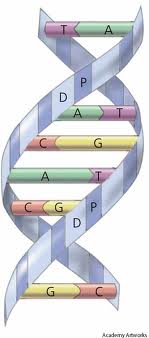
Which 2 molecules forms the sides (backbone) of the DNA ladder?
a)
deoxyribose and adenine
b)
deoxyribose and a hydrogen bond
c)
sugar and the nucleus
d)
deoxyribose (sugar) and phosphate
98.

What does DNA stand for?

a)

Denatured Acid

b)

Dominant Acid

c)

Deoxyribonucleic Acid

d)

Diribonucleic Acid

99.

The following describes ________ during mitosis. The chromosomes line up along the center/middle of the cell and the spindle fibers attach to each chromosome at the centromere.

a)

prophase

b)

metaphase

c)

anaphase

d)

telophase

100.

TT,tt,PP,pp,SS,ss are examples of alleles that are?

a)

homozygous

b)

heterozygous

c)

different

d)

homologous

101.

The exact genetic makeup of an organism, such as RR, Tt, PP is its?

a)

phenotype

b)

dominance

c)

genotype

d)

trait

102.

Females-XX; MalesXY. A couple has 4 girls. What is the chance the next child will be a boy?

a)

75%

b)

100%

c)

25%

d)

50%

103.
Which statement is part of Darwin’s theory of evolution by natural selection?
a)
More offspring are produced than can possibly survive.
b)
The organisms that are the fittest are always largest and strongest.
c)
The number of offspring is not related to fitness.
104.
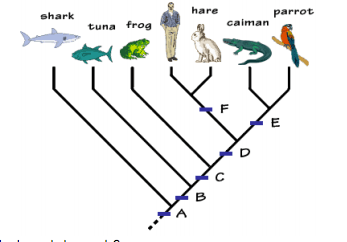
According to this cladogram, birds are LEAST related to -
a)
Amphibians
b)
Sharks
c)
Ray Finned Fish
d)
Crocodiles
105.
On the cladogram, which organism is the closest relative of the human?
a)
Frog
b)
Hare
c)
Caiman
d)
Parrot
106.
If green is dominant over purple, then what is the genotype for this individual?
a)
Purple
b)
Green
c)
GG
d)
gg
107.
This image shows a...
a)
Punnett Square
b)
Phenotype
c)
Genotype
d)
Dominant allele
108.
A phenotype is the...
a)
letter combination
b)
dominant gene
c)
recessive gene
d)
physical appearance
109.
Tt is-
a)
homozygous dominant
b)
homozygous recessive
c)
heterozygous
d)
none of these
110.
Which of the following genotypes is homozygous recessive?
a)
RR
b)
Rr
c)
rr
d)
None of the Above
111.
The longest phase of the cell cycle 
a)
prophase
b)
interphase
c)
metaphase
d)
mitosis
112.
The process by which the nuclear material is divided equally between two new cells
a)
mitosis
b)
cancer
c)
spindle
d)
centromere
113.
This picture shows which process?
a)
mitosis
b)
meiosis
c)
the cell cycle
114.
Genetic variation can arise from a random change in the DNA of a gene.  The change is called a(n)
a)
mutation
b)
gene flow
c)
gene pool
d)
allele
115.

Which statement best describes the process of evolution?

a)

Populations can survive in different locations on earth

b)

Environmental conditions limit the number of species on Earth

c)

Populations grow when resources are abundant

d)

The traits of a species can change over time

116.

A ____ is a testable, possible answer to a problem or question.

a)

hypothesis

b)

constant

c)

variable

d)

experiment

117.

The ______ group in an experiment serves as the "baseline" for comparing other groups' or trials' data to it.
This group is typically not manipulated like the other groups/trials.

a)

control

b)

constant

c)

experimental

d)

variable

118.

In an experiment, the _____ variable (effect) responds to any manipulation of the _____ variable (cause).

a)

dependent, independent

b)

independent, dependent

c)

constant, control

d)

control, constant

119.

The scientific method begins with you _____ something.

a)

answering

b)

observing/noticing

c)

hypothesizing

d)

theorizing

120.

A ____ is any factor in an experiment that remains the same for both the control group and experimental group.

a)

constant

b)

control

c)

variable

121.

When living things maintain a stable internal environment, they are carrying out ____.

a)

homeostasis

b)

evolution

c)

growth

d)

metabolism

122.

The study of life.

a)

Biology

b)

Mycology

c)

Zoology

d)

Botany

123.

A testable hypothesis is most often tested by carrying out a/an ____.

a)

experiment

b)

theory

c)

observation

124.

An old (and disproven) theory that life originates from non-living origins.
(i.e. multicellular life can just suddenly appear)

a)

spontaneous generation

b)

biogenesis

c)

random generation

d)

evolution

125.

The smallest living unit of life.

a)

cells

b)

atoms

c)

molecules

d)

organs

126.

Select the characteristic that is NOT a characteristic of all living things.

a)

movement

b)

made of cells

c)

use energy

d)

respond/adapt

127.

When creating a graph for data, the ____ variable goes on the x (horizontal) axis.

a)

independent

b)

dependent

128.

When creating a graph for data, the ____ variable goes on the y (vertical) axis.

a)

independent

b)

dependent

129.

Of the choices of organization listed below, which is the largest?

a)

Population

b)

Tissues

c)

Organs

d)

Cells

130.

A self-regulating process by which biological systems maintain stability while adjusting to changing external conditions.

a)
Homeostasis
b)
Metabolism
c)
Photosynthesis
d)
Respiration