
 Worksheets
Air Quality in California for Summer 2017
Total questions: 110
Worksheet time: 55mins

Deeandra’s homework assignment for winter break was to record four different observations about anything occurring in the natural world. .Which of Deandra's observations is scientifically testable?
Blackberries are sweeter than wild cherries.
Liquid soap has a more refreshing smell than a bar of soap.
Bread molds faster on the kitchen counter than in the refrigerator.
A Gouldian Finch is a more attractive bird than a Gouch Moorhen bird.

Charlie created an atomic model similar to the one seen below. .Which of the following is NOT a benefit of using a scientific model like the one Charlie created?
Models allow you to formulate hypotheses about processes.
Models allow you to study processes that cannot be duplicated.
Models are often simplified to help explain complex concepts.
Models make it possible to duplicate the real thing.
Which of the following is not a method that scientists use to solve problems?
Conducting research
Making observations
Constructing models
Following instincts
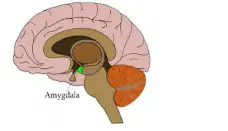
Below is a model of the brain. Which of the following is most likely a benefit of using a model of the human brain?
The model does not act exactly like the brain.
The model represents all possible real-world cases.
The model is oversimplified to help explain brain function.
The model provides visual representation without expensive resources.
Why is it a good idea to take an average of several measurements rather than taking just one measurement?
Because if you get different measurements, it means that you can’t use any of the data.
Because getting different measurements helps identify other variables.
Because it is easier to graph just one number rather than several numbers.
Because the more data you collect, the more accurate the results will be.
How can computers assist researchers in technology and science?
They can completely replace expensive experiments.
They can make difficult ethical decisions for researchers.
They can extend people’s abilities to collect, sort, analyze, and share data.
They can generate many new ideas for technological solutions.
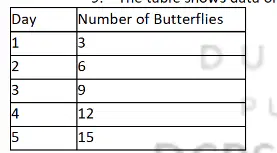
The table shows data on how the population of butterflies in a backyard change over five days.
Which mathematical model accurately predicts how many butterflies there will be on Day 6?
Number of butterflies = 3 + 3
Number of butterflies = 15 + 3
Number of butterflies = 3 x 3
Number of butterflies = 15 x 3
Which word describes the examples of tools used by scientists to investigate how and why things happen, such as a diagram of a food chain in the Everglades, a plastic replica of the human digestive system, and a mathematical equation for finding the speed of an object?
Experiment
Hypothesis
Model
Observation
What conclusion can be drawn from the development of a new type of wound dressing by University of Florida scientists that keeps bacteria out of the wound?
Scientific discoveries lead to new technologies.
Scientists only study phenomena they find interesting.
Scientific advances are always made in the field of medicine.
Scientists may make discoveries that have no impact on society.
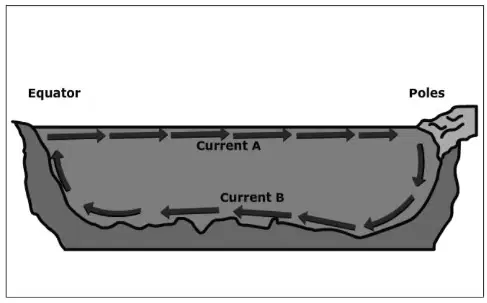
Refer to the diagram showing ocean currents between the equator and the poles. What is the temperature of Current A and Current B respectively?
Cold Water, Cold Water
Cold Water, Warm Water
Warm Water, Cold Water
Warm Water, Warm Water
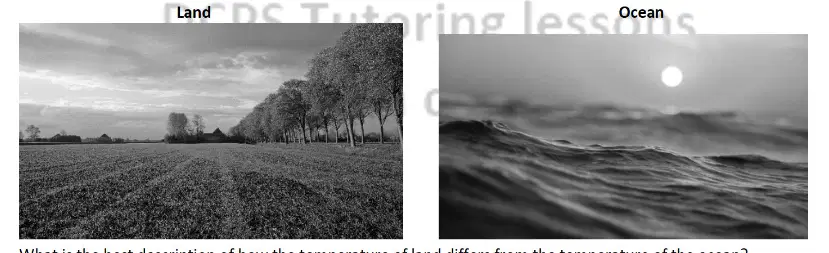
Below is an illustration of the land and ocean, during the day, in the summer.
What is the best description of how the temperature of land differs from the temperature of the ocean during the day in the summer?
Land has no important role in helping to regulate the Earth’s temperature.
No difference in the temperature between the land and the ocean.
The temperature above the land is warmer than above the ocean.
Air above land is cooler than air above the ocean.
Climate change is a worldwide phenomenon. Climate change has accelerated over the past several decades. Which of the following is a human contribution to climate change?
Changes in the sun’s energy
Changes in the location relative to the sun?
Burning of fossil fuels
Higher moisture content
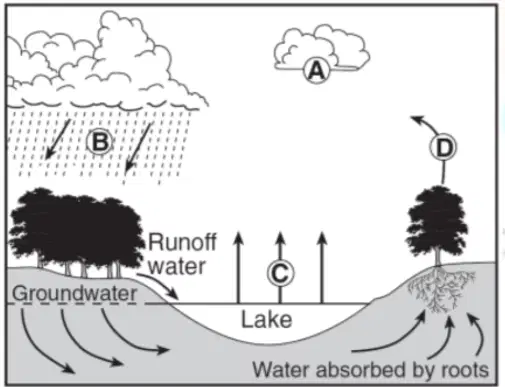
The following diagram represents the different parts of the water cycle. What combination of heat transfer allows for letter C in the diagram to occur?
Conduction
Radiation
Convection
Condensation
Energy transfers occur in many ways on Earth. Which type of energy transfer in the atmosphere do particles circulate to transfer energy?
Conduction
Radiation
Convection
Condensation

What process is illustrated at point A in the diagram, involving clouds and precipitation?
Condensation
Evaporation
Precipitation
Transpiration
Climate change is a worldwide phenomenon. Climate change has accelerated over the past several decades. Which of the following is a human contribution to climate change?
Changes in the sun’s energy
Changes I the location relative to the sun?
Burning of fossil fuels
Higher moisture content
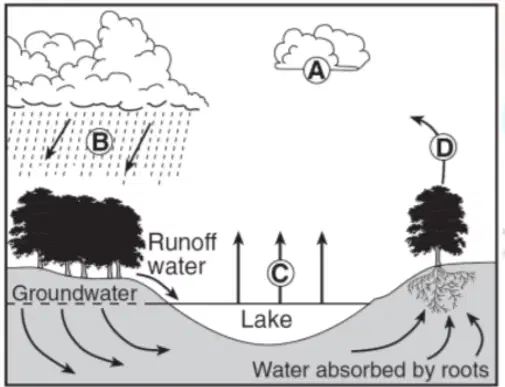
Which process is taking place at point B ?
Condensation
Evaporation
Precipitation
Runoff
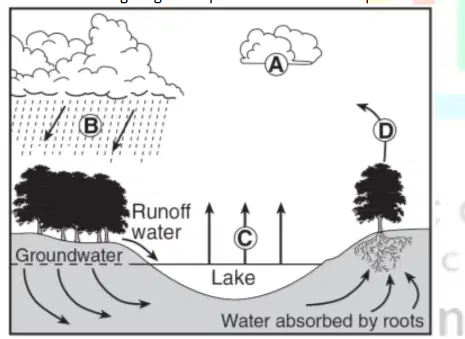
What is happening at point C in the diagram where water flows into the lake?
Evaporation
Precipitation
Runoff
Transpiration
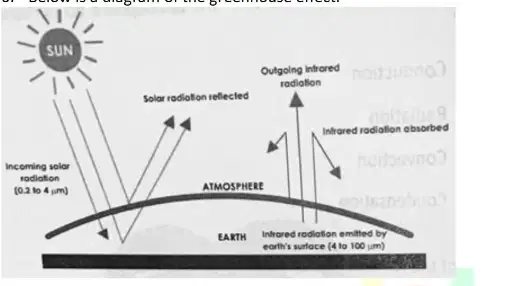
Below is a diagram of the greenhouse effect. Which of the following explains the greenhouse effect?
The atmosphere traps some of the incoming solar radiation, warming the Earth enough to support life.
Incoming solar radiation is reflected into space cooling the Earth to support life.
Infrared radiation emitted by the Earth’s surface escapes the atmosphere, warming Earth to support life.
Infrared radiation is absorbed above the atmosphere, cooling the Earth to support life.
A student conducts an experiment by heating sand and water for several minutes. Which statement BEST describes the conclusions he will make when his experiment is complete?
The sand will heat up more quickly than the water.
The water will heat up more quickly than the sand.
The sand and the water will heat up at the same rate.
The sand and water will remain at the same temperature.
The Earth is provided with energy from the Sun. Which of the following statements reasonably predicts what would happen to ocean and wind currents if energy from the Sun no longer reached Earth?
The currents would not change.
The currents would reverse direction.
The currents would speed up.
The currents would stop moving.
El Paso, Texas is located at the western most point of Texas on the board with Mexico. Which graph or chart gives you the best clue about what the climate might be like in El Paso, Texas?
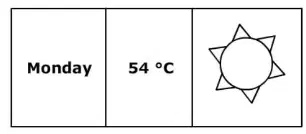
Sunny
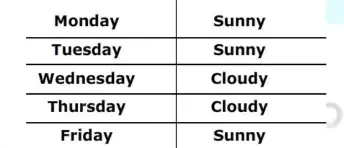
Cloudy
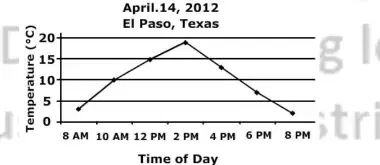
Rainy
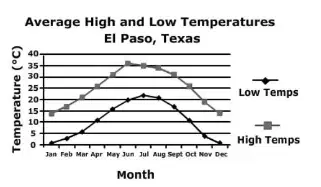
Snowy
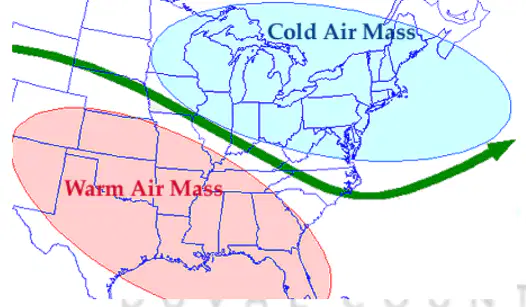
Below is a diagram of air masses.
Which of the following best describes the jet stream?
Fast flowing narrow air current found in the atmosphere
Fast spinning air mass high in the atmosphere
Slow spinning air mass low in the atmosphere
Slow and wide air current found in the atmosphere
Leslie lives in an area where the weather forecaster announces that an air mass formed over the ocean in the tropics and is moving into the area where she lives. What kind of weather can Lesile expect to encounter?
Warm and dry
Cold and dry
Cold and wet
Warm and wet
Which statement BEST describes the interaction of Earth's spheres as learned by Sue and Jamal in science class?
Weather is an interaction between the hydrosphere and the atmosphere.
Life in the oceans is an example of an interaction between the biosphere and the geosphere.
A plant's need for water is an example of an interaction between the biosphere and the cryosphere.
Weathering and erosion is an example of an interaction between the hydrosphere and the cryosphere.
The National Oceanic and Atmospheric Administration (NOAA) uses weather data and climate data. Which of the following is NOAA’s most likely reason for using climate data?
Predicting tomorrow’s temperature highs and lows.
Calculating the chance of rainfall this Saturday.
Identifying states with the lowest annual rainfall.
Warning the public of days when roads will be closed due to ice.
Scientists have been studying the rate of melting glaciers around the world for over a century. They are concerned that some of the world’s largest glaciers are melting at ever increasing rates. Which of the following statements BEST describes how melting polar ice could most likely affect the climate on Earth?
Worldwide temperature may fall due to the cooling of the oceans by the melting ice.
Worldwide temperatures would fall as land cools off at a faster rate than the oceans.
Worldwide temperatures may rise because the glaciers are no longer reflecting solar radiation.
Worldwide temperatures would be higher in the summer with no ice to cool the atmosphere, but no change in winter temperatures.
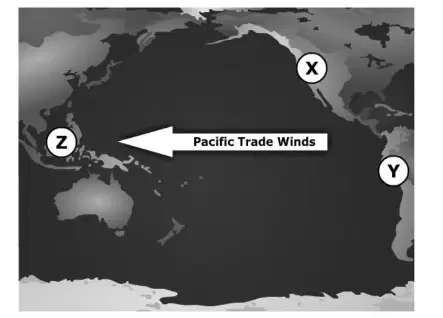
Strong westward-blowing trade winds along the equator normally drive warm surface water across the Pacific Ocean from the eastern Pacific to the western Pacific. However, every two to seven years these trade winds weaken allowing warmer than normal water temperatures to occur along the coastlines in the eastern Pacific and cooler than normal water temperatures to occur along the coastlines in the western Pacific. This is called an El Niño event. Which of the following weather patterns is probably NOT the result of an El Niño event?
A decrease in precipitation around point X
A decrease in precipitation around point Z
An increase in air temperatures around point Y
An increase in air temperatures around point Z
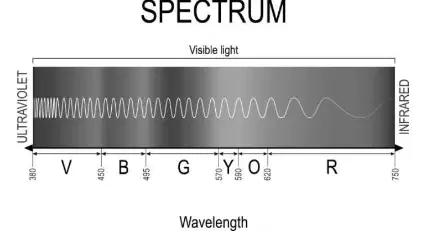
The picture shows the visible light spectrum.
Which of the following best describes the blue light in the visible light spectrum?
Blue light has a longer wavelength than red light.
Blue light has a shorter wavelength than red light.
Blue light travels at a faster speed than red light.
Blue light travels at a slower speed than red light.
Which of the following correctly identifies the property of light that causes the white light to split into the colors of the rainbow when passing through a prism?
The brightness of each color is different.
The wavelength of each color is different.
The heat produced by each color is different.
The speed of each color in vacuum is different.
The images of the M81 group of galaxies appear different primarily because they are:
A. using different space satellites.
B. looking at different sides of the galaxies.
C. viewing the galaxies from different distances.
D. recording different parts of the electromagnetic spectrum.
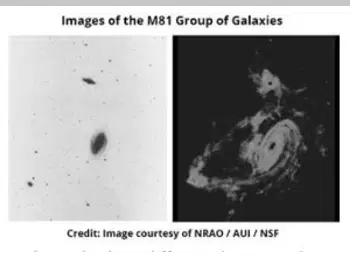
Messier 81 (M81) is a galaxy found in Ursa Major. It is easily seen with binoculars. There are several other galaxies in the M81 group. The images show the same group of Galaxies.
The images of the same galaxies look so different because the images were created by –
using different space satellites.
B. looking at different sides of the galaxies.
viewing the galaxies from different distances.
recording different parts of the electromagnetic spectrum.
Which type of electromagnetic waves might astronomers use to study a distant region of the universe?
A. Radio Waves
B. Ultraviolet Waves
C. Visible Light Waves
D. X-ray Waves

When light is passed through a glass prism, the light waves refract at different angles producing a phenomenon known as color dispersion. What type of light passed through the prism as illustrated in the diagram below?
X-ray light
Visible light
Ultraviolet light
Infrared light
Light waves originate from the Sun and reach Earth in the form of radiation. After taking a two-hour nap on the beach, Megan discovered that despite her use of sunscreen, she still developed a sunburn on her left shoulder. What part of the electromagnetic spectrum caused Megan to sunburn?
Visible light
Ultraviolet light
Infrared light
Gamma rays
Which type of radiation do oncologists most likely use for radiation therapy to shrink cancerous tumors and damage DNA within cancer cells?
X-rays and ultraviolet
Microwaves and radio
Radio and infrared
X-ray and gamma rays
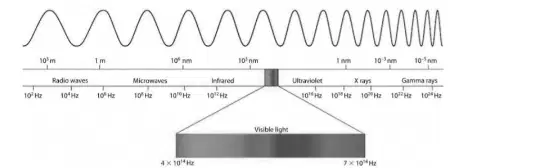
The electromagnetic spectrum contains a wide range of wavelengths and frequencies. Radio waves have the longest wavelengths, while the wavelengths of gamma rays are just microscopic ripple about the length of an atomic nuclei.
The electromagnetic spectrum contains a wide range of wavelengths and frequencies. Radio waves have the longest wavelengths, while the wavelengths of gamma rays are just microscopic ripple about the length of an atomic nuclei.
Gamma rays have the shortest wavelengths, highest frequency, and highest energy.
Gamma rays have the shortest wavelengths, lowest frequency, and lowest energy.
Radio waves have the longest wavelength, highest frequency, and highest energy.
Radio waves have the longest wavelength, lowest frequency, and lowest energy
Astronauts on the Moon can jump higher than if they were on Earth. Which of the following best explains why?
There is no friction on the Moon.
The Moon is less massive than Earth.
The astronauts have less mass on the Moon.
Newton’s Laws of Motion don’t apply on the Moon.

If two magnets were held in the position shown below, what would happen?
The magnets would simultaneously repel and attract each other.
The magnets would neither repel nor attract each other.
The magnets would attract each other.
The magnets would repel each other.
When Katie rubs a balloon against her hair, what type of charge does the balloon acquire?
Positive charge
Negative charge
No charge
Both positive and negative charge
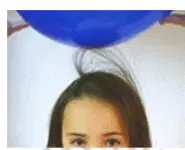
. Katie rubs a balloon against her hair. Electrons from her hair travel to the balloon, giving the balloon a negative charge and her hair a positive charge.
.Which of the following statements correctly explains why when the negatively charged balloon is brought near the strands of Katie’s hair, they move to get closer to the balloon, without the balloon actually touching them?
Electric attraction is a force that can act at a distance.
The electric attraction is a force that can only act on contact.
Katie’s hair would move in this way with or without the balloon.
The particles in the air must be pulling Katie’s hair toward the balloon.
Nora tied a string around a tennis ball, and then she swung it in a circle in front of her to demonstrate a planet orbiting the Sun. She explained that her hand represented the Sun, the ball represented a planet, and the string kept the ball from leaving the “orbit” around her hand. Why doesn’t the string work in the same way as gravity?
There is no difference between the two systems.
The string only pulls one way; gravity pulls both ways.
The string holding the ball in orbit is a contact force; gravity is a noncontact force.
The string keeps the distance between the bodies the same; gravity makes the distance vary.
There are events that are caused by contact forces. Which of the following events is caused by contact forces?
Jupiter’s moons staying in orbit
Picking up paper clips with a magnet
High tides occurring on the East Coast
Earthquakes along the San Andreas fault in California
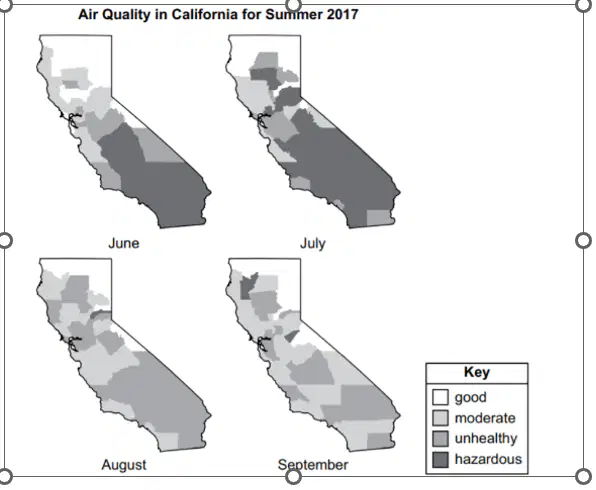
The air breathed by organisms contains more than oxygen and carbon dioxide. Microscopic pollutant particles in the air can cause serious health issues for humans. The image below shows a sample of air quality data for the state of California during the summer of 2017.
A person claims that these sets of data are conclusive evidence that global warming is impacting the lives of all Americans. A scientist disagrees with this statement and wants to investigate the topic in more detail. Which pair provides the best clarifying question about the claim that the scientist could ask and the investigation the scientist should conduct?
a. Question: How were the lives of Americans affected during these months? Investigation: Conduct interviews with all American citizens to gather qualitative data for the summer of 2017.
b. Question: How is air quality related to the impact of global warming? Investigation: Record the average air temperature across the United States for ten years to see if there is a rise in global temperature.
c. Question: What was the cause of the change in air quality in 2017? Investigation: Gather information to investigate information on pollutant sources in California and see if similar events occur across the United
d. Question: What are the historic levels of pollution in the state and is 2017 unique or part of a larger trend? Investigation: Examine the historical records in California to see what the pollution levels were at different points in time
Liam wants to find out why there is so much algae in his favorite fishing pond after a big rainstorm. The fishing pond is located next to a large cornfield. The cornfield was fertilized two days before the storm came. Fertilizer contains nitrates. Liam tests the water and discovers that the nitrate levels are 10 times higher than normal. Which of the following hypotheses would this discovery support?
If runoff from the cornfield has not contaminated the pond, then nitrate levels will be normal.
If runoff from the cornfield has contaminated the pond, then nitrate levels will be lower than normal.
If runoff from the cornfield has contaminated the pond, then nitrate levels will be higher than normal.
If runoff from the cornfield has not contaminated the pond, then nitrate levels will be lower than normal.
In the late 1800s, Charles Richet was conducting research with sea anemone toxin. He gave what he thought was a lethal dose to a group of dogs. The dogs developed severe allergic reactions, and some died. Richet hypothesized that the surviving dogs had developed an immunity to the toxin. He gave those dogs a second, smaller dose of the toxin. Instead of being less affected, the dogs were even more sensitive to the toxin. In fact, the smaller dose killed them immediately. How did Richet’s original hypothesis lead to valuable medical information?
Scientists now know that dogs are not allergic to sea anemone toxin.
Scientists now understand how severe allergic reactions develop in humans.
Scientists now know that vaccines can be used to treat sea anemone stings.
Scientists now know that humans can be vaccinated with blood serum from other animals.
Carlos stomps a soda can flat and throws it away. Which of the following statements best describes the change made in the soda can?
The soda can kept the same mass as it changed in shape only.
The soda can lost mass as it was changed into a smaller size.
The soda can paper gained mass because its shape changed.
The soda can lost mass as it was crumpled.
A geologist who has been analyzing rock data from the past found evidence of continental drift. A biologist studying the animal life on different continents also found evidence of continental drift. What does this imply about science?
Geology and biology are the same type of science.
When scientific disciplines overlap, researchers should choose new topics.
Different scientific disciplines can be used to investigate similar questions.
There should be fewer sciences, as they seem to answer the same questions.
Joanne decided to go on a picnic in the park. While she was packing her lunch, she ate half of her apple and was going to save the rest for later. On her way home, she started to eat the rest of the apple when she noticed that it had started to turn brown and rot. What happened to Joanne's apple?
A chemical change occurred, because a new substance was forming.
A chemical change occurred, because a new substance did not form.
A physical change occurred, because a new substance was forming.
A physical change occurred, because a new substance did not form.
Which of the following is an example of how heat energy can be used to influence the rate at which a chemical change occurs?
increasing the heat in an oven to make a cake bake faster
increasing the heat on a stove to make a pot of water boil faster
decreasing the temperature in the dryer to increase the drying time
decreasing the temperature in a freezer to make items freeze faster

Ryan and his family are visiting a theme park and he wants to ride a roller coaster. At which point in the diagram would he expect to have the greatest amount of potential energy?
Point W
Point X
Point Y
Point Z
A ball with a mass of 3 kilograms rolls down a ramp, 50 meters long. The ramp started from a height of 10 meters. When the ball reached the end of the ramp its kinetic energy was measured. It was slightly less than its potential energy at the top of the ramp. Which of the following statements best explains the difference between the ball’s potential energy at the top of the ramp and its kinetic energy at the bottom of the ramp?
Some of the energy is destroyed as the ball rolls down the ramp.
The Law of Conservation of Energy does not apply to rolling objects.
Some of the ball’s mass is converted to energy as it rolls down the ramp.
Some of the energy is converted to heat from friction as the ball rolls down the ramp.

A model of a nitrogen atom is shown below. In this model, what do the black spheres represent?
electrons
neutrons
photons
protons
A student performs an investigation and titles her report: The Effect the Amount of Rain has on the Clarity of Well Water. In her investigation, they used specialized tubes to collect rain water for several days. The student ran tests on the clarity of water using the specialized tube and weighted disks and records the data in a table. What is the tested variable (independent variable) in this investigation?
the well
the date of rain
the amount of rainfall
the clarity of the well water
Atoms are known as the building blocks of all matter because they make up the observed structures of the universe. What are some of the building blocks of atoms?
cells and tissues
protons, neutrons and electrons
elements and compounds
electromagnetism and radiation
A researcher tested the effects of salinity on plant growth. He set up three groups of plants and watered them at the same time each day for 10 weeks. Group 1 received water that contained 1 percent salt. Group 2 received water that contained 2 percent salt. Group 3 received water that contained no salt. The researcher recorded the heights of the plants each day after watering.
Which statement best describes this experiment?
A. It is scientific because it tests plant growth.
B. It is scientific because it has a control group.
C. It is pseudoscientific because it supports the researcher’s opinion.
D. It is pseudoscientific because it is designed to prove a preexisting belief.

Saliva, produced by glands in the mouth, plays an important role in the digestion of food. Saliva contains a chemical, called amylase, that breaks down starch in the food we eat. A scientist conducts an experiment to investigate at which temperatures amylase works the best. He hypothesizes that the reaction will occur fastest if the amylase reaction is conducted near the normal human body temperature of 37ºC (degrees Celsius). In order to test his hypothesis, the scientist measures the reaction rate, which is how fast the amylase breaks down the starch at six different temperatures. The reaction rate is rated on a scale of 0 to 10, with 0 meaning no reaction and 10 meaning the fastest reaction. The results are recorded in the data table.?
A. He should reject the hypothesis because amylase reacts at all temperatures.
B. He should accept the hypothesis because amylase reacts only at body temperature.
C. He should reject the hypothesis because amylase reacts faster above body temperature.
D. He should accept the hypothesis because amylase reacts fastest near normal human body temperature and slower above and below normal human body temperature.
Saliva, produced by glands in the mouth, plays an important role in the digestion of food. Saliva contains a chemical, called amylase, that breaks down starch in the food we eat. A scientist conducts an experiment to investigate at which temperatures amylase works the best. He hypothesizes that the reaction will occur fastest if the amylase reaction is conducted near the normal human body temperature of 37ºC (degrees Celsius). In order to test his hypothesis, the scientist measures the reaction rate, which is how fast the amylase breaks down the starch at six different temperatures. The reaction rate is rated on a scale of 0 to 10, with 0 meaning no reaction and 10 meaning the fastest reaction. The results are recorded in the data table.?
A. He should reject the hypothesis because amylase reacts at all temperatures.
B. He should accept the hypothesis because amylase reacts only at body temperature.
C. He should reject the hypothesis because amylase reacts faster above body temperature.
D. He should accept the hypothesis because amylase reacts fastest near normal human body temperature and slower above and below normal human body temperature.

Use the periodic table to answer the question. Which list shows elements with properties that are most similar to each other?
Cl, Br, I, At
B. N, O, F, Ne
C. Ca, Sc, Sr, Y
D. P, As, Sb, Bi

Avery sees a portion of the periodic table in her textbook. She needs to identify the element that has only 14 protons. What should she label the element and why?
Silicon (Si), because the number of protons determines the atomic number.
Nitrogen (N), because the atomic mass is determined by the number of protons.
Carbon (C), because the number of protons is determined by the atomic number.
Phosphorus (P), because the number of protons always equals the number of neutrons.

Jolie is trying to classify a substance. The substance melts between the temperatures of 1025°C and 1080°C. It has a hardness of about 2–3 on the Mohs scale. The substance is also nonreactive with HCl (hydrochloric acid). Jolie uses the table below to classify the substance.
Which element in the table comes closest to having the same properties as the substance that Jolie is trying to classify?
calcium
gold
lead
platinum
Kim dissolved a powered drink mix into room temperature water. In order to cool the drink quickly, she places it on a shelf in the freezer. What happens to the solution while it is in the freezer?
The solution takes in coldness from the cold air in the freezer.
The molecules of air in the freezer enter the solution and cool it.
The molecules in the solution continue moving at the same speed.
The solution loses heat energy to the air and the shelf in the freezer.
Jackson noticed that the music from his cell phone sounds louder when laid on his desk than when he held it up in the air. Which of the following explains the difference in sound that Jackson is experiencing?
Sound waves move faster through air because the molecules are further apart.
Sound waves move faster through solids because the molecules are further apart.
Sound waves move faster through air because the molecules are closely packed together.
Sound waves move faster through solids because the molecules are closely packed together.
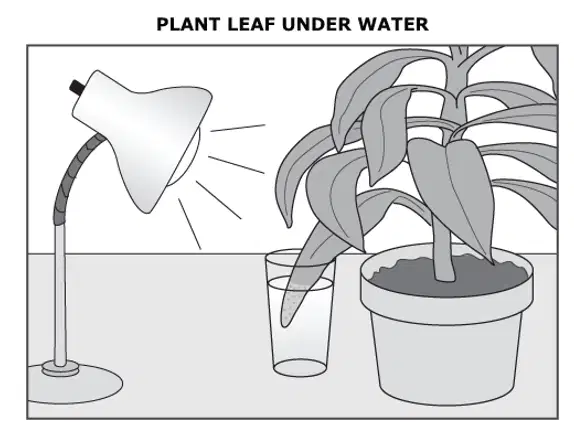
One living plant leaf, still attached to the plant, is placed into a cup and covered with water. A light source is placed above the cup shining into the cup of water so that the leaf receives the light. In moments, bubbles appear at the surface of the plant leaf.
Which statement explains what causes the bubbles to appear?
Photosynthesis is occurring and bubbles of carbon dioxide gas are being released by the surrounding area and absorbed into the plant leaf.
Photosynthesis is occurring and bubbles of carbon dioxide gas are being released by the leaf into the surrounding area.
Photosynthesis is occurring and bubbles of oxygen gas are being released into the surrounding area.
Photosynthesis is occurring and bubbles of air are entering the water from the area around the plant.
Claudia wrote the following equation to summarize the process of photosynthesis: Oxygen + Water → Carbon Dioxide + Sugar.
Which statement explains why this equation is incorrect?
During photosynthesis, plants release more water than they take in.
During photosynthesis, plants take in more oxygen than they release.
During photosynthesis, plants take in carbon dioxide and release oxygen.
During photosynthesis, plants take in oxygen, water, and carbon dioxide, and release sugar.
Olympic swimmers train for six or more hours per day by swimming laps in pools. As a result, they need to consume huge amounts of calories, between 3,000 and 7,000 per day. Why is it important for Olympic swimmers to eat huge amounts of calories?
The calories will travel to the body's cells to be used for the production of vitamins.
The calories will help produce energy through the process of photosynthesis.
The calories will produce large quantities of oxygen needed for breathing.
The calories will be the energy the cells need to function.
Cellular respiration occurs in the body 24 hours per day. During exercise, the rate of cellular respiration increases. Why does increased cellular respiration cause people to breathe faster?
More water is lost from the body, and breathing hydrates the body.
B. More heat is generated by the body, and breathing cools the body quickly.
C. More nutrients are needed to produce more energy, and more oxygen must be removed from the body.
D. More oxygen is needed to produce more energy, and more carbon dioxide waste must be removed from the body
Scientists conduct many types of scientific investigations. Their efforts often include fieldwork, surveys, models, and experiments. Which statement about scientific experimental investigations is true?
They do not involve the collection of data under controlled conditions.
They do not include comparing results from previous similar experiments.
They require that steps are followed exactly because there is only one scientific method.
They require multiple and repeatable trials to increase the reliability of the data collected.
According to the particle theory of matter, particles are constantly in motion. The motion of particles characterizes the states of the matter. Which list ranks the states of matter, according to the motion of particles, from fastest to slowest?
solid, liquid, gas
gas, solid, liquid
liquid, gas, solid
gas, liquid, solid
While watching a video in class, Jennifer observed that astronauts were able to move large containers around easily on the Moon. However, she remembered that the same containers seemed more difficult to move when they were training on Earth. How does the mass and weight of the containers on Earth compare to mass and weight of the containers on the Moon?
The mass of the containers on the Moon is less than on Earth.
The weight of the containers on the Moon is less than on Earth.
The mass and weight of the containers are both less on the Moon.
The mass and weight of the containers are the same on the Earth and Moon.

Patricia is attempting to determine how all living and non-living things on Earth come from this table. Which of the following statements best describes what Patricia is attempting to understand? Patricia is completing her project on the Periodic Table of Elements.
Below is The Periodic Table of Elements:
Elements combine to form various mixtures that have new properties to form different substances.
Elements combine to form various compounds that have new properties to form different substances.
Non-living things are formed with elements from the periodic table and living things are formed from minerals.
Living things are formed with elements from the periodic table and non-living things are formed from minerals.
Patricia is attempting to determine how all living and non-living things on Earth come from this table. Which of the following statements best describes what Patricia is attempting to understand? Patricia is completing her project on the Periodic Table of Elements.
Below is The Periodic Table of Elements:
Elements combine to form various mixtures that have new properties to form different substances.
Elements combine to form various compounds that have new properties to form different substances.
Non-living things are formed with elements from the periodic table and living things are formed from minerals.
Living things are formed with elements from the periodic table and non-living things are formed from minerals.
C6H12O6 is the chemical formula for glucose, a type of sugar. Which statement is true about glucose?
Glucose is an element, because it can be separated into smaller components.
Glucose is an element, because it is made up of more than one kind of atom.
Glucose is a compound, because it is made of more than one element.
Glucose is a compound, because it is made of protons, neutrons, and electrons.

The diagram shows the different size of vacuoles between a plant cell and an animal cell.
Why is the vacuole in a plant cell larger than a vacuole in an animal cell?
The vacuole in the plant cell produces ribosomes.
The vacuole in the plant cell controls cellular activities.
The vacuole in the plant cell performs photosynthesis.
The vacuole in the plant cell maintains water balance .
During a laboratory experiment, a student was instructed to add an alkaline solution to an acidic solution and record any observations in their laboratory manual. The student noticed some fumes from the new solution and afterwards observed some crystals at the bottom of the beaker. Which of the following most likely describes the crystals formed when an acid is combined with a base?
Salt
Halogen
Metalloid
Alkaline Metal
Jordan was investigating the evaporation rate of a clear liquid. The teacher instructed him to pour the liquid into a shallow flat container. The next morning he observed that the liquid had evaporated, leaving a crystal-like powder at the bottom of the container. Based upon this observation, how should Jordan classify the clear liquid?
suspension
solution
element
compound
A group of students are studying the different types of forces. They have to place the types of forces into categories that best describe them. One of the categories are all the forces that can act over a distance. Which of the following should be removed from the list?
Electric
Friction
Magnetic
Gravitational
Sarah has a 3-kilogram block and a 5-kilogram block. When would a block's gravitational force on Sarah be the strongest?
when she stands one meter away from the 3-kilogram block
when she stands one meter away from the 5-kilogram block
when she stands five meters away from the 3-kilogram block
when she stands five meters away from the 5-kilogram block
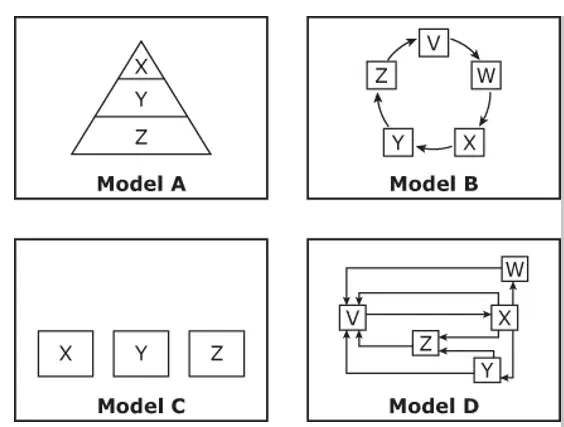
Isabel needs an image to represent the carbon cycle for a presentation in her science class. She has the following diagrams to choose from.
Based on the information represented in the concept models above, which statement is true?
. Model A would be the best model for the carbon cycle because carbon depletes over time as it is used by different organisms.
. Model B would be the best model for the carbon cycle because carbon will follow the same path when it is transferred from one place to another.
Model C would be the best model for the carbon cycle because the carbon cycle has a definite beginning and end where carbon eventually cannot be reused.
Model D would be the best for the carbon cycle because the carbon cycle is a flow of matter which can take different paths bringing carbon back to the same place.
A student is drawing a model of the carbon cycle. Which caption should he include to explain how herbivores contribute to the carbon cycle from the food they eat?
A. Herbivores eat plants, producing carbon dioxide during cellular respiration that is released into the atmosphere.
B. Herbivores eat plants, producing carbon dioxide during photosynthesis that is released into the atmosphere.
C. Herbivores use carbon dioxide from the atmosphere to produce oxygen during cellular respiration.
D. Herbivores use oxygen from the atmosphere to produce carbon dioxide during photosynthesis.
During photosynthesis, plants absorb carbon dioxide and water, and produce oxygen and glucose. Which statement best describes how this process follows the law of conservation of mass?
A. The volume of water used by this process is equal to the volume of water released from plant leaves at night.
The amount of carbon dioxide gas absorbed by one plant is equal to the amount of carbon dioxide gas exhaled from one human.
The cells in the plant absorb the same amount of energy from the Sun that humans need when burning sugars during digestion.
The number of oxygen atoms in the carbon dioxide and water used by this process equals the total number of oxygen atoms produced by the plant.

The diagram below shows some of the organisms within a marine food web. How does the diagram provide evidence that living systems follow the Law of Conservation of Energy?
Energy is destroyed after the organism uses it for growth.
The amount of energy decreases as it is used by each organism.
Energy from one organism moves to another organism but is not destroyed.
The amount of energy produced by each organism increases through the food web.
In 1906, there were an estimated 4,000 deer on the Kaibab Plateau. The government decided to create a preserve for them. Livestock had overgrazed the food on the plateau. The Forest Service chose to move the horses, sheep, and cows off of the preserve. They also decided to remove the deers' natural predators. In 1920, the Forest Service discovered that the number of deer in the preserve was very large. By 1923, most of the deer were starving from a lack of food. Which statement best describes what happened on the Kaibab Preserve?
Overgrazing by livestock caused the deer on the Kaibab Plateau to starve.
Because there were no natural predators, the deer population grew too large.
The natural predators could not keep up with the growth of the deer population.
The large growth and starvation of the deer population was simply a natural event.
In the early 1900's, government officials wanted to convert parts of the Everglades into farmland. They wanted to drain parts of the Everglades to make the land suitable for agriculture and development. The loss of water changed features of the marsh, making it impossible for alligators to dig their burrows on the water's edge. How would these changes to the Everglades affect biodiversity?
The available ecosystem will become larger for the animals in the Everglades.
Animals will improve their migratory patterns.
migratory patterns.
Animals will be exposed to less pollution than before.
Animals will be cut off from the resources important to their survival.
Manatees are an endangered mammal species that lives in bodies of water in Florida. Manatees eat plants that grow in the water. They know where to find fresh drinking water in their environment. Manatees migrate from summer habitats to winter habitats and look for safe areas to feed and raise their young. People in boats need to give space to manatees to protect them from harm.
What might conservationists do to reduce the limiting factors and increase manatee populations?
Increase the number of boats.
Increase the local fish population.
Increase the dissolved oxygen available.
Increase the amount of habitat available.
Some organisms live in areas where many individuals share the same space. Certain species of fish travel in schools in this way. They live and move very closely together. Which of these statements describes a negative impact of living so closely together?
Searching for food is more difficult.
Keeping young safe takes more effort.
Avoiding predators is more challenging.
Spreading diseases between individuals is more likely.
38. The mass of a stick of butter is 115.0 grams (g). It is cut into eight equal parts. What do you predict will be the mass of all 8 pieces combined?
A. 14.5 g
B. 29.0 g
57.5 g
115.0 g

The students in Ms. Ramirez's science class are classifying different types of reactions. They have divided the reactions into two columns as shown below. Use the table to answer the questions that follow.
Why are the reactions listed in Column A classified as chemical reactions?
. They form new substances.
. They form new substances.
They change the shape of the substance.
They do not change the characteristics of the original substance.
The product of the reaction can be changed back into the original products easily.
You have two small beakers of water. One beaker contains cold water and the other beaker contains hot water. Your teacher gives you two antacid tablets that will dissolve in water. You add one tablet into each of the beakers. Which statement best describes what you would observe next?
A. The tablet will dissolve faster in the hot water
B. The tablet will dissolve faster in the cold water.
C. The tablet in the cold water will not dissolve.
D. Both tablets will dissolve at the same rate.
. Currents in the ocean are caused by differences in water density. Colder, denser water tends to
. rise and flow from west to east.
rise and flow from east to west.
sink and flow from the equator to polar regions.
sink and flow from polar regions to the equator.
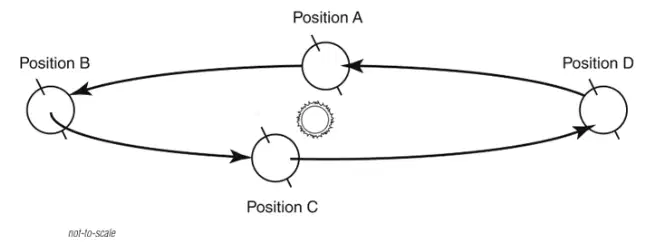
The diagram shows Earth in its yearly orbit around the Sun. During the year, places in the Northern and Southern Hemispheres experience seasons because of the tilt of Earth’s axis.
Which statement correctly identifies the seasons in the Northern and Southern hemispheres when the Earth is at Position D?
It is summer in the Northern and Southern hemispheres because the Earth tilts as it rotates around its axis.
It is winter in the Northern Hemisphere and summer in the Southern Hemisphere because the Earth is tilted on its axis.
It is spring in the Northern Hemisphere and Fall in the Southern Hemisphere because Earth is farther from the Sun than it is at points A and C.
It is summer in the Northern Hemisphere and winter in the Southern Hemisphere because the northern part of Earth, titled toward the Sun, gets more of the Sun’s energy.
The moon viewed from Earth is mainly visible as a bright circle or part of a circle in the night sky. It can sometimes appear as a faint object during the day. Which statement BEST explains why the Moon as seen from Earth is a bright object?
A.The Moon is able to give off its own light.
B. The Moon is bright because it reflects light from Earth.
C. The Moon is bright because it reflects light from the Sun.
D. The Moon is bright because most Moon rocks are light colored.
Sean is holding a rubber ball and a feather. He drops them both from the same height at the same time. Why does the feather take longer to fall to the ground?
A. The feather has less mass.
B. Gravity exerts less force on the feather.
C. Air resistance has no effect on the feather.
D. Air resistance has a greater effect on the feather due to it’s surface area.
46. While watching a video in class, Jennifer observed that astronauts were able to move large containers on the Moon easily. However, she remembered that the same containers seemed more difficult to move when they were training on Earth. How does the mass and weight of the containers on Earth compare to the mass and weight of the containers on the Moon?
on.
A. The mass of the containers on the Moon is less than on Earth.
B. The weight of the containers on the Moon is less than on Earth.
C. The mass and weight of the containers are both less on the Moon.
D. The mass and weight of the containers are the same on the Earth and Moon.
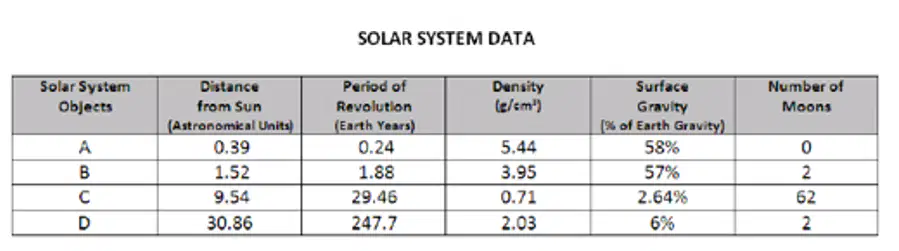
47. Students are collecting information on the properties of various objects in the Solar System. They have constructed a table of the data collected which is shown below.
Based on the data in the table, which of the following objects should be classified as a gas giant?
Object A
Object B
Object C
Object D
47. Students are collecting information on the properties of various objects in the Solar System. They have constructed a table of the data collected which is shown below.
Based on the data in the table, which of the following objects should be classified as a gas giant?
Object A
Object B
Object C
Object D

Mr. Luna asked his science class to work in groups to compare the heliocentric and geocentric models of the solar system. The students developed the chart shown below.
Which group provided answers that most accurately compared the models?
Group 1
Group 2
Group 3
Group 4
. Scientists use satellites to monitor and record Earth's radiation from space.
In which example would a scientist most likely be monitoring and recording infrared radiation?
A. measuring the area of land flooded by a tsunami
B. measuring the rate of cloud formation over a certain continent
C. measuring the difference between the temperatures at Earth's poles
D. measuring the movement of continental plates beneath Earth's surface
Alvin was the name of the first deep-sea submersible capable of carrying passengers. It was able to make dives to about 15,000 feet and remain submerged for up to 10 hours. In 2011 and 2012, Alvin underwent an extensive overhaul. Although the dive time could not be extended, additions included new view-ports, improved lighting and imaging systems, and an increased operating depth to more than 20,000 feet.
What is the best way scientists could apply this upgraded technology to their oceanic studies?
A. as access to remote oceanic locations
B. as a new way to observe oceanic weather phenomenon
C. as a method to collect more detailed data on coastal beach erosion
as a new way to follow whale migrations through extreme conditions
51. Monique went on a camping trip with her family out to the country. It was her first time being away from the city. She was amazed at all the stars she saw. It seemed like a completely different sky, but she knew that it only looked different because there was no interference from the city lights. Without that interference, she could see that stars actually came in several colors. Which of the following qualities is responsible for giving stars their color?
A. Speed.
B. Volume.
C. Distance.
D. Temperature.
The distance from the Sun to the nearest star, Proxima Centauri, is approximately 4.22 light-years. Which conclusion best fits this information?
A. The Sun is 4.22 years older than Proxima Centauri.
B. Light from the Sun is 4.22 times brighter than light from Proxima Centauri.
C. Proxima Centauri travels 4.22 times more quickly than the Sun.
D. Light from Proxima Centauri takes 4.22 years to reach the Sun.
The universe is a vast expanse of space that contains matter and energy. A scientific article about the universe will most likely describe the universe as which of the following?
A. Consisting of billions of galaxies.
B. Being less than two billion years old.
C. Containing approximately ten planets.
D. Becoming smaller over time.
Which statement best describes what happens to a snow skier's potential energy while gliding down a ski slope?
A. Potential energy is conserved and has an equal value at the top and bottom of the slope.
B. Potential energy is destroyed at a rate equal to the speed the skier travels down the slope.
C. Potential energy is transformed into an equal amount of kinetic energy as the skier moves down the slope.
D. Potential energy is created in an amount equal to the change in elevation as the skier moves down the slope.

Keesha did an experiment to study the rate of photosynthesis in the water plant Elodea. She placed a piece of Elodea in a beaker of water and set the beaker 10 centimeters (cm) from a light source. Keesha counted the bubbles released from the plant every minute for five minutes (min). She repeated the process two more times. First, she moved the light to 20 cm from the beaker, and then she moved the light to 30 cm from the beaker. Keesha’s setup and data are shown below.
A. the number of bubbles produced
B. the type of plant placed in the beaker
C. the amount of time the bubbles were counted
D. the distance of the light source from the plant

Two types of models that can be used to show details of the structures of cells are shown below.
Which of the following describes a limitation of the drawing but NOT the clay model?
It does not represent the main parts of a cell. B.
It does not contain the correct number of nuclei
It cannot represent a living cell, since a true cell is three-dimensional
It cannot represent a living cell, since the cytoplasm should be in constant motion
One physical property of a star is apparent magnitude. Which of the following is used in determining the apparent magnitude of a star?
A the constellation the star is in
the distance the star is from Earth
the number of times the star rotates
the number of prominences the star makes
The surface of Mercury has many more craters than the surface of Earth has. Which of the following statements best explains why Mercury has many more craters than Earth has?
A. Mercury rotates faster than Earth does.
B. Mercury has a smaller mass than Earth has.
C. Mercury is much closer to the Sun than Earth is.
D. Mercury has a thinner atmosphere than Earth has.
The oldest rock formation identified on Earth is found on the shoreline of Hudson Bay in Canada. This rock formed 4.28 billion years ago. Which information does a scientist need to most accurately determine the age of a rock?
A. the percentage of each mineral that makes up the rock
B. the thickness of younger rock layers that cover the rock
C. the amount of each radioactive element present in the rock
D. the amount of weathering present on the surface of the rock
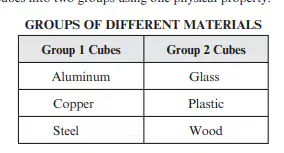
Matthew has six cubes of different materials. Each cube has a mass of 10 grams (g). Matthew sorts the cubes into two groups using one physical property.
Which physical property did Matthew most likely use to sort the cubes into two groups?
A. density
B. magnetism
C. melting point
D. electrical conductivity
Sunlight is composed of energy that is visible to humans and energy that is not visible to humans. Which statement describes how the visible energy from the Sun is different from the nonvisible energy?
A. It travels at a different speed through space.
B. It travels a different distance through space.
C. It has different wavelengths.
D. It has different amplitudes.

