
 Worksheets
Physical Science Reviewer
Total questions: 100
Worksheet time: 53mins
What is the difference between rotation and revolution?
Rotation is movement around an axis, revolution is the orbit of one body around another
Rotation is the orbit of one body around another, revolution is movement around an axis
Rotation always takes a longer period of time than revolution
Rotation and revolution are synonyms
What is an axis?
An imaginary line around which an object revolves
The plane of an object's orbit
The invisible path of an object's orbit
An imaginary line around which an object rotates
How long is a lunar cycle?
24 hours
29.5 days
365 days
24 hours 50 minutes
What causes the tides? (Select ALL that apply)
Gravitational pull of the Sun
Gravitational pull of the Earth
Gravitational pull of the Moon
Gravitational pull of the Planets
What is the difference between Spring and Neap tide?
Spring tides occur in the Spring, Neap tides occur in the Fall
Spring tides are higher, Neap tides are lower
Spring tides are lower, Neap tides are higher
Spring tides have a greater tidal range, Neap tides have a lower tidal range
What is the difference between the Umbra and Penumbra?
The Umbra is the darkest part of the eclipse shadow, the Penumbra is the lighter part of the shadow
The Penumbra is the darkest part of the eclipse shadow, the Umbra is the lighter part of the shadow
The Penumbra is larger than the Umbra
The Umbra is larger than the Penumbra
Which of the following statements about a Lunar Eclipse is TRUE?
Moon moves into the Earth's shadow
Moon is between the Earth and the Sun
It is only visible from the daylight side of the Earth
It only occurs during a New Moon phase
Why are eclipses so rare?
Moon's orbit is tilted compared to Earth's
Moon is smaller than the Earth
The Sun is further away than the Moon
The Earth, Moon, Sun almost never align
What happens during a Total Lunar Eclipse?
The Moon turns into a black circle, similar to a New Moon
The Moon turns red
The Moon is totally blocked by the Sun
The Moon's orbit is at 0 degrees
Which of the following statements about Solar Eclipses is FALSE?
The Earth moves into the Moon's shadow
The Earth is between the Moon and the Sun
Only occur during a New Moon phase
Only occur over a small area of the Earth
What is the difference between the Summer and Winter Solstice?
The Summer Solstice is the shortest day of the year, the Winter Solstice is the longest day of the year
The Summer Solstice is the longest day of the year, the Winter Solstice is the shortest day of the year
The Summer Solstice is the longest day of the year, the Winter Solstice has the same amount of day and night
Both the Summer and Winter Solstices have the same amount of day and night

Tide that occurs when the sun is at a right angle to the line between Earth and the moon
High Tide
Neap Tide
Spring Tide
Low Tice

Tide that occurs when the sun, Earth and the moon line up.
High Tide
Neap Tide
Spring Tide
Low Tice
During equinox, the sun's rays strike Earth at a 90-degree angle along the equator. What is the result of the equinox?
the hours of daylight and the hours of darkness are about the same
the hours of daylight are longer than the hours of darkness
the hours of darkness are longer than the hours of daylight
an unseasonably warm day in the midst of winter

The darkest part of the eclipse shadow is called the...
Umbra
Penumbra
Node
Corona
Why do we have a 366th day once every four years?
To have Presidential Elections
It takes 365.25 days for Earth to revolve around the Sun
The Earth gets farther from the Sun every four years
Because the equinox is on September 23rd
What is the shape of the orbit of the Earth around the Sun?
A circle, of course
Oval shape called an ellipse
The Earth does not orbit the Sun
The shape is called a Solar Eclipse
Why are days 24 hours long?
That is how long it takes the Earth to go around the Sun
That is the time it takes to go from a New Moon to a Full Moon
That is how long it takes the Earth to spin once on its axis
That is how long it takes the Moon to go around the Earth
What is the main difference between the heliocentric theory and geocentric theory of the solar system?
The heliocentric theory has the Sun as the center of the solar system, and the geocentric theory has the Earth as the center of the solar system.
The heliocentric theory has the Earth as the center of the solar system, and the geocentric theory has the Sun as the center of the solar system.
The heliocentric theory has Earth moving around the Moon, and the geocentric theory has the Sun moving around the Moon.
The heliocentric theory has the Sun moving around the Earth, and the geocentric theory has Earth moving around the Sun.
Why do the stars appear to move across the sky?
Because the Earth is spinning (rotating)
Because the stars are spinning (rotating)
Because you are dizzy
They're not, it is an illusion
The terrestrial planets differ from the Jovian planets because the terrestrial planets are
less dense and larger
less dense and smaller
more dense and larger
more dense and smaller

The diagram represents our solar system. The system is best classified as
heliocentric, with circular orbits
heliocentric, with elliptical orbits
geocentric, with circular orbits
geocentric with elliptical orbits
The actual shape of Earth's orbit is
a perfect circle
an ellipse
a sphere
a triangle
The outer planets are also called ________.
terrestrial planets
larger planets
gas giants
farthest planets
The four inner planets are:
Jupiter, Saturn, Uranus and Neptune
Mercury, Venus, Earth and Pluto
Mercury, Venus, Earth and Mars
Jupiter, Saturn, Neptune and Pluto
The four outer planets are:
Jupiter, Saturn, Uranus and Neptune
Mercury, Venus, Earth and Pluto
Mercury, Venus, Earth and Mars
Jupiter, Saturn, Neptune and Pluto
What is an example of natural satellite
a nebula
the Hubble Space telescope
the moon
a galaxy
Which of the following statements is the reason why the planets and stars are round?
Gravity pushes out from the edge of the planet or star.
Gravity pushes out from the center of the planet or star.
Gravity pulls toward the center of the planet or star.
Gravity pulls toward the edge of the planet or star.
Mercury is closer to the Sun than Venus but the average temperature of Venus is higher than Mercury. Which of the following statements best describe the reason the Venus has overall higher temperature than Mercury?
Venus is larger in size when compared to Mercury.
Venus has a thicker atmosphere that traps heat energy.
Venus’ revolution around the Sun is shorter.
Venus’ rotation is shorter than Mercury’s
Which planets in our solar system revolve the fastest?
The gas giant planets
Planets closest to the Sun
Planets farthest from the Sun
All planets revolve at the same speed
One complete orbit around an object
Rotation
Orbit
Revolution

If a planet is further away from the Sun the
longer the year
shorter the year
greater the gravity
the greater the mass
What phenomenon causes the day and night cycle on Earth?
Revolution
Rotation
Orbit
Gravity
What is an equinox?
The longest day of the year
The shortest day of the year
When day and night are of equal length
When the Earth is farthest from the Sun


The phase between a full moon and a third quarter moon is called a
waning gibbous moon.
waxing gibbous moon.
waning crescent moon.
waxing crescent moon.
What is a crescent moon?
when the moon is in the process of waning
when the moon’s shape is exactly a third quarter moon
when the moon’s shape is larger than a semicircle, but not a full circle
when the moon’s shape is smaller than a semicircle, but not completely dark
What becomes visible during a total solar eclipse that is normally not seen?
The Sun's inner core
The Moon's surface
The Sun's outer atmosphere (corona)
Earth's shadow on the Moon
When can viewers safely remove their eclipse glasses during a total solar eclipse?
When the eclipse reaches totality
During the partial eclipse phase
They should never remove their eclipse glasses
At any time if they look away from the Sun
What is the path of the 2024 total solar eclipse?
Across the entire continent of Africa
Starting in Alaska and ending in Florida
From Canada to Mexico, passing through the United States from Maine to Texas
From Mexico, through the United States from Texas to Maine, and up through Canada


Na+ has 12 neutrons and 10 electrons. Which of the following statement is correct?
Na+ has atomic number equal to 10 and mass number 22
Na+ has atomic number equal to 11 and mass number 23
Na+ has atomic number equal to 10 and mass number 23
Na+ has atomic number equal to 11 and mass number 22
How many electrons, protons and neutrons will be present in X–, if atomic number of X is 9 and mass number is 19 ?
E = 9, P = 9, N = 10
E = 10, P = 9, N = 10
E = 10, P = 10, N = 10
E = 9, P = 10, N = 10
Which of the following are true for an element?
(i) Atomic number = number of protons + number of electrons
(ii) Mass number = number of protons + number of neutrons
(iii) Atomic mass = number of protons = number of neutrons
(iv) Atomic number = number of protons = number of electrons
(i) and (ii)
(i) and (iii)
(ii) and (iii)
(ii) and (iv)
The ion of an element has 3 positive charges. Mass number of the atom is 27 and the number of neutrons is 14. What is the number of electrons in the ion?
13
10
14
16
What is the maximum number of electrons that are allowed on the second orbital?
9
7
8
3
What is the mass number of an atom which contains 28 protons, 28 electrons, and 34 neutrons?
28
56
62
90
Which of the following statement is always correct?
An atom has equal number of electrons and protons.
An atom has equal number of electrons and neutrons.
An atom has equal number of protons and neutrons.
An atom has equal number of electrons, protons and neutrons.
An atom has a mass number of 23 and atomic number 11. The number of protons is _________.
11
12
23
44
Carbon-12 atom has_______________.
6 electrons, 12 protons, 6 neutrons
12 electrons, 6 protons, 6 neutrons
6 electrons, 6 protons, 6 neutrons
18 electrons, 6 protons and 6 neutrons


The vertical (up and down) columns in the Periodic Table are called
groups
towers
periods
atomic numbers
Which group of the periodic table is composed of inert (not reactive) gases?
answer choices
alkali metals
alkaline earth metals
halogens
noble gases
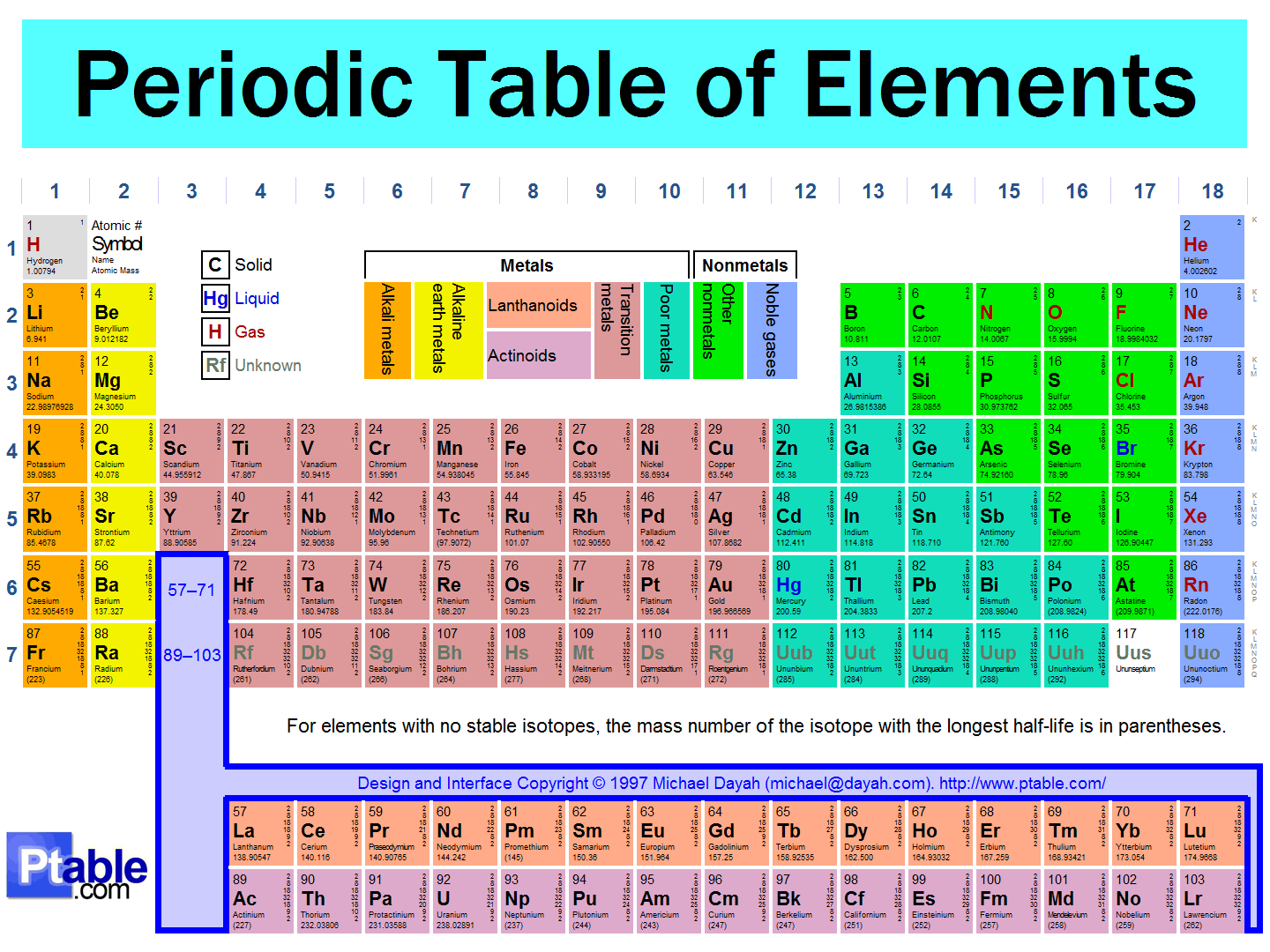

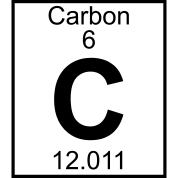

Which color on the image of the periodic table corresponds with the metalloids.
bright yellow
gold
teal
light blue
The periodic table is mostly comprised of what type of element?
Metals
Nonmetals
Metalloids

Which elements are colored red?
nonmetals
metals
metalloids
what is the name of group number 2
transition metals
halogens
metaloids
alkaline earth
what is the name of group number 1
halogens
noble gases
alkali
alkaline earth
what is the big group of metals called found within the metals
transition metals
nonmetals
noble gases
halogens
what is the small group of elements called that include C,N,O
metals
nonmetals
metaloids
noble gases
symbols must have at least
1 cap. letter
2 cap. letters
2 lower case letters
any letter you want
where are the metaloids found
far left, vertical
stair step/diagonal
far right horizontal
at the bottom

