
Font size
 Worksheets
7th grade comp
Total questions: 94
Worksheet time: 52mins
Which is the SI unit of mass?
Milligram (mg)
Centigram (cg)
Kilogram (kg)
Gram (g)
Which is a unit of volume?
Millimeter (mm)
Centimeter (cm)
Millimeters cubed (mm³)
Mile (mi)
Which is the SI unit of length?
Kilometer (km)
Millimeter (mm)
Centimeter (cm)
Meter (m)
Which is the SI unit of temperature?
Celsius
Fahrenheit
Kelvin
Millimeters of Mercury
Which is the SI unit of time?
Seconds
Minutes
Hours
Nanoseconds
McLellan measured 145.89 g of iron. How many kilograms of iron is this?
0.14589 kg
1.4589 kg
145.890 kg
0.014589 kg
Luke had 91.300 mL of Bromine in a volumetric flask. Sky removed 5.25 mL of Bromine. What volume of Bromine does Luke now have to correct significant figures?
86 mL
86.1 mL
86.05 mL
86.050 mL
What is the smallest unit of an element that still retains the element’s properties?
Electron
Atom
Proton
Compound
Which of the following is made up of only one type of atom?
NaF
N₂
SiF₄
MgI₂
Which of the following substances can’t be broken down by ordinary chemical means?
Water (H₂O)
Copper (Cu)
Isopropyl Alcohol (C₃H₈O)
Glucose (C₆H₁₂O₆)
Substances that are combined physically and can be physically separated are called:
Substances composed of atoms of 2 or more different elements that are bonded are called:
Diatomic elements
Compounds
Homogenous Mixtures
Heterogeneous Mixtures
Which of the following substances is a suspension?
Fog
Tomato juice
Salt water
Air
Which of the following substances is dissolved in water?
HNO₃ (s)
HNO₃ (l)
HNO₃ (g)
HNO₃ (aq)
A pure substance made up of only one type of atom is called a(n) (a) .
Which of the following is not found as a diatomic element in nature?
B₂
O₂
H₂
F₂
In which phase does a substance have very fast moving, compressible particles?
Solid
Liquid
Gas
Plasma
In which phase does a substance have particles that are very tightly packed?
Solid
Liquid
Gas
Plasma
In which phase does a substance have a definite volume but no definite shape?
Solid
Liquid
Gas
Plasma
Changes that result in a change in the identity of a substance are called:
Physical changes
Chemical changes
Identical changes
Phase changes
Which of the following is not a physical property?
Density
Melting Point
Flammable
Odor
A teacher pours sulfuric acid on sugar in a beaker. The sugar turns yellow and then black. Smoke rises, and a strong smell is released. This is an example of what kind of change?
Physical
Chemical
Electrical
Magnetic
Which of the following is the change from a liquid to a gas?
Boiling
Melting
Condensation
Freezing
Which of the following is the change from a gas to a liquid?
Boiling
Melting
Condensation
Freezing
Which of the following is the change from a liquid to a solid?
Boiling
Melting
Condensation
Freezing
When a substance is melted, what happens to the particles in the substance?
They make new bonds
They get further from each other
They break bonds
They get closer together
The ability of a substance to allow the flow of either heat or electricity is called:
Ductility
Malleability
Conductivity
Luster
The ability of a substance to be beaten into a thin sheet is called:
Ductility
Malleability
Conductivity
Luster
Which of the following is not an example of a chemical reaction?
Combustion of methane gas
Sublimation of carbon dioxide
Rusting of copper metal
Tarnishing of silver
Which types of matter are pure substances?
Elements
Homogeneous Mixtures
Compounds
Both a and b
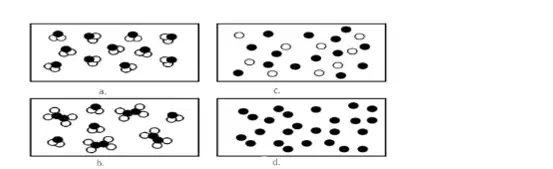
Which of the following diagrams depicts a mixture?
Salt completely dissolved in water. In this mixture, water is the ____________.
Solute
Solution
Solvent
Suspension
Suspensions are which of the following?
Have large particles (>1000nm)
A and B
Particles settle out.
Are uniform.
Compounds have __________ composition and mixtures have __________ composition.
(a)
Distillation is a separation technique that takes advantage of the difference in __________ of the components in the mixture.
Affinity for the mobile phase
Density
Particle size
Boiling point
What would be the best method for separating solid tea leaves from a pot of liquid tea?
Distillation
Chromatography
Filtration
Decanting
Liquid Isopropyl Alcohol (boiling point of 82.6 °C) and liquid water (boiling point of 100 °C) are mixed to form a homogenous mixture. What is the best technique for separating this mixture?
Chromatography
Filtration
Distillation
Decantation
Which technique involves pouring a less dense substance out of a container, leaving the more dense substance behind?
Distillation
Using a magnet
Chromatography
Decantation
Decantation and Filtration are separation techniques used to separate what substances?
Elements
Heterogeneous mixtures
Compounds
Homogeneous mixtures
All of the following are physical properties of matter except __________.
Luster
Density
Acidity
Malleability
(a) is the ability of a substance to be drawn into wires without breaking.
As pressure increases, the boiling point of a substance will ____________ while the melting point of a substance will ____________.
Increase, Increase
Increase, Decrease
Decrease, Decrease
Decrease, Increase
The following properties of matter can be observed without changing the identity of the substance, except for ______________.
Boiling Point
Ductility
Solubility
Reactivity
What is the name of the phase change from solid to liquid?
Freezing
Melting
Condensation
Evaporation
Which phase of matter has fixed volume but takes the shape of its container?
Solid
Gas
Liquid
Plasma
Which phase of matter has particles that are tightly packed together and vibrating?
Solid
Gas
Liquid
Plasma
What is the name of the phase change from a gas to a solid?
Evaporation
Deposition
Sublimation
Condensation
What is the mass of an atom with 14 protons, 11 neutrons, and 10 electrons?
21 amu
27 amu
24 amu
25 amu
Where are the sub-atomic particles found?
Protons, Electrons, and neutrons are in the nucleus.
Protons are in the nucleus, electrons and neutrons are in the electron cloud.
Protons, neutrons, and electrons are in the electron cloud.
Protons and neutrons in the nucleus, and electrons are in the electron cloud.
A neutron has a charge of ________, and a mass of ________.
(a)
Which element has 80 protons?
Mercury
Nickel
Bismuth
Bromine
Which subatomic particles contribute to the mass of an atom and are in the nucleus?
Protons and electrons
Protons
Electrons and neutrons
Protons and Neutrons
In an isotope, two atoms of the same element have different.
Charges
Numbers of protons
Numbers of electrons
Numbers of neutrons
In an atom of Carbon-14, which of the following is an accurate description of its sub-atomic particles?
Protons: 14, Neutrons: 12, Electrons: 14
Protons: 6, Neutrons: 6, Electrons: 6
Protons: 6, Neutrons: 8, Electrons: 6
Protons: 14, Neutrons: 6, Electrons: 14
Using hyphen notation, we can write an isotope of Carbon with two extra neutrons as:
13th-Carbon
Carbon-14
Carbon-13
14th-Carbon
When a neutral atom loses electrons, it becomes:
An anion.
An isotope.
A cation.
A different element
When a neutral atom gains electrons, it becomes:
An anion.
An isotope
A cation
A different element
Atoms that have a different number of protons and electrons are called
(a)
Nitrogen gains 3 electrons. Which of the following is a correct description of it?
Neutral
Cation
Anion
Metal
When calcium becomes a cation, it becomes Ca²⁺. How many TOTAL electrons will it have?
2
18
8
20
What is the formula for Nitrate?
(a)
What is the formula for Ammonium?
(a)
Carbonate and Sulfate all have a charge of:
+2
+1
-2
-1
Hydroxide, Cyanide, and acetate all have a charge of:
+2
+1
-2
-1
Selenium is in which period?
6
6A
4
4A
How many electron shells does Iodine have?
5
7
53
17
Which element has 4 electron clouds and 3 valence electrons?
Si
Ga
Sc
Ti
Which of the following is a property of nonmetals?
Lustrous
Dull
Semi-conductors
Malleable
The correct electron configuration for Cl is
1s²2s²2p⁶3s²3p⁴
1s²2s²2p⁶3s²3p⁵
1s²2s²2p⁶3s²3p³
1s²2s²2p⁶3s²3p¹
Of the following elements, which one would have the smallest radius?
Fluorine (F)
Oxygen (O)
Nitrogen (N)
Carbon (C)
The least electronegative elements are the…
Halogens
Noble gases
Metalloids
Alkali metals
Of the elements below, which element has the largest ionization energy?
Li
Na
K
Rb
The Lewis dot structure of NH₃ depicts __________ number of lone pairs on the central atom.
There are no lone pairs of electrons
There is one lone pair of electrons
There are two lone pairs of electrons
There are three lone pairs of electrons
If the metal in an ionic compound is not in group 1A or 2A or in the “Triangle Metals”, then the compound is a _______________ ionic compound.
Metallic
Binary I
Binary II
Binary III
Which of the following metals would form a binary II ionic compound with oxygen?
Zirconium
Fluorine
Cesium
Gallium
Which of the following charges is not a possible charge for the metal in a Binary II Ionic Compound?
+1
-2
+4
+2
What do the Roman Numerals in the name of a Binary II ionic compound represent?
Charge on the compound
Charge on the nonmetal
Charge on the metal
Subscript on the metal
What kind of bonding is involved in sodium cyanide?
Metallic
Covalent
Ionic
Both b and c
What is the chemical formula for rubidium selenide?
RbSe
RbSe2
Rb2Se
Rb2Se
What is the chemical formula for scandium (III) chloride?
ScCl
ScCl3
Sc2Cl3
Sc3Cl
What is the chemical formula for the carbonate ion?
CO3+2
CO3-2
CO2+3
CO2-3
What is the chemical formula for the acetate ion?
C₂H₃O₂⁺
C₂H₃O₂⁺
C₂H₃O₂⁻
C₂H₃O₂⁻
What is the chemical formula for magnesium hydroxide?
MgHO
Mg₂OH
MgOH
Mg(OH)₂
What is the chemical formula for lithium oxide?
LiO
LiO₂
Li₂O
Li₂O₂
What is the chemical formula for barium sulfate?
BaSO₃
Ba(SO₃)₂
BaSO₄
BaS
What type of bond would Carbon and Fluorine form?
Ionic
Metallic
Covalent
They wouldn’t bond
An ionic bond is between ____________.
Two metals
Two nonmetals
One metal and one nonmetal
One nonmetal and one metalloid
Subscripts in a chemical formula represent the __________.
Charge
Neutrons
Protons
Number of atoms
Ionic compounds have ________ melting points and ________ boiling points.
High, high
Low, high
High, low
Low, low
Binary I ionic compounds include:
A metal with variable charge and a nonmetal
A metal with fixed charge and a nonmetal
Two nonmetals
Two metals
The correct name of Cu(OH)₂ is:
Copper Hydroxide
Copper (II) Hydroxide
Copper Dihydroxide
Copper (I) Dihydroxide
What is the formula for carbon tetrafluoride?
C₄F
C₄Fl
CF₄
CFl₄
How many electrons are shared in a single covalent bond?
1
4
2
8
Which of these compounds would NOT have covalent bonds?
PCl₃
C₂H₆
K₂O
H₂O₂

