
 Worksheets
8th Comp #1
Total questions: 91
Worksheet time: 56mins
If you completely dissolve NaCl in pure, distilled water, the result would be classified as:
Element
Homogenous mixture
Compound
Heterogenous mixture
Which is an example of a heterogeneous mixture?
Oil and water
Calcium carbonate
Sodium metal
Air
A pure substance made up of only one type of atom is called a(n) (a) .
Which of the following is an element?
HCO₃
KCl
CO
Cl₂
Which of the following is a compound?
Crude oil
Water
Steel
Neon
Combustion reactions always form carbon dioxide and water as products. Carbon dioxide is a:
Pure element
Ionic compound
Covalent compound
Mixture of elements
5 ml of ethanol is added to 200 ml of water. In this mixture, ethanol is called:
Solute
Element
Solvent
Suspension
Which of these common substances is a homogeneous mixture?
Table salt
Sand and water
Salt water
Pure water
What would be the best method for separating tea leaves from a pot of tea?
Distillation
Chromatography
Filtration
Decanting
Liquid Isopropyl Alcohol (boiling point of 82.6 °C) and liquid water (boiling point of 100 °C) are mixed together to form a homogenous mixture. What is the best technique for separating this mixture?
Chromatography
Filtration
Distillation
Decantation
A method to physically separate a mixture using a mobile and a stationary phase, is called (a) .
Distillation is a separation method that takes advantage of the difference in (a) of the components in the mixture.
Barium sulfate is not soluble in water. Which separation technique would work best to remove it from the water?
Decantation
Chromatography
Centrifugation
Filtration
Salt can be separated from saltwater solution by:
Filtration
Distillation
Evaporation
Salt cannot be separated from saltwater solution.
Which of the following is an example of a chemical property?
Shiny
Brittle
Malleable
Reactive with water
Which observation is a sign of a chemical change?
A rotting potato gives off a bad smell.
A melting block of ice leaves a puddle.
Crumbling of cookies.
Iron pellets melting at 1500°C
Which of the following is a chemical change?
Burning
Dissolving
Boiling
Sublimating
An example of a physical change is:
A reaction of sodium with water.
Burning wood.
Breaking a glass.
Baking a cake.
All of the following are properties of SO₂. Which one is a physical property?
It reacts with oxygen to form SO₃²⁻.
It forms acid rain in the atmosphere.
It condenses to a liquid at 14°F.
It is a by-product of burning coal.
Which of the following properties would NOT help you to identify an unknown substance?
Mass
Density
Color
Solubility
Which of the following is a physical property?
Density is 0.534 g/cm³
Produces LiOH and H₂ in water
Reactive with acid.
Rusts in the presence of air.
Which sample of matter has particles with fast movement and random motion?
He (g)
H₂O (s)
H₂O (l)
He (s)
In which phase does a substance have a definite volume but no definite shape?
Liquid
Gas
Solid
Plasma
If a substance has fast moving particles that rapidly bounce off one another, it is currently in a:
Solid state
Gaseous state
Liquid state
Plasma state
If water droplets form from the vapor in the air on the outside of my cold-water bottle, what process is taking place?
Evaporation
Melting
Condensation
Freezing
Which of the following diagrams have definite volume?
A
C
B
A and C
A measure of the average KE of particles is the (a) .
Radiation involves the transfer of heat via:
Cindy heated a pot of hot water to make ramen by transferring 1800 calories of energy to the water using a stove top. If the water is the system, is this process endothermic or exothermic? Explain.
Exothermic, because water absorbed heat from the stove top, raising its temperature.
Exothermic, because the stove top absorbed heat released by the water.
Endothermic, because water absorbed heat from the stove top, raising its temperature.
When sweat evaporates from the skin, it cools the body down. Which of the following statements is true about this process?
Sweat evaporating is exothermic. Sweat absorbs heat from the skin in order to evaporate.
Sweat evaporating is endothermic. Sweat absorbs heat from the skin in order to evaporate.
Which heating method works well with solids and involves a substance transferring heat to another substance that it is in contact with?
Convection
Enthalpy
Conduction
Radiation
Near the ceiling of a room the air is warmer. The warm air rises because of:
Convection
Enthalpy
Conduction
Radiation
Which element below would form the charge of -3 when ionized?
Boron
Silicon
Scandium
Nitrogen
Mr. Wade is reacting bromine with aluminum, creating a bright orange flame. During the reaction the bromine becomes an ion. What is the charge on bromine?
Br⁺
Br²⁺
Br⁻
Br₂⁻
An atom of Ar contains 18 electrons. How many energy levels are needed to contain these electrons?
1
2
3
4
What is the number of electrons in an Al³⁺ ion?
3
13
10
16
Which element has three electron shells and five valence electrons?
V
Pd
N
Na
Atoms to the left of the “staircase” on the periodic table that are shiny, conduct electricity and are malleable are:
Metal and gain electrons, becoming negative.
Metal and lose electrons, becoming positive.
Nonmetal and gain electrons, becoming negative.
Nonmetal and lose electrons, becoming negative.
Which of the following elements is likely to be brittle as a solid and an insulator?
Lithium
Boron
Titanium
Phosphorus
Which of the following is a property of non-metals?
Dull
Lustrous (shiny)
The elements in Group 2 have similar chemical properties because each atom of these elements has the same:
Atomic number
Number of electron shells
Mass number
Number of valence electrons
The most nonreactive (stable) group on the periodic table is
Alkali metals
Alkaline-earth metals
Noble gases
Halogens
The most reactive elements on the periodic table are nonmetals and appear at room temperature as solid, liquids, and gases. To which family do they belong?
Alkali metals
Halogens
Noble gases
Transition metals
Which element would you expect to have similar properties to oxygen?
As
Se
Si
Ne
Put the following elements in order of increasing (smallest to largest) atomic radii: Ne, Fr, S, As, Ba
S, As, Ba, Fr, Ne
Ne, S, As, Ba, Fr
Fr, Ba, As, S, Ne
Ne, Fr, S, As, Ba
The ionic radius of bromide is ____ than neutral bromine because ____.
Smaller; an e- has been lost.
Smaller; an e- has been gained.
Larger; an electron has been lost.
Larger; an electron has been gained.
Put the following in order of increasing (smallest to largest) ionization energy: Ne, Fr, S, As, Ba
S, As, Ba, Fr, Ne
Ne, S, As, Ba, Fr
Fr, Ba, As, S, Ne
Ne, Fr, S, As, Ba
Select the element with the lowest ionization energy. As, P, N, Sb
N
As
P
Sb
Arrange the following elements by increasing Atomic Radius (left to right): N, K, Ga, Cs, Ne
Cs, K, Ga, N, Ne
Ne, N, Ga, K, Cs
N, Ga, Ne, Cs, K
Ga, N, Ne, K, Cs
Which of the following properties increases as you move across a period from left to right? I. Electronegativity II. Ionization energy III. atomic radius
I and II only
II and III only
I and III only
I, II, and III
Which of the following has the smallest ionic radius?
O²⁻
Na⁺
F⁻
Mg²⁺
The atomic radius of helium is smaller than the atomic radius of hydrogen because:
Hydrogen has less electrons, which makes the valence shell bigger.
Helium has less protons, which makes it smaller.
Hydrogen has more neutrons, so it has more mass.
Helium has more protons that pull harder on the electron shells.
Arrange the following elements by increasing Atomic Radius (left to right): N, K, Ga, Cs, Ne
Cs, K, Ga, N, Ne
Ne, N, Ga, K, Cs
N, Ga, Ne, Cs, K
Ga, N, Ne, K, Cs
The atomic radius of helium is smaller than the atomic radius of hydrogen because:
Hydrogen has less electrons, which makes the valence shell bigger.
Helium has less protons, which makes it smaller.
Hydrogen has more neutrons, so it has more mass.
Helium has more protons that pull harder on the electron shells.
Of the four elements Na, S, F and Cl, the MOST electronegative is
Na
F
S
Cl
Which of the following has the highest electronegativity?
Nitrogen
Fluorine
Bromine
Arsenic
Which of the following reasons best explains why Noble Gases are not electronegative?
Arrange the following elements in order of increasing Electronegativity: S, Li, Zn, Xe, Cl
Xe < Li < Zn < S < Cl
Cl < Xe < Zn < Li < S
Li < Zn < S < Cl < Xe
Zn < Li < S < Cl < Xe
Choose the correct ranking for elements increasing (from lowest to highest) in electronegativity.
K < O < Br < I
He < F < Se < Sn
Ag < Pt < Zr < Fr
Na < Mg < C < F
Put the following in order of increasing (smallest to largest) electronegativity: Ne, Fr, S, As, and Ba based on periodic trends:
S, As, Ba, Fr, Ne
Fr, Ba, As, S, Ne
Ne, S, As, Ba, Fr
Ne, Fr, Ba, As, S
Which of the following elements has the lowest electronegativity?
Iodine
Chlorine
Bromine
Fluorine
Which element would you expect to have similar properties to oxygen?
As
Se
Si
Ne
Which combination of elements is most likely to produce a compound with ionic bonds?
S and Br
N and Cl
Ni and Co
V and Se
An ionic bond forms between:
Two nonmetals
Two metalloids
Two metals
A metal and a nonmetal
In the compound lead sulfide, PbS2, what charge would the lead ion have?
-4
+4
-2
+2
What occurs when potassium reacts with chlorine to form potassium chloride?
Electrons are shared and the bonding is ionic.
Electrons are shared and the bonding is covalent.
Electrons are transferred and the bonding is ionic.
When a nonmetal forms an ionic bond, the nonmetal tends to do which of the following?
Lose protons
Gain electrons
Lose electrons.
What molecule would you predict Ca (calcium) and Cl (chlorine) form?
CaCl
Ca2Cl
CaCl2
If a molecule has a formula of AlX3, which of the following elements would be a reasonable ion for X?
(a)
Mystery element X reacts with oxygen and forms an ionic compound with the formula X2O. Which of the following families could we find element X in?
Alkali metals
Boron family
Alkaline Earth metals
Halogens
What is the correct name for the compound ZnCl2?
Zinc chloride
Zinc (III) chloride
Zinc chloride (II)
Zinc dichloride
What is the name of the following compound: Cr(C2H3O2)4 ?
Chromium carbon oxide
Chromium (IV) acetate
Chromium (I) acetate
Chromium acetate
The charge on the indium ion in indium nitrate, In(NO3)3, is:
+1
+2
+3
+4
What is the formula of the compound Iron (II) Phosphide?
Fe₃PO₄
Fe₂P₃
Fe₃PO₃
Fe₃P₂
What is the formula for carbon tetrafluoride?
C₄F
C₄Fl
CF₄
CF₄I
What is the name of this compound, Br₂O₇?
Perbromate ion
Oxygen bromide
Dibromine heptoxygen
Dibromine heptoxide
Which of these compounds would NOT have covalent bonds?
PCl₃
C₂H₆
K₂O
H₂O₂
The correct name for the compound N₂O₃ is
Dinitrogen Trioxide
Nitrogen (III) Oxide
Nitrogen Oxide
Nitrogen (II) Oxide
Which of these pairs of elements can be joined by a covalent bond?
C and K
C and Fr
C and Fe
C and Cl
Which of the following is the correct formula for hexanitrogen tetrabromide?
N₄Br₄
N₅Br₆
N₆Br₄
N₈Br₃
In covalent bonding, electrons are ________ whereas in ionic bonding, electrons are ________
Acetylene is C₂H₂. What sort of bond joins the two carbons in the Lewis dot structure?
When diatomic oxygen (O₂) is formed, we find that it is symmetrical. Which of the following best describes the Lewis structure for each oxygen?
1 bonding pair, 3 lone pairs
2 bonding pairs, 2 lone pairs
3 bonding pairs, 1 lone pair
4 bonding pairs, 0 lone pairs
In the Lewis structure of a water molecule (H₂O) how many bonding pairs and lone pairs are on the oxygen atom?
3 bonding pairs, 1 lone pair
1 bonding pair, 3 lone pairs
2 bonding pairs, 0 lone pairs
2 bonding pairs, 2 lone pairs
The Lewis Dot Structure of NH₃ contains:
Three single bonds and no lone pairs of electrons.
Three single bonds and one lone pair of electrons.
Two single bonds and two lone pair of electrons.
Two single bonds and three lone pairs of electrons.
If a central atom is bonded to three atoms and has no lone pairs, what is the molecular geometry of the molecule?
Trigonal Planar
Trigonal bipyramidal
Tetrahedral
Linear
What are the bond angles for a molecule with tetrahedral geometry?
90°
120°
180°
109°
What is the geometry of NH₃?
Bent
Trigonal Pyramidal
Trigonal Planar
Tetrahedral
What geometry does ozone (O₃) have?
Trigonal Planer
Trigonal Planar
Bent (109°)
Linear
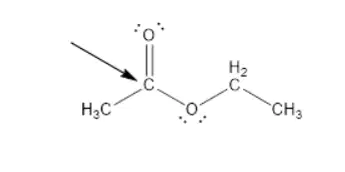
What is the molecular geometry around the carbon atom the arrow is pointing to in the structure below?
Bent
Trigonal planar
Trigonal pyramidal
Tetrahedral
Which of the following will exhibit metallic bonding?
Zinc, Zn(s)
CaCO₃(s), calcium carbonate
C₃H₈(l), propane
C, carbon (s)

