Wayground logo

Free Printable Worksheets

Font size

S
M
L
XL
Worksheets

Y8 For after test

Total questions: 134

Worksheet time: 2hrs 35mins

Name
Class
Date
1.

How many blood vessel types do humans have?

a)

4

b)

5

c)

3

d)

2

2.

Human blood vessels are

a)

artries, capillaries, and atria

b)

ventricles, atria and pulmonary veins

c)

capillaries, artries, and veins

d)

veins, artries, and aorta

3.

The thickest and strongest blood vessel is the

a)

vein

b)

artery

c)

capillary

d)

both veins and capillaries

4.

The blood vessel that has the largest diameter is

a)

vein

b)

artery

c)

capillary

5.

The blood vessel that has valves at intervals...

a)

capillary

b)

artery

c)

vein

d)

none of the above

6.

Valves in veins

a)

support them

b)

protect them

c)

prevent the backward movement inside them

d)

provide them elesticity

7.

which of the blood vessels do you think have greatest blood pressure

a)

veins

b)

capillaries

c)

atria

d)

arteries

8.
Carry blood away from heart; mostly oxygen-rich
a)
Arteries
b)
Veins
c)
Capillaries
9.
Carry blood toward heart; mostly oxygen-poor
a)
Arteries
b)
Veins
c)
Capillaries
10.

These are one cell thick

a)

arteries

b)

capillaries

c)

veins

11.
I have muscular walls, and a small lumen.  Pump blood away from the heart
a)
Artery
b)
Vein
c)
Capillary
d)
Arteriole
12.
I have a large lumen, I have thin muscular walls, I pump blood towards the heart
a)
Artery
b)
Vein
c)
Capillary
d)
Arteriole
13.
What is the space between the structure of a blood vessel?
a)
Artery
b)
Lumen
c)
Gap
d)
Loomen
14.
A system of the body which pumps blood too and from the lungs to become oxygenated. 
a)
Systemic
b)
Pulmonary 
15.
A system of the body which pumps blood from the left ventricle of the heart to the Aorta and the rest of the body. 
a)
Systemic
b)
Pulmonary
16.
What is Haemoglobin?
a)
Iron rich protein that transports oxygen in the blood cells. 
b)
Blood Cells
c)
Blood Vessels
d)
A type of Capillary
17.
Mitchell has been exercising and his face is Red. What is Vasodilation?
a)
This occurs when the artery walls increase in diameter 
b)
This occurs when the artery walls decrease in diameter 
c)
When the ARTERY IS FEELING IT
18.
What shape is a red blood cell?
a)
Tri Bonfave
b)
Bi Facade
c)
Bi Concave 
d)
Biscuit shaped
19.
A substance that causes your immune system to produce antibodies...
a)
Antibodies
b)
White Crud Cell
c)
Antiben
d)
Antigen
20.
Which is the largest artery in the body?
a)
Aorta 
b)
Superior Vena Cava
21.
Which is the largest vein in the body?
a)
Aorta 
b)
Arteriole 
c)
Superior Vena Cava 
22.
Who scored the most goals in the premier league in the 2016/2017 season? 
a)
Sergio Aguero
b)
Romelo Lukaku 
c)
Alexis Sanchez
d)
Harry Kane
23.
Which lever system would Thierry Henry use when heading the football?
a)
1st EFL
b)
2nd ELF
c)
3rd FEL
24.
Omar is on his Tip Toes before doing a Rabona which lever system will he be using?
a)
1st EFL
b)
2nd ELF
c)
3rd FEL
25.
Taylor Ridley is Bicep curling a HUGE weight!!! Which lever is this?
a)
1st EFL
b)
2nd ELF
c)
3rd FEL
26.
The amount of blood ejected from the heart per beat is?
a)
Stroke Volume
b)
Cardiac Output
c)

Heart Rate

27.

Which of the following is NOT a type of blood vessel?

a)

Artery

b)

Capillary

c)

Vein

d)

Ventricle

28.

Which blood vessels take blood TO the heart?

a)

Veins

b)

Arteries

c)

Capillaries

29.

Which blood vessels take blood AWAY from the heart?

a)

Veins

b)

Arteries

c)

Capillaries

30.

Which is the smallest of the 3 blood vessels?

a)

Veins

b)

Arteries

c)

Capillaries

31.

What type of blood do the arteries usually carry?

a)

Oxygenated Blood

b)

Deoxygenated Blood

32.

Which blood vessel has valves to prevent the back-flow of blood?

a)

Veins

b)

Arteries

c)

Capillaries

33.

Human blood vessels are

a)

artries, capillaries, and atria

b)

ventricles, atria and pulmonary veins

c)

capillaries, artries, and veins

d)

veins, artries, and aorta

34.

The thickest and strongest blood vessel is the

a)

vein

b)

artery

c)

capillary

d)

both veins and capillaries

35.

The blood vessel that has the largest diameter is

a)

vein

b)

artery

c)

capillary

36.

The blood vessel that has valves at intervals...

a)

capillary

b)

artery

c)

vein

d)

none of the above

37.

Valves in veins

a)

support them

b)

protect them

c)

prevent the backward movement inside them

d)

provide them elesticity

38.
Carry blood away from heart; mostly oxygen-rich
a)
Arteries
b)
Veins
c)
Capillaries
39.
Carry blood toward heart; mostly oxygen-poor
a)
Arteries
b)
Veins
c)
Capillaries
40.

These are one cell thick

a)

arteries

b)

capillaries

c)

veins

41.
Where material exchange takes place between the cells and blood vessels:
a)
arteries
b)
veins
c)
venules
d)
capillaries
42.
Largest artery in the human body:
a)
Pulmonary artery
b)
femoral artery
c)
aorta
d)
carotid artery
43.
Contract and expand with the heart beat:
a)
arteries
b)
veins
c)
venules
d)
capillaries
44.
Carry oxygenated blood back to the heart, only type of these to do this:
a)
pulmonary arteries
b)
pulmonary veins
c)
pulmonary capillaries
d)
aorta artery
45.
Which is NOT a function of the circulatory system?
a)
deliver O2 and nutrients to cells
b)
remove CO2 and wastes from cells
c)
break down carbohydrates into glucose
d)
transport other materials through body
46.

What is the function of coronary artery?

a)

Transports oxygenated blood from aorta to heart muscles

b)

Transports oxygenated blood from aorta to liver

c)

Transports oxygenated blood from aorta to kidneys

47.

If the dominant trait is having freckles (F) and the recessive trait is no freckles (f), which allele combination(s) below would represent a person who has freckles? (select all that apply)

a)

FF

b)

Ff

c)

ff

48.
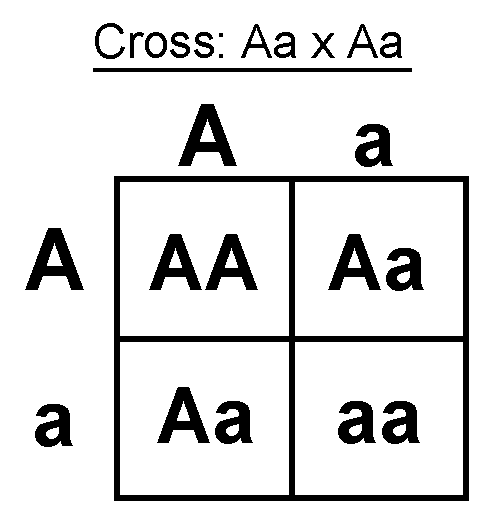
What is the phenotype of the offspring? (A-Brown hair; a-blond hair) 
a)
50 % Brown Hair and 50% Blond Hair 
b)
25 % Brown Hair and 75% Blond Hair 
c)
75 % Brown Hair and 25% Blond Hair 
d)
0% Brown Hair and 100% Blond Hair 
49.

The combination of genes a person has, represented by letters, is their...

a)

Genotype

b)

Phenotype

c)

Chromosome

d)

Punnett Square

50.

What belongs in the last box?

a)

RR

b)

Rr

c)

rr

d)

ff

51.
T - tall and t = short
In the punnett square below, what belongs in the missing square
a)
tt
b)
Tt
c)
Bb
d)
TT
52.

Look at the punnett square shown. What allele pair would replace the "?"

a)

WW

b)

Ww

c)

ww

53.

What belongs in Box 4?

a)

Y

b)

YY

c)

Yy

d)

yy

54.

Look at the punnett square. What is the probability that the offspring would have homozygous alleles for the trait?

a)

100%

b)

75%

c)

50%

d)

25%

e)

0%

55.
Both parents in this Punnet square
a)
are homozygous dominant
b)
are homozygous recessive
c)
are heterozygous
d)
have blue eyes
56.

What is the probability & phenotype of the offspring? (A-Brown hair; a-blond hair)

a)

50% Brown Hair and 50% Blond Hair

b)

25 % Brown Hair and 75% Blond Hair

c)

75 % Brown Hair and 25% Blond Hair

d)

0% Brown Hair and 100% Blond Hair

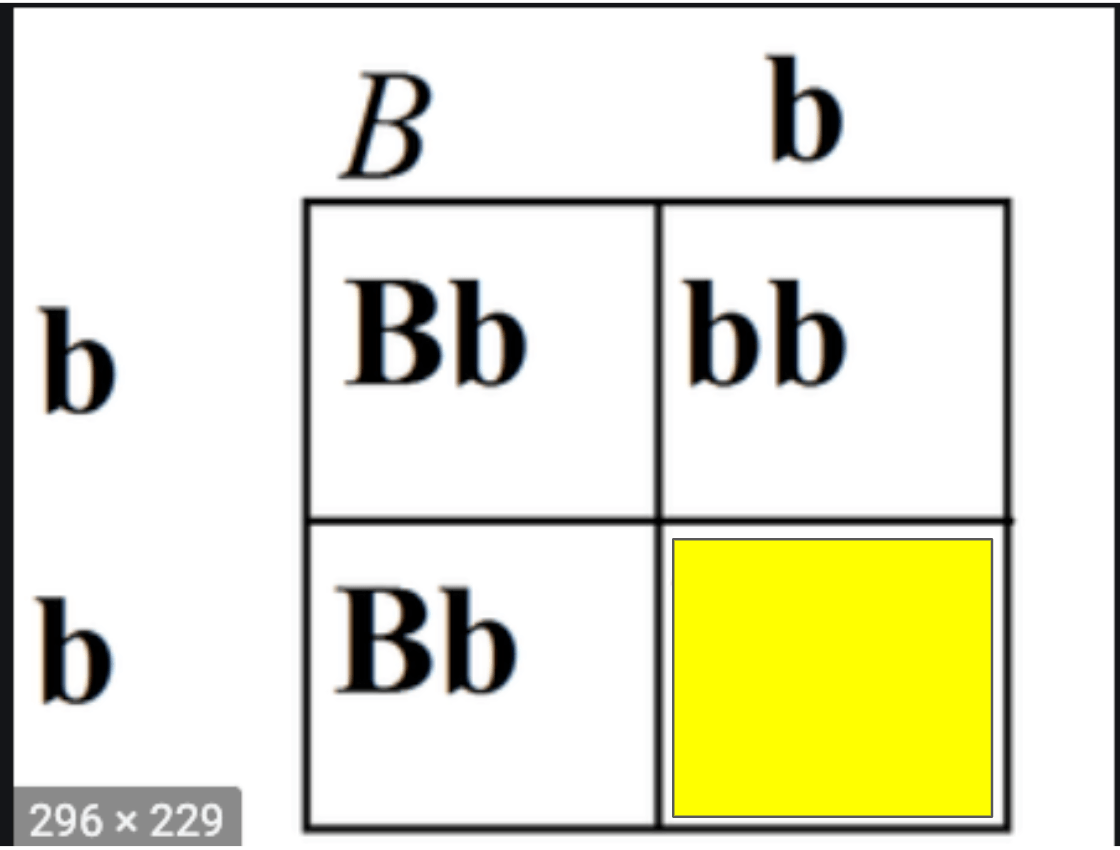
57.

Fill in the Yellow Box

a)

Bb

b)

BB

c)

bb

58.

Which of the following allele pairs is heterozygous?

a)

RR

b)

Qq

c)

ss

59.
What allele combination should go in the missing box?
a)
AA
b)
Aa
c)
aa
d)
none of these
60.
B = brown fur  b = white fur
In the punnett square, what is the probability for white fur? 
a)
0%
b)
25%
c)
50%
d)
75%
61.
A red flowered plant (RR) breeds with a White flowered plant (WW). The gene for petal color in these plants expresses incomplete dominance.  What percentage of the offspring will have pink (RW) flowers?
a)
0%
b)
25%
c)
50%
d)
100%
62.
Which of the following is a phenotype?
a)
Aa
b)
red hair
c)
heterozygous
d)
DNA
63.
Dominant alleles are represented by a:
a)
Male gene
b)
lowercase letter
c)
recessive trait
d)
capital letter
64.
If B = brown hair and b = blonde hair, what is the probability of brown hair?
a)
25%
b)
50%
c)
0%
d)
75%
65.
In certain species of plants, purple flowers (P) are dominant to white flowers (p). If two heterozygous plants are crossed, what will be the phenotype of the offspring?
a)
100% purple flowers
b)
100% white flowers
c)
75% white flowers, 25% purple flowers
d)
25% white flowers, 75% purple flowers
66.
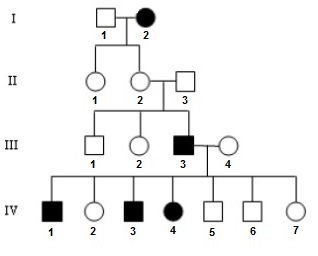
How many individuals are there in the 3rd generation?
a)
2
b)
3
c)
4
d)
6
67.
Give the genotype for person III-3
a)
GG
b)
Gg
c)
gg
68.
Give the genotype for person II-1
a)
GG
b)
Gg
c)
gg
69.
What does a filled in square represent?
a)
Not affected Female
b)
Not affected Male
c)
Affected Male
d)
Affected Female
70.
How many kids did the mother and father from the first generation have?
a)
2
b)
4
c)
5
d)
6
71.
This pedigree represents the inheritance of hemophilia in this family. How many of the females have the hemophilia trait?
a)
8
b)
5
c)
2
d)
3
72.
Is this trait (the shaded individuals) dominant or recessive?
a)
dominant
b)
recessive
73.

Which of the following correctly states the genotype probabilities for the offspring of the parents shown in this punnett square?

a)

50% heterozygous 50% homozygous dominant

b)

50% heterozygous 50% homozygous recessive

c)

50% heterozygous 25% homozygous recessive 25% homozygous dominant

d)

100% heterozygous

74.

Which of the following correctly states the genotype probabilities for the offspring of the parents shown in this punnett square?

a)

50% heterozygous 50% homozygous dominant

b)

50% heterozygous 50% homozygous recessive

c)

50% heterozygous 25% homozygous recessive 25% homozygous dominant

d)

100% heterozygous

75.
Hooke's Law fails when a material reaches its:
a)
breakdown
b)
elastic limit
c)
end of tether
d)
fracture stress
76.
If F is force, k is spring constant and x is extension, Hooke's Law tells us that:
a)
F=k/x
b)
x=Fk
c)
k=Fx
d)
F=kx
77.
Hooke's Law describes the behaviour of which kind of material under tension?
a)
plastic
b)
metals only
c)
elastic
d)
non-metals only
78.
A graph of extension against force for an elastic material is:
a)
A downward curve
b)
An upward curve
c)
A straight line from any point on the x and y axis
d)
A straight line from the origin
79.
Which statement most accurately represents Hooke's Law?
a)
a) Extension of a spring is proportional to the force applied.
b)
b) Extension of a spring is proportional to the number of coils.
c)
c) Extension of a spring is inversely proportional to the force applied.
d)
d) Thickness of a spring wire is proportional to the force applied.
80.

Spring constant is measured in

a)

N

b)

N/m

c)

m

81.

If the original length of a spring is 20m and its extended length is 30m. What is the extension?

a)

20m

b)

12m

c)

75m

d)

45m

e)

10m

82.

___________ is the unit of force

a)

Km

b)

cm

c)

m

d)

N/cm

e)

N

83.

At point P, _______.

a)

the force applied to the spring is equal to its elongation

b)

Hooke's Law ceases to be valid

c)

the spring is can be stretched but still springs back into shape reversibly

d)

the spring constant increases

84.
A force of 470 N is applied to stretch a spring which has a spring constant, k=1100 N/m.  How much does the spring stretch past its free length?
a)
0.214 m
b)
2.34 m
c)
0.427 m
d)
5.17 X 10^5 m
85.
A spring extends 1.5m under load 10N. What is its spring constant?
a)
0.15N/m
b)
10N/m
c)
6.7N/m
d)
15N/m
86.

Enzymes are usually made of

a)

Lipids

b)

Protein

c)

Carbohydrates

d)

Nucleic Acids

87.

Enzymes are responsible for-

a)

Speeding up reactions

b)

Giving the body energy

c)

Slowing down reactions

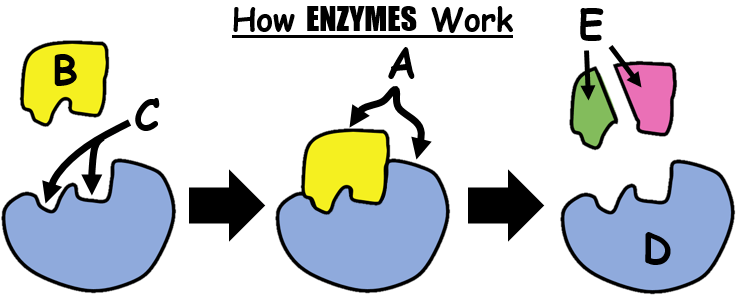
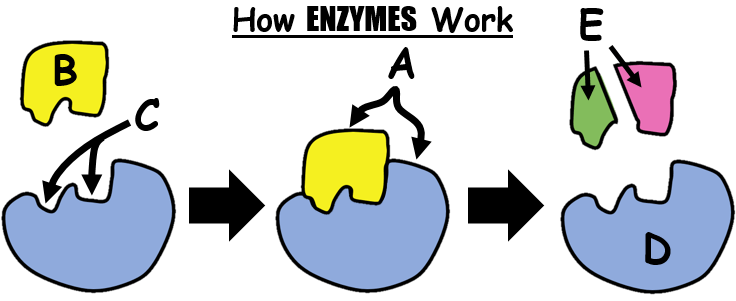
88.

Letter D...

a)

active site

b)

enzyme

c)

substrate

d)

products

89.

Letter B...

a)

active site

b)

enzyme

c)

substrate

d)

products

90.

Letter c...

a)

active site

b)

enzyme

c)

substrate

d)

products

91.

Each enzyme only has 1 substrate that will fit its active site.  What is this called?

a)

reusablility

b)

denaturation

c)

specificity

d)

fragility

92.

What is a substance called if it speeds up a chemical reaction?

a)

reusable

b)

catalyst

c)

specific

d)

fragile

93.

An enzyme speeds up a chemical reaction in the cell but can only be used once.  True or False? 

a)

true

b)

false

94.

What happens when enzymes are heated to a high temperature?

a)

The enzymes die.

b)

The shape of the enzymes are altered- 'denatured'

c)

The enzymes' amino acid sequence changes.

d)

The enzymes remain the same

95.

Label the parts of the enzyme model

96.

Click on the temperature that this enzyme is having optimum activity.

97.
Enzymes are...
a)
nucleic acids
b)
proteins
c)
lipids
d)
carbohydrates
98.
Which enzyme is most efficient in a basic solution?
a)
A
b)
B
99.
What happens when enzymes are heated to a high temperature?
a)
The enzymes die.
b)
The shapes of the enzyme are altered denature
c)
The enzymes' amino acid sequence changes.
d)
The enzymes remain the same
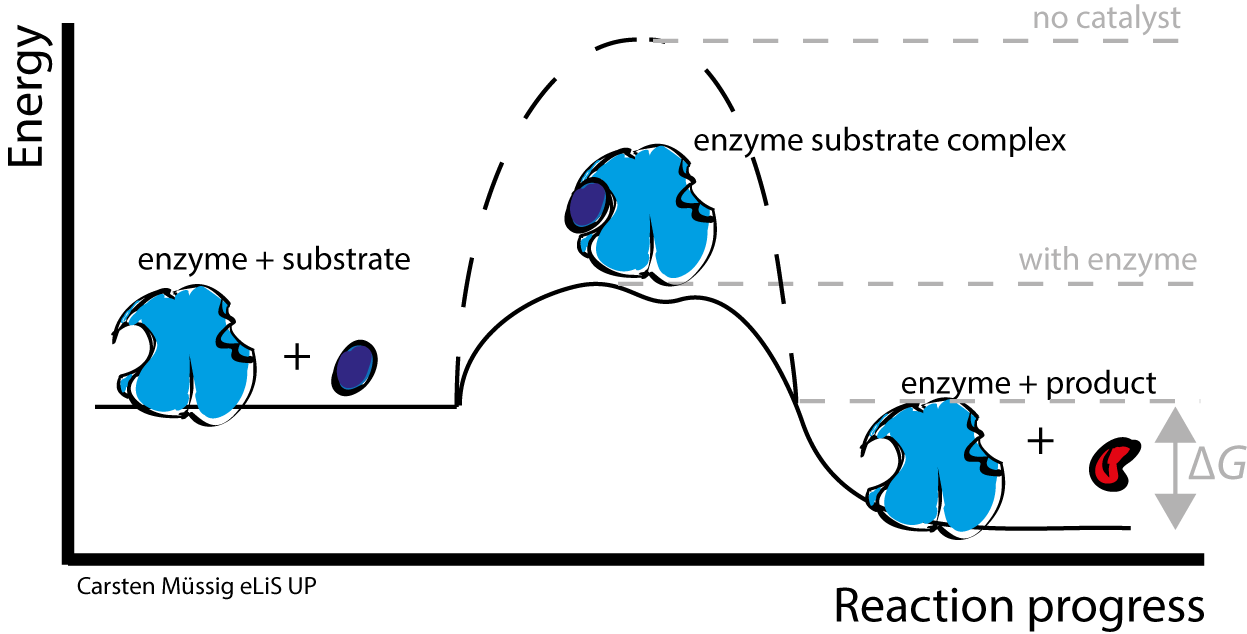
100.
An enzyme speeds up a reaction by
a)
lowering the activation energy.
b)
raising the activation energy.
c)
releasing energy.
d)
absorbing energy.
101.
What happens to an enzyme when it is denatured?
a)
Activation energy is lowered.
b)
It becomes stronger.
c)
It loses its shape.
d)
Activation energy is raised.
102.

What is the purpose of an enzyme?

a)

control how many reactions occur

b)

raise activation energy

c)

give permission for the reaction

d)

speed up chemical reactions

103.

Enzymes are ​ (a)   that ​ (b)   chemical reactions by​ (c)   the amount of activation energy required to start the reaction.

Choose from the below words
proteins
speed-up
decreasing
carbohydrates
increasing
slow-down
104.

Match the following Macromolecules to its structure

a)
1.

Carbohydrate

b)
2.

Lipid

c)
3.

Nucleic Acids

d)
4.

Protein

105.

Enzymes act on many different substrates

a)

True

b)

False

106.

Enzyme can be used again and again

a)

True

b)

False

107.
What 3 letters do enzymes typically end in?
a)
-ose
b)
-ase
c)
-ese
d)
-tic
108.
Any substance that is acted upon by an enzyme is called a(n)?
a)
Coenzyme
b)
Substrate
c)
Vitamin
d)
Polypeptide
109.
After the enzyme and substrate bind together and perform the reaction, what does the substrate become?
a)
a substrate
b)
an enzyme
c)
a product
d)
an active site
110.
Enzymes provide a site where reactants called substrates can be brought together in an enzyme-catalyzed reaction. The site is called the
a)
enzyme substrate complex.
b)
reaction site.
c)
active site.
d)
lock and key.
111.
Every enzyme has a optimal temperature and pH. True or False?
a)
True 
b)
False
112.
A(n) ______ is a substance with a pH less than 7
a)
Acid
b)
Alkaline
c)
Base
d)
Buffer
113.
A(n) _______ is a substance with a pH greater than 7.
a)
Base
b)
Acid
c)
Buffer
d)
Water
114.

Substances with a pH of 7 are

a)

Acidic

b)

Basic

c)

Neutral

d)

Saturated

115.

Which food group is needed for insulation and energy?

a)

Carbohydrates

b)

Fats

c)

Proteins

d)

Vitamins and Minerals

116.

Which of the following is not a food group?

a)

Carbohydrate

b)

Dairy

c)

Fat

d)

Protein

117.

Which of the following foods is a good source of protein?

a)

Bread

b)

Fruit

c)

Meat and fish

d)

Crisps

118.

Which food group is needed for growth and repair?

a)

Carbohydrates

b)

Fats

c)

Vitamins and minerals

d)

Protein

119.

Which food group is needed to ensure chemical reactions can take place in cells?

a)

Carbohydrates

b)

Fats

c)

Vitamins and minerals

d)

Water

120.

Which mineral is needed to ensure you have strong bones and teeth?

a)

Calcium

b)

Iron

c)

Magnesium

d)

Sodium

121.

Which food would you eat to prevent scurvy?

a)

Banana

b)

Orange

c)

Potato

d)

Carrot

122.

Which food group provides immediate energy for exercise?

a)

Carbohydrate

b)

Fat

c)

Protein

d)

Fibre

123.

Which food group keeps your digestive system healthy, preventing constipation?

a)

Carbohydrates

b)

Fats

c)

Fibre

d)

Protein

124.

Which of following foods is a good source of fibre?

a)

Cereal

b)

Burger

c)

Pasta

d)

Yoghurt

125.
Define the term 'balanced diet'.
a)
A diet containing some nutrients in the correct proportions.
b)
A diet containing most nutrients in the correct proportions.
c)
A diet containing none nutrients in the correct proportions.
d)
A diet containing all nutrients in the correct proportions.
126.
Not eating too much or too little means we are eating in ____________________.
a)
moderation
b)
sufficiently
c)
balanced
d)
variety
127.
__________________ are examples of high energy high nutrient food
a)
Fruits & vegetables
b)
Chocolate & Ice cream
c)
Milk & Cheese
d)
Pancake & Maple syrup
128.
Which nutrient provides the most amount of energy per gram?
a)
Carbohydrate
b)
Fats
c)
Protein
d)
Vitamin
129.
Which of the following is NOT a factor that determines how much energy we need.
a)
Age
b)
Gender
c)
Health status
d)
Level of activity
130.
Taller and bigger people need ______________ energy than shorter and smaller people.
a)
same
b)
more
c)
equal
d)
less
131.
When energy intake decreases and energy expenditure increases, body weight ______________.
a)
remains the same
b)
goes up
c)
goes down
d)
is unstable
132.
Define the term "energy balance".
a)
Energy intake is unequal to energy expenditure.
b)
Energy intake is equal to energy expenditure.
c)
Energy intake is more than energy expenditure.
d)
Energy intake is less than energy expenditure.
133.
_____________ increases the risk of diet related diseases.
a)
High Blood Pressure
b)
Coronary Heart Disease
c)
Diabetes
d)
Obesity
134.
Which component of a healthy, balanced diet helps with constipation? 
a)
Fibre
b)
Fats
c)
Minerals
d)
Protein