
Font size
 Worksheets
U4 AOS1 SAC Quiz
Total questions: 88
Worksheet time: 22hrs 0mins
What does the degree of unsaturation indicate in a hydrocarbon?
The number of hydrogens that can be added
The number of double or triple bonds and/or rings
The molecular weight of the compound
The solubility in water
Which type of bond is generally stronger, a carbon-carbon single bond or a carbon-carbon double bond?
Single bond
Double bond
Both are equally strong
It depends on the molecular structure
What is the degree of unsaturation in a molecule with the formula C 4 H 6 ?
1
2
3
4
What is the relative stability of a carbon-fluorine bond compared to a carbon-hydrogen bond?
More stable
Less stable
Equally stable
Stability depends on the molecular environment
Give the correct semi-structural formula for propyl ethanoate
(a)
Give the correct name for this semi-structural formula CH3CH2COOCH2CH3
(a)


Give the correct IUPAC name:
1-oxopentan-3-oic
3-carboxylicpent-1-ate
1-carboxypetan-3-one
3-oxopentanoic acid
Hydrocarbon boiling points increase when branching increases.
true
false
Which of the following has the highest boiling point?
heptane
pentane
nonane
All members of a homologous series are similar in terms of
structural formula
molecular formula
physical properties
chemical properties
Which of the following can be used to distinguish between alkanes and alkenes?
add a few drops of aqueous bromine
add a few drops of Universal indicator
add a piece of blue litmus paper
add a piece of red litmus paper
Dispersion
Which molecule forms dipole - dipole bonds as its strongest intermolecular bond?
CH3CHO
CH3COOH
CCl4
CO2
Which substance does not have hydrogen bonding between its molecules?
C6H5OH
CH3CHO
CH3COOH
C3H7OH
Although they have the same relative molecular mass, the boiling temperatures of hexane (69oC) and 2,2-dimethylbutane (49oC) are significantly different. The reason for this is.
the intermolecular forces are stronger between hexane molecules because it has more electrons
there are significantly stronger permanent dipole forces between hexane molecules
the number of covalent bonds in hexane molecules allows them to form more dispersion forces
the molecular shape of hexane molecules allows them to form stronger dispersion forces
Which of the following has dipole-dipole interactions between its molecules, but no hydrogen bonding?
Methane, CH4
Methanol, CH3OH
Ammonia, NH3
Hydrogen iodide, HI
For hydrogen bonding to occur, a molecule must have a hydrogen bonded to
carbon
another hydrogen
Fluorine, Chlorine or Oxygen
Fluorine, Nitrogen or Oxygen

Does this molecule contain hydrogen bonding?
yes
no
Which substance has the weakest intermolecular forces?
Substance A, boiling point of 75 °C
Substance B, boiling point of 105 °C
Substance C, boiling point of 25 °C
Substance d, boiling point of 45 °C
A compound with 2 degrees of unsaturation could have__in it.
two double bonds
two triple bonds
a double bond or a ring
neither
C8H14 has ___ degrees of unsaturation
1
3
2
Other
What are the conditions for forming a haloalkane from an alkane? Select all that apply.
Halogen gas
UV light
Low temperatures
Metal catalyst
High pressures
A substitution reaction is when:
A substituent is added to an organic compound.
A substituent is removed from an organic compound.
Two compounds are combined to form a new compound.
A substituent is replaced with another substituent on an organic compound.

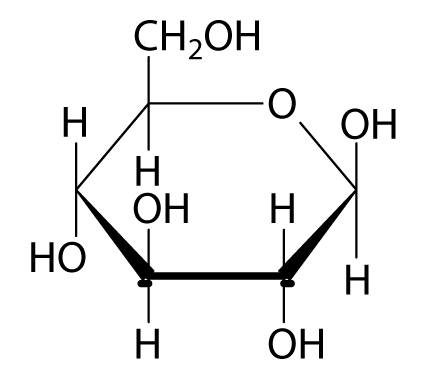
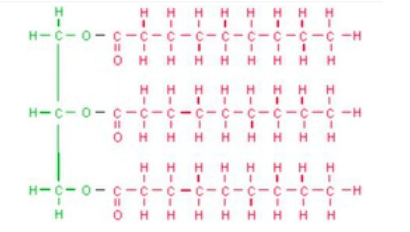
This is a structure of
polysaccharide
dipeptide
lipid
disaccharide
polypeptide
What is the name of the bond that saccharides in a chain?
glycosidic link
peptide link
ester bond
ether bond
lipid link

An unsaturated fatty acid has:
all C-C single bonds
all atoms are fully bonded
a fatty acid that is bonded to glycerol
no isomers
1 or more C-C double bonds

The type of reaction that joins parts of lipids together is
hydrolysis reaction
substitution reaction
condensation reaction
addition reaction
oxidation reaction

The type of reaction that joins saccharides together is:
hydrolysis reaction
substitution reaction
condensation reaction
addition reaction
oxidation reaction
What is the name of the bond that joins amino acids in a chain?
glycosidic link
peptide link
ester bond
ether bond
lipid link
What is the name of the bond that fatty acids to the backbone molecules?
glycosidic link
peptide link
ester bond
ether bond
lipid link
a) The number of fatty acids in every lipid is:
b) The molecule that joins with fatty acids is called:
a) it varies and b) glycogen
a) 3 and b) glycogen
a) 1 and b) glycerol
a) 3 and b) glycerol
a) 1 and b) no molecule
Which of the following are the correct functional groups for an amino acid?
Hydroxyl and Amine
Carboxyl and Amide
Carboxyl and Amine
Ester, Amine and Benzyl

Name this amino acid
Arginine
Phenylalanine
Asparagine
Glycine
A peptide link is formed through
Condensation
Hydrolysis
Electrolysis
Combustion

From left to right: this image shows.
Unsaturated, unsaturated, saturated fatty acids
Saturated, monounsaturated, polyunsaturated fatty acids
All the same
Polyunsaturated, monounsaturated, saturated fatty acids
Which is true of triglycerides, polypeptides and polysaccharides?
They are all water soluble
They are all polar
They can all be formed through condensation reactions
They are all made up of glycogen monomers
8. Haloalkane to alcohol
NaOH/H2O and reflux
SOCl2
Reduced with LiAlH4
NaCN/Ethanol
2. Alkane to halogenoalkane
X2/ UV
HX, room temperature
H2O
NaCN/ H+
Nucleophilic addition
3. Alkene to halogenoalkane
X2/ UV
HX, room temperature
H2O
NaCN/ H+
Nucleophilic addition
Carboxylic + alcohol makes ester and
HCl
H2O
NaOH
H2O2

What type is reaction 4?
Reduction
Electrophilic substitution
Oxidation
nucleophilic addition

Complete the box
(a)
If I wanted to convert a Br group into a OH group what would reagents and conditions would I use?
Which compound is influenced by H bonding?
Propanal
Butanone
Ethylethanoate
Pentanoic Acid
What is the catalyst used in the hydration of alkenes?
Sulphuric Acid
Phosphoric Acid
HCl
Ni
Which compound is formed when pent-2-ene is reacted with bromine?
1,1-dibromopentane
1,2-dibromopentane
2,2-dibromopentane
2,3-dibromopentane
What would I observe if I reacted 2-methylbutan-2-ol with acidified potassium dichromate?
Colourless to brick red
Orange to green
Green to Orange
No observations
What is the ester formed when Methanol is reacted with butanoic acid?
Butyl methanoate
Methyl butanoate
Butyl ethanoate
Methyl propanoate
Why does ethanol have a lower boiling point than water?
Weaker forces of attraction between molecules
The ethanol molecules easily loose a hydrogen atom
The –OH groups have more tendency to cling
Ethanol is more concentrated than water
Which organic compound has the highest boiling point?
2,3,4-trimethylpentane
Octane
Methylheptane
2,3-dimethylhexane
When reacting Na with Cl2, we calculated that the theoretical yield should be 13 grams. Our actual yield was 12.5 grams. What is the percent yield?
90.4%
104%
96.15%
1.04%
24 grams of CH4 was added to the above reaction. Calculate the theoretical yield of CO2.
Consider the production of 2-chloro-2-methylpropane in the following reaction:
(CH3)3COH + HCl --> (CH3)3CCl + H2O
What is the atom economy for the above reaction?
(Relative atomic masses: H = 1.0, C = 12.0, O = 16.0, Cl = 35.5)
50.0%
67.0%
83.7%
95.0%
Which of the following are the benefits of using catalysts in industrial processes?
(1) Obtaining a higher yield per reaction cycle
(2) Lowering the operating temperature
(3) Getting more product in a relatively shorter period of
time
(1) and (2) only
(1) and (3) only
(2) and (3) only
(1), (2) and (3)
What is green chemistry?
the utilization of a set of guidelines that increases or adds the use or generation of hazardous substances in the design, manufacture and application of chemical products.
the utilization of a set of principles that reduces or eliminates the use or generation of hazardous substances in the design, manufacture and application of chemical products.
a form of chemistry that focuses on how the color green was chemically formed and its components


What is the common name of the above substance?
glycerol
triglycerol
triglyceride
fatty acid methyl ester (F.A.M.E.)

What is the name of this compound?
glycerol
triglycerol
triglyceride
fatty acid methyl ester (F.A.M.E.)
What is the mole ratio of Triglyceride to methanol, needed for the transesterification reaction of forming biodiesel
1:1
3:1
1:3

What is the correct systematic name for
2-bromo-3-methylpent-2-ene
2-bromo-3-ethylbut-2-ene
3-bromo-2-ethylbut-2-ene
4-bromo-3-methylpent-3-ene
Theoretical yield = 73g
Actual yield =62g
Calculate the percentage yield.
1.16%
116%
85%
76%
Given the reaction
2KClO3 → 2KCl + 3O2
Masses: O = 16, K = 39, Cl = 35
Calculate the % atom economy for the formation of potassium chloride.
22.4
96
30
60.7
Use chemicals which are made from renewable sources rather than from petrochemical sources.
Design for degradation
Use of renewable feedstocks
Designing safer chemicals
Less hazardous chemical synthesis
Atom economy
Reduce waste at the molecular level by maximizing the number of atoms incorporated into the product
Use catalytic instead of stoichiometric reagents in reactions
Monitor chemical reactions in real-time as they occur to prevent the formation and release of any potentially hazardous substances
Choose the least energy-intensive chemical route
Design for degradation
Prioritize the prevention of waste
Minimize the use of temporary derivatives
Minimize toxicity directly by molecular design
Design chemicals that degrade and can be discarded easily

A resource that can restore or renew itself (unless badly mismanaged) or can be used over and over is called a:
Renewable resource
Non-renewable resource
Perpetual resource
Indestructible resource
A resource that can only be used once and cannot be replaced once used is called a...
Renewable resource
Non-renewable resource
Perpetual resource
Infinite resource
What does sustainability mean?
Using lots of resources.
Maintaining the world we live in for future generations.
Cutting down trees.
Using lots of water and electricity.
Which is the SKELETAL structural formula of the following organic compound?
CH3CH=CHCH(CH3)CH2CH3


Identify the functional group in alcohols.
Carbonyl
Hydroxyl
Carboxyl
Amino

All of these structure formulas are correct, except for ___?
a.
b.
c.
d.

How many hydrogens are missing from this extended structural formula?
6
7
8
9

The given image is the structure of linoleic acid in ...
Expanded form
Condensed form
Skeletal form
Which of the following skeletal structure has a formula of CH3CH=CHCH(CH3)CH2CH3?


What is the condensed formula of this structure?
CH3CH2CH2OH
CH3COCH3
CH3CH2CHO
CH3OCH2CH3

What is the condensed formula of this structure?
CH3CH2CH2OH
CH3COCH3
CH3CH2CHO
CH3OCH2CH3

