
Font size
 Worksheets
Unit 2 Biology Exam
Total questions: 89
Worksheet time: 2hrs 33mins
A segment of DNA that has the ability to code for a specific characteristic.
gene
trait
chromosome
chromatid
Genome
Chromosome
Traits
Genes
DNA
RNA
Amino Acids
Adenine

An Example of an inherited trait would be?
The bird likes big seeds
The bird had two chicks
The bird has a medium sized beak
The bird lives in an oak tree
A scientist is looking at a section of a chromosome that carries the code for red hair in a human. What part of a chromosome is he observing?
Trait
Gene
DNA Sequence
The genome
Genetically determined characteristic. For example: eye color.
Gene
Genetics
Heredity
Trait

Which of the following is a base pair?
Adenine - Cytosine
Cytosine - Thymine
Deoxyribose - Cytosine
Cytosine - Guanine
DNA is wrapped around spool like proteins called
hormones
chemicals
Histones
enzymes
Humans have ____________ pairs of chromosomes
19
23
46
25

The karyotype diagram below represents a human female with the genetic disorder known as Turner syndrome. Chromosomal analysis of this karyotype reveals the mutation is a result of
a missing X chromosome
a missing Y chromosome
an extra 21 chromosome
missing chromosome #9

The karyotype diagram below represents a human male. Chromosomal analysis of this karyotype reveals the abnormality in this karyotype is:
a missing X chromosome
a missing Y chromosome
an extra 21 chromosome
missing chromosome #9

Homologous pairs:
(select all that apply)
Have the same genes on them
May have different alleles
Each comes from one parent
Combine to give you your genotypes
Full set of chromosomes of a cell arranged with respect to size, shape, and number.
chromatin
karyotype
phenotype
genotype

**************** chromosome
metacentric
acrocentric
submetacentric
telocentric
The survival of a species depends on its ability to adapt to changes in the environment. Which statement correctly describes a way that mutations increase the likelihood that a species will survive in a changing environment?
Mutations are a source of variation in the species
Mutations are the cause of disease in the species
Mutations are not harmful when they occur in somatic cells
Mutations are always passed on to subsequent generations


Generation 2 individuals 5 and 6 are
brother and sister.
cousins.
married.
not related.

On a pedigree, this symbol represents a ---
not affected female.
not affected male.
affected male.
affected female.
If one of your parents is blood type A and the other is type B, which of the following blood types could you be?
O
AB
A or B
Any of these


Objective #13
This is a pedigree that follows blue eyes which is a recessive trait. What is the genotype of the father (square) in generation 1?
Aa
AA
aa
A?

What is the mode of inheritance for this pedigree?
Autosomal Recessive
Autosomal Dominant
X-linked Dominant
X-linked Recessive

What is the mode of inheritance for this pedigree?
Autosomal Recessive
Autosomal Dominant
X-linked Dominant
X-linked Recessive

What is the mode of inheritance for this pedigree?
Autosomal Recessive
Autosomal Dominant
X-linked Dominant
X-linked Recessive

What is the mode of inheritance for this pedigree?
Autosomal Recessive
Autosomal Dominant
X-linked Dominant
X-linked Recessive

What is the mode of inheritance for this pedigree?
Autosomal Recessive
Autosomal Dominant
X-linked Dominant
X-linked Recessive

What is the mode of inheritance for this pedigree?
Autosomal Recessive
Autosomal Dominant
X-linked Dominant
X-linked Recessive

Assuming a trait is AUTOSOMAL DOMINANT, what genotype would make a person UNAFFECTED?
AA
Aa
aa
XAY
XaY

Assuming a trait is X-LINKED RECESSIVE, what are the genotypes of an AFFECTED person?
XAY
XaY
XAXA
XAXa
XaXa
How do you classify the following genotype : AA
Homozygous Dominant
Homozygous Recessive
Heterozygous
If Purple Flowers (P) are dominant over white flowers (p), what would the phenotype be for a Pp genotype?
Purple flowers
White flowers
Not enough information
If straight hair (S) is dominant to curly hair (s) - what are the possible Genotype(s) for curly hair?
ss only
SS only
SS or Ss
Curly Hair
Straight Hair


The alleles of a gene pair in a heterozygote are both expressed with no blending.
codominance
incomplete dominance
polygenic
multiple alleles
Which of these Punnett squares represents a cross between a homozygous dominant parent and a heterozygous parent?


The complete instructions for making an organism, consisting of all the genetic material in that organism's chromosomes.
Epigenome
DNA
genome
genetic markers
All genes are expressed in every cell
True
False
To discover whether an animal showing the dominant trait is homozygous or heterozygous, it must be crossed with an animal that is:
homozygous dominant
homozygous recessive
heterozygous
Hemizygous
In a test cross to determine whether a fruit fly is homozygous (WW) or heterozygous (Ww) for long wings, 7 long-winged flies & 1 short winged-fly are produced. Which is a valid conclusion?
the fruit fly is WW
the fruit fly is Ww
the fruit fly is ww
more offspring are needed
In hamsters, long tails (L) are dominant to short tails (l). A student wishes to perform a test cross to determine whether a female long-tailed hamster is homozygous or heterozygous for tail length. She mates the hamster with a male long-tailed hamster & studies the offspring, which are 100% long-tailed. She concludes that the female hamster's genotype is "LL". What mistake(s) did the student make?
she should have mated the female hamster with a male that was known to be hybrid
she should have mated the female hamster with a short-tailed male hamster
she should have mated the female hamster with another long-tailed female
she has to mate members of the litter before she can make a conclusion

Which phase of Mitosis is shown in the picture?
Anaphase
Metaphase
Prophase
Telophase

Select the correct description for the picture
Prophase: The cell PREPARES for cell division as chromosomes coil up.
Metaphase: Chromosomes line up in the MIDDLE
Anaphase: Chromosomes pull APART to ends of the cell.
Teleophase: Chromosomes unwind and start to form TWO new cells.


Which option below best completes this sentence:
Genetic variation refers to
the presence of genetic similarities between individuals
the presence of genetic differences between individuals
similarities in the DNA sequence between individuals
differences in alleles between individuals

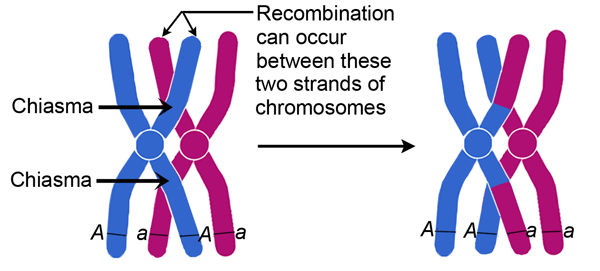
The diagram shows a diploid cell (2n=4) with genotypes.
Name the genotypes of possible daughter cells that have not undergone crossing over during meiosis.
(a)
Which of the following is the best definition for MEIOSIS?
the process of two haploid cells uniting
the counting of chromosomes within a diploid cell
a two-step process that reduces the number of chromosomes in half such that there is only one copy of all the chromosomes
the equational division of a cell into two identical copies
Check all of the following that DO occur during Telophase I and cytokinesis.
The separated homologous chromosomes are at opposite poles of the cell.
The cell divides in two.
The chromosomes do not uncoil, since they are getting ready for Meiosis II.
Sister chromatids are pulled away from each other.
What phase does independent assortment take place?
Prophase I
Prophase II
Metaphase I
Metaphase II
When does DNA replication occur for meiosis?
Before meiosis during interphase
During prophase when the cell is preparing
During metaphase when chromosomes are in the middle
During telophase when the nuclear envelope is forming
Describe the daughter cells in meiosis vs parent cell
The daughter cells are…
Identical & Diploid
Unique & Diploid
Identical & Haploid
Unique & Haploid

Which type of asexual reproduction does this picture represent?
binary fission
vegetative propagation
regeneration
budding
Asexual reproduction creates offspring that are
genetically identical to the parent
different from the parent
different from each other
formed by 2 parents
Budding, vegetative propagation, regeneration, and binary fission are all types of
sexual reproduction
asexual reproduction

The type of asexual reproduction shown in the diagram is called
regeneration
binary fission
vegetative propagation
budding

The type of asexual reproduction shown in the picture is called
regeneration
binary fission
vegetative propagation
budding
The purpose of cell division is
growth
evolution
repair
reproduction
In an animal, why would skin cells reproduce
growth
evolution
repair
reproduction
The egg cell of a koala contain 12 chromosomes. How many chromosomes does a normal cell contain?
6
12
24
36
A hydra has 32 chromosomes and reproduces by budding. How many chromosomes does its offspring have?
8
16
32
64
Gametes are made in
skin cells
stomach cells
reproductive systems
the circulatory system
What is it called when the egg and sperm cell join?
zygote
gamete
fertilization
mitosis
Can adapt easier to an environmental change
Sexual Reproduction Advantage
Asexual Reproduction Advantage
more energy is required to produce offspring and for that offspring to reach maturity
advantage of sexual reproduction
advantage of asexual reproduction
disadvantage of sexual reproduction
disadvantage of asexual reproduction
can be easily wiped out by disease
advantage of sexual reproduction
advantage of asexual reproduction
disadvantage of sexual reproduction
disadvantage of asexual reproduction

What type of asexual reproduction is it?
vegetative propagation
sporulation
budding
binary fission

What type of asexual reproduction is it?
budding
regeneration
sporulation
binary fission

What type of asexual reproduction is it?
vegetative propagation
sporulation
budding
binary fission
A daffodil can reproduce through both sexual and asexual reproduction. How does it reproduce asexually?
All Of These
Self-Pollination
Through their root systems
Cross-Pollination

