
 Worksheets
AP Biology: Unit 1 Review
Total questions: 66
Worksheet time: 17hrs 30mins
Why does organic chemistry focus on the study of carbon containing compounds?
Carbon is the most abundant element on Earth
Carbon is the easiest element to study
Carbon is backbone of the 4 categories of biomolecules and is found in all living things.
Carbon makes up the largest percentage of living organisms mass
Which elements are found in carbohydrates?
C, H, O
C, H, O, N
C, H, O, P
C, H, O, N, P
Which elements are found in lipids?
C, H, O
C, H, O, N
C, H, O, P
C, H, O, N., P
Which elements are found in proteins?
C, H, O
C, H, O, N
C, H, O, P
C, H, O, N, P
Which elements are found in nucleic acids?
C, H, O
C, H, O, N
C, H, O, P
C, H, O, N, P
What are the structural difference between DNA and RNA?
DNA is double stranded, RNA is single stranded
DNA contains thymine, RNA contains uracil
DNA contains deoxyribose sugar, RNA contains ribose sugar
All of the above
What type of bond holds amino acids together?
Glycosidic bond
Ester bond
Peptide bond
Phosphodiester bond
What type of bonds link monomers in biological polymers?
Ionic bonds
Metallic bonds
Hydrogen bonds
Covalent bonds
In a DNA molecule, what type of bond binds adenine and thymine together?
Peptide bonds
Hydrogen bonds
Covalent bonds
Disulfide bridges
How do monomers combine into polymers?
A molecule of water is added to the monomers forming a new hydrogen bond
A molecule of water is removed between the two monomers, and a covalent bond is formed
They form hydrogen bonds between their polar functional groups.
One monomer takes electrons from the other and they form an ionic bond
How do organisms breakdown polymers into monomers?
By digesting them with powerful enzymes
Through the process of reverse osmosis
By removing water from the polymer, which makes the chain dry and brittle
By adding a molecule of water between the monomers separating them
What is the difference between saturated and unsaturated lipids?
Saturated lipids contain the maximum number of carbon-hydrogen single bonds
Saturated lipids are solids at room temperature
Unsaturated lipids contain double bonds
Unsaturated lipids are easier for our bodies to breakdown
All of the above
What is the strongest type of bond found in a protein?
Peptide bond
Disulfide bridge
Van der Waals interactions
Hydrogen bond
How will altering a protein's primary structure affect its final structure?
An altered primary structure changes every level of structure above it, most likely rendering the protein non-functional
Primary structure does not influence the structure of the protein
The secondary structure will be altered as will but the other levels will remain the same
Why is molecular shape crucial in biology?
The shapes will change based on a cell's needs
Organisms like to look pretty
Structure determines function
The larger the molecule the more biological significance it has
What biomolecules contain nitrogen?
Proteins and Nucleic acids
Carbohydrates and Lipids
Nucleic acids and Carbohydrates
Lipids and Proteins
What is the cause of surface tension in water?
The high density of water
Hydrogen bonds form between the positive hydrogen of one water molecule and the negative oxygen of another
Covalent bonds form between the water molecules
Water's high specific heat
What is cohesion?
Water's ability to form 4 covalent bonds
Water's ability to absorb a large amount of energy
Water's tendency to "stick" to other water molecules
Water's tendency to "stick" to other compounds and surfaces
Where will hydrophobic amino acids orient themselves during protein folding?
At the top of the protein
On the sides of the protein
In the interior of the protein
On the surface of the protein
Where will hydrophilic amino acids orient themselves during protein folding?
They will be found throughout the proteins structure
On the surface of the protein
On the bottom of the protein
In the interior of the protein
What is the primary structure of a protein?
The interaction of multiple polypeptide chains
Folding caused by environmental interactions with the R-groups of the amino acids
The sequence of amino acids
Hydrogen bonds forming between the carbon skeletons of the amino acids
What is the secondary structure of a protein?
The sequence of amino acids
Folding caused by environmental interactions with the R-groups of amino acids
Hydrogen bonds forming between carbon skeletons, creating alpha helixes and beta pleats
Combining of multiple polypeptide chains to form 1 protein
What is the tertiary structure of a protein?
The sequence of amino acids
Folding caused by hydrogen bonds forming between the carbon skeletons
Multiple polypeptides combining to form one protein
Folding caused by environmental interactions with the amino acid R-groups
What is the quaternary structure of a protein?
The sequence of amino acids
When multiple polypeptide chains combine to form one protein
Hydrogen bonds forming between the carbon skeletons of amino acids
Environmental interactions with the R-groups of amino acids
What is the biological significance of water's polarity?
The polarity prevents water from being contaminated with lipids
The polarity allows water to form 4 covalent bonds with its open valence electrons
Being polar allows water to form hydrogen bonds, which give rise to the emergent properties
Water is not polar under most conditions
What structures of an amino acid join to form peptide bonds?
The R-groups of the amino acids bond together
The carboxyl group of one amino acid, with the R group of the next
The carboxyl group of one amino acid, and the amine group of the next
The amine groups join together
What is an enzyme?
A catalyst made of protein
A catalyst made of DNA or RNA
A catalyst made of metals only
Where does a peptide bond form?
between the five-carbon sugar of one nucleotide and the phosphate group of another nucleotide
between the R group of one amino acid and the carboxyl group of another amino acid
between the amino group of one amino acid and the carboxyl group of another amino acid
between the nitrogenous base of one nucleotide and the phosphate group of another nucleotide
Why is carbon able to form a large number of different molecules?
carbon only forms ionic bonds
carbon only forms ring structures
carbon can form four covalent bonds
carbon forms small simple structures
A polar covalent bond between atom occurs when
One of the atoms has a greater affinity for electrons than the other atom
The atoms attract the electrons equally
An electron from one of the atoms is completely transferred to the other atom
The molecule becomes ionized
The basic units or building blocks of fats are
Simple sugars (monosaccharides)
Double sugars (disaccharides)
Amino acids
Glycerol and fatty acids


What is the monomer of a lipid?
Amino Acid
Fatty Acid
Monosaccharides
Glucose
The parts of a nucleotide are:
nitrogen, sulfur, phosphate group
DNA, RNA, ATP
nitrogenous base, ATP, glucose
nitrogenous base, 5-carbon sugar, phosphate group
A ____ reaction releases water molecules while ____ a molecule.
dehydration; building
dehydration; breaking down
hydrolysis; building
hydrolysis; breaking down
A ____ reaction uses a water molecule to ___ a molecule.
dehydration; build
hydrolysis; build
dehydration; break down
hydrolysis; break down
The linkages formed between nucleotides are called ___ bonds.
peptide
ester
phosphodiester
glycosidic

To which class of macromolecules does this molecule belong?
carbohydrates
lipids
proteins
nucleic acids

To which class of macromolecules does this hormone molecule belong?
carbohydrates
lipids
proteins
nucleic acids

To which class of macromolecules does this molecule belong?
carbohydrates
lipids
proteins
nucleic acids

To which class of macromolecules does this molecule belong?
carbohydrates
lipids
proteins
nucleic acids

To which class of macromolecules does this molecule belong?
carbohydrates
lipids
proteins
nucleic acids


What functional group is shown in red?
carboxyl group
hydroxyl group
amino group
phosphate group

What functional group is shown in red?
carboxyl group
hydroxyl group
amino group
phosphate group

Which functional group is shown in red?
carboxyl group
hydroxyl group
amino group
phosphate group

Which functional group is shown?
carboxyl group
hydroxyl group
amino group
phosphate group

What functional group is shown in yellow?
amino group
phosphate group
carbonyl group
sulfhydryl group
Which functional group makes di-sulfide bridges in protein formation?
amino group
phosphate group
carbonyl group
sulfhydryl group
Alcohols have this functional group:
carboxyl group
hydroxyl group
amino group
phosphate group
Proteins contain this functional group:
carboxyl group
hydroxyl group
amino group
phosphate group

This molecule is...
A saturated fatty acid
An unsaturated fatty acid
Glycerol
Glucose

This molecule is...
A saturated fatty acid
An unsaturated fatty acid
Glycerol
Glucose
In a normal cellular protein, where would you expect to find a hydrophobic amino acid such as valine?
in the interior of the folded protein, away from water
on the exterior surface of the protein, interacting with water
in the transmembrane portion interacting with lipid fatty acid chains
in the interior of the folded protein, away from water, or in a transmembrane portion interacting with lipid fatty acid chains

There are 20 different amino acids. What makes one amino acid different from another?
different side chains (R groups) attached to a carboxyl carbon
different side chains (R groups) attached to the amino groups
different side chains (R groups) attached to an α carbon
different structural and optical isomers
Polysaccharides, triacyl-glycerides, and proteins are similar in that they
are synthesized from monomers by the process of hydrolysis.
are synthesized from subunits by dehydration reactions.
are synthesized as a result of peptide bond formation between monomers.
are decomposed into their subunits by dehydration reactions.
A carbon skeleton is covalently bonded to both an amino group and a carboxyl group. When placed in water it
would function only as an acid because of the carboxyl group.
would function only as a base because of the amino group.
would function as neither an acid nor a base.
would function as both an acid and a base.
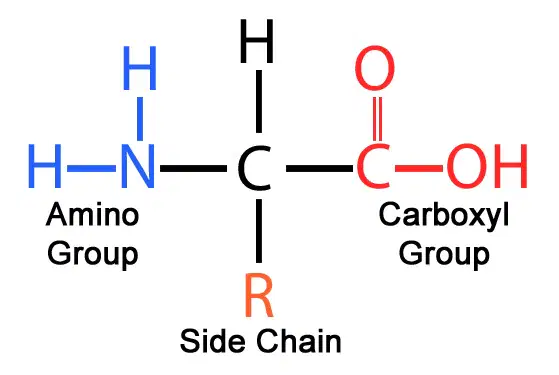
Which two functional groups are always found in amino acids?
ketone and methyl
carbonyl and amino
carboxyl and amino
amino and sulfhydryl
What is the difference between covalent bonds and ionic bonds?
Covalent bonds are formed between atoms to form molecules; ionic bonds are formed between atoms to form compounds.
Covalent bonds involve the sharing of pairs of electrons between atoms; ionic bonds involve the sharing of single electrons between atoms.
Covalent bonds involve the sharing of electrons between atoms; ionic bonds involve the electrical attraction between atoms.
Covalent bonds involve the sharing of electrons between atoms; ionic bonds involve the sharing of protons between atoms.
Which bond or interaction would be difficult to disrupt when compounds are put into water? Think about the polarity of water as it acts as a solvent.
covalent bond
hydrogen bond
van der Waals interaction
ionic bond
Which explanation best describes how a PEPTIDE BOND determines a protein's structure?
A chemical bond formed between two ions of opposite charges. In a protein, bonds form between the ionized acidic or basic groups of amino acids. This bond can be broken if the pH level changes and can cause the denaturation of proteins. This bond stabilized Tertiary and Quaternary structures.
Forms amino acid chains (primary structure) due to a covalent bond formed between a carboxyl group of an amino acid and the R-group of another amino acid to create a polypeptide.
Covalent bonds between sulfurs in sulfhydryl (-SH) side groups that reinforce the tertiary structures of a protein.
Bonds present in the-OH group of –NH2 of amino acids become slightly electropositive. Bonds between the oxygen (δ-) atoms and hydrogen (δ+) atoms attached to the nitrogen help stabilize the polypeptide backbone. Results in an 𝛂 Helix or 𝛃 Pleated Sheet. High frequency of these bonds leads to high stability of proteins at the secondary, tertiary, and quaternary levels.
Which explanation best describes how an IONIC BOND determines a protein's structure?
A chemical bond formed between two ions of opposite charges. In a protein, bonds form between the ionized acidic or basic groups of amino acids. This bond can be broken if the pH level changes and can cause the denaturation of proteins. This bond stabilized Tertiary and Quaternary structures.
Forms amino acid chains (primary structure) due to a covalent bond formed between a carboxyl group of an amino acid and the R-group of another amino acid to create a polypeptide.
Covalent bonds between sulfurs in sulfhydryl (-SH) side groups that reinforce the tertiary structures of a protein.
Bonds present in the-OH group of –NH2 of amino acids become slightly electropositive. Bonds between the oxygen (δ-) atoms and hydrogen (δ+) atoms attached to the nitrogen help stabilize the polypeptide backbone. Results in an 𝛂 Helix or 𝛃 Pleated Sheet. High frequency of these bonds leads to high stability of proteins at the secondary, tertiary, and quaternary levels.
Which explanation best describes how a DISULFIDE BRIDGE determines a protein's structure?
A chemical bond formed between two ions of opposite charges. In a protein, bonds form between the ionized acidic or basic groups of amino acids. This bond can be broken if the pH level changes and can cause the denaturation of proteins. This bond stabilized Tertiary and Quaternary structures.
Forms amino acid chains (primary structure) due to a covalent bond formed between a carboxyl group of an amino acid and the R-group of another amino acid to create a polypeptide.
Covalent bonds between sulfurs in sulfhydryl (-SH) side groups that reinforce the tertiary structures of a protein.
Bonds present in the-OH group of –NH2 of amino acids become slightly electropositive. Bonds between the oxygen (δ-) atoms and hydrogen (δ+) atoms attached to the nitrogen help stabilize the polypeptide backbone. Results in an 𝛂 Helix or 𝛃 Pleated Sheet. High frequency of these bonds leads to high stability of proteins at the secondary, tertiary, and quaternary levels.
Which explanation best describes how a HYDROGEN BOND determines a protein's structure?
A chemical bond formed between two ions of opposite charges. In a protein, bonds form between the ionized acidic or basic groups of amino acids. This bond can be broken if the pH level changes and can cause the denaturation of proteins. This bond stabilized Tertiary and Quaternary structures.
Forms amino acid chains (primary structure) due to a covalent bond formed between a carboxyl group of an amino acid and the R-group of another amino acid to create a polypeptide.
Covalent bonds between sulfurs in sulfhydryl (-SH) side groups that reinforce the tertiary structures of a protein.
Bonds present in the-OH group of –NH2 of amino acids become slightly electropositive. Bonds between the oxygen (δ-) atoms and hydrogen (δ+) atoms attached to the nitrogen help stabilize the polypeptide backbone. Results in an 𝛂 Helix or 𝛃 Pleated Sheet. High frequency of these bonds leads to high stability of proteins at the secondary, tertiary, and quaternary levels.
Which explanation best describes how a HYDROPHOBIC INTERACTION determines a protein's structure?
A chemical bond formed between two ions of opposite charges. In a protein, bonds form between the ionized acidic or basic groups of amino acids. This bond can be broken if the pH level changes and can cause the denaturation of proteins. This bond stabilized Tertiary and Quaternary structures.
Forms amino acid chains (primary structure) due to a covalent bond formed between a carboxyl group of an amino acid and the R-group of another amino acid to create a polypeptide.
Due to some R-Groups in amino acids being non-polar, when these polypeptide chains are in an aqueous environment, such as a cell, the polypeptide will fold into a shape that has the non-polar amino acids come into close contact with each other. This results in a globular protein shape.
Bonds present in the-OH group of –NH2 of amino acids become slightly electropositive. Bonds between the oxygen (δ-) atoms and hydrogen (δ+) atoms attached to the nitrogen help stabilize the polypeptide backbone. Results in an 𝛂 Helix or 𝛃 Pleated Sheet. High frequency of these bonds leads to high stability of proteins at the secondary, tertiary, and quaternary levels.

