wayground logo

Free Printable Worksheets

Font size

S
M
L
XL
Worksheets

CA1 Review - Units 1 & 2

Total questions: 75

Worksheet time: 1hrs 15mins
Name
Class
Date
1.
What biomolecule do enzymes belong to? 
a)
Carbohydrate
b)
Lipid
c)
Nucleic Acid
d)
Protein
2.
Which biomolecule is found in pasta and bread?
a)
Lipid
b)
Protein
c)
Nucleic Acid
d)
Carbohydrate
3.
Which biomolecule is a main source of quick energy?
a)
Nucleic Acid
b)
Protein
c)
Lipid
d)
Carbohydrate
4.
Which biomolecule is found in fats, oils, and waxes and is a source of long-term energy
a)
Proteins
b)
Nucleic Acid
c)
Lipids
d)
Carbohydrate
5.
What is the function of a nucleic acid?
a)
Stores genetic information
b)
Stores energy
c)
Quick source of energy
d)
Builds structures
6.
Carbon, Hydrogen, Oxygen and Nitrogen are elements in what biomolecule?
a)
Carbohydrate
b)
Lipid
c)
Protein
d)
Nucleic acid
7.
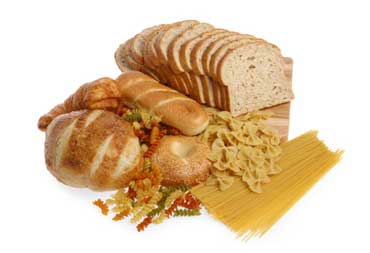
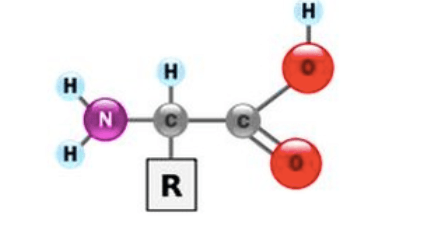
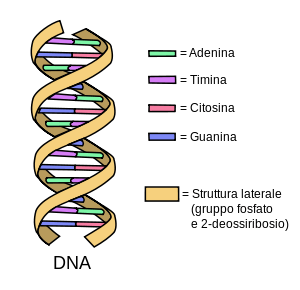
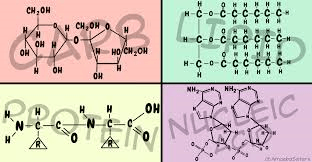
Which biomolecule is this a picture of?
a)
Protein
b)
Nucleic Acid
c)
Lipid
d)
Carbohydrate
8.
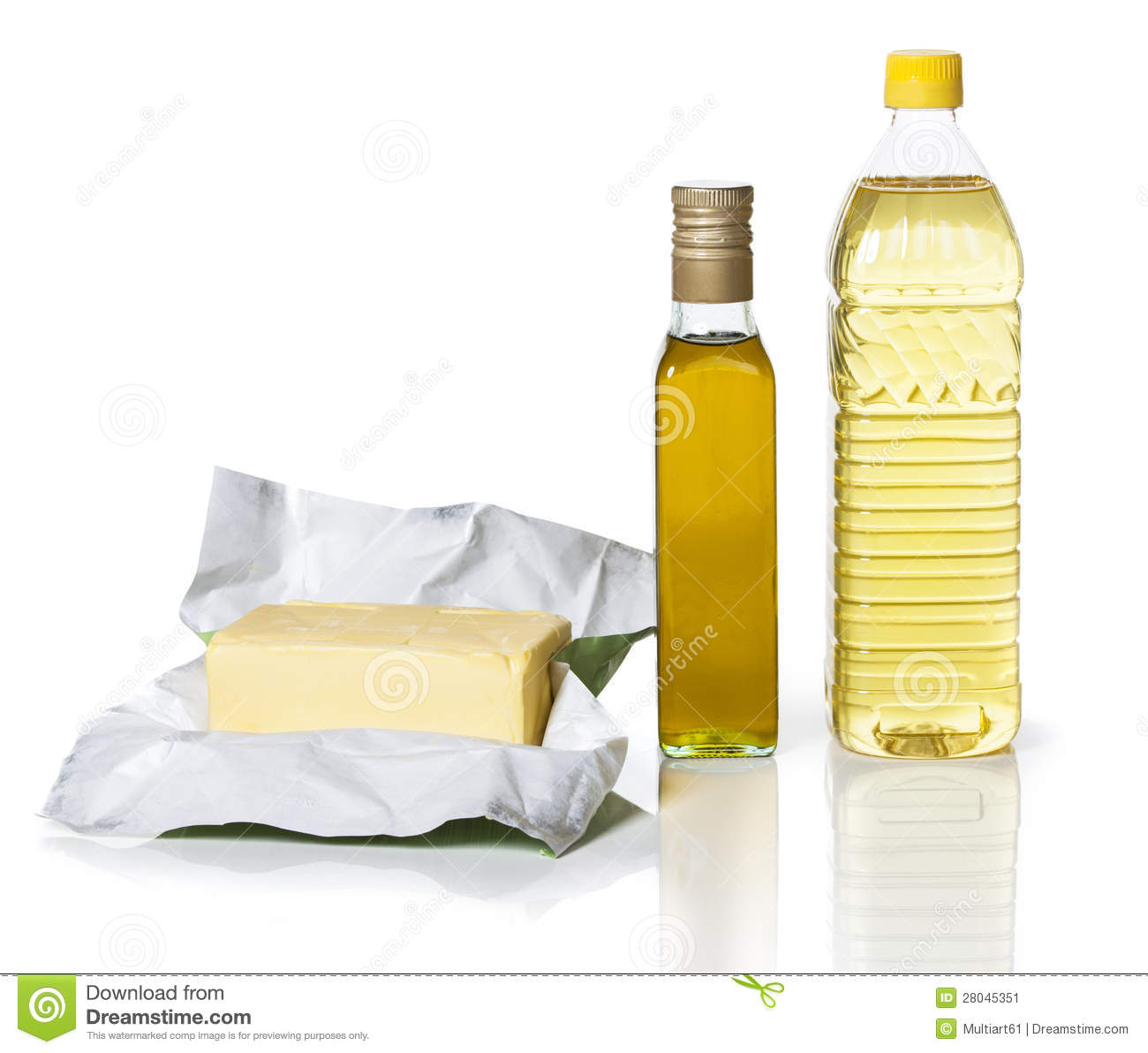
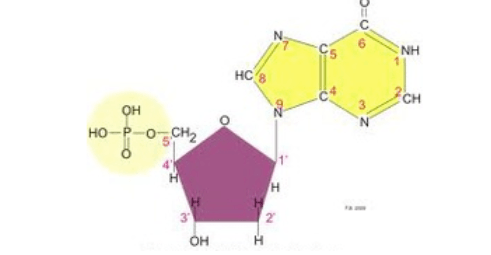
Which biomolecule is this a picture of?
a)
Protein
b)
Nucleic Acid
c)
Lipid
d)
Carbohydrate
9.
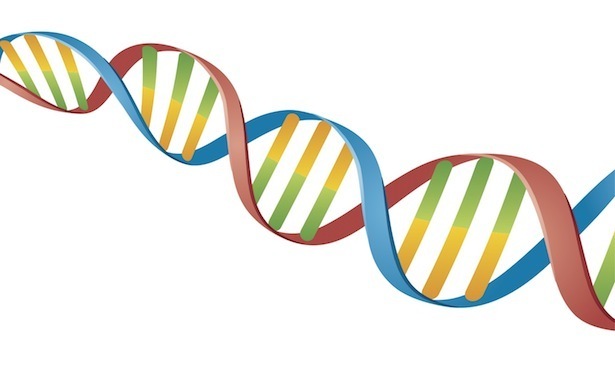
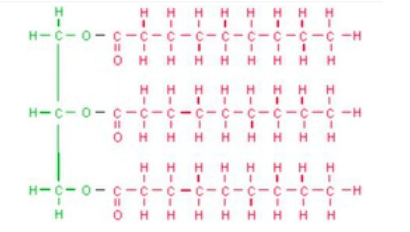
Which biomolecule is this a picture of?
a)
Protein
b)
Nucleic Acid
c)
Lipid
d)
Carbohydrate
10.
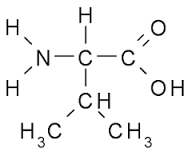
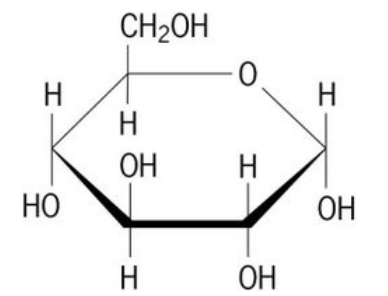
Which biomolecule is this a picture of?
a)
Protein
b)
Nucleic Acid
c)
Lipid
d)
Carbohydrate
11.
Which biomolecule is made of nucleotides and contain you DNA?
a)
Carbohydrate
b)
Lipids
c)
Protein
d)
Nucleic Acid
12.

Which biomolecule helps form muscles?

a)

Nucleic Acid

b)

Carbohydrate

c)

Protein

d)

Lipids

13.
Which biomolecule is responsible for insulation and energy storage?
a)
Protein
b)
Nucleic Acid
c)
Lipid
d)
Carbohydrate
14.
Which biomolecule has sugars and starches?
a)
Lipids
b)
Proteins
c)
Carbohydrates
d)
Nucleic Acid
15.
What type of molecule is this?
a)
Nucleic acid
b)
Protein
c)
Carbohydrate
d)
Lipid
16.
What elements are common to all 4 biomolecules?
a)
Carbon, hydrogen, nitrogen
b)
Carbon, Nitrogen, Phosphorus
c)
Carbon, Hydrogen, Oxygen
d)
Carbon, Hydrogen, Phosphorus
17.
A monomer is ...
a)
a single atom
b)
a building block for polymers
c)
a single element
d)
is an inorganic molecule
18.
Enzymes are considered to be 
a)
Lipids
b)
Carbohydrate
c)
Protein
d)
Nucleic Acid
19.
What is the purpose  of an enzyme?
a)
give permission for the reaction
b)
raise activation energy
c)
speed up reactions
d)
control how many reactions occur
20.
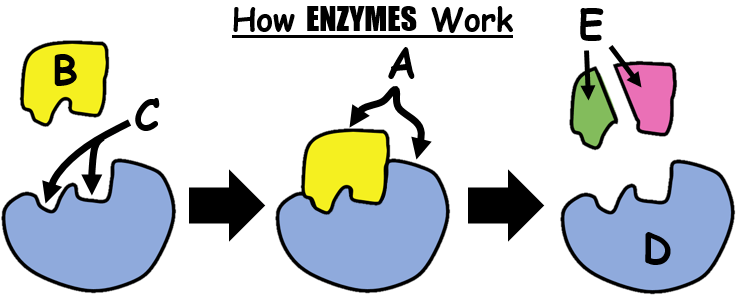
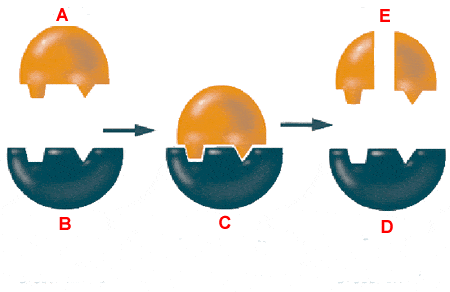
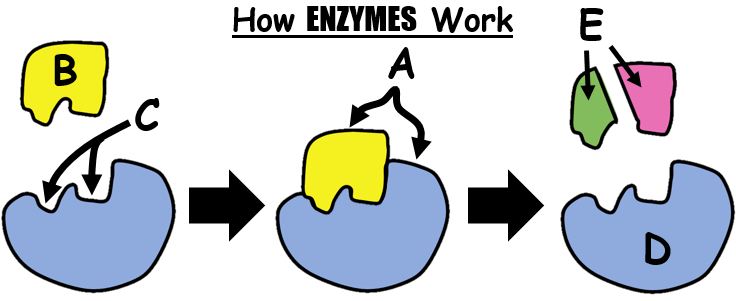
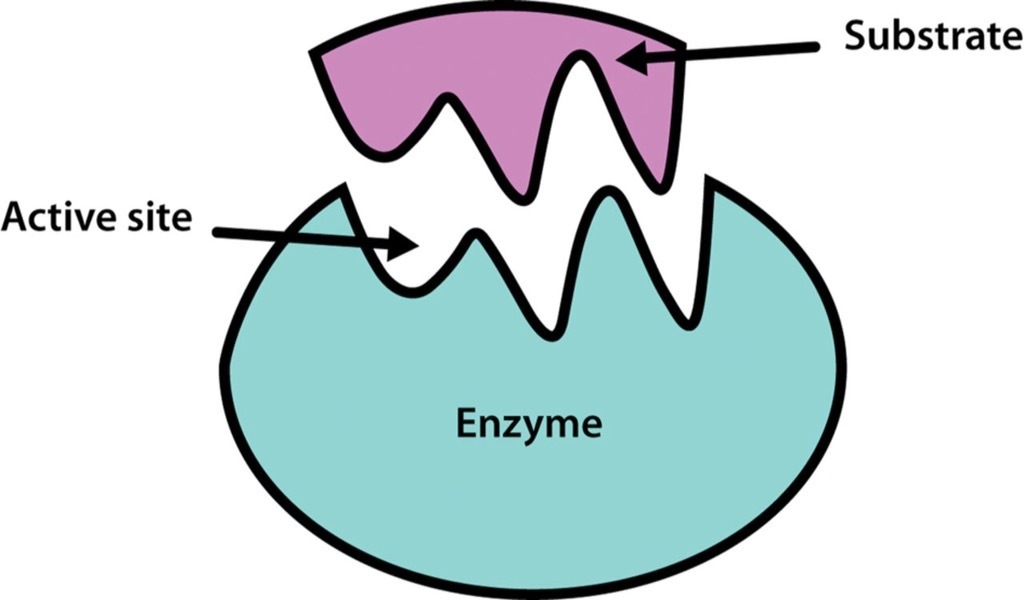
Letter D...
a)
active site
b)
enzyme
c)
substrate
d)
products
21.

Match the following.

a)

Lipid

1.

Long term energy

Insulators

b)

Nucleic Acid

2.

Genetic material

codes for traits

c)

Carbs

3.

Main source of energy

d)

Proteins

4.

Enzymes +

Builds muscle

22.

Match the following

a)

1.

Hypertonic

b)

2.

Hypotonic

c)

3.

Isotonic

d)

4.

Osmosis

e)

5.

Diffusion

23.

Organize these options into the right categories

Determine the Tonicity

(Each has 1 picture answer and 3 discrilptions)

Categorize the following

Cells are in an environment in which solute concentration is high

Cells are in an environment in which solute concentration is low

Cells are in an environment in which solute concentration is the same inside/outside the cell

Water diffuses out of the cell

Water diffuses into the cell

Water diffuses into and out of the cell

Cell shrink / shrivel

Cell swell and can burst (lyse)

Cell is at normal functional size

Hypertonic Solution
Hypotonic Solution
Isotonic Solution
24.

Determine the tonicity

Categorize the following
Hypotonic
Isotonic
Hypertonic
25.
When the concentration of particles inside of a cell is the same as the concentration of particles outside of the cell. 
a)
active transport
b)
concentration
c)
diffusion
d)
equilibrium
26.
Active Transport typically uses ______ to transport materials across the cell membrane.
a)
ATP
b)
Glucose
c)
Na+
d)
K+
27.

Which image best represents facilitated diffusion?

a)
b)
c)
d)
28.

Which is a picture of a phospholipid bilayer?

a)
b)
c)
29.

Which correctly points to the part of the image that is hydrophobic?

a)

A

b)

B

30.
Osmosis is a form of ______________. 
a)
Passive Transport
b)
Active Transport
31.
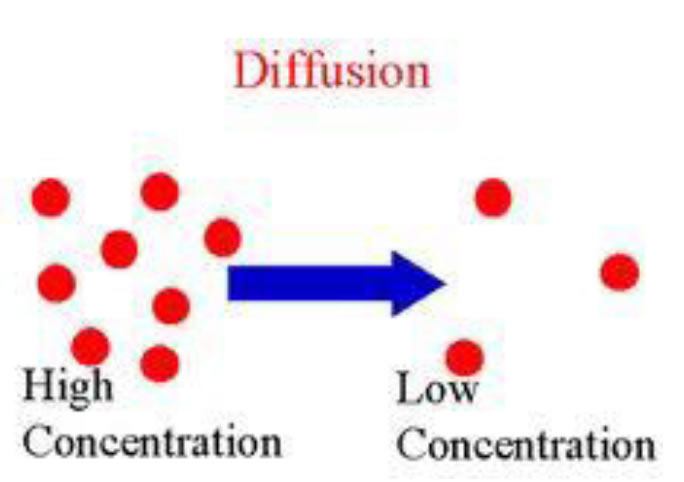
Movement of particles from high to low concentration. 
a)
Passive Transport
b)
Active Transport
32.

Identify the following structure

a)

Phospholipid

b)

Cell

c)

Cell membrane

d)

Protein

33.

What happens during osmosis?

a)
Transfer of energy from one place to another
b)

Movement of small molecules from high concentration to low concentration

c)

Movement of water molecules from an area of high water concentration to an area of low water concentration

d)
Process of breaking down food into simpler substances
34.

Organize these options into the right type of transport:

Categorize the following

does NOT require energy

requires energy

molecules move WITH the gradient

molecules move AGAINST the gradient

molecules move from high concentration to low

molecules move from low concentration to high

Passive Transport
Active Transport
35.

What is the correct description of the transport in the image?

a)

small molecules crossing the lipid bilayer (diffusion)

b)

large molecules crossing through a protein (facilitated diffusion)

c)

many molecules coming into the cell using a membrane vesicle (endocytosis)

d)

many molecules coming out of the cell using a vesicle to fuse with the membrane (exocytosis)

36.

Passive transport ​ (a)   require energy because it moves ​ (b)   the concentration gradient, from ​ (c)   .

Choose from the below words
does NOT
does
with
against
high to low
low to high
37.

Match the following

a)

Simple Diffusion

1.

When molecules passively cross the plasma membrane through the phospholipid bilayer

b)

Facilitated Diffusion

2.

When molecules passively cross the plasma membrane through a channel protein

c)

Osmosis

3.

The movement of water across the cell membrane

d)

Endocytosis

4.

Bringing in large materials through the cell membrane into a vacuole.

e)

Exocytosis

5.

Moving larger amounts or large quantities of materials through the cell membrane

38.

Match the monomer to its corresponding polymer

a)

Glycerol & Fatty Acids

1.

Triglyceride

b)

Nucleotide

2.

DNA/RNA

c)

Monosaccharide

3.

Polysaccharide

d)

Amino Acids

4.

Polypeptide

39.

Match the biomolecule to its corresponding monomer

a)

Carbohydrate

1.

Monosaccharide

b)

Lipid

2.

Glycerol & Fatty Acids

c)

Proteins

3.

Amino Acids

d)

Nucleic Acids

4.

Nucleotide

40.

Categorize the options into the right categories

Categorize the following
Fatty Acids

Monosacharride
Glucose

Amino Acids
Genetic information
Nucleotides
Catalyze chemical reactions in cells.
Long term energy storage

CARBOHYDRATES
LIPIDS
PROTEINS
NUCLEIC ACID
41.

Letter "E" represent the __________

a)

Phospholipids

b)

Active site

c)

Products

d)

Enzyme

42.

Enzymes can be affect by: (select all that apply)

a)

Temperate

b)

Isotonic solution

c)

pH

d)

Amount of substrate (concentration)

43.

Letter "A" represents the ___________

a)

Prokaryote

b)

Active site

c)

Product

d)

Substrate

44.

Enzymes catalyze reactions by ___________ activation Energy.

a)
Increasing
b)
Decreasing
45.
Letter D...
a)

Active site

b)

Enzyme

c)

Substrate

d)

Products

46.
One of the building blocks of lipids, the triglyceride, is composed of
a)
3 Fatty Acids and 3 Glycerol
b)
1 Fatty Acid and 3 Glycerol
c)
3 Fatty Acids and 1 Glycerol
d)
1 Fatty Acid and 3 Glycerol
47.

What is the function of lipids?

a)

Perform cell's functions/tasks

b)

Fast energy

c)

Energy storage

d)

Alter other biomolecules

e)

Store information for cells

48.

What is the function of nucleic acids?

a)

Perform cell's functions/tasks

b)

Fast energy

c)

Energy storage

d)

Alter other biomolecules

e)

Store information for cells

49.

Which organic molecule would a long-distance runner most likely choose to eat two hours before a race?

a)

A protein, because it builds muscle mass.

b)

A lipid because it provides long term energy storage.

c)

A carbohydrate because it releases energy quickly.

d)

A protein, because it transports oxygen into the blood stream.

50.

Match the following functions to the biomolecule

a)

Act as hormones

1.

Lipid

b)

Build muscle

2.

Protein

c)

Carry genetic information

3.

Nucleic acid

d)

Energy source (cellular respiration)

4.

Carbohydrate

51.

Match the following

a)
1.

Protein

b)
2.

Nucleic acid

c)
3.

Carbohydrate

d)
4.

Lipid

52.
Which is true of prokaryotic and eukaryotic cells?
a)
Prokaryotic cells are larger than eukaryotic cells.
b)
Eukaryotic cells do not have nuclei, and prokaryotic cells do have nuclei.
c)
Prokaryotic cells lack membrane-bound organelles, and eukaryotic cells contain membrane-bound organelles.
d)
Eukaryotic cells are simpler than prokaryotic cells.
53.
This is a picture of:
a)
Prokaryote
b)
Eukaryote
54.
What do the following terms have in common?
-diffusion
-osmosis
-facilitated diffusion
a)
They require energy to move materials
b)
They move from a low concentration to a high concentration
c)
They move move materials DOWN the concentration gradient
d)
They require ATP
55.
Facilitated diffusion is the movement of materials into and out of the cell
a)
with the use of energy
b)
with the use of proteins but no energy
c)
by moving water
d)
by using ATP
56.
Which form of transport is being shown in the diagram.
a)
diffusion
b)
osmosis
c)
facilitated diffusion
d)
active transport
57.
Semi-permeable mean to allow
a)
all materials across the membrane
b)
only some materials across the membrane
c)
no material to cross the membrane
d)
to allow only water across the membrane
58.
Which illustration of transport across the membrane requires energy?
a)
A
b)
B
c)
C
d)
D
59.

What is the name of 'B' found on the structure below

a)

Protein

b)

Lipic bilayer

c)

Phosphate hydrophilic heads

d)

Lipid hydrophobic heads

60.
This picture represents what type of cell transport?
a)
endocytosis
b)
exocytosis
c)
osmosis
d)
passive transport
61.
The cell below is in a _________ solution.
a)
Hypotonic
b)
Hypertonic
c)
Isotonic
62.
The cell below is in a _____________ solution.
a)
Hypertonic
b)
Hypotonic
c)
Isotonic
63.

Match the monomer to its corresponding polymer

a)

Glycerol & Fatty Acids

1.

Triglyceride

b)

Nucleotide

2.

DNA/RNA

c)

Monosaccharide

3.

Polysaccharide

d)

Amino Acids

4.

Polypeptide

64.

Match the biomolecule to its corresponding monomer

a)

Carbohydrate

1.

Monosaccharide

b)

Lipid

2.

Glycerol & Fatty Acids

c)

Proteins

3.

Amino Acids

d)

Nucleic Acids

4.

Nucleotide

65.
When the concentration of particles inside of a cell is the same as the concentration of particles outside of the cell. 
a)
active transport
b)
concentration
c)
diffusion
d)
equilibrium
66.
In the diagram, what is letter A? 
a)
product
b)
substrate
c)
enzyme-substrate complex
d)
active site
67.
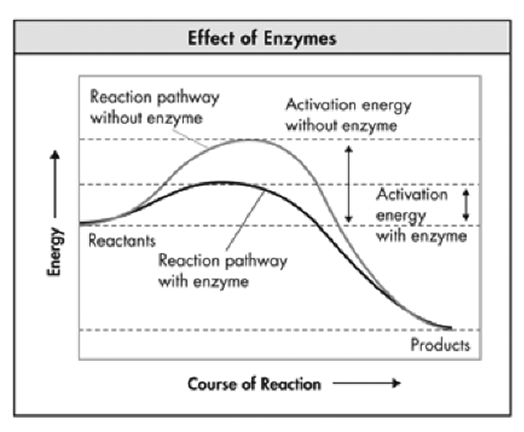
The graph shows how enzymes affect reactions in cells. Which statement best summarizes the information shown in the graph?
a)
Enzymes increase the energy of the reactants.
b)
Enzymes decrease the energy level of the products.
c)
Enzyme decrease the activation energy of the reaction.
d)
Enzymes reverse the direction of the reaction.
68.
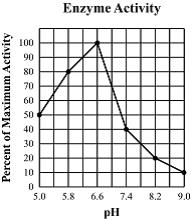
Which of the following conclusions can be drawn from this graph?
a)
The optimum pH of the enzyme is 6.6.
b)
The optimum pH of the enzyme is 5.8
c)
The enzyme’s activity increases as pH increases 5.0 to 9.0
d)
The enzyme’s activity is greater around pH of 8.0 .
69.
What happens when enzymes are heated to a high temperature?
a)
The enzymes die.
b)
The shapes of the enzyme are altered denature
c)
The enzymes' amino acid sequence changes.
d)
The enzymes remain the same
70.
Semi-permeable mean to allow
a)
all materials across the membrane
b)
only some materials across the membrane
c)
no material to cross the membrane
d)
to allow only water across the membrane
71.

Match the following

a)
1.

Plant Cell

b)
2.

Bacteria Cell

c)
3.

Animal Cell

d)

* All cells have

4.

* DNA, Cytoplasm, Ribosomes

e)

* Smaller simple cells no nucleus

5.

* Prokaryote

72.

Which does only eukaryotic cells contain?

a)

nucleus

b)

DNA

c)

cell membrane

d)

ribosomes

73.

Prokaryotic cells do not have…….

a)

membrane bound organelles

b)

cell membrane

c)

DNA or RNA

d)

life

74.

Which of the following is NOT a characteristic of a Prokaryotic cell?

a)

Unicellular

b)

Floating DNA

c)

Very small

d)

Complex

75.

Is this cell a Prokaryote or Eukaryote?

Is this cell Unicellular or Multicellular?

Bacteria (E. Coli)

a)

Prokaryote

Unicellular

b)

Eukaryote

Unicellular

c)

Eukaryote

Multicellular