
 Worksheets
Unit 1-3 Test Review
Total questions: 90
Worksheet time: 55mins
Which of the following is the smallest structural level of the human body?
Organism
Organ
Cellular
Chemical
Which plane divides the body into anterior and posterior parts?
Sagittal
Frontal
Transverse
Proximal
What is the correct directional term for 'toward the midline of the body'?
Anterior
Lateral
Medial
Distal
Which of the following pairs is an example of anatomical directions?
Cranial/Spinal
Superficial/Deep
Thoracic/Abdominal
Neurons/Neuroglial cells
Which of the following is a dorsal body cavity?
Thoracic
Abdominal
Cranial
Pelvic
What are the four main types of tissues in the human body?
Epithelial, Connective, Muscle, Nervous
Epithelial, Connective, Bone, Blood
Muscle, Nervous, Bone, Blood
Connective, Muscle, Bone, Blood
Which layer of the skin is responsible for providing a barrier against pathogens?
Epidermis
Dermis
Hypodermis
Subcutaneous layer
What is the primary function of the dermis?
Protection from UV radiation
Sensory reception and thermoregulation
Fat storage
Production of melanin
Which of the following glands is involved in thermoregulation?
Sebaceous glands
Sweat glands
Salivary glands
Endocrine glands
What are the levels of organization in order?
Cell, Tissue, Organ, Organ System, Organism
Cell, Tissue, Organ, Organ System
Cell, Tissue, Organ, Organism, Organ System
Cell, Organ, Tissue, Organ System, Organism
Match the following terms
away from the surface of the body
deep
toward the surface fo the body
superficial
closer to the trunk
proximal
away from the trunk
distal
away from the midline of the body
lateral
Below another part of the body
superior
inferior
distal
proximal
Toward the midline
anterior
posterior
medial
lateral
Front of the body
anterior
posterior
medial
lateral
Back of the body
anterior
posterior
medial
lateral
The cranial cavity is _____ to the thoracic cavity.
inferior
anterior
peripheral
superior
The strength of the dermis would mainly be due to _____.
the amount of blood vessels
the distribution of elastic fibers
the presence of collagen fibers
the thickness of the layers

Identify the type of connective tissue from the picture above.
Areolar
Bone (osseous)
Blood
Dense irregular

Identify the type of connective tissue from the picture above.
Adipose
Areolar
Blood
Bone (osseous)

Name this tissue
Skeletal muscle
Cardiac muscle
Smooth muscle

Name this tissue
Skeletal muscle
Cardiac muscle
Smooth muscle


Name the tissue
Skeletal Muscle
Cardiac muscle
Smooth Muscle

Pseudostratified columnar
Stratified columnar
Simple columnar
Basic columnar

What tissue is this?
Adipose Connective Tissue
Areolar Connective Tissue
Blood
Dense Regular

Name this tissue.
Simple columnar
Simple cuboidal
Smooth muscle
Stratified columnar

Name this tissue.
Adipose tissue
Hyaline cartilage
Dense Irregular
Blood

Adipose
Areolar
Elastic
Dense irregular connective
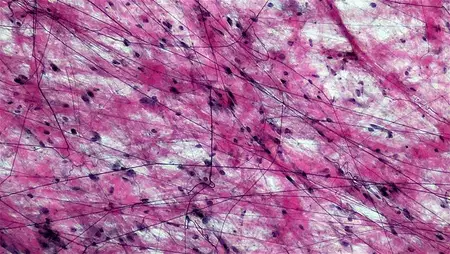
Dense regular connective
Areolar
Elastic
Dense irregular connective
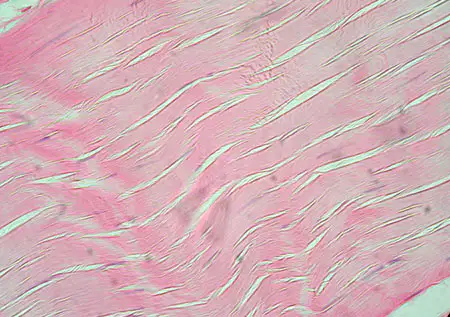
Dense regular connective
Areolar
Elastic
Dense irregular connective
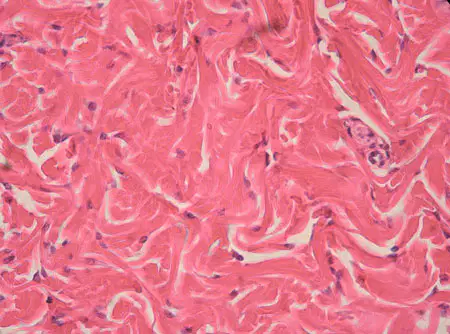
Dense regular connective
Areolar
Elastic
Dense irregular connective
Where would you find hyaline cartilage?
ends of bones
nose
vertebral discs
epiglottis
What is the most rigid connective tissue?
Cartilage
Blood
Bone
Adipose Tissue

What is the function of skeletal muscle tissue? (Select all that apply)
Allows movement of the head, trunk, and limbs
Generates heat when the body gets cold
Pushes material through hollow organs
Pumps blood throughout the body
Helps maintain blood pressure

Where is smooth muscle tissue found? (Select all that apply)
It makes up most of the tissue of the heart
None of the above
It is found in the walls of hollow organs
It is attached to the bones of the skeleton
It is found in the walls of the blood vessels

What type of muscle tissue is this?
cardiac
skeletal
smooth

What type of muscle tissue is this?
cardiac
skeletal
smooth

Label the muscle type from left to right.
cardiac smooth skeletal
skeletal cardiac smooth
skeletal smooth cardiac
cardiac skeletal smooth
Match the muscle tissues to their correct descriptions.
Skeletal Muscle
Voluntary control, attached to bones
Smooth Muscle
Involuntary control, found in internal organs
Cardiac Muscle
Involuntary control, found in the heart
Match the muscle tissues to the correct image.

Skeletal Muscle

Smooth Muscle

Cardiac Muscle
Nervous tissue is primarily responsible for:
Contracting muscles
Transmitting electrical signals
Providing support and structure
Regulating body temperature
The basic functional unit of the nervous system is the:
Neuron
Muscle fiber
Red blood cell
Adipocyte
Which type of connective tissue is responsible for storing energy in the form of fat?
Adipose Tissue
Cartilage
Bone
Blood
What is the role of ATP in the cell?
To store genetic information
To transport oxygen
To store and release energy
To produce proteins
What is responsiveness in the context of human life functions?
The ability to move
The ability to adjust to changes in internal and external environments
The ability to reproduce
The ability to grow and develop
Which of the following is an example of human movement?
Sweating in response to heat
Digesting food
Breathing
All of the above
What is the process of differentiation?
The process of reproduction
The process of breaking down food
The process of cells becoming specialized in structure and function
The process of energy release
Which of the following is NOT a function of the human body?
Metabolism
Reproduction
Organization
Photosynthesis
What is the importance of organization in the human body?
To transport oxygen
To store genetic information
To produce energy
To maintain distinct internal compartments
What is the body's response to short-term exposure to heat?
Sweating
Increased blood flow
Decreased metabolism
Shivering
What is the body's response to short-term exposure to cold?
Sweating
Shivering
Increased blood flow
Decreased metabolism
What is the clinical term for an abnormally low body temperature?
Hyperthermia
Hypothermia
Thermoregulation
Cryotherapy
What is the primary function of carbohydrates and lipids in the body?
Building blocks of the body
Energy-yielding nutrients
Regulating body temperature
Transporting oxygen
Which nutrient is the most critical for human survival?
Carbohydrates
Proteins
Water
Vitamins
What is the scientific study of the chemistry and physics of the structures of the body and the ways in which they work together to support the functions of life?
Anatomy
Physiology
Biology
Chemistry
What is the scientific study of the body's structure called?
Physiology
Anatomy
Biology
Pathology
What does the study of physiology primarily focus on?
The body's tendency toward homeostasis
The body's ability to grow
The body's response to external stimuli
The body's genetic makeup
What is homeostasis?
The process of cell division
The state of steady internal conditions maintained by living things
The body's response to infection
The process of energy production in cells
Which of the following is the correct sequence of levels of organization from simplest to most complex?
Atoms → molecules → cells → tissues → organs → organ systems → organisms → biosphere
Molecules → atoms → cells → tissues → organs → organ systems → organisms → biosphere
Subatomic particles → atoms → molecules → organelles → cells → tissues → organs → organ systems → organisms → biosphere
Cells → tissues → organs → organ systems → organisms → biosphere → subatomic particles → atoms → molecules
What level of organization involves a community of similar cells forming a body tissue?
Cellular level
Tissue level
Organ level
Organ system level
At what level do two or more different tissues combine to form an organ?
Cellular level
Tissue level
Organ level
Organ system level
What is the smallest independently functioning unit of a living organism?
Tissue
Cell
Organ
Organ System
Which level of organization consists of a group of organs that work together to perform major functions or meet physiological needs of the body?
Organ System
Tissue
Cell
Organ
What does a sagittal plane divide the body into?
A. Upper and lower portions
B. Front and back portions
C. Left and right portions
D. Inner and outer portions
Which of the following is NOT a characteristic of the anatomical position?
Body standing upright
Feet at shoulder width and parallel with toes forward
Upper limbs held out to each side
Palms of the hands facing backward
In anatomical terms, where would a scar in the "anterior (front) carpal (wrist) region" be located?
On the back side of the wrist
On the palm side of the wrist
On the side of the wrist
On the top of the wrist
How is a body that is lying face-down described?
Supine
Prone
Lateral
Dorsal
How is a body that is lying face-up described?
Supine
Prone
Lateral
Dorsal
Which term describes a position in a limb that is nearer to the point of attachment or the trunk of the body?
Distal
Superficial
Proximal
Deep
What does the term "distal" describe?
A position in a limb that is farther from the point of attachment or the trunk of the body
A position closer to the surface of the body
A position farther from the surface of the body
The middle or direction toward the middle of the body
Which term describes a position closer to the surface of the body?
Deep
Superficial
Proximal
Medial
What does the term "deep" describe?
A position closer to the surface of the body
A position farther from the surface of the body
The side or direction toward the side of the body
The middle or direction toward the middle of the body
Which cavity houses the brain?
Cranial Cavity
Spinal Cavity
Thoracic Cavity
Abdominal Cavity
What does the Spinal (or vertebral) Cavity enclose?
The brain
The heart
The spinal cord
The lungs
Which cavity is the more superior subdivision of the anterior cavity and is enclosed by the ribcage?
Abdominal Cavity
Pelvic Cavity
Thoracic Cavity
Dorsal Cavity
What does the thoracic cavity contain?
Liver and stomach
Lungs and heart
Kidneys and intestines
Bladder and reproductive organs
Which cavity houses the digestive organs?
Thoracic Cavity
Pelvic Cavity
Abdominal Cavity
Dorsal Cavity
Which cavity houses the organs of reproduction?
Thoracic Cavity
Abdominal Cavity
Pelvic Cavity
Dorsal Cavity
Match the name of the plane with its correct location
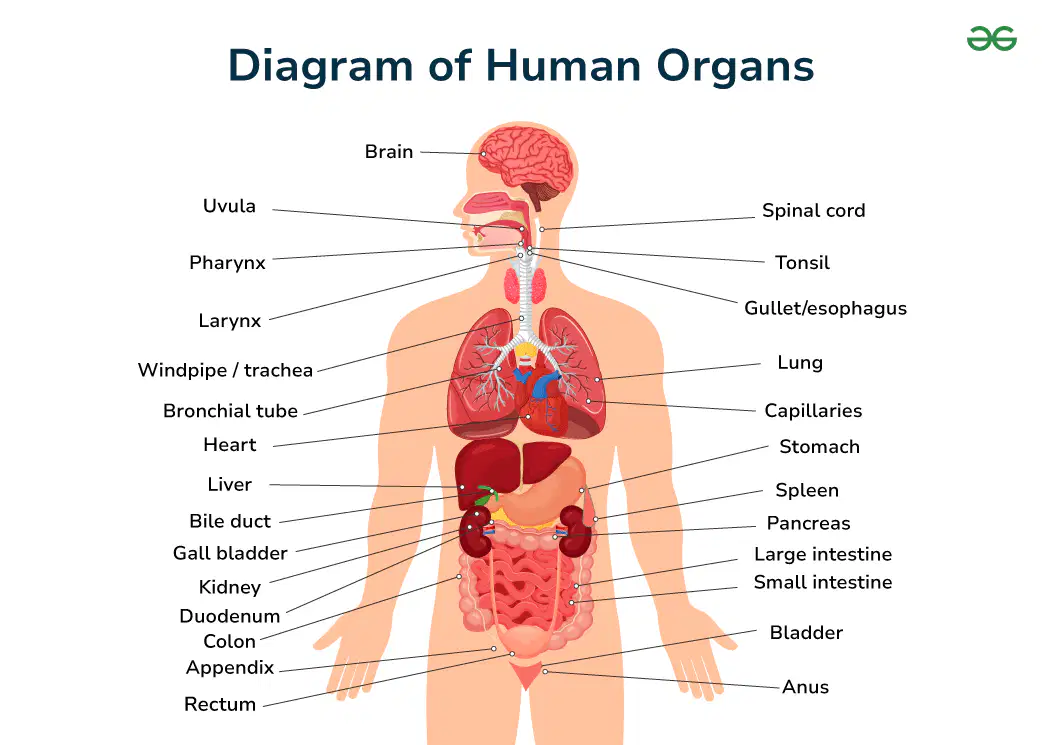
Which organ in the photo is lateral left to the kidney?
Liver
Stomach
Spleen
Pancreas
Click on the organ that is most superior in the picture.
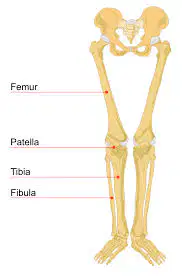
The fibula is (a) to the tibia and (b) to the patella.

