wayground logo

Free Printable Worksheets

Font size

S
M
L
XL
Worksheets

Unit 3: Review/study

Total questions: 76

Worksheet time: 1hrs 8mins

Name
Class
Date
1.
What are the products of photosynthesis?
a)
oxygen and carbon dioxide
b)
oxygen and glucose
c)
carbon dioxide and water
d)
water and glucose
2.
What is the chemical formula for glucose?
a)
C6H12O6
b)
C6H6O12
c)
C12H6O12
d)
C6O2H6
3.

Why are plants usually green?

a)

Because the chlorophyll reflects green light

b)

Because the chlorophyll absorbs green light

c)

Because the accessory pigments combine to make green

d)

Because the accessory pigments only absorb green light

4.
Which of these conditions would decrease the rate of photosynthesis in a plant?
a)
Above average precipitation
b)
Changing the daylight hours from 14 hrs to 10 hrs
c)
Changing the CO2 concentration from 380 ppm to 410 ppm
d)
All of these choices
5.
After photosynthesis, plants store their energy as _________ .
a)
chlorophyll
b)
pigment
c)
glucose (sugar)
d)
Oxygen
6.
If carbon dioxide is completely removed from a plant’s environment, what would you expect to happen to the plant’s production of high-energy sugars (rate of photosynthesis)?
a)
Sugar production will likely increase.
b)
Sugars will not be produced.
c)
The rate of sugar production will decrease .
d)
Fewer sugars will be produced at first, but then the plant will recover.
7.
The fluid like substance found inside the chloroplast is called
a)
Cytoplasm
b)
Stroma
c)
Thykloids
d)
Cell Wall
8.
__________ is a stack of thylakoids
a)
Granum
b)
Stomata
c)
Stroma
d)
Chloroplast
9.
a)
Stroma
b)
Thylakoid
c)
Skittle
d)
Grana
10.
Which organisms perform Photosynthesis?
a)
Only Autotrophs
b)
Only Heterotrophs
c)
Autotrophs and Heterotrophs
11.

Which organelle is responsible making food (Glucose) using sunlight?

a)

Cell Membrane

b)

Nucleus

c)

Chloroplast

d)

Mitochondria

12.

Which of the following are TRUE statements? (Select ALL that apply)

a)

Photosynthesis takes place in the chloroplasts of leaf cells

b)

Photosynthesis means "making food using sun"

c)

Photosynthesis can occur in the dark

d)

All plants, plant-like protists, and some bacteria go through photosynthesis

13.
What two products does a plant make during photosynthesis?
a)
Water and Glucose
b)
Oxygen and Glucose
c)
Oxygen and Water
d)
CO2 and Glucose
14.
What three things are needed for a plant to do photosynthesis?
a)
Glucose, Oxygen, Sunlight
b)
CO2, Oxygen, Sunlight
c)
CO2, Water, Sunlight
d)
Oxygen, Water, Sunlight
15.
The two main stages of photosynthesis are the
a)
light reactions and respiration
b)
dark reactions and the Calvin cycle 
c)
light reactions and the Calvin cycle
d)
dark reactions and fermentation
16.

Cellular Respiration occurs in what cell organelle?

a)

chloroplast

b)

cytoplasm

c)

mitochondria

d)

animal

17.

Which organism go through cellular respiration?

a)

animals

b)

plants

c)

both animals and plants

d)

none

18.

Which molecule is the reactant of Glycolysis?

a)

water

b)

glucose

c)

carbon dioxide

d)

ATP

19.

Which equation represents Cellular Respiration

a)

b)

c)

d)

20.

Which of the following is a reactant Cellular Respiration?

a)

Oxygen

b)

Carbon Dioxide

c)

Water

d)

Sunlight

21.

Which of the following is a reactant Cellular Respiration?

a)

Sunlight

b)

CO2

c)

H20

d)

C6 H12 O6

22.

Cellular Respiration is an aerobic process which means it requires Oxygen.

a)

True

b)

False

23.

What type of organism makes it's own food?

a)

Autotroph

b)

Heterotroph

c)

Consumer

d)

Omnivore

24.

What type of organism has to consume energy?

a)

Producers

b)

Plant

c)

Autotroph

d)

Heterotroph

25.

What is the best definition for cellular respiration?

a)

A process in which glucose is broken down to be used for energy.

b)

A process in which Carbon Dioxide is used to break down Glucose.

c)

The process in which animals make their own energy.

26.

Click on the two products of Cellular Respiration?

a)

H2O

b)

O2

c)

CO2

d)

C6 H12 O6

27.

What is the name of the energy caring molecule 4?

a)

ATP

b)

ADP

c)

NADH

d)

NAD+

28.

Many different chemical reactions occur during cellular respiration. It is a process that requires certain resources to get started and in turn it produces resources when it is finished. With all of that being said, why do organisms want to perform cellular respiration? What is the main purpose?

a)

To make H2O from CO2

b)

To harvest energy from food

c)

To create much needed O2

d)

To create glucose

29.
Cellular Respiration's goal is to
a)
make water
b)
make ATP
c)
make glucose
d)
make  oxygen
30.
This process releases chemical energy from sugars and other carbon-based molecules to make ATP when oxygen is present.
a)
photosynthesis
b)
light-independent reaction
c)
cellular respiration
d)
light-dependent reaction
31.
The waste gas given off by cellular respiration is?
a)
oxygen
b)
carbon dioxide
c)
nitrogen
d)
methane
32.

In which way are photosynthesis and cellular respiration different?

a)

Cellular respiration stores ATP, while photosynthesis releases ATP.

b)

Cellular respiration produces oxygen, while photosynthesis uses oxygen.

c)

Photosynthesis releases energy, while cellular respiration stores energy.

d)

Photosynthesis uses carbon dioxide, while cellular respiration produces carbon dioxide.

33.
What does metabolism mean?
a)
Converting energy into food
b)
Making light reactions happen
c)
Converting food into energy
34.
Photosynthesis ______ glucose while cellular respiration ______ glucose.
a)
builds; breaks apart
b)
breaks apart; builds
35.

What are the products of cellular respiration?

a)

NADH and ATP

b)

oxygen and heat

c)

FADH2 and NADH

d)

CO2 and H2O

36.

What organelle converts glucose into ATP?

a)

Ribosomes

b)

Vesicles

c)

Cytoskeleton

d)

Mitochondria

37.
Please select who performs cellular respiration: 
a)
Animals 
b)
Both animals and plants 
c)
plants 
38.
Cellular respiration is...
a)
the process by which cells break down glucose into energy. 
b)
the process by which cells break light down into energy. 
c)
the process by which cells communicate with other cells. 
39.

What is the equation for photosynthesis?

a)

6O2+ H2O → C6H12O6 + CO2

b)

CO2+ Light → C6H12O6 + O2

c)

6 CO2+ 6 H2O+ light → C6H12O6 + 6 O2

40.

In Cellular Respiration, cells use energy available in food to create what energy-rich compound?

a)

ATP

b)

ADP

c)

glucose

d)

water

41.

Energy is released from ATP when:

a)

ATP is exposed to sunlight

b)

a phosphate group is broken

c)

adenine bonds to ribose

d)

a phosphate group is added

42.

Which of the following would most affect the rate of photosynthesis?

a)

Amount of carbon dioxide in the atmosphere

b)

amount of water in the soil

c)

amount of sunlight

d)

All of the above

43.

What are the products of the light dependent reaction in photosynthesis

a)

All of these

b)

Oxygen

c)

ATP

d)

NADPH

44.

What are the reactants in the light independent reaction or Calvin Cycle in photosynthesis?

a)

carbon dioxide

b)

ATP

c)

NADPH

d)

All of the above

45.

What are the products in the light independent or Calvin Cycle of photosynthesis?

a)

water

b)

oxygen

c)

carbon dioxide

d)

glucose

46.

In cellular respiration, the first step in releasing the energy of glucose in the cell is known as:

a)

electron transport

b)

glycolysis

c)

the Krebs Cycle

d)

the Calvin Cycle

47.

After the bond depicted in the photo is broken, what will be the correct name of the molecule?

a)

ATP

b)

Glucose

c)

ADP

d)

NADPH

48.

The process that releases energy from food in the presence of oxygen is:

a)

fermentation

b)

photosynthesis

c)

cellular respiration

d)

synthesis

49.

The light dependent portion of photosynthesis takes place in what part of the chloroplast?

a)

mitochondria

b)

cytoplasm

c)

thylakoids

d)

stroma

50.

What are the correct steps, in order, of cellular respiration?

a)

Light Dependent Reaction, Calvin Cycle, Dark Reaction

b)

Glycolysis, Krebs Cycle, Electron Transport Chain

c)

Photosynthesis, Glucose, Respiration

d)

Krebs Cycle, Glycolysis, Electron Transport Chain

51.

Where does at the Krebs cycle take place?

a)

Cytoplasm

b)

Mitochondria

c)

Stroma

d)

Thylakoid

52.

Where does at the electron transport chain take place?

a)

Cytoplasm

b)

Mitochondria

c)

Stroma

d)

Thylakoid

53.
In which way are photosynthesis and cellular respiration different?
a)
Cellular respiration stores ATP, while photosynthesis releases ATP.
b)
Cellular respiration produces oxygen, while photosynthesis uses oxygen.
c)
Photosynthesis releases energy, while cellular respiration stores energy.
d)
Photosynthesis used carbon dioxide, while cellular respiration produces carbon dioxide.
54.
Where does glycolysis take place?
a)
Cytoplasm
b)
Stroma
c)
Thylakoid
d)
Mitochondria
55.
What is the correct equation for cellular respiration?
a)
6O2 + C6H12O6 -> 6CO2 + 6H2O + Energy
b)
6O2 + C6H12O6 + Energy -> 6CO2 + 6H2O
c)
6CO2 + 6H2O -> 6O2 + C6H12O6 + Energy
d)
6CO2 + 6H2O + Energy -> 6O2 + C6H12O6
56.

Which of the following are a part of cellular respiration? (select all that apply)

a)

glycolysis

b)

Krebs cycle

c)

electron transport chain

d)

photosynthesis

e)

Calvin cycle

57.
Enzymes are considered to be 
a)
Lipids
b)
Carbohydrate
c)
Protein
d)
Nucleic Acid
58.
What is the purpose  of an enzyme?
a)
give permission for the reaction
b)
raise activation energy
c)
speed up reactions
d)
control how many reactions occur
59.
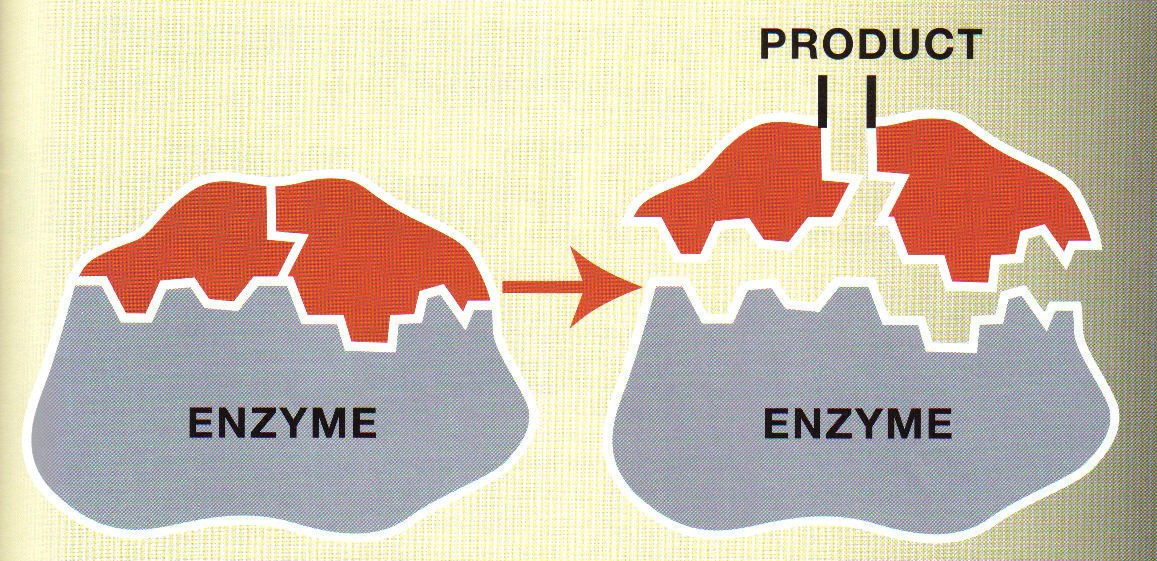
Where do substrates bind on an enzyme?
a)
voltage-gated channels
b)
surface receptor
c)
calcium channels
d)
active site
60.
What 3 letters do enzymes typically end in?
a)
-ose
b)
-ase
c)
-ese
d)
-tic
61.
What is the name for the mechanism of enzyme activity?
a)
Lock and key
b)
jigsaw puzzle
c)
hammer and nail
d)
two hands pattern
62.
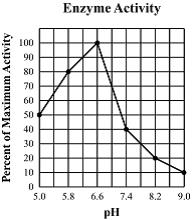
Which of the following conclusions can be drawn from this graph?
a)
The optimum pH of the enzyme is 6.6.
b)
The optimum pH of the enzyme is 5.8
c)
The enzyme’s activity increases as pH increases 5.0 to 9.0
d)
The enzyme’s activity is greater around pH of 8.0 .
63.
What is the purpose  of an enzyme?
a)
give permission for the reaction
b)
raise activation energy
c)
speed up reactions
d)
control how many reactions occur
64.
Enzymes are capable of increasing the rate of a chemical reaction within a living cell.  Enzymes accomplish this through which of the following means?
a)
reducing the number of products   
b)
reducing the activation energy
c)
increasing the temperature of the cell
d)
increasing the concentration of reactants 
65.
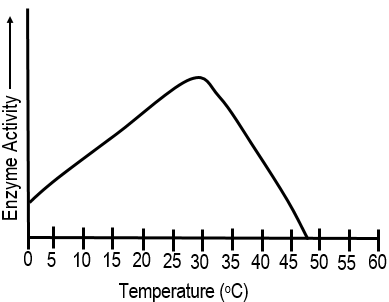
Based on the graph, what is the optimal temperature for this enzyme? 
a)
15oC
b)
40oC
c)
30oC
d)
35oC
66.
What is a substance called if it speeds up a chemical reaction?
a)
reusable
b)
catalyst
c)
specific
d)
fragile
67.
What happens when enzymes are heated to a high temperature?
a)
The enzymes die.
b)
The shapes of the enzyme are altered denature
c)
The enzymes' amino acid sequence changes.
d)
The enzymes remain the same
68.
The molecule an enzyme is working on is called the:
a)
Substrate
b)
Solvent
c)
Allosteric Inhibitor
d)
CoEnzyme
69.
Enzymes will make a reaction go _______ and use ______ energy.
a)
faster, less
b)
faster, more
c)
slower, less
d)
slower, more
70.
Which bond of the ATP molecule is broken in order to release energy?
a)
A
b)
B
c)
C
d)
D
71.
What are the parts of the ATP molecule?
a)
adenine, thylakoids, stroma
b)
stroma, grana, chlorophyll
c)
adenine, ribose, phosphate groups
d)
NADH, NAHPH, FADH
72.
What do all cells use as energy?
a)
Carbs
b)
Protein
c)
Fat
d)
ATP
73.
Energy is released from ATP when
a)
a phosphate group is added
b)
adenine bonds to ribose
c)
ATP is exposed to sunlight
d)
a phosphate group is removed
74.
What is the activation energy?
a)
The energy of the products
b)
The energy of the reactants
c)
The minimum energy needed by the reactants to form the products.
d)
The energy lost in the reaction
75.

How does a catalyst work in speeding up a reaction?

a)

By lowering the activation energy or reaction

b)

by giving them more energy

c)

by making them more available

76.
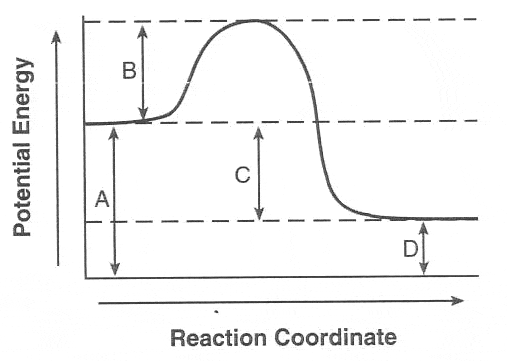
What letter represents the energy of the products?
a)
A
b)
B
c)
C
d)
D