wayground logo

Free Printable Worksheets

Font size

S
M
L
XL
Worksheets

Unit 4: The Cell Cycle

Total questions: 106

Worksheet time: 1hrs 13mins

Name
Class
Date
1.

Shall we stand and fight and see another night?

a)

Yes

b)

No

2.

What are the three stages of interphase?

a)

Prophase, metaphase, telophase

b)

G1, S, and G2

c)

G2, S, and G3

d)

Prophase, G1, and S

3.

What are the two main stages of the cell cycle?

a)

Prophase and Mitosis

b)

Mitosis and G1

c)

Interphase and Telophase

d)

Interphase and Mitosis

4.

What two characteristics tell you the image is in interphase?

a)

The cell still has a nuclear membrane and the DNA is relaxed in the form known as chromatin

b)

The cell's nuclear membrane is disappearing and the DNA is condensed in the form known as chromosomes

5.

Is the following cell a prokaryotic cell or a eukaryotic cell?

a)

Prokaryotic because it lacks a nucleus

b)

Eukaryotic because it has a membrane-bound nucleus

6.

In what phase of interphase does a cell produce a supply of organelles for its daughter cells?

a)

G1

b)

S

c)

G2

d)

None of the above

7.

What part of Interphase is cell growth and development?

a)

G1

b)

S

c)

G2

8.

This phase is for DNA replication.

a)

G1

b)

S phase

c)

G2

9.

What is the phase after DNA replication?

a)

G1

b)

S phase

c)

G2

10.
The cell spends most of it's life in ________________.
a)
mitosis
b)
cytokinesis
c)
Interphase
d)
None of the above
11.
Humans have ________ pairs of chromosomes.
a)
21
b)
23
c)
46
d)
None of the above
12.
Before cells can divide, what must be copied?
a)
mitochondria
b)
cytoplasm
c)
DNA
d)
Cell Wall
13.
Which stage of the cell cycle is shown in the diagram?
a)
Prophase
b)
Interphase
c)
Anaphase
d)
Telophase
14.
The structure shown in the diagram is a _____________?
a)
chromatid
b)
chromosome
c)
centromere
d)
DNA
15.
Which stage of mitosis is shown in the diagram?
a)
Anaphase
b)
Cytonkinesis
c)
Interphase
d)
Prophase
16.
What is the name of the structure labeled X?
a)
Centriole
b)
Centrosome
c)
Chromatid
d)
Chromosome 
17.
What structure is the red arrow pointing to?
a)
chromosome
b)
centromere
c)
chromatid
d)
centriole
18.
Which stage of mitosis is shown in the diagram?
a)
Cytokinesis
b)
Interphase
c)
Anaphase
d)
Metaphase
19.
Which is Metaphase?
a)
A
b)
E
c)
C
d)
F
20.
How many chromosomes do humans have?
a)
46
b)
21
c)
10
21.
Which stage of mitosis is shown in the diagram?
a)
Cytokinesis
b)
Anaphase
c)
Telophase
d)
Prophase
22.
Which structures are indicated by the green arrows?
a)
sister chromatids
b)
chromosomes
c)
spindle fibers
d)
centrioles
23.
Which stage of mitosis is shown in the diagram?
a)
Anaphase
b)
Cytokinesis
c)
Telophase
d)
Metaphase
24.
How many cells are made in the process of MITOSIS?
a)
one
b)
two
c)
four
d)
eight
25.
Cytokinesis happens at the end of mitosis. That is when
a)
the cell membrane splits
b)
the nucleus splits again
c)
the chromosomes merge
26.
Which stage of cell division is shown in the diagram?
a)
Anaphase
b)
Metaphase
c)
Cytokinesis
d)
Telophase
27.
Why would it be important to replicate DNA before a cell divides in mitosis or meiosis?
a)
In order for genetic information to be transferred into daughter cells.
b)
In order for the cell to be able to increase in size.
c)
In order for the DNA to be contained in the nucleus.
d)
In order for the cell to re-order the DNA sequencing in the new cells.
28.
In mitosis, the two resulting cells are
a)
different from the starting cell and identical to each other.
b)
different from the starting cell and different from each other.
c)
identical to the starting cell and different from each other.
d)
identical to the starting cell and identical to each other.
29.
Highly coiled strand of DNA
a)
Chromatin
b)
Chromosome
c)
Sister Chromatid
d)
Centeromere
30.
Attaches the two identical sister chromatids to form a chromosome. 
a)
Chromatin
b)
Chromosomes
c)
Sister Chromatid
d)
Centromere
31.
What structure is the blue arrow pointing to?
a)
chromatid
b)
chromosome
c)
centromere
d)
centriole
32.
Chromosomes are copied during which phase of the cell cycle?
a)
M phase
b)
G1 phase
c)
G2 phase
d)
S phase
33.
Which stage of the cell cycle is shown in the diagram?
a)
Prophase
b)
Interphase
c)
Anaphase
d)
Telophase
34.
The structure shown in the diagram is a _____________?
a)
chromatid
b)
chromosome
c)
centromere
d)
DNA
35.
Which stage of mitosis is shown in the diagram?
a)
Anaphase
b)
Cytonkinesis
c)
Interphase
d)
Prophase
36.
What is the name of the structure labeled X?
a)
Centriole
b)
Centrosome
c)
Chromatid
d)
Chromosome 
37.
What structure is the red arrow pointing to?
a)
chromosome
b)
centromere
c)
chromatid
d)
centriole
38.
Which stage of mitosis is shown in the diagram?
a)
Cytokinesis
b)
Interphase
c)
Anaphase
d)
Metaphase
39.
Which is Metaphase?
a)
A
b)
E
c)
C
d)
F
40.
How many chromosomes do humans have?
a)
46
b)
21
c)
10
41.
Which stage of mitosis is shown in the diagram?
a)
Cytokinesis
b)
Anaphase
c)
Telophase
d)
Prophase
42.
Which structures are indicated by the green arrows?
a)
sister chromatids
b)
chromosomes
c)
spindle fibers
d)
centrioles
43.
Which stage of mitosis is shown in the diagram?
a)
Anaphase
b)
Cytokinesis
c)
Telophase
d)
Metaphase
44.
How many cells are made in the process of MITOSIS?
a)
one
b)
two
c)
four
d)
eight
45.
Cytokinesis happens at the end of mitosis. That is when
a)
the cell membrane splits
b)
the nucleus splits again
c)
the chromosomes merge
46.
Which stage of cell division is shown in the diagram?
a)
Anaphase
b)
Metaphase
c)
Cytokinesis
d)
Telophase
47.
Why would it be important to replicate DNA before a cell divides in mitosis or meiosis?
a)
In order for genetic information to be transferred into daughter cells.
b)
In order for the cell to be able to increase in size.
c)
In order for the DNA to be contained in the nucleus.
d)
In order for the cell to re-order the DNA sequencing in the new cells.
48.
In mitosis, the two resulting cells are
a)
different from the starting cell and identical to each other.
b)
different from the starting cell and different from each other.
c)
identical to the starting cell and different from each other.
d)
identical to the starting cell and identical to each other.
49.
Highly coiled strand of DNA
a)
Chromatin
b)
Chromosome
c)
Sister Chromatid
d)
Centeromere
50.
Attaches the two identical sister chromatids to form a chromosome. 
a)
Chromatin
b)
Chromosomes
c)
Sister Chromatid
d)
Centromere
51.
What structure is the blue arrow pointing to?
a)
chromatid
b)
chromosome
c)
centromere
d)
centriole
52.
Chromosomes are copied during which phase of the cell cycle?
a)
M phase
b)
G1 phase
c)
G2 phase
d)
S phase
53.

How many rounds of division in mitosis?

a)

1

b)

2

c)

0

d)

4

54.

Mitosis divides…

(a)  

55.

Cytokinesis divides…

(a)  

56.

During interphase, a cell will grow only in the S phase

a)

False

b)

True

57.

A disorder in which some of the body's cells lose the ability to control growth.

a)

growth factor

b)

human growth hormone

c)

cancer

d)

tumor

58.

Proteins that direct cells to speed up or slow down the cell cycle.

a)

growth factor

b)

human growth hormone

c)

cancer

d)

tumor

59.

Mass of rapidly dividing cells that can damage surrounding tissue.

a)

growth factor

b)

human growth hormone

c)

cancer

d)

tumor

60.

Apoptosis is

a)

the process of programmed cell death

b)

the process of programmed cell growth

c)

the process of programmed cell birth

d)

the process of programmed cell regulation

61.

Cyclin is a family of proteins that regulates what?

a)

Mitosis

b)

Meiosis

c)

Cell Cycle

d)

Interphase

62.

Which type of tumor causes more damage?

a)

malignant

b)

benign

c)

premalignant

63.

What are internal and external regulators?

a)

lipids

b)

carbohydrates

c)

proteins

64.

Which one of these is characteristic of cancer cells?

a)

They undergo apoptosis.

b)

They do not respond to growth inhibitors

c)

They respond to growth inhibitors.

65.

Which is a function of cyclins?

a)

Cyclins are carbohydrates that regulate DNA replication during the mitosis phase of the cell cycle.

b)

Cyclins are glycoproteins that repair DNA in the beginning of cell cycle.

c)

Cyclins are proteins that regulate when and how often a cell divides.

66.
A cancerous tumor is called
a)
benign
b)
malignant
c)
apoptosis
d)
cyclin
67.
The causes of cancer may include which of the following?
a)
poor diet & activity levels
b)
UV radiation
c)
inheritance
d)
all of these
68.
Which of the following is a type of protein that regulates the cell cycle? 
a)
actin 
b)
myosin 
c)
cyclin 
d)
pepsin 
69.
Non-cancerous tumors are called _____. Cancerous tumors are called _____.
a)
metastatic ; malignant
b)
malignant ; benign
c)
benign ; malignant
d)
benign ; metastatic
70.
The spreading of cancerous cells is called
a)
metastasis
b)
carcinogenesis
c)
angiogenesis
d)
homeostasis
71.
Which phrase best describes cancer?
a)
absence of cyclins
b)
multiple gene mutations
c)
uncontrolled cell growth
d)
precesnce of genetic defects
72.

Which is NOT a normal reason for apoptosis?

a)

Destroy old or worn out cells

b)

Destroy damaged or dangerous cells

c)

Encourage division of cancer cells

d)

Break down unwanted tissue in embryos

73.

Cancer promoting substances are called:

a)

Tumors

b)

Carcinogens

c)

Cyclins

d)

Malignant

74.

What is the name of the signaling molecule in cell communication?

a)

ligand

b)

receptor

c)

operon

d)

inhibitor

75.

Choose the correct order of communication.

a)

reception, response, transduction

b)

transduction, reception, response

c)

response, transduction, reception

d)

reception, transduction, response

76.

All signals and receptors are the same in all cells.

a)

True

b)

False

77.

All cells have the same response to the same signal.

a)

True

b)

False

78.

Identify the type of receiver seen here.

a)

G-protein coupled receptor

b)

gated ion channel

c)

RTKs

d)

cAMP

79.

Long distance signals involving hormones are ________ signals.

a)

paracrine

b)

synaptic

c)

endocrine

80.

Adrenaline is released from your adrenal glands to affect various systems in the body. This is an example of ____ signaling.

a)

synaptic

b)

endocrine

c)

paracrine

d)

autocrine

81.

Which are two widely used second messengers?

a)

cAMP

b)

RTK's

c)

Ca2+

d)

sodium

82.

Which kind of receptors are seen here?

a)

G-coupled protein receptor

b)

RTK's

c)

Gated ion channels

83.

Phosphorylation cascades are often used for

a)

reception

b)

responses

c)

amplification

d)

termination

84.

Programmed cell death is known as

a)

mutation

b)

termination

c)

cytokinesis

d)

apoptosis

85.

What type of signaling is shown here?

a)

autocrine

b)

synaptic

c)

endocrine

d)

paracrine

86.

What determines whether a signal molecule binds on the surface or enters the cell?

a)

size

b)

polarity

c)

ability to cross the membrane

d)

all of these

87.

Which of the following can activate a protein by transferring a phosphate group to it?

a)

cAMP

b)

G-protein

c)

protein kinases

d)

phosphatases

88.

Which two terms describe this image?

a)

long distance signal

b)

local signal

c)

synaptic

d)

paracrine

89.

What is the first step of apoptosis?

a)

the organelles fragment

b)

the cell is engulfed by a scavenger

c)

the DNA is destroyed

d)

The cell blebs

90.

Many cancer cells signal themselves to grow and divide. This is an example of ______ signaling.

a)

long distance

b)

autocrine

c)

paracrine

d)

hormone

91.

After a cellular response, how is it terminated?

a)

separate the ligand and receptor

b)

block the transduction pathway

c)

it will keep responding

d)

send out a different signal

92.

Communication between neighboring/touching cells is common in plants.

a)

True

b)

False

93.

We have discovered a vast majority of cell surface receptor proteins.

a)

True

b)

False

94.
If the environment gets cold, we will often shiver in order to:
a)
keep body temperature the same as the external temperature
b)
decrease body temperature
c)
increase body temperature
d)
regulate blood pressure
95.
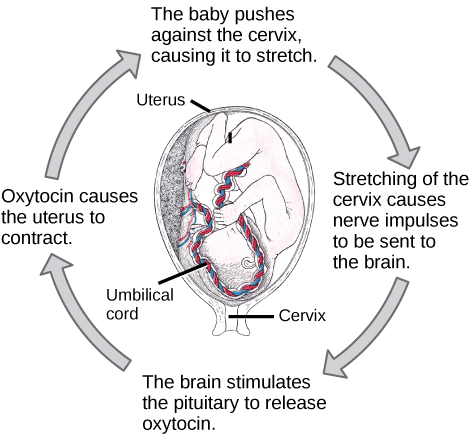
What type of feedback loop is shown?
a)
negative
b)
neutral 
c)
positive
96.
Negative Feedback Loops:
a)
amplify processes
b)
prevent small changes from getting larger
c)
are initiated during childbirth
d)
are found only in plants
97.
The two types of feedback systems that help organisms maintain homeostasis are:
a)
positive and negative 
b)
receptor and effector
c)
static and dynamic
d)
minor and major
98.
Maintaining body temperature is an example of a:
a)
negative feedback loop
b)
positive feedback loop
99.

As the Earth warms, increased evaporation produces more clouds. Clouds increase albedo, reflecting more light away from the Earth. The temperature falls. Rates of evaporation fall.

a)

Positive Feedback Loop

b)

Negative Feedback Loop

100.

A organization posts an advertisement with a very "click-baity" title and image on a social media platform. The title and image draw in people to click on the ad. As the ad receives more views, the algorithm shows the ad to more people.

a)

Positive Feedback Loop

b)

Negative Feedback Loop

101.

As the Earth warms, upper layers of permafrost melt, producing waterlogged soil above frozen ground. Methane gas is released into the environment. The greenhouse effect is enhanced. The Earth warms, melting more permafrost.

a)

Positive Feedback Loop

b)

Negative Feedback Loop

102.

As the Earth warms, ice cover melts, exposing soil or water. Albedo decreases. More energy is absorbed by the Earth’s surface. Global temperature rises. More ice melts.

a)

Positive Feedback Loop

b)

Negative Feedback Loop

103.

In some developing countries poverty causes illness and contributes to poor standards of education. In the absence of knowledge of family planning methods and hygiene, this contributes to population growth and illness, adding further to the causes of poverty; “a vicious circle of poverty.”

a)

Positive Feedback Loop

b)

Negative Feedback Loop

104.

In a positive feedback loop, each action creates a consequence that _____________________ the other action.

a)

decreases

b)

has no effect on

c)

amplifies

105.

In a negative feedback loop, each action creates a consequence that _____________________ the other action.

a)

decreases

b)

has no effect on

c)

amplifies

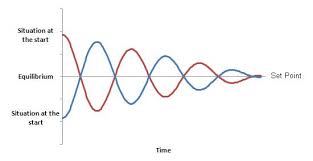
106.

Does the graph show positive or negative feedback?

a)

Positive, because when the red line shifts, the blue one does also

b)

Negative, because the blue line starts below equilibrium

c)

Negative, because the two actions are keeping each other near equilibrium

d)

Both positive and negative because the graph moves up and down