
Font size
 Worksheets
Chapter 8 - Photosynthesis
Total questions: 78
Worksheet time: 43mins
What is the primary function of photosynthesis in living organisms?
To convert chemical energy into solar energy
To convert solar energy into chemical energy
To produce oxygen from carbon dioxide
To break down carbohydrates into energy
Match the following substances with their roles in photosynthesis.
Carbon dioxide
Used in the Calvin cycle to produce glucose
Water
Source of electrons and protons in light reactions
Carbohydrates
Primary product of photosynthesis
Nitrogen
Not directly involved in photosynthesis
What do all living organisms on Earth have in common regarding energy?
They produce energy from nitrogen
They rely on photosynthesis for energy
They require energy to function
They do not need energy
What is an autotroph?
An organism that cannot produce its own food
An organism that relies on other organisms for food
An organism that can produce its own food
An organism that only consumes meat
What do photoautotrophs use to synthesize chemical energy?
Water and minerals
Sunlight and carbon dioxide
Oxygen and nitrogen
Proteins and lipids
Match the following Greek roots with their meanings.
"Self" (auto)
"Auto"
"Other" (hetero)
"Hetero"
"Light" (photo)
"Photo"
"Plant" (phyto)
"Phyto"
Which of the following is an example of a heterotroph?
Algae
Plants
Deer
Cyanobacteria
What are the starting reactants required for photosynthesis?
Oxygen, glucose, and sunlight
Sunlight, carbon dioxide, and water
Water, oxygen, and glucose
Carbon dioxide, glucose, and oxygen
What is the main carbohydrate molecule produced directly from photosynthesis?
Starch
Cellulose
Glucose
Fructose
Match the following processes with their contributions to the food chain.
It provides oxygen for animals to breathe
Role of photosynthesis in providing essential gases
It creates energy stored in carbohydrate molecules
Role of photosynthesis in energy storage
It produces water for plants
Role of photosynthesis in water production
It generates heat for the environment
Role of photosynthesis in thermal regulation
Match the following reactants with their respective processes.
Oxygen and glucose
Reactants in cellular respiration
Carbon dioxide and water
Reactants in photosynthesis
Nitrogen and water
Reactants in nitrogen fixation
Oxygen and water
Reactants in water oxidation
Where does the process of photosynthesis primarily occur in plants?
Roots
Stems
Leaves
Flowers
What is the role of chlorophyll in photosynthesis?
It stores energy
It absorbs light
It releases oxygen
It transports water
What is the function of stomata in the process of photosynthesis?
Transporting water
Gas exchange
Absorbing sunlight
Storing glucose
What is the internal space enclosed by the thylakoid membrane called?
Stroma
Granum
Thylakoid space
Chloroplast
What is a stack of thylakoids known as?
Stroma
Granum
Chlorophyll
Mesophyll
What is the space surrounding the granum called?
Stroma
Thylakoid space
Chloroplast
Mesophyll
In which part of the chloroplast do the light-dependent reactions take place?
Stroma
Thylakoid membrane
Outer membrane
Nucleus
What is released as a byproduct during the light-dependent reactions?
Carbon dioxide
Oxygen
Glucose
Water
Where does the Calvin cycle take place?
Thylakoid membrane
Stroma
Granum
Mesophyll
What is the specific component of sunlight that autotrophs use in photosynthesis?
Ultraviolet light
Infrared light
Visible light
Gamma rays
How is light energy transformed during photosynthesis?
Into mechanical energy
Into chemical energy
Into thermal energy
Into electrical energy
The term used to describe the distance between two consecutive, similar points in a series of waves is (a) .
What is the range of all possible wavelengths of radiation called?
Visible light
Electromagnetic spectrum
Ultraviolet rays
Infrared waves
Which type of light waves carry the most energy?
Long waves
Short waves
Medium waves
Infrared waves
What happens to light energy during photosynthesis?
It is reflected by pigments
It is absorbed by pigments
It is converted into sound
It is emitted as heat
Which colors of the visible light spectrum have shorter wavelengths and higher energy?
Red and orange
Yellow and green
Violet and blue
Green and yellow
What pigment is responsible for the common green color associated with plants?
Carotenoids
Chlorophyll b
Chlorophyll a
Xanthophyll
What is the absorption spectrum?
The range of colors a pigment reflects
The specific pattern of wavelengths a pigment absorbs from visible light
The amount of light a plant can absorb
The wavelengths that are emitted by a pigment
What is the purpose of light-dependent reactions in photosynthesis?
To produce chlorophyll
To convert light energy into chemical energy
To absorb carbon dioxide
To release oxygen
What happens when a photon of light energy reaches a molecule of chlorophyll?
The chlorophyll molecule is destroyed
The chlorophyll molecule becomes "excited"
The chlorophyll molecule absorbs carbon dioxide
The chlorophyll molecule releases oxygen
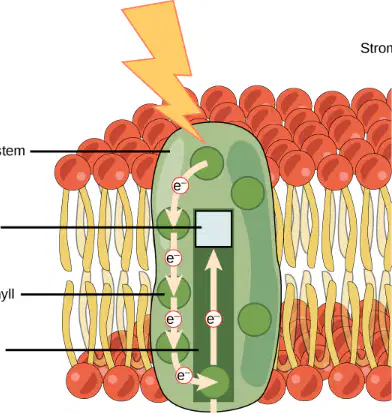
What is the primary purpose of the light-dependent reactions in photosynthesis?
To produce glucose directly
To convert solar energy into chemical energy
To release carbon dioxide
To absorb oxygen
What happens to the electron after it is excited by light energy in the chlorophyll molecule?
It is absorbed by oxygen
It is transferred to a primary electron acceptor
It is used to form glucose
It is stored in the chlorophyll molecule
Which photosystem is involved first in the light-dependent reactions?
Photosystem I
Photosystem II
Photosystem III
Photosystem IV
What is the role of hydrogen ions in the light-dependent reactions?
They are used to form glucose
They create an electrochemical gradient
They absorb light energy
They release oxygen
What are the two types of energy-carrier molecules mentioned in the light-dependent reactions of photosynthesis?
ATP and NADPH
ADP and NADP+
NADH and FADH2
ATP and FADH2
The process that allows ATP synthase to form ATP in the thylakoid membrane is (a)
What is the role of the electron transport chain in photosynthesis?
To generate glucose directly
To transport oxygen to the mitochondria
To use energy from electrons to pump hydrogen ions into the thylakoid
To break down water molecules
What is the purpose of the Calvin cycle in photosynthesis?
To produce oxygen
To generate ATP
To fix carbon into carbohydrate molecules
To release carbon dioxide
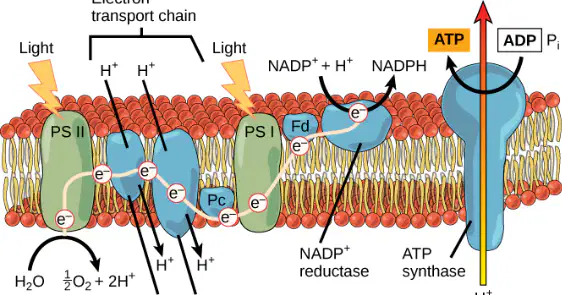
Where does the electron transport chain occur during photosynthesis?
Electron transport chain occurs in the thylakoid membrane.
ATP synthesis is not related to the thylakoid membrane.
The thylakoid membrane is involved in photosynthesis.
Electron transport chain is unrelated to ATP synthesis.
What is the Calvin cycle primarily responsible for in photosynthesis?
Breaking down glucose
Forming glucose and other carbohydrates
Releasing oxygen
Absorbing sunlight
Who is the Calvin cycle named after?
Andrew Benson
Melvin Calvin
James Watson
Francis Crick
The role of RuBisCO in the Calvin cycle is to (a)
What is the three-carbon compound formed during the Calvin cycle called?
Glucose
RuBP
3-PGA
ATP
How many turns of the Calvin cycle are required to produce one glucose molecule?
Three
Four
Six
Eight
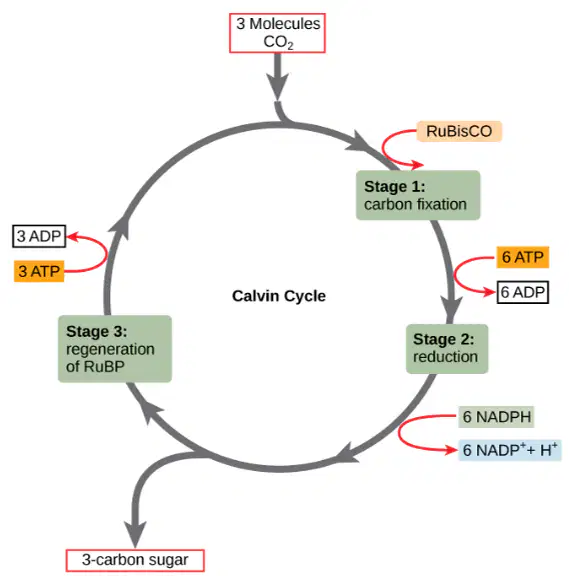
Which enzyme incorporates carbon dioxide into an organic molecule during the Calvin cycle?
ATP synthase
RuBisCO
NADPH oxidase
Cytochrome c
How many ATP molecules are required in the regeneration step of the Calvin cycle?
3 ATP
6 ATP
9 ATP
12 ATP
The main purpose of the Calvin cycle in photosynthesis is (a)
The adaptation that allows plants in dry climates to photosynthesize with low levels of CO2 is (a)
Where do the light-dependent reactions and the Calvin cycle take place in prokaryotes?
Chloroplasts
Mitochondria
Plasma membrane infoldings
Nucleus
Match the following roles with their corresponding functions in living organisms.
Structural support
Cellulose in plant cell walls
Storage molecules for energy
Glycogen in animal liver
Catalysts for reactions
Enzymes in metabolic pathways
Transport molecules
Hemoglobin in blood
Which organisms are mentioned as being able to carry out photosynthesis without chloroplasts?
Algae
Cyanobacteria
Fungi
Mosses
What is the overall reaction for photosynthesis?
6CO2 + 6H2O → C6H12O6 + 6O2
C6H12O6 + 6O2 → 6CO2 + 6H2O
6O2 + 6H2O → C6H12O6 + 6CO2
6CO2 + C6H12O6 → 6O2 + 6H2O
What is the byproduct of photosynthesis?
Carbon dioxide
Oxygen
Glucose
Water
Which process produces carbon dioxide as a byproduct?
Photosynthesis
Cellular respiration
Fermentation
Glycolysis
What is the relationship between photosynthesis and cellular respiration?
They are identical processes.
Photosynthesis is the reverse of cellular respiration.
They occur in the same organelles.
Both produce carbon dioxide.

Diagram showing the carbon cycle with plants and animals exchanging gases.
Plants release oxygen and take in carbon dioxide.
Animals release carbon dioxide and take in oxygen.
Plants release nitrogen and take in oxygen.
Animals release oxygen and take in nitrogen.

Which organelle performs the process of Photosynthesis?
Mitochondria
Chloroplast
Cell Membrane
Endoplasmic reticulum
(a) is a pigment that absorbs (b) and blue visible light and reflects (c)


Which is a product of the light dependent reactions?
water
chlorophyll
NADP+
oxygen
carbon dioxide
True or False? __ Except for water, the inputs of the light dependent reactions are outputs of the light independent reactions.
True
False
C is fixed to produce organic compounds during the __ reactions.
light dependent only
light independent only
both the light dependent and light independent
Which of these organisms can produce oxygen?
heterotrophs during the day
autotrophs during the day
heterotrophs at night
autotrophs at night
autotrophs during day or night
What is the original source of the C atoms that make up the sugars produced by the light dependent reactions?
ATP
NADPH
carbon dioxide
glucose
chlorophyll
Drag the labels to the correct numbered boxes in the Photosynthesis Diagram.
chloroplast
carbon dioxide + water
solar energy
the sun
glucose + oxygen
ADP
ATP
NADPH
FADH
NADP+
Label the following diagram correctly.
NADPH
ATP
Glucose
Water
Stroma
Oxygen
Carbon Dioxide
Thylakoids
Chloroplast
Light

Mesophyll cells (used for photosynthesis)
A
B
C
D
M
Upper epidermis
B
C
E
I
J
Lower epidermis
B
C
E
I
J
Palisade mesophyll
E
F
G
I
J
Spongy mesophyll
E
F
G
I
J
Stoma
B
C
D
E
F
K
CO2
O2
L
CO2
O2

