
Font size
 Worksheets
6/7 Exam
Total questions: 113
Worksheet time: 2hrs 1mins
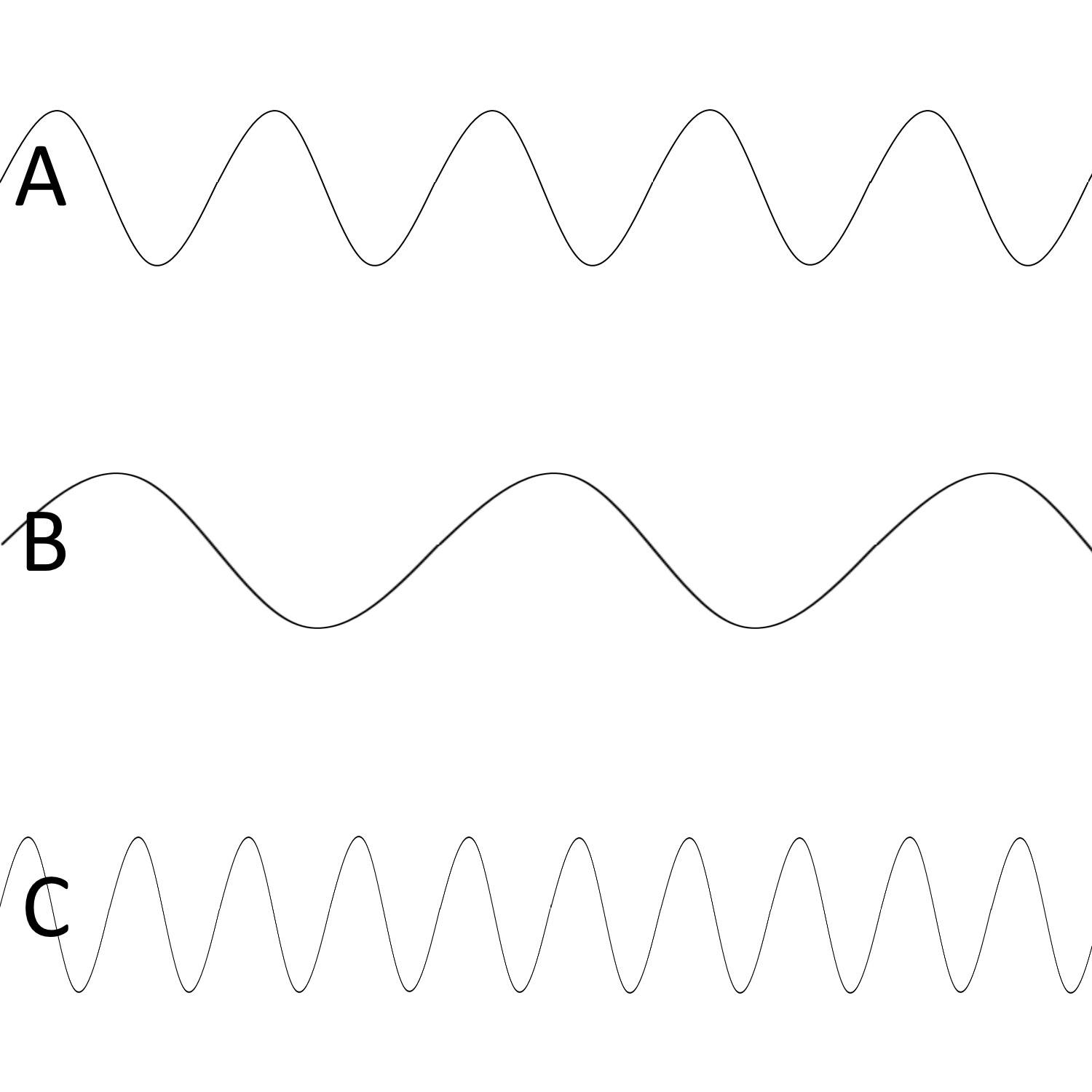
Another way of saying amplitude is (a)
wavelength in a compressional wave
(a)

how fast do electromagnetic waves travel through the vacuum of space?
they don't
250,000,000 m/s
the speed of light
100mph
what affects the speed of a wave?
the medium it travels through
amplitude
plasma

Electromagnetic radiation that can be seen with the unaided eye.
visible light
ultraviolet light
gamma rays
UV light

A wave that moves the medium at right angles to the direction in which the wave travels.
compression wave
transverse wave
sound wave
longitudinal wave


When the car moves AWAY from you, its horn seems...
Low pitched
High pitched
Normal

When an ambulance move TOWARD you it sounds ________ pitched.
high
low
medium

The Doppler effect is seen when a wave-making source moves toward an observer.
True
False
The measurement of how much mass fits within a certain volume is called ____________________.
density
volume
mass
weight
Density describes how tightly the ________________ that make up a substance are packed together.
particles
molecules
atoms
cells
Objects float if they are _________ dense than the substance in which they are placed. They __________ if they are denser than the substance in which they are placed.
less
sink
more
float
equal
Steel is denser than water. However, steel ships can float on water because their hulls are filled with ______________.
air
water
sand
metal
An object’s density is found by dividing its ________ by its ____________.
mass and volume
weight and height
length and width
temperature and pressure
The density of a material depends on the __________ of the particles that make up the material and the ____________ between the particles.
mass
space
color
temperature
The particles of a solid tend to be packed __________ together. The particles of a(n) ___________ tend to be spread out.
tightly
loosely
randomly
gas
Usually, matter in the ____________ state is denser than in the liquid state. Matter in the liquid state tends to be denser than in the gaseous state.
solid
gaseous
plasma
liquid
The density of a substance is the __________ no matter how much of the substance is present.
same
different
variable
changing
Density can help ______________ an unknown.
identify
measure
destroy
ignore
Gold has a density of 8.92 g/cm3. If an unknown substance has a density of 8.92 g/cm3, it would most likely be ____________.
gold
silver
copper
iron
Materials that can flow, such as liquids and gases, are called _______________.
fluids
solids
crystals
metals
Objects can float because of _______________.
buoyancy
gravity
friction
inertia
Buoyancy occurs because the fluid that is being _______________ out of the way pushes back on the object.
displaced
absorbed
evaporated
condensed
According to _______________ principle, the amount of buoyant force acting on an object is equal to the weight of the fluid it displaces.
Archimedes'
Newton's
Pascal's
Bernoulli's
If the buoyant force is greater than the object’s weight, the object will _______________.
float
sink
remain suspended
move sideways
Density is a physical property of an object because it is:
a measure of mass per unit volume
dependent on the object's shape
a chemical property
variable with temperature
The __________ of an object is found by dividing its mass by its volume.
density
weight
height
temperature
When an object is placed in a fluid, the fluid __________ on the object.
pushes
pulls
ignores
absorbs
This push is called the __________.
Buoyant force
Gravitational force
Frictional force
Magnetic force
If a fluid is denser than the object, the object will __________.
float
sink
remain suspended
dissolve
If the object is denser than the fluid, the object will __________.
sink
float
remain suspended
dissolve
The density of an object depends on the mass of the __________ that make up the object and the __________ between them.
particles
distances
colors
shapes
textures
In general, a(n) __________ is the densest state of matter.
solid
liquid
gas
plasma
However, solid water is __________ dense than liquid water.
less
more
equally
not
The state of matter where both volume and shape can change is ______?
solid
liquid
gas
can't tell

In which state of matter are the particles farthest away from each other
solid
liquid
gas
Can't tell

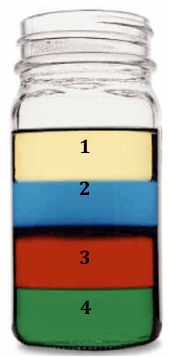
How is density measured?
In liters per gram
In meters per second
In grams per cubic centimeter
In kilograms per meter
What does density describe?
The color of a substance
The temperature of a substance
How tightly packed the particles that make up matter are
The speed of particles in a substance
Density is a measurement of how much mass fits within a certain what?
Area
Volume
Length
Height
What is the volume of a liquid if its mass is 80.3 g and its density is 1.1 g/mL?
73 mL
80 mL
70 mL
75 mL
What is the density of a liquid if its mass is 50 g and its volume is 25 mL?
2 g/mL
1 g/mL
0.5 g/mL
4 g/mL
Which box would have more mass?
The box filled with steel
The box filled with feathers
Both boxes have the same mass
Neither box has mass
What does density depend on?
Mass of the particles
Color of the object
Temperature of the environment
Shape of the object
What is a common property of liquids and gases?
Both have tightly packed particles
Both can change shape
Both are stationary
Both have a fixed shape
What is the behavior of particles in a gas?
Tightly packed
Move freely and fill the container
Stationary
Fixed in place
Which of the following is NOT associated with Archimedes?
Deep thinker
Discovered displacement
Invented the wheel
Greek philosopher
Which state of matter is the most common in the universe?
Solid
Liquid
Gas
Plasma
Can solids take the shape of their container?
Yes, always
No, they cannot
Only when heated
Only under pressure
How are the particles in liquids compared to solids?
More closely packed than solids.
Less closely packed than solids.
The same as in solids.
Not packed at all.
Which state of matter is not involved in sublimation?
Solid
Liquid
Gas
Plasma

Which state of matter has both definite shape and definite volume?
Gas
Liquid
Solid

Which state of matter has no definite shape and no definite volume?
Gas
Liquid
Solid

Which state of matter has no definite shape but does have definite volume?
Gas
Solid
Liquid

A gas has _______________ . (Pick 3)
A lot of space between particles
Very little space between particles
Particles with no definite pattern.
Particles that hold a very definite pattern.
Particle that bounce all over the place.

A solid has _______________ . (Pick 3)
A lot of space between particles
Very little space between particles
Particles with no definite pattern.
Particles that hold a very definite pattern.
Particles that only vibrate in place.
A liquid has _______________ . (Pick 3)
A lot of space between particles.
Very little space between particles.
Particles that have have no definite pattern.
Particles hold that a very definite pattern.
Particles that freely flow past each other.

This is a picture of blowing wind. Which state of matter is wind?
solid
liquid
gas

Which state of matter is in this picture?
Solid
Liquid
Gas

Which state of matter is this boulder?
Solid
Liquid
Gas
A ___________ is a push or pull.
force
attraction
repulsion
A _________ is a force that moves an object away from you.
force
pull
push
A pull is a force that moves an object ____________ you.
toward
away
behind
What forces result when two objects physically touch each other?
noncontact
contact
balanced
What forces result when two objects do not physically touch each other?
noncontact
contact
balanced

What type of force is this woman exerting on the stroller?
friction
applied
magnetic

Is magnetic force contact or non-contact force?
contact
noncontact
balanced

Which force is represented in the picture?
applied
electric
gravity

What force acts in the opposite direction of the baseball's motion, to slow it down?
friction
electric
normal

What force is represented in the picture?
magnetic
friction
electric

What force is acting from the surface of the desk onto the laptop resting on the surface?
magnetic
electric
normal
Which forces are non-contact forces?
applied, normal, friction
gravity, magnetic, electric
gravity, friction, magnetic
Which forces are contact forces?
applied, friction, normal
gravity, magnetic, electric
applied, electric, normal
A smoother surface has less friction.
True
False
What can we add to a surface to make it smoother and reduce friction?
heat
liquid or lubricant
sand
When balanced forces act on an object, the object's motion will change.
True
False
An object moves when unbalanced forces act on the object.
True
False
The sum of all forces acting on an object.
net force
applied
contact

Calculate the net force on the object.
70 N
10 N
0 N
Which direction will the object move?
right
left
stationary

