wayground logo

Free Printable Worksheets

Font size

S
M
L
XL
Worksheets

Ecology 1: food chains, webs, relationships

Total questions: 88

Worksheet time: 3610secs

Name
Class
Date
1.

What is the definition of ecology?

a)

How an environment uses it's resources

b)

The study of living things and how they interact in an environment

c)

Caring for an environment

d)

How you take care of any given environment

2.

Biotic factors are non living things

a)

True

b)

False

3.
Scientific study of all the interrelationships between organisms and their environment.
a)
Ecology
b)
Population 
c)
Biology
d)
Chemistry
4.

Is wind a biotic or abiotic factor?

a)

biotic

b)

abiotic

5.

Is soil a biotic or abiotic factor?

a)

biotic

b)

abiotic

6.

Are rocks biotic or abiotic factors?

a)

biotic

b)

abiotic

7.

Is water a biotic or abiotic factor?

a)

biotic

b)

abiotic

8.

Is temperature a biotic or abiotic factor?

a)

biotic

b)

abiotic

9.

Is precipitation a biotic or abiotic factor?

a)

biotic

b)

abiotic

10.

Is sunlight a biotic or abiotic factor?

a)

biotic

b)

abiotic

11.

Abiotic factors are ___________.

a)

non-living parts of an ecosystem

b)

living parts of an ecosystem

c)

things that once were alive, but now are dead

d)

not important parts of ecosystems.

12.

Biotic factors are ___________.

a)

non-living parts of an ecosystem

b)

living parts of an ecosystem

c)

things that once were alive, but now are dead

d)

not important parts of ecosystems.

13.

An ecosystem is made up of __________.

a)

living things only

b)

non-living things only

c)

both living and non-living things

14.

T/F: Abiotic factors are an unimportant part of ecosystems.

a)

true

b)

false

15.

Zebra

a)

Biotic (living)

b)

Abiotic (non-living)

16.

Lion

a)

Abiotic (non-living)

b)

Biotic (living)

17.

Sand

a)

Abiotic (non-living)

b)

Biotic (living)

18.

Sunlight

a)

Biotic (living)

b)

Abiotic (non-living)

19.
A living or once-living organisms in an ecosystem is a
a)
population
b)
biotic factor
c)
abiotic factor
d)
community
20.
Water, air, soil, and temperature are all examples of __________ factors.
a)
abiotic
b)
organisms
c)
biotic
d)
population
21.
Humans
a)
Biotic
b)
Abiotic
22.
A producer?
a)
Eats other plants and animals
b)
Makes its own food
c)
Eats dead plants or animals
23.
A consumer?
a)
Makes its own food
b)
Eats dead plants and animals
c)
Eats plants and other animals for energy
24.
A decomposer?
a)
Eats dead plants or animals and breaks down to put nutrients in the soil
b)
Eats plants or other animals for food
c)
Makes its own food
25.

Green plants are producers who make food in their leaves.

a)

True

b)

False

26.

Consumers get their energy by eating food.

a)

True

b)

False

27.

Frog. It is a....

a)
Producer
b)

Consumer

c)
Decomposer
28.
Earthworm. Is it a...
a)
Producer
b)
Consumer
c)
Decomposer
29.
Fungi. Is it a...
a)
Producer
b)
Consumer
c)
Decomposer
30.
Pine Tree. Is it a...
a)
Producer
b)
Consumer
c)
Decomposer
31.
An apple tree is a
a)
producer
b)
consumer
c)
decomposer
32.
A hawk is an example of a
a)
consumer
b)
producer
c)
decomposer
33.
A mushroom is a 
a)
producer
b)
consumer
c)
decomposer
34.
A carrot is an example of a 
a)
producer
b)
consumer
c)
decomposer
35.
Bamboo is a 
a)
producer
b)
consumer 
c)

decomposer

36.
A cougar is a 
a)
producer
b)
consumer
c)

decomposer

37.
Bacteria is an example of a 
a)
producer
b)
consumer
c)
decomposer
38.

Which is a synonym for an autotroph?

a)

heterotroph

b)

consumer

c)

producer

39.
Which terms best describe heterotrophs?
a)
Plants; producers
b)
Animals; producers
c)
Plants; consumers
d)
Animals; consumers
40.
Which terms best describe autotrophs?
a)
Plants; producers
b)
Animals; producers
c)
Plants; consumers
d)
Animals; consumers
41.
From where do autotrophs obtain their energy?
a)
The sun
b)
Other organisms
42.
What is another name to describe a heterotroph?
a)
Consumer
b)
Producer
43.

What are producers source of energy?

a)

animals

b)

animal waste

c)

sunlight

d)

other plants

44.

Heterotrophs are also known as...

a)

producers

b)

consumers

45.
In the energy pyramid here, which organisms have the most energy available?
a)
Producers
b)
Carnivores
c)
Herbivores
d)
Top Predator
46.
In the energy pyramid below, which organism has the least amount of energy available?
a)
Producers
b)
Herbivores
c)
Carnivores
d)
Top Predator
47.
The diagram represents a pyramid of energy in an ecosystem.  Which level would most likely contain members of the plant kingdom?
a)
A
b)
B
c)
C
d)
D
48.
Which organism recieves the least amount of energy from the producer?
a)
Owl
b)
Grasshopper
c)
Lilypad
d)
Mouse
49.
Where do producers get their energy? 
a)
soil
b)
decomposers
c)
sun
d)
garbage
50.
Only eats meat
a)
omnivore
b)
herbivore
c)
carnivore
d)
primary consumer
51.
Only eats plants
a)
omnivore
b)
carnivore
c)
herbivore
d)
tertiary consumer
52.
An organism that needs to eat other organisms to obtain energy is known as a:
a)
Autotroph
b)
Producer
c)
Consumer
d)
Mutualist
53.
The arrows in a food chain or web represents what?
a)
They point to the organism that is being eaten.
b)
It shows how sunlight flows within an ecosystem.
c)
They show what direction the energy is flowing between organisms. 
d)
They represent how water is transferred within a habitat.
54.
A MUSHROOM is a
a)
Herbivore
b)
Carnivore
c)
Omnivore
d)
Decomposer
55.
Which is the PRODUCER?
a)
Lettuce
b)
Slug
c)
Bird
d)
Cat
56.
Which is a HERBIVORE?
a)
Lettuce
b)
Slug
c)
Bird
d)
Cat
57.
Where does the BIRD get its energy?
a)
The sun
b)
The slug
c)
The bird
d)
The cat
58.
Where does the CAT get its energy?
a)
The sun
b)
The slug
c)
The bird
d)
The cat
59.
What do we call a type of consumer that only eats the remains of dead organisms?
a)
Consumer
b)
Third level consumer
c)
scavenger
d)
omnivore
60.
An organism that lives by breaking apart dead organic matter into simpler parts is...
a)
scavenger
b)
consumer
c)
decomposer
d)
carnivore
61.

Decomposers get energy from...

a)

the sun

b)

eating plants

c)

eating animals

d)

dead things and waste

62.

Producers are ...

a)

plants

b)

able to do photosynthesis

c)

also called autotrophs

d)

all of these are true

63.

Arrows in a food web represent...

a)

eating

b)

sunlight

c)

energy

d)

matter

64.

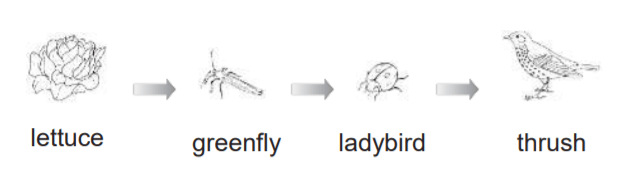
Who is the producer?

a)

lettuce

b)

greenfly

c)

ladybird

d)

thrush

65.

An animal that hunts other animals for food is a ___________

a)

herbivore

b)

predator

c)

prey

d)

omnivore

66.

What is a herbivore?

a)

an animal that gets energy from eating other animals

b)

an organism that gets energy from eating only plants

c)

an animal that gets energy by eating both plants and other animals

67.

An organism that gets energy from eating other organisms is a ______________

a)

producer

b)

consumer

c)

decomposer

68.

A connection of food chains with many food energy paths in an ecosystem is a ____________

a)

ecosystem

b)

food web

c)

environment

69.

An animal that is hunted and eaten for food is a

a)

predator

b)

prey

70.

What is a carnivore?

a)

an animal that gets energy by eating other animals

b)

An animal that gets energy by eating only plants

c)

an animal that gets energy by eating both plants and animals

71.

An animal that gets energy from eating both plants and animals is a(n)

a)

herbivore

b)

carnivore

c)

omnivore

72.

Which of the following is NOT a consumer

a)

grass

b)

dog

c)

shark

d)

fish

73.

Which of the following is a living part of the ecosystem?

a)

Air

b)

Sunlight

c)

Mushroom

d)

Soil

74.

The main source of energy for all of earth's food chains is the...

a)

sun

b)

water

c)

nutrients

d)

producers

75.

Plants produce their own food through...

a)

symbiosis

b)

photosynthesis

c)

genetics

d)

magic

76.

All food chains begin with a...

a)

grass

b)

producer

c)

consumer

d)

decomposer

77.

The second link in a food chain is a...

a)

consumer

b)

producer

c)

herbivore

d)

carnivore

78.

A herbivore is a...

a)

consumer that eats both plants and other animals

b)

consumer that only eats other animals

c)

consumer that only eats plants

79.

A herbivore is also known as...

a)

primary consumer

b)

secondary consumer

c)

tertiary consumer

80.

The second consumer in the food chain is called...

a)

primary consumer

b)

secondary consumer

c)

tertiary consumer

81.

The secondary consumer is a carnivore which means...

a)

a consumer that eats both plants and other animals

b)

a consumer that eats only plants

c)

a consumer that eats only other animals

82.

The third consumer in the food chain is called...

a)

primary consumer

b)

secondary consumer

c)

tertiary consumer

83.

An omnivore is a...

a)

consumer that eats both plants and other animals

b)

consumer that eats only other animals

c)

consumer that eats only plants

84.

Animals that are not hunted and eaten by any animals are called...

a)

herbivores

b)

carnivores

c)

omnivores

d)

apex predators

85.

The level of apex predators in the food chain is...

a)

first

b)

second

c)

tertiary

d)

top

86.

Apex predators contribute to the food chain by...

a)

being eaten by other animals

b)

decomposers breaking down their bodies when they die

c)

producing their own food

87.

Examples of decomposers are...

a)

plants

b)

animals

c)

bacteria and fungi

88.

The level of humans in the food chain is...

a)

first

b)

second

c)

tertiary

d)

top