
 Worksheets
DNA Components and Commonality
Total questions: 96
Worksheet time: 1hrs 7mins
In DNA only, Adenine always pairs with:
Thymine
Cytosine
Uracil
Guanine
The shape of DNA is called:
Helix
Double helix
Triple helix
Ladder
What is the monomer of DNA?
Amino acid
Glucose
Fatty acid
Nucleotide
What are the three parts of a nucleotide? Select all that apply
Adenine
hydrogen bond
Sugar
Phosphate
Nitrogen Base
Who took the first picture of DNA?
Rosalind Franklin
James Crick
John Watson
Maurice Wilkins
Which part of the DNA nucleotide makes up the "backbone" of DNA?
Sugar (Deoxyribose)
Nitrogen base
Sugar (deoxyribose) and Phosphate
Nitrogen base and Phosphate
What part of the DNA molecules carries the code for specific traits?
The sequence of nitrogen bases
Sugar-phosphate backbone
"Sides" of the ladder
The phosphate
ATG TGA CAG
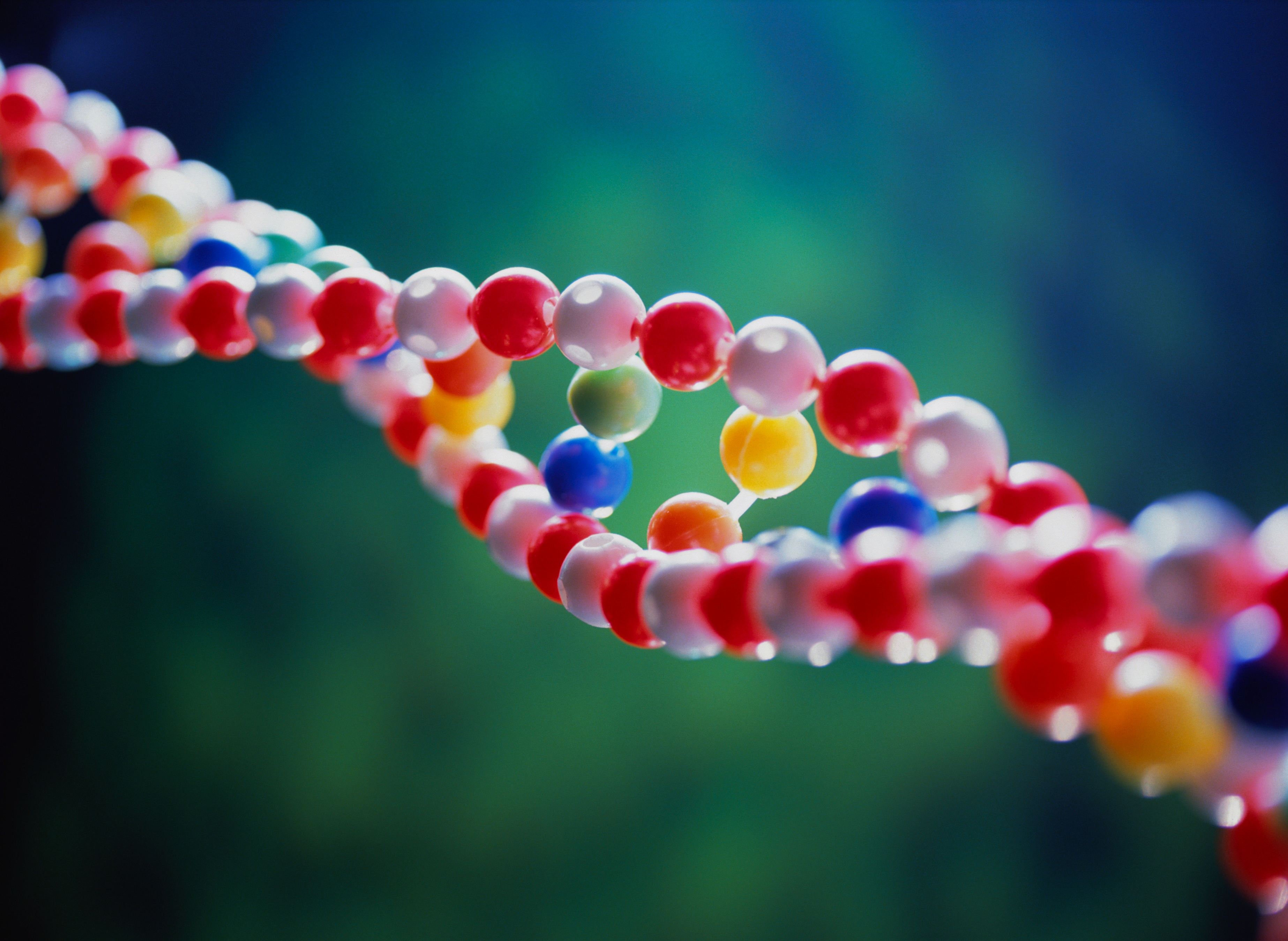
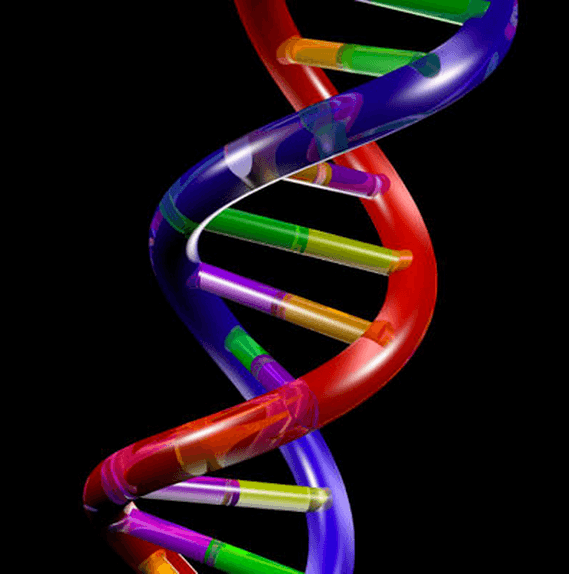


DNA is housed in which organelle?
Cell Membrane
Cell nucleus
Ribosome
Nucleotide
DNA is made of _______ strand(s), creating a _______ shape.
one ; circular
two ; double helix
four ; ladder
Too many ; complicated
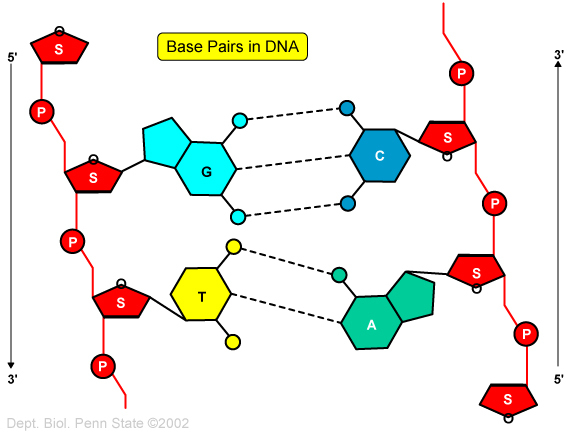
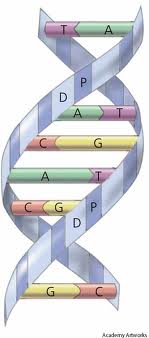
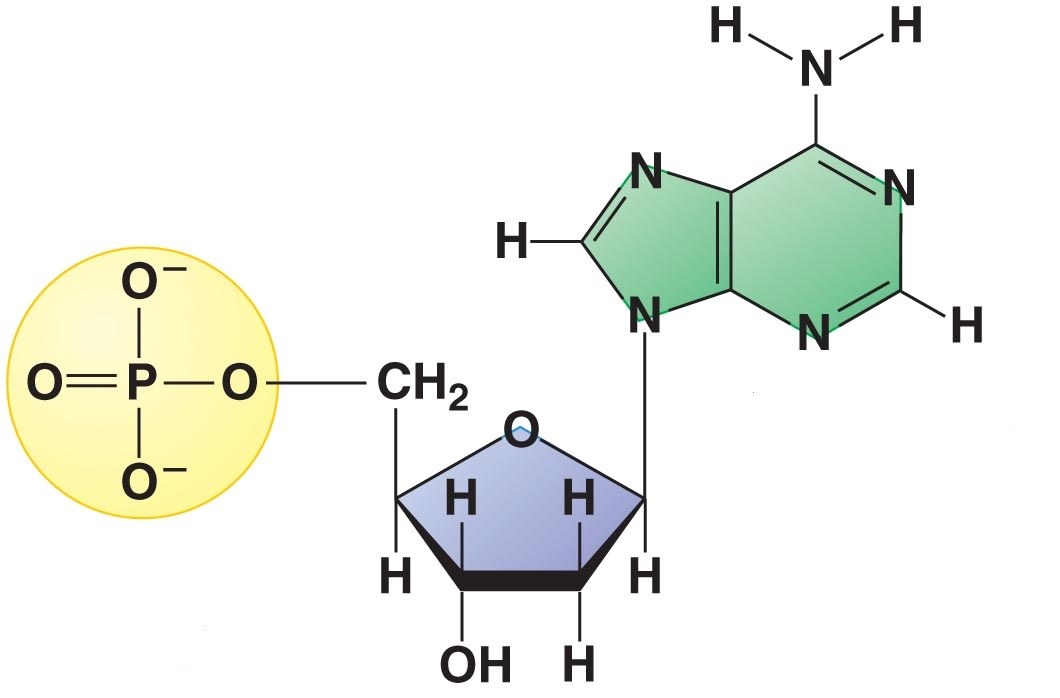
In DNA Adenine would pair with:
Cytosine
Guanine
Another Adenine
Thymine


Name this structure
double helix
nucelotide
twisted ladder
hydrogen bond
All organisms have the same:
Cell organelles
Types of proteins needed for life
Division of the nucleus
DNA bases just in different order

The DNA of all living organisms is made up of a sugar, phosphate, and nitrogen base. The "sequence" (order) of the nitrogenous bases is the only difference found in the DNA of all living organisms.
True
False
ATGCATTCGA

What makes up the SIDES of a DNA ladder?
nitrogen bases
sugars & phosphates
genes & chromosomes
RNA

What makes up the rungs (steps) of a DNA ladder?
sugars & phosphates
nitrogen bases
sugars
genes & chromosomes
What does DNA code for?
What nucleotides are the components of DNA?
What nucleotides are the components of RNA?
What holds the two strands of DNA together?
What is the structure of RNA?
T or F: Nucleotides contain a 5-carbon sugar and a phosphate group.
False
True
Ribose
Cellulose
Fatty acids


What part of the nucleotide is labled "A"
Phosphate
Nitrogenous Base
Protein
Sugar (Deoxyribose or Ribose)
What part of the nucleotide is labled "B"
Phosphate
Nitrogenous Base
Protein
Sugar (Deoxyribose or Ribose)
What part of the nucleotide is labled "C"
Phosphate
Nitrogenous Base
Protein
Sugar (Deoxyribose or Ribose)

A segment of a DNA strand is shown. Which of these is the correct complementary DNA strand for the segment shown?
5' AGGTCAGGT 3'
5' ACCUGAGGU 3'
5' TGGACTGGA 3'
5' TCCAGTCCA 3'

Students are given data from an investigation that identified some of the chemical elements present in four different samples. Which sample was most likely DNA?
Sample 1
Sample 2
Sample 3
Sample 4
Which part of a DNA molecule is responsible for the direct coding of specific traits in an organism?
the number of hydrogen bonds that hold the strands of DNA together
the number of carbons in the DNA molecule
the sequence of nucleotide bases in the DNA molecule
the sequences of phosphates along each DNA strand
Differences in traits such as hair texture are determined by differences in -
the location of sugar groups in DNA
the sequence of nucleotides in DNA
the number of nitrogenous bases in DNA
the molecules attached to the phosphate in DNA

A student used poster board to construct this model of a section of DNA. Which statement describes this model of DNA?
the model is inaccurate because the base pairs are incorrect
the model is accurate because it contains correctly paired bases
the model is accurate because it shows each base splitting to form a double helix
the model is inaccurate because some typical bases in DNA are missing

A student used poster board to construct this model of a section of DNA. Which statement describes this model of DNA?
the model is inaccurate because the base pairs are incorrect
the model is accurate because it contains correctly paired bases
the model is accurate because it shows each base splitting to form a double helix
the model is inaccurate because some typical bases in DNA are missing
Nitrogenous bases are located on both strands of the DNA double helix. What is the significance of the nitrogenous bases?
the number of adenines and cytosines determines the type of RNA that will be produced
the order of nitrogenous bases determines the order of amino acids in the proteins synthesized
the amount of thymine and guanine in the DNA molecules determines the length of the genes
the type of hydrogen bonding between the nitrogenous bases determines which amino acid will be added to the peptide chain

Each strand of a DNA molecule contains nitrogenous bases that pair with other nitrogenous bases in very specific ways. A diagram of a section of DNA is shown. Which DNA strand is complementary to the one shown above?


A segment of DNA is represented in the illustration. How is information for the specific protein carried on the DNA molecule?
as a sequence of nucleotides
in the double-helix shape of the condensed chromosome
in the ratio of adenines to thymines
as a pattern of phosphates and sugars

A student builds a model of a DNA strand. Which of these models of a DNA strand shows bases that are complementary to the ones on the student's DNA model?


The sequence of nitrogenous bases in DNA varies widely. The sequence of the bases in DNA is most important for which of the following?
providing the instructions for the traits of an organism
preventing mutations from occurring during DNA replication
allowing the DNA to have the shape necessary for replication
helping form the sugar-phosphate backbone of DNA molecules

A model of a DNA molecule is shown. The arrow indicates -
the bond between adjacent phosphate and deoxyribose molecules
the junction of introns and exons in the sense strand of DNA
the hydrogen bond between complementary nucleotides
the junction of a codon and a DNA triplet

A model of a DNA molecule is shown. The arrow indicates -
the bond between adjacent phosphate and deoxyribose molecules
the junction of introns and exons in the sense strand of DNA
the hydrogen bond between complementary nucleotides
the junction of a codon and a DNA triplet
Characteristics such as a widow's peak or attached earlobes are determined by the genetic code. Which components of DNA are referred to as the genetic code?
phosphate groups
nitrogenous bases
deoxyribose sugars
hydrogen bonds
How does DNA in cells determine an organism's complex traits?
DNA contains codes for proteins, which are necessary for the growth and functioning of an organism
DNA separates into long single strands that make up each part of an organism
DNA produces the energy an organism needs in order to grow
DNA folds into the nucleus of each of the cells of an organism
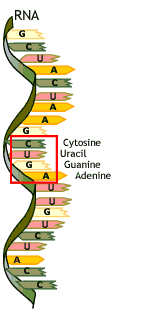
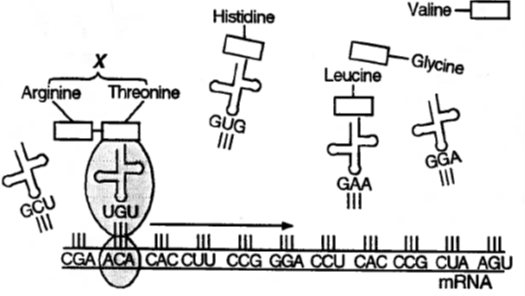
ATG GGA ACT CCA

A small organelle in the cell on which proteins are assembled, It is a type of protein.
Mitochondria
Ribosome
Nucleus
Lysosome
Transcribe the following DNA strand: CTG AAT
GAC TTA
CTG AAT
GAC UUA
CUG AAU
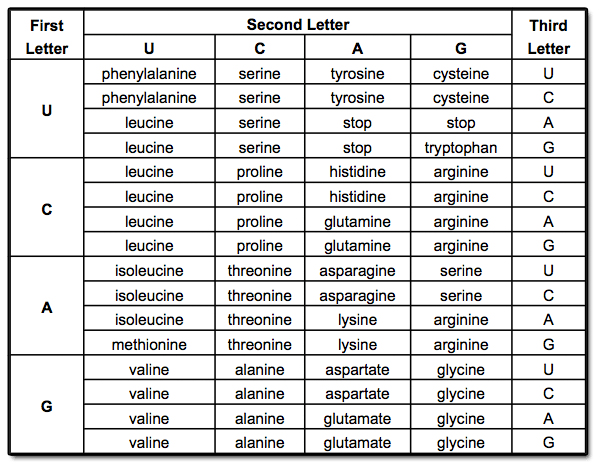

What is the amino acid sequence for the following mRNA strand:
UGG-ACU-CGA-GUG
(a)
What is the amino acid sequence for the following mRNA strand:
AUU-AAG-UGC-GGG
(a)
What is the amino acid sequence for the following mRNA strand:
CCA-GAG-UUU-UAG
(a)
What is the amino acid sequence for the following mRNA strand:
GUA-CAU-UUG-AGA
(a)
What is the amino acid sequence for the following mRNA strand:
AUG-CAG-UAC-AGC
(a)

What is the amino acid sequence for the following mRNA strand:
UCG-GAA-CAC-AAU
(a)
What is the amino acid sequence for the following mRNA strand:
AGG-UUC-CUG-GCC
(a)
What is the amino acid sequence for the following mRNA strand:
UGU-UGG-AUA-CCC
(a)
What is the amino acid sequence for the following mRNA strand:
AAU-UCG-CAA-GGG
(a)
What is the amino acid sequence for the following mRNA strand:
AUG-GAC-ACU-UAG
(a)

