
 Worksheets
Unit 2 - Ecology
Total questions: 89
Worksheet time: 1hrs 23mins


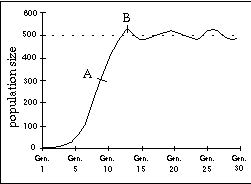

Shows Population Growth With No Limits
Unlimited Resources
No Limiting Factors
The information above explains what type of population growth curve?
Usually starts with an Exponential Growth Phase
Population Growth Levels Out at Carrying Capacity
Realistic
Regulated by Density Dependent Limiting Factors
The information above explains what type of population growth curve?


A species that plays a critical role in the health, maintenance, growth, or definition of an ecosystem.
keystone
invasive
engineer
predator

A species that does not belong in a balanced ecosystem, comes in, and changes it (usually for the worse).
flagnship
umbrella
invasive
predator
keystone species
a system of interlocking and interdependent food chains.
All the living organisms that inhabit an environment
A series of steps in which organisms transfer energy by eating and being eaten
a species on which other species in an ecosystem largely depend, such that if it were removed the ecosystem would change drastically.
trophic cascade
All the living organisms that inhabit an environment
The number of different species in an area
indirect effects in a community that are initiated by a predator
Each step in a food chain or food web
trophic level
indirect effects in a community that are initiated by a predator
The number of different species in an area
Each step in a food chain or food web
All the living organisms that inhabit an environment
food chain
A series of steps in which organisms transfer energy by eating and being eaten
a system of interlocking and interdependent food chains
An environmental factor that prevents a population from increasing
Each step in a food chain or food web
Biodiversity
The number of different species in an area
Each step in a food chain or food web
indirect effects in a community that are initiated by a predator
a system of interlocking and interdependent food chains.
food web
A series of steps in which organisms transfer energy by eating and being eaten
a system of interlocking and interdependent food chains.
An environmental factor that prevents a population from increasing
(1). air(2). water(3). sunlight(4). soil(5). temperature(6). climate
limiting factor
Largest number of individuals of a population that a environment can support
(1). air(2). water(3). sunlight(4). soil(5). temperature(6). climate
An environmental factor that prevents a population from increasing
All the living organisms that inhabit an environment
Abiotic factors examples
All the living organisms that inhabit an environment
An environmental factor that prevents a population from increasing
(1). air(2). water(3). sunlight(4). soil(5). temperature(6). climate
ecosystem has to maintain stable condition in order for all organisms to survive
biotic factors
All the living organisms that inhabit an environment
An environmental factor that prevents a population from increasing
(1). air(2). water(3). sunlight(4). soil(5). temperature(6). climate
The removal of trees faster than forests can replace themselves.
Which of the following is an example of a keystone species?
Cattle
Sea otter
Grass
Mosquito
What is a trophic cascade?
A process where nutrients flow from one trophic level to another.
A series of secondary extinctions triggered by the primary extinction of a key species in an ecosystem.
The migration of species from one habitat to another.
The increase in population size of a species at the bottom of the food chain.
How can the removal of a keystone species affect an ecosystem?
It can increase biodiversity.
It can lead to a more stable ecosystem.
It can cause a trophic cascade and disrupt the ecosystem balance.
It has no significant effect.
In a food chain, what is the primary source of energy?
Carnivores
Herbivores
Decomposers
The Sun
Which of the following best describes a food web?
A linear sequence of who eats whom in an ecosystem.
A single pathway of feeding relationships among organisms in an ecosystem.
A complex network of feeding relationships among organisms in an ecosystem.
A graphical representation of the energy flow in an ecosystem.
What happens to energy as it moves up the food chain?
It increases exponentially.
It remains constant.
It decreases due to energy loss at each trophic level.
It is completely recycled.
Why are keystone species important for biodiversity?
They are the most numerous species in their ecosystems.
They provide food for all other species.
They help to maintain the structure and integrity of the ecosystem.
They have no predators, ensuring their survival.
What could be a direct consequence of removing a top predator from an ecosystem?
A decrease in the population of primary consumers.
An increase in the diversity of plant species.
A decrease in the overall biodiversity of the ecosystem.
An increase in the population of herbivores, leading to overgrazing.
1. What makes a species invasive?
Moving to a new ecosystem and taking resources from natives
Not having papers
Species that can't adapt
Plants that take up too much space

Why do the populations of invasive species grow so quickly?
Invasive Species are native to an area.
Invasive species are prey to many animals.
Invasive species have no natural predators.
Invasive species keep the ecosystems in equilibrium.


What happens when different species try to occupy the same niche?
The species compete with each other
The species cooperate with each other
The species coexist with each other
All of the above
What is a niche?
The habitat that an organism lives in
An organism’s “role” in an ecosystem
A type of consumer
The relationship between a producer and consumer
The first organism in a food chain is ALWAYS a:
producer
consumer
decomposer
Any of the above
What is biodiversity?
The different ways species reproduce
The degree of variation of life on Earth
A way to describe similarities between different species
The process of creating new species


If a disease strikes the snake population in the food chain shown, what will be the initial effect on the populations of hawks and rabbits?
The populations of hawks and rabbits will decrease.
The populations of hawks and rabbits will increase.
The population of hawks will increase. The population of rabbits will decrease.
The population of hawks will decrease. The population of rabbits will increase.


What is a keystone species?
A species that is most abundant in an ecosystem.
A species that plays a critical role in maintaining the structure of an ecological community.
A species that has no predators in its ecosystem.
A species that can live in a variety of ecosystems.
Which of the following is an example of a keystone species?
Cattle
Sea otter
Grass
Mosquito
What is a trophic cascade?
A process where nutrients flow from one trophic level to another.
A series of secondary extinctions triggered by the primary extinction of a key species in an ecosystem.
The migration of species from one habitat to another.
The increase in population size of a species at the bottom of the food chain.
How can the removal of a keystone species affect an ecosystem?
It can increase biodiversity.
It can lead to a more stable ecosystem.
It can cause a trophic cascade and disrupt the ecosystem balance.
It has no significant effect.
What is a keystone species?
A species that is the most abundant in an ecosystem
A species that has a crucial role in the way an ecosystem functions
A species that is the largest in an ecosystem
A species that is the smallest in an ecosystem
What can happen to an ecosystem without keystone species?
The ecosystem would remain the same
The ecosystem would become more diverse
The ecosystem would be dramatically different or cease to exist
The ecosystem would have more predators


