
 Worksheets
Integrated Science A Final Review
Total questions: 86
Worksheet time: 1hrs 25mins
The shorter wavelengths in the light coming from distant celestial objects moving toward the observer.
Big Bang
Blue Shift
Red Shift
Violet Shift
What is one major piece of evidence that the Big Bang theory is correct?
astronomers have detected leftover radiation from the Big Bang
everything in the universe has remained the in same location for billions of years
astronomers have detected that the universe is no longer expanding
astronomers have detected that the universe is contracting
Which theory is used to explain the formation of the universe?
Big Bang Theory
Heliocentric Theory
Geocentric Theory
Creation Theory
After a supergiant, a high mass star explodes to form a
nebula, main sequence, red giant, planetary nebula, white dwarf
Nebula, main sequence, brown dwarf, white dwarf
Momentum is represented with which letter?
b
m
v
p
What is the unit for momentum?
m/s
kg
N
kg* m/s
J
After a collision, momentum is always conserved.
True
False
If an object velocity is 0 m/s, which of the following is true?
The object has momentum, but we need more information to determine how much
The object's momentum is changing
The object has NO momentum
What is the formula for momentum?
p=m/v
p=mv
m=mv
m=p/v
The momentum of an object depends on its ______ and ______.
velocity and speed
mass and size
size and shape
mass and velocity
A 2000kg car has a momentum of zero. How is this possible?
it is easily stopped
it is traveling at light speed
it is not moving
it is traveling in space

You are traveling in a car in a straight line. The driver puts on the brakes and you keep moving forward due to inertia. Which of Newton's Laws does this demonstrate?
1st
2nd
3rd

Which of Newton's laws deals with force, mass, and acceleration?
1st
2nd
3rd

Which of Newton's Laws states that an object in motion will stay in motion and an object at rest will stay at rest unless acted on by an external force?
1st
2nd
3rd
Which of Newton's Laws uses the formula F=ma?
1st
2nd
3rd

___________ are two forces acting in opposite directions on an object, and equal in size. Choose the best answer.
Balanced Forces
Unbalanced Forces
Cancelled Forces
Same Forces
You do not know an object's velocity until you know it's
Speed
Direction
Speed and direction
Acceleration
Collisions where objects BOUNCE apart.
inelastic collisions
elastic collisions
explosions
none of these
Collision where objects collide, and stick together.
inelastic collision
elastic collision
explosion
none of these
Object 1 has a mass of 20 kg and an initial velocity of 5 m/s, and object 2 has a mass of 30 kg and an initial velocity of 6 m/s. What is their total momentum?
280 kg m/s
30 kg m/s
180 kg m/s
100 kg m/s

Calculate the momentum of a 55-kg running back moving westward at 10 m/s.
550 N
550 kg·m/s
550 m/s
550 kg
What is the unit for velocity?
kg
m/s
N
kg m/s
What is the unit for force?
kg
m/s
N
kg m/s
What is the unit for mass?
kg
m/s
N
kg m/s
How long does it take a car to travel 40m at 12m/s?
4.8 s
480 s
3.33 s
33.3 s
The unit for acceleration is:
m/s2
joules
m
s
Speed = _______________
Distance + time
Distance – time
Distance x time
Distance / time
You roll a tennis ball a distance of 18 meters it takes 6 seconds to cover the distance. What is the average speed of the tennis ball?
3 km/s
6 m/s
3
3 m/s
Which is NOT an example of Acceleration?
An object speeds up
An object slows down
An object changes direction
An object is in motion at a constant velocity
What is the formula to calculate force?
Force = Mass x Acceleration
Force = Mass / Acceleration
Force = Acceleration / Mass
Force = Mass - Acceleration
An object's resistance to move. If it is at rest, it will stay at rest and if it is in motion, it will stay in motion.
Friction
Gravity
Inertia
Air resistance
The rubbing or sliding of objects against each other, causing one object to slow down or stop.
Gravity
Friction
Force
Inertia
This is a push or pull on an object.
Force
Gravity
Air Resistance
Friction
The energy an object has due to its position.
Energy
Mechanical Energy
Kinetic Energy
Potential Energy
A law that states that energy cannot be created or destroyed but can change from one form to another.
Law of Gravity
First Law of Motion
Law of Conservation of Energy
Second Law of Motion
The energy of an object that is due to the objects motion.
Mechanical Energy
Potential Energy
Kinetic Energy
Energy
The ability to do work of cause change.
Mechanical Energy
Energy
Potential Energy
Kinetic Energy
A type of friction that occurs when an object slows down due to coming in contact with air molecules.
Gravity
Friction
Air Resistance
Force
An object in motion stops when.....
It falls of an edge.
it is acted upon by an outside force.
It is eaten
It never stops
According to Newton's third law, what happens when you push against a wall?
The wall pushes back at you half as hard as you push against it
The wall pushes back at you with the same amount of force
The wall pushes back at you twice as hard as you push against it
The wall doesn't push at all
If an unbalanced force acts on an object, what will happen
It will not move at all
It will accelerate in the direction of the force
It will accelerate in the opposite direction to the force
It will accelerate in a random direction
According to Newtons Third Law of Motion, every action has an equal and opposite _________.
gravity
force
mass
reaction
The greater the mass of an object, the greater the amount of ______ is needed to make it accelerate.
Force
Matter
Acceleration
Velocity
The speed boats speed increased from 0m/s to 24m/s in a time span of 12 seconds. What is the average acceleration?
Normal Force can be defined as:
any observed push or pull from any other source
the force that is exerted on an object in contact with a surface
resistive force when moving through air
opposes surface from sliding against each other
What is a contact force?
a force that can make an object accelerate
a force that requires two objects to physically touch
a force that can only be the value of 1 N
a force that does not require physical contact
Applied Force can be defined as:
any observed push or pull from any other source
pushes out from surface
resistive force when moving through air
opposes surface from sliding against each other
Tension force can be defined as:
any observed push or pull from any other source
pull from a rope or chain
an attraction to the center of the Earth
pushes out from a surface
Damon was testing the amount of time leaves take to fall to the ground after being tossed up into the air. What force made the leaves fall to the ground?
Seasons
Friction
Magnetism
Gravity
When forces are _________, the object DOES NOT move.
What is the evidence that the Universe is expanding?
first galaxies were 200 million years ago
radio telescopes
Red Shift
the Universe is not expanding

Stars lives can take different paths due to having different _____________
Our sun is known as a middle-aged, stable star. Also known as a ____________________.
Gas Giant
Nebula
Pulsar
Main Sequence Star
Which of the following correctly defines absolute brightness of a star?
The brightness of a star as seen from various distances.
The brightness of a star compared to the Sun.
The true brightness of a star at a standard distance.
The true brightness of a star as seen from Earth.
Which of the following correctly defines apparent brightness of a star?
The brightness of a star as seen from various distances.
The brightness of a star compared to the Sun.
The true brightness of a star at a standard distance.
The brightness of a star as seen from Earth.

Based on the information in the table, which statement is true?
Sirius and Rigel appear blue from Earth
Sirius and Arcturus appear the dimmest from Earth
Sirius appears the brightest from Earth, but Rigel has the greatest absolute brightness.
Rigel has a lower absolute brightness than Sirius.

A 11kg baby crawls across the yard at 2 m/s. What is his kinetic energy?
KE = 11 x 1/2 + 22
KE = 0.5 x 11 x 22
KE = 0.5 x 2 x 112
KE = 1/2 + 0.5 + 112
A 11kg baby crawls across the yard at 2 m/s. What is her kinetic energy?
44 J
11 J
16 J
22 J

If a 90 kg man and his bicycle are traveling down a path at 25 km/h, what is his total kinetic energy?
28,125 J
690 J
625 J
56,250 J
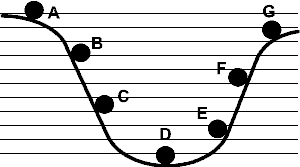
At which point does the ball has the greatest gravitational potential energy (GPE)?
A
G
D
C
G
Which of the following is the correct equation for calculating an object's gravitational potential energy?
PE = mgh
PE = mg / h
PE = mg + h
PE = gh
What is the value of the Earth's acceleration due to gravity (g)?
9.8 m/s2
100 m/s2
25 m/s2
3.14 m/s2
What is the gravitational potential energy (GPE) of a 1 kilogram book that is 1 meter above the ground?
g = 9.8 m/s2
9.8 Joules
1.0 Joule
0.10 Joule
11.8 m/s2

