
 Worksheets
Review Quiz for Stage 9
Total questions: 114
Worksheet time: 2hrs 33mins
Li+


Diamond is an example of a
simple covalent molecule
giant covalent structure
ionic compound
giant ionic lattice
Group 7 Halogens have 7 electrons in their outer shell, when the halogen gains an electron it has a charge of
+1
-1
+2
-2
How many electrons does oxygen gain to become a negatively charged ion?
1
2
3
4
When an atom loses electrons it becomes a
positively charged ion
negatively charged ion
an atom with no net charge
When atom loses or gains electrons they develop
energy
a charge
extra protons
NH3 would have ____________ bonds.
Covalent
Ionic
Simple covalent molecules are usually liquids or gases at room temperature
True
False
Weak ____________ forces hold simple covalent molecules together.
Intermolecular
Covalent
Ionic
Simple covalent molecules have charged particles so they can conduct electricity
True
False
Giant ionic structures have charged particles, so can move and conduct electricity when molten or dissolved.
True
False
Simple covalent molecules typically have...
Low melting and boiling points
High melting and boiling points
do packed particles make an object more dense or less dense?
less dense
more dense
all of the above
half and half



This is an example of...
a simple molecule
an extended structure

This is an example of...
a simple molecule
an extended structure

This is an example of...
a simple molecule
an extended structure

This is an example of...
a simple molecule
an extended structure

This is an example of...
a simple molecule
an extended structure
Which of these is a simple molecule?


According to the law of conservation of energy, energy can be created or destroyed.
True
False
According to the law of conservation of energy, the total amount of energy in the universe ____.
remains constant
changes constantly
increases
decreases

The SI Unit for Energy is
Joule
Potential
Calorie
Kilojoule

The light bulb converts electrical energy into light and _________.
chemical
electromagnetic
heat
nuclear

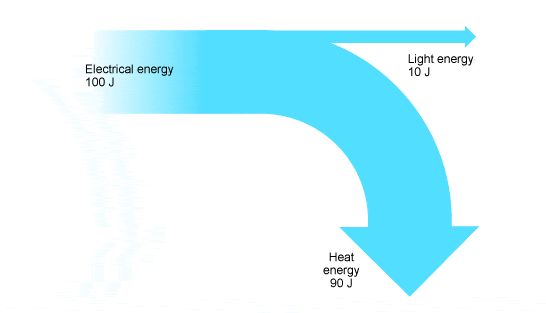
According to the law of conservation of energy, energy can be created or destroyed.
True
False

Which liquid is the least dense?
Oil
Water
Syrup
Plastic bottle

Which box has a higher density?
A
B
They are the same

What causes an object to sink in a water?
if the object's density is less than the water's density.
if the object's density is the same as water's density.
if the object's density is greater than water's density.
if the object's density is zero

What do you use this tool to measure?
Volume of Liquids
Volume of Rectangular Solids
Density
Mass
The amount of matter in a "given" amount of a substance cm3
Density
Mass
Volume
The amount of space an objects takes up or occupies
Mass
Density
Volume
None

The diagram above represents a thermometer. Which of the following best explains how the thermometer works?
Liquid changes to a gas when heated.
Gas changes to a liquid when heated.
Liquids expand when heated and contract when cooled.
Liquids contract when heated and expand when cooled.
This phase of matter has the most thermal energy
gas
liquid
solid
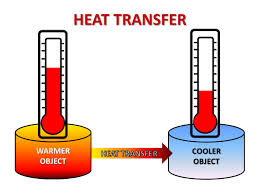
Heat always moves
in convection currents
by radiation
from hot to cold
from cold to hot
The measure of the average kinetic energy of particles in an object is its
temperature
heat
thermal energy
hotness
The metric scale of temperature measurement that the world uses is
Farenheit scale
Celcius scale
Kelvin scale
How do you increase the kinetic energy (movement) of molecules?
Decrease the temperature
change the energy input
increase the temperature
expand the molecules and increase the density

In this example, explain the movement of thermal energy in the glass.
Heat is moving from the lemonade to the glass
Heat is moving from the lemonade to the ice
Cold is moving from the ice to the lemonade
Cold is moving from the ice to the glass
Thermal energy always moves from areas of ______ heat to areas of ______ heat.
low -- high
high -- low
high -- high
low -- low
When matter goes from a gas to a liquid, the molecules ____________.
Expand and slow down
Contract and slow down
Contract and speed up
Expand and speed up
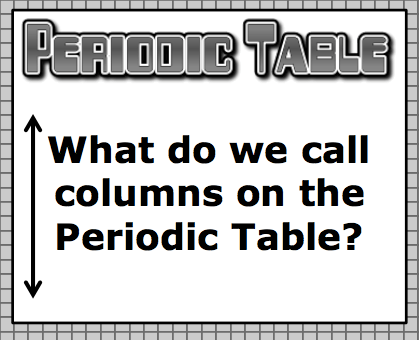
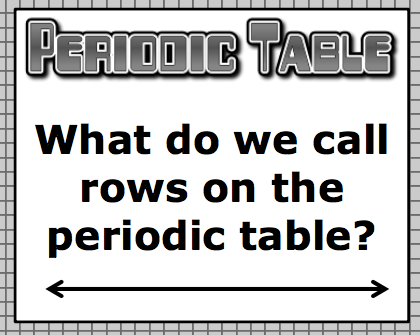
Which element is located in Group 11 & Period 4?
Vanadium
Cadmium
Copper
Rhodium
What element is located in Group 18 & Period 5?
Xenon
Krypton
Radon
Helium

The period for Bromine is ___________.
3
2
4
5



Iron + copper oxide =
Iron + copper oxide
Iron oxide + copper oxide
Iron oxide + copper
Magic
Which one of the following combinations result in a displacement reaction?
Iron with magnesium chloride
magnesium with iron chloride
Iron with Zinc Sulphate
gold with silver nitrate
What will the products of this reaction be?
calcium + zinc nitrate --------->
Calcium + zinc nitrate
Zinc + calcium nitrate
there will be no reaction
Zinc + calcium chloride
What are two reactions that can be used to produce copper sulfate?
Copper Oxide + Sulphuric Acid
Copper Carbonate + Sulphuric Acid
Copper Oxide + Nitric Acid
Sodium Carbonate + Hydrochloric Acid
Copper Carbonate + Hydrochloric Acid
What does the term ‘in excess’ mean?
Too much
The right amount
Too little
In a lump
Why did we need to ensure that the solution had a neutral pH before we tried to make crystals of copper sulphate?
To make sure all the acid had reacted
To make sure it was safe to drink
So that we didn't burn ourselves with the acid
To make sure that the copper sulphate crystals were blue
What would be sensible precautions to reduce the risks of this experiment?
Wear goggles
Tie long hair back
Wash hands afterwards
Spray equipment with water to cool it down
Do the experiment standing up with stool pushed under table.
Which of these is not a hazard in this experiment.
Sulphuric acid is corrosive
Copper Sulphate is harmful
Hot equipment
Copper Sulphate is extremely flammable

Meera added blue copper sulphate crystals to some water in a beaker. The copper sulphate dissolved in the water. Which of the following are ways for Meera to see that the Copper sulphate had dissolved in the water? (Tick two 2 correct answers)
copper sulphate crystals cannot be seen
there is precipitation
the liquid had turned blue
it becomes warm

Meera poured some of the copper sulphate solution into a dish. She left it in a warm room for a week.
A week later there was a blue solid but no liquid in the dish.
What happened to the water in the copper sulphate solution?
it was spilled
the beaker was leaked
it was absorbed by the copper sulphate
it evaporated
Meera poured some of the copper sulphate solution into a dish. She left it in a warm room for a week.
A week later there was a blue solid but no liquid in the dish.
What was the blue solid left in the dish?
(a)
Copper sulphate + iron = ------- + ----------.
(a)
The unit for measuring DENSITY is
g
cm3
g/cm3
Mass divided by volume will give you
mass
density
volum
Mass is measured in what units
grams
centimeters
cubic centimeters

Use the figure above, to answer the following question. Pic the answer that puts the objects in order from MOST DENSE to LEAST DENSE.
B, A, C, D
D, C, A, B
A, B, C, D
D, C, B, A

Why does this huge ship float on the water. Why it does not sink?
Because it is less dense than the water
Because it is denser than the water
Because it is havier than the water
Because it is less dense than the water

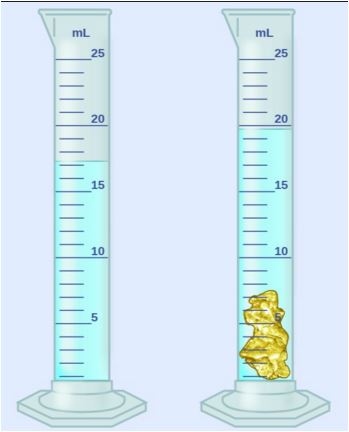
Why do we use this device
To measure volume of irregular objects
To measure mass of irregular objects
to measure volume of regular objects
to measure....... I don't know

I have a wood of 200cm3 and its mass is 400g. What is its density?
2g/cm3
2kg/m3
20g
20kg

