wayground logo

Free Printable Worksheets

Font size

S
M
L
XL
Worksheets

PSci Unit 7- Nuclear Chemistry Review

Total questions: 91

Worksheet time: 2hrs 50mins
Name
Class
Date
1.
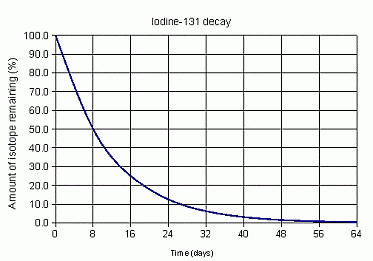
What is the half-life of iodine-131?
a)
32 days
b)
8 days
c)
16 days
d)
24 days
2.

Which of the following statements is true?

a)

An unstable daughter isotope decays into a stable parent isotope.

b)

An unstable parent isotope decays into a stable daughter isotope.

c)

A stable daughter isotope decays into an unstable parent isotope.

d)

A stable parent isotope decays into an unstable daughter isotope.

3.

An isotope has a half life of 20 years. If it starts with a sample of 100g, how much of it will be left after 80 years?

a)

25 grams

b)

50 grams

c)

6.25 grams

d)

12 grams

4.

After 2 half lives have passed, what percent of the parent isotope is left?

a)

25%

b)

50%

c)

75%

d)

100%

5.
After the third half-life, how much of a radioactive sample is left?
a)
1/2
b)
1/3
c)
1/16
d)
1/8
6.
Barium-122 has a half-life of 2 minutes. A fresh sample weighing 80 g was obtained. If it takes 10 minutes to set up an experiment using barium-122, how much barium-122 will be left when the experiment begins?
a)
0.25g
b)
2.5g
c)
25g
d)
80g
7.
The half-life of strontium-90 is 25 years. How much strontium-90 will remain after 100 years if the initial amount is 4.0 g?
a)
3.0g
b)
0.25mg
c)
0.3g
d)
0.25g
8.
146C has a half life of 5730 years, how many years would it take the 4.0 g sample to decay to 0.25 g?
a)
4 years
b)
5730 years
c)
22,920 years
d)
28,650 years
9.
A 2.5 gram sample of an isotope of strontium-90 was formed in a 1960 explosion of an atomic bomb at Johnson Island in the Pacific Test Site. The half-life of strontium-90 is 28 years. In what year will only 0.625 grams of this strontium-90 remain? 
a)
1988
b)
2016
c)
2044
d)
2072
10.
Actinium-226 has a half-life of 29 hours. If 100 mg of actinium-226 disintegrates over a period of 58 hours, how many mg of actinium-226 will remain? 
a)
50 mg
b)
25 mg
c)
12.5 mg
d)
6.25 mg
11.
The half-life of Zn-71 is 2.4 minutes. If one had 100.0 g at the beginning, how many grams would be left after 7.2 minutes has elapsed?
a)
100.0g
b)
50.0g
c)
12.5g
d)
8.5g
12.
The half life of iodine-131 is 8 days. What fraction of an iodine-131 sample will remain after 40 days?
a)
1/2
b)
1/64
c)
1/5
d)
1/32
13.
What makes an element radioactive?
a)
When it's nuclei expands
b)
When it's electrons explode
c)
When it's nuclei behave
d)
When it's nuclei decay
14.
Alpha particles.....
a)
a) are positively charged.
b)
b) consist of two protons and four neutrons.
c)
c) can penetrate any thickness of matter
d)
d) All of the above 
15.
Radioactive materials have unstable...
a)
electrons
b)
protons
c)
nuclei
d)
neutrons
16.
Which type of nuclear radiation is being emitted here?
a)
Alpha
b)
beta
c)
gamma 
d)
none
17.
In the equation,  146C --> 147N + 0-1B, the _______ decay of radioactive carbon-14 results in the creation of a new nitrogen-14 atom.
a)
Radioactive
b)
Beta
c)
Alpha
18.
What particle completes this reaction?
a)
alpha particle
b)
beta particle
c)
gamma particle
d)
neutron
19.
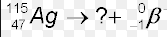
What element is the ?
a)
Ag-115
b)
Cd-115
c)
Pd-115
d)
Not Listed
20.
Which type of nuclear radiation is being emitted here?
a)
alpha
b)
beta
c)
gamma
d)
none
21.
If Gadolinium-150 goes through alpha decay, the resulting element has a new atomic mass of _____.
a)
150
b)
148
c)
146
22.

In the symbol 20682Pb what does 206 stand for?

a)

Number of neutrons

b)

Atomic number

c)

Atomic mass

d)

Number of protons

23.
What is the symbol for an alpha particle?
a)
42He
b)
0-1e
c)
0+1 e
d)
10n
24.
What element is the ?
a)
Ag-115
b)
Cd-115
c)
Pd-115
d)
Not Listed
25.
Balance the following equation:
146C --> 0-1e + ________
a)
145B
b)
146C
c)
147N
d)
42He
26.
Type of radiation that requires thick layers of concrete or lead in order to be stopped
a)
Gamma
b)
They are equal
c)
Beta
d)
Alpha
27.
a)
42He
b)
0-1 e
c)
00Y
d)
178O
28.
Solve this equation for alpha decay.
88226Ra = ___ + 24He
a)
86222Rn
b)
89226Ac
c)
84224Po
d)
88225Ra
29.
Solve this equation for alpha decay.
85209At = ___ + 24He
a)
83205Bi
b)
86209Rn
c)
81207Tl
d)
85208At
30.
Solve this equation for beta decay.
614C = ___ + -10e
a)
410Be
b)
714N
c)
210He
d)
613C
31.
Solve this equation for beta decay.
2760Co = ___ + -10e
a)
2556Mn
b)
2860Ni
c)
2358V
d)
2759Co
32.

When a neutron decays by turning into a proton and an electron is emitted - what is the name of the emitted electron?

a)

an alpha particle

b)

a beta particle

c)

gamma radiation

d)

an alpha particle and gamma radiation

33.
A helium nucleus with two protons and two neutrons is called a(n) ____.  
a)
alpha particle
b)
electroscope
c)
beta particle
d)
gamma ray
34.
Negatively charged particles emitted from a nucleus at a high speed are ____.  
a)
alpha particle
b)
gamma rays
c)
beta particles
d)
X rays
35.
The three types of nuclear radiation in increasing order of penetrating power are ____.  
a)
  alpha, beta, gamma 
b)
X ray, beta, gamma
c)
alpha, gamma, beta 
d)
X ray, gamma, beta 
36.
For which of the following problems would a scientist most likely use carbon-14? 
a)
to calculate the age of the Earth's oldest rocks
b)
to calculate the age of a piece of bone 
c)
to identify the elements that make up a rock 
d)
to identify the elements that make up a bone
37.

Describe the structure of an alpha particle.

a)

a fast-moving electron

b)

2 protons and 2 neutrons

c)

a slow-moving neutron

d)

a hydrogen nucleus

38.

In alpha decay, the atomic number...

a)

increases by 2

b)

decreases by 2

c)

increases by 4

d)

decreases by 4

39.

The mass number of Neptunium (Np) is (a)   .
40.
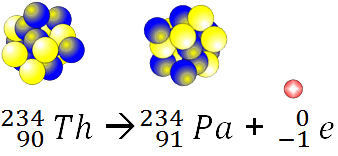
Which type of nuclear radiation is being emitted here?
a)
Alpha
b)
beta
c)
gamma 
d)
none
41.
What type of decay?
a)
alpha
b)
beta
c)
gamma
42.
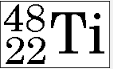
How many protons does this isotope of titanium have?
a)
48
b)
22
c)
26
d)
70
43.

What element went through Alpha Decay in the above Equation?

a)

Uranium 234

b)

Uranium 226

c)

Uranium 88

44.

Which type of decay is represented in this equation?

a)

Alpha

b)

Beta

c)

Gamma

45.

What is the missing mass number of Thorium?

a)

239

b)

231

c)

92

d)

92

46.

How many protons are in Uranium?

a)

235

b)

92

c)

90

d)

2

47.

How many neutrons are in Uranium 235?

a)

235

b)

92

c)

143

d)

144

48.

Which type of nuclear decay is pictured above?

a)

Alpha

b)

Beta

c)

Gamma

49.

How many protons does Copper have?

a)

64

b)

29

c)

28

d)

35

50.

What type of nuclear equation is represented in the above equation?

a)

Alpha

b)

Beta

c)

Gamma

51.

What is the atomic mass of Thorium in the above equation?

a)

233

b)

92

c)

90

d)

229

52.

How many neutrons are in Uranium 233?

a)

233

b)

92

c)

90

d)

141

53.

The above equation is an example of which type of nuclear decay?

a)

Alpha

b)

Beta

c)

Gamma

54.

In the equation, which of the following is true? (Pick 2)

a)

A beta particle is released

b)

A proton is converted into a neutron

c)

The atomic mass remains constant

d)

The atomic mass increase by 1

e)

The atomic mass decreases by 1

55.

Which type of nuclear decay is represented in the above equation?

a)

alpha

b)

beta

c)

gamma

56.

What is the missing element on the right side of the equation?

a)

Polonium

b)

Lead

c)

Radium

57.

How many protons are in gold?

a)

185

b)

79

c)

106

58.

If gold goes through Alpha decay, what is the mass of the new element?

a)

185

b)

79

c)

181

d)

80

59.

If gold goes through Alpha decay, what is the atomic number of the new element?

a)

185

b)

181

c)

77

d)

79

e)

80

60.
Barium-122 has a half-life of 2 minutes. A fresh sample weighing 80 g was obtained. If it takes 10 minutes to set up an experiment using barium-122, how much barium-122 will be left when the experiment begins?
a)
0.25g
b)
2.5g
c)
25g
d)
80g
61.
The half-life of strontium-90 is 25 years. How much strontium-90 will remain after 100 years if the initial amount is 4.0 g?
a)
3.0g
b)
0.25mg
c)
0.3g
d)
0.25g
62.
The half life of iodine-131 is 8.040 days. What percentage of an iodine-131 sample will remain after 40.20 days?
a)
312.5%
b)
31.25%
c)
.3125%
d)
3.125%
63.
The half-life of Zn-71 is 2.4 minutes. If one had 100.0 g at the beginning, how many grams would be left after 7.2 minutes has elapsed?
a)
100.0g
b)
50.0g
c)
12.5g
d)
8.5g
64.
 Fermium-253 has a half-life of 0.334 seconds. A radioactive sample is considered to be completely decayed after 10 half-lives. How much time will elapse for this sample to be considered gone?
a)
0.334 seconds
b)
3.34 seconds
c)
1.77 seconds
d)
13.4 seconds
65.
If the half-life of uranium-232 is 70 years, how many half-lives will it take for 10 g of it to be reduced to 1.25 g?
a)
1 half-life
b)
2 half-lives
c)
3 half-lives
d)
4 half-lives
66.

What is the half-life of an isotope if after 20.0 days you have 4.0 grams remaining of a 64.0 grams sample?

a)

1.25 days

b)

5.0 days

c)

80 days

d)

4.25 days

67.
Actinium-226 has a half life of 29 hours. If 100 milligrams of Actinium disintegrate over a period of 58 hours, how many milligrams of Actinium will remain? 
a)
100 mg
b)
50 mg
c)
25 mg
d)
58 mg
68.
You have 100 grams of radioactive C-14. The half life of C-14 is 5730 years. 
How many grams are left after 1 half life? 
a)
100 grams
b)
25 grams
c)
2 grams
d)
50 grams
69.
You have 100 grams of radioactive C-14. The half life of C-14 is 5730 years. 
How many grams are left after 2 half lives? 
a)
100 grams
b)
25 grams
c)
50 grams
d)
14 grams
70.

What is the definition of Half-Life?

a)

The time for half the radioactive nuclei in any sample to undergo radio active.

b)

Radioactive decay.

c)

The number of protons and neutrons.

71.

What is Mass Number?

a)

Plural for nucleus

b)

Radiation deflected towards negative plate.

c)

The number of protons and neutrons in the nucleus of an atoms.

72.

What is Alpha Particle?

a)

Chemically identical but radioactive.

b)

A helium nucleus that is emitted from a radioactive atom.

c)

Process in which unstable nuclei loses energy.

73.

What is an Isotope?

a)

Atoms that have the same number of protons but different numbers of neutrons. Isotopes are chemically identical, but some may be radioactive while others are not.

b)

A beta particle

c)

Numbers that explain the chemical.

74.

What is fission?

a)

Used to indicate protons and neutrons.

b)

High energy that is emitted from a radioactive nucleus.

c)

Breaking a large nucleus into smaller nuclei.

75.

What is Gamma Ray?

a)

A high energy wave

b)

A low energy particle

c)

An energy level

76.

What is radiation?

a)

The ability to do work or cause change.

b)

An electron that is emitted from a radioactive atom.

c)

The emission of Alpha Particles, Beta Particles, or Gamma Rays from the nucleus of an atom.

77.

What is fusion?

a)

Releases more energy than nuclear energy.

b)

Combining smaller nuclei together to form larger nuclei.

c)

A nuclear power plant.

78.

The nucleus ejects two protons and two neutrons (a helium nucleus)

a)

Beta Decay

b)

Gamma Decay

c)

Alpha Decay

79.

The splitting of an atom's nucleus into two smaller nuclei and neutrons; releases large amounts of  energy

a)

Nuclear Fussion

b)

Nuclear Fission

c)

Nuclear Energy

d)

Nuclear Reaction

80.

a series of fission reactions triggered by neutrons released during the fission of a nucleus

a)

Nuclear Notation

b)

Radioactive waste

c)

Nuclear Energy

d)

Chain Reaction

81.

Nucleus converts a neutron to a proton and electron, ejecting the electron

a)

Alpha Decay

b)

Beta Decay

c)

Gamma Decay

82.

Waste after the nuclear fuel is used up and can't produce heat, but still emits radioactivity.

a)

Radioactive Waste

b)

Nuclear Reaction

c)

Half-Life

d)

Radioactivity

83.

the release of gamma rays from a nucleus, no gain or loss of particles only energy

a)

Alpha Decay

b)

Beta Decay

c)

Gamma Decay

84.

Energy stored in and released from the nucleus of an atom

a)

Nucleus

b)

Isotope

c)

Nuclear Energy

d)

Strong Nuclear Force

85.

A spontaneous process in which unstable nuclei lose energy and/or particles by emitting radiation

a)

Radioactivity

b)

Strong Nuclear Force

c)

Nuclear Fission

d)

Nuclear Fussion

86.

Short-range force that holds nucleus together, overcoming the repulsion of the protons

a)

Fission

b)

Isotope

c)

Fussion

d)

Strong Nuclear Force

87.

the center of an atom, consisting of protons and neutrons

a)

Isotope

b)

Half-Life

c)

Nucleus

d)

Radioactivity

88.

a reaction that involves a change in an atom's nucleus, examples include fission, fusion or nuclear decay

a)

Radioactivity

b)

Nuclear Reaction

c)

Nuclear Energy

d)

Chain Reaction

89.

the combination of the nuclei of small atoms to form a larger nucleus; releases large amounts of  energy

a)

Nuclear Fission

b)

Nuclear Fusion

c)

Half-Life

d)

Isotope

90.

Atoms of the same element that have different numbers of neutrons

a)

Fusion

b)

Fission

c)

Gamma Decay

d)

Isotope

91.

The time it takes for half of the atoms of a radioactive element to decay into a new isotope.

a)

nuclear decay

b)

half life

c)

nuclear notation

d)

nuclear reaction