
 Worksheets
Unit 9: Evolution Review
Total questions: 82
Worksheet time: 1hrs 24mins
What is is the study of how and why plants and animals live where they do?
Evolution
Adaptive Radiation
Biogeography
Biogeology
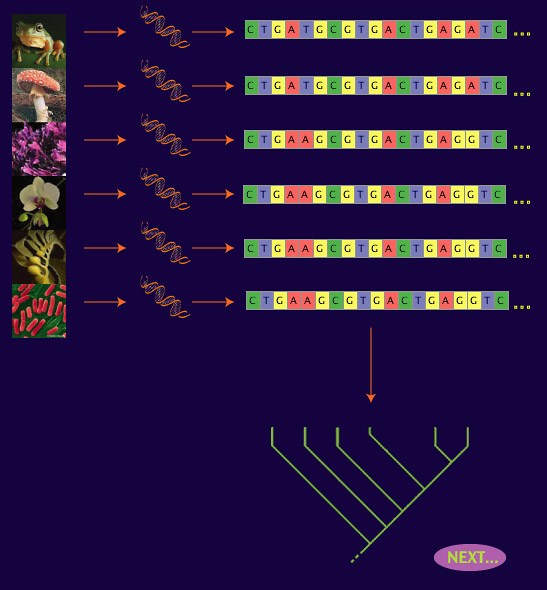
What does comparative DNA tell scientists?
Types of proteins they have
How much DNA an organism has
How similar two organisms are
Number of mitochondria
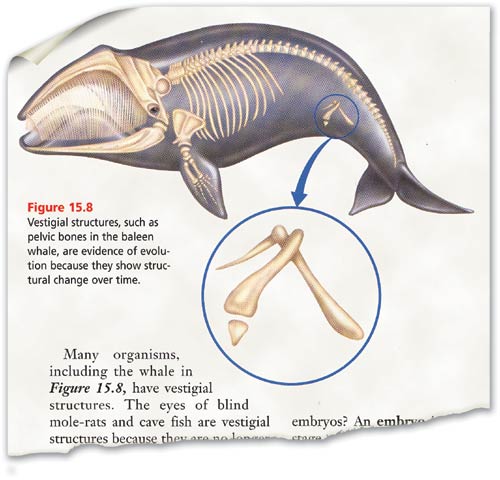
The tail bone, wisdom teeth, and appendix are all parts of the human anatomy that would be considered...
homologous structures
vestigial structures
fossils
extinct
Whales are aquatic mammals that contain a pelvis (hip) bone. Even though it does not aid in its movement, the function must have been used by a common ancestor of the whale. Thus, the pelvis is referred to as a(n)
vestigial structure
analogous structure
homologous structure

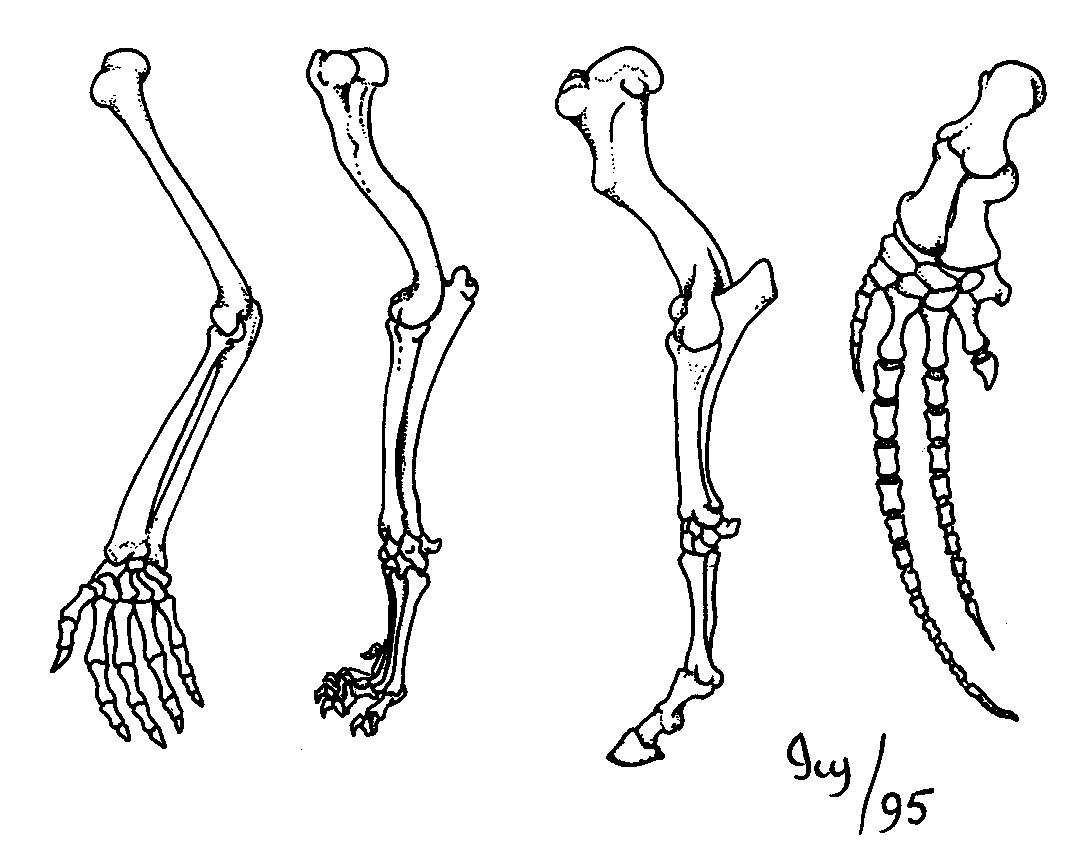
Structures with the same parts have different functions; suggests that organisms share a common ancestry
vestigial structures
homologous structures
adaptive radiation
fossil
Better adapted organisms survive to pass traits along to offspring.
Evolution
Natural Selection
Extinction
Artifical Selection
What do we call a change in a species over time?
Adaptation
Evolution
Extinction
Environmental influences

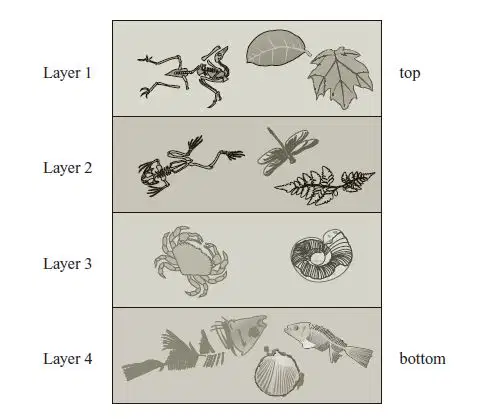
According to the picture, how has the environment led to changes over time?
Animals were able to walk in the past, but now they swim.
A species has lived there and never changed.
Animals used to swim in the past, but now they walk.
The environment was changed when animals decided to walk instead of swim.

Which animal is the LEAST similar to the Human from the list below?
Bat
LIzard
Whale
Bird
Which animal is the MOST similar to the Human from the list below?
Bat
LIzard
Whale
Bird
What caused the Horse and Whale to evolve?
They wanted to become bigger so they ate as much as they could.
Their environments changed so they had to adapt.
They wanted to look different so they changed their appearance.

Which two animals are closer relatives?
Dolphin and Wolf
Wolf and Shark
Shark and Dolphin

Evolution is best defined as:
the process which organisms die.
the process which organisms change over time.
the process which organisms that are extinct become revived.
the process which non-living things fossilize.
What do we call a change in a species over time?
Adaptation
Evolution
Extinction
Environmental influences

The three species pictured do not share a common ancestor, yet have evolved to have a similar anatomy and life style. This is an example of ?
Homologous Structures
Divergent Evolution
Vestigial Organs
Convergent Evolution
Slow changes over a long period of time.
Gradualism
Extinction
Coevolution
Convergent evolution
Bursts of change followed by periods of stability.
Punctuated equilibrium
Gradualism
Extinction
Speciation
A number of different species arise from one common ancestor.
Adaptive Radiation (aka, Divergent Evolution)
Gradualism
Coevolution
Speciation

Phyletic Speciation
Adaptive Radiation
Convergent Evoltion
Divergent Evoltuion
Co-evolution


The three species pictured do not share a common ancestor, yet have evolved to have a similar anatomy and life style. This is an example of ?
Homologous Structures
Divergent Evolution
Vestigial Organs
Convergent Evolution

The three species pictured share a common ancestor and have adapted so that each lives in a different environment. This is an example of
Law of Superposition
Evolutionary Arms Race
Divergent Evolution
Convergent Evolution

Which of these is an example of Divergent Evolution?
The Whale Lineage
Cheetah Cubs
Darwin's Finches
Dolphin and Shark Bodies

Many different groups of organisms have wings, even though they do not share a recent common ancestor. This is because they evolved in environments with similar selective pressures. Wings are an example of a(n) ______________ structure.
vestigial
analogous
homologous

A trait or change in lifestyle that helps a plant or animal survive in its environment
adaptation
evolution
homologous
vestigial

Why does the ability to lay 1,000 to 5,000 eggs increase the fitness of the species L. clamitans clamitans?

What type of evidence is shown in this picture?
Fossils
Homologous Structures
Vestigial Structures
DNA


| Options : History : Help : Feedback | Close |

What does the similarity of these structures tell us about these organisms?
They grow at different rates
they have a common ancestor
They evolved slowly
They do the same thing

What type of speciation is this?
Geographical
Temporal
Behavioral

What type of speciation is this?
Geographical
Temporal
Behavioral

What type of speciation is this?
Geographical
Temporal
Behavioral

What type of speciation is this?
Geographical
Temporal
Behavioral

What type of speciation is this?
Geographical
Temporal
Behavioral

What type of speciation is this?
Geographical
Temporal
Behavioral

What type of speciation is this?
Geographical
Temporal
Behavioral
If a population experiences no migration, is very large, has no mutations, has random mating, and there is no selection, which of the following would you predict?
The population will evolve, but much more slowly than normal
The makeup of the population's gene pool will remain virtually the same as long as these conditions hold.
The composition of the population's gene pool will change slowly in a predictable manner.
Dominant alleles in the population's gene pool will slowly increase in frequency while recessive alleles will decrease.
The population probably has an equal frequency of A and a alleles.
It can be harder for small island populations to evolve. Why?
They are at genetic equilibrium.
They have more phenotypic plasticity.
They have less genetic diversity.
They exhibit disruptive selection.
Why are advantageous traits more likely to be passed onto offspring?
Because they are more likely to survive and reproduce.
Because they come from dominant alleles.
Because they come from recessive alleles.
Because the organism knew it needed that trait, survives, and passes it on.
Starlings produce an average of five eggs in each clutch. If there are more than five,
the parents cannot adequately feed the young. If there are fewer than five, predators may destroy the entire clutch. As a result, five eggs becomes the most common clutch size.
Directional Selection
Stabilizing Selection
Disruptive Selection
Seed cracker birds have either large beaks or small beaks. They do not have medium sized beaks because medium sized beaks do not allow for adequate cracking of seeds.
Directional Selection
Stabilizing Selection
Disruptive Selection
A scientist measures the circumference of acorns in a population of oak trees and
discovers that the most common circumference is 2 cm. There are very few acorns with circumferences of 3 cm or
circumferences of 1 cm. Only the 2 cm circumference acorns survive.
Directional Selection
Stabilizing Selection
Disruptive Selection
_A population of Madagascar hissing cockroaches lives in a woodpile. The
cockroaches are eaten by lizards. Because the lizards have small heads, the lizards are unable to eat the very largest
adult cockroaches, and instead prey upon small and medium sized adults. Over time, only the large headed lizards
survive.
Directional Selection
Stabilizing Selection
Disruptive Selection
Female birds that lay close to the optimum number of eggs have the most surviving offspring. Those that lay fewer or more eggs have lower relative fitness.
Directional Selection
Stabilizing Selection
Disruptive Selection
A population of birds with various size beaks eats seeds. Small seeds can be eaten
by birds with small beaks. Larger, thicker seeds can only be eaten by birds with larger, thicker beaks. During a
drought, only large thick seeds exist so only the large, thick-beaked birds survive.
Directional Selection
Stabilizing Selection
Disruptive Selection
Black rabbits (BB) and white rabbits (bb) are both able to survive because they can camouflage into the white and black rocks in their environment. However, the intermediate gray rabbits (Bb) do not survive. This results in only white and black rabbits.
Directional Selection
Stabilizing Selection
Disruptive Selection
Small lizards have difficulty defending territories so they end up dying out. Large lizards are more likely to be preyed upon by owls. Over time, only medium sized lizards end up surviving.
Directional Selection
Stabilizing Selection
Disruptive Selection
Women often have complications during labor while giving birth to very large babies, whereas very small babies tend to be underdeveloped. As a result, medium sized babies are the ones that end up surviving to adulthood.
Directional Selection
Stabilizing Selection
Disruptive Selection

NAME THAT CURVE!!
Directional Selection
Stabilizing Selection
Disruptive Selection

NAME THAT CURVE!!
Directional Selection
Stabilizing Selection
Disruptive Selection

NAME THAT CURVE!!
Directional Selection
Stabilizing Selection
Disruptive Selection

