
 Worksheets
311 PART 3
Total questions: 35
Worksheet time: 18mins
What is one of the recommendations by the Solid Fuel Association for storing coal?
Store coal in a plastic bag inside the house
Store coal in a purpose-built bunker outside the property
Store coal in a wooden box in the garage
Store coal in a metal container in the basement
Why should the base of a coal bunker be sloped?
To make it easier to shovel
To prevent water collecting
To allow more coal to be stored
To improve ventilation
What is a requirement for the floor of a coal storage bunker?
It should be made of wood
It should be hard and smooth
It should be covered with carpet
It should be painted
Why should a coal bunker be well ventilated?
To prevent moisture building up
To keep the coal warm
To reduce the smell of coal
To allow sunlight to enter
What material are domestic tanks generally made from?
Wood or aluminum
Plastic or steel
Glass or concrete
Copper or brass
What standard must plastic tanks conform to?
OFS T200
OFS T300
OFS T100
OFS T400
What standard must steel tanks conform to?
OFS T100
OFS T200
OFS T300
OFS T400
How often should an inspection of the tank take place?
Every month
Every six months
Annually
Every two years
What is a secondary containment system used for in environmental protection?
To store extra oil
To counteract the risk of pollution if oil is split
To increase the capacity of the tank
To enhance the aesthetic of the installation
What is a bund in the context of oil storage?
A type of oil filter
A secondary containment system
A primary storage tank
A water purification device
What must a bund be capable of holding in relation to the tank's capacity?
90% of the tank's capacity
100% of the tank's capacity
110% of the tank's capacity
120% of the tank's capacity
When might a secondary bunded tank or oil impermeable wall be used?
When the tank is located in a desert
When the tank is located near a river or watercourse
When the tank is used for storing water
When the tank is located in a forest
What is the minimum distance a fuel oil tank must be from non-fire related eaves, buildings, or sheds?
1.8m
760mm
600mm
2.5m
How far must a fuel oil tank be from openings like doors or windows?
1.5m
1.8m
760mm
600mm
What is the required distance from a non-fire rated boundary, such as a wooden fence, for a fuel oil tank?
1.8m
760mm
600mm
500mm
If the required distances cannot be met, what must be provided for a fuel oil tank?
A 15-minute fire protection barrier
A 30-minute fire protection barrier
A 45-minute fire protection barrier
A 60-minute fire protection barrier
Why is it important to remember that LPG is heavier than air?
It will rise to the highest point.
It will always find the lowest point.
It will remain at the same level.
It will disperse evenly in the air.
Where can an LPG tank be located?
Only above ground level.
Only below ground level.
Either above or below ground level, subject to the water table.
Only at the water table level.
What does the HSE state about the location of LPG storage tanks?
They should be placed near drains or gullies.
They should have no minimum separation distances.
There should be no drains or gullies nearby, unless protected by a water trap.
They should be placed in high traffic areas.
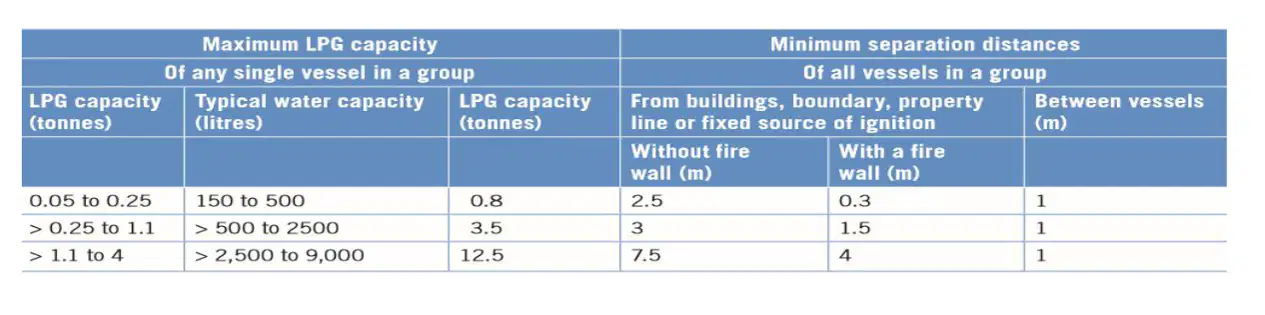
What is the typical water capacity for an LPG capacity of 0.05 to 0.25 tonnes?
150 to 500 litres
500 to 2500 litres
2500 to 9000 litres
1000 to 3000 litres
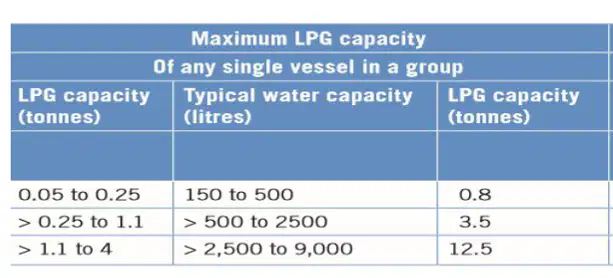
What is the minimum separation distance from buildings for an LPG capacity of 1.1 to 4 tonnes without a fire wall?
2.5 meters
3 meters
7.5 meters
5 meters
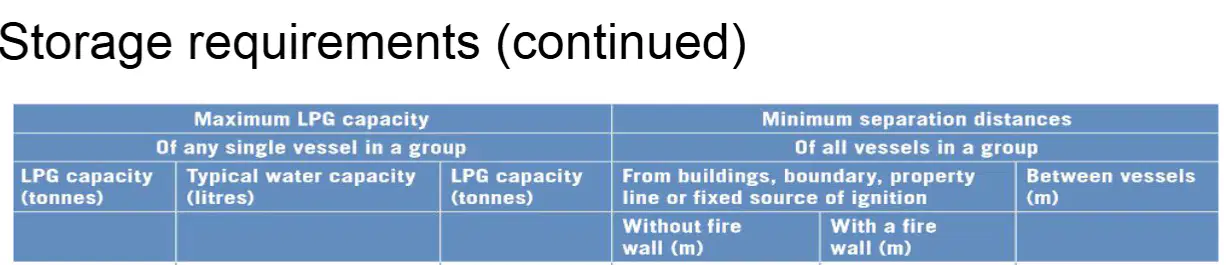
For an LPG capacity of 0.25 to 1.1 tonnes, what is the minimum separation distance between vessels?
0.3 meters
1 meter
1.5 meters
2 meters
What additional consideration is mentioned for LPG tanks?
Color coding
Ventilation and protection from impact
Temperature control
Regular maintenance
What are some of the storage options that need to be watertight for biomass?
Hook bin, covered shed, hopper, silos, bunker
Open bin, uncovered shed, basket, tank, crate
Hook bin, open shed, barrel, silos, box
Covered bin, open shed, hopper, tank, crate
Why is early consideration for the type of storage important in biomass systems?
It affects the design of the system
It reduces the cost of materials
It increases the storage capacity
It improves the aesthetic appeal
What is a major factor to consider for fuel storage?
Color of the fuel
Space required
Type of vehicle
Weather conditions
Why is vehicle access important for delivery requirements?
To ensure quick delivery
To allow for easy parking
To accommodate tankers and HGVs
To reduce noise pollution
Which of the following is a safety concern related to storage requirements?
Confined spaces
Temperature control
Inventory management
Lighting conditions
What is a potential risk associated with storage that involves flammable materials?
Water damage
Fire risk
Pest infestation
Noise pollution
Which of the following is a hazard that can occur due to improper ventilation in storage areas?
Carbon monoxide build-up
Excessive humidity
Dust accumulation
Electrical failure
What safety issue is related to the physical movement of goods in storage areas?
Slips, trips, and falls
Data loss
Overheating
Vandalism
Which of the following is important for maintaining health standards in storage areas?
Personal hygiene
Color coding
Labeling
Temperature monitoring
What weather conditions can cause late or cancelled deliveries, particularly in rural areas?
Sunny and clear skies
Wind, rain, hail, and snow
Warm and dry conditions
Fog and mist
How can bad weather affect biomass systems?
It makes them more efficient
It can render them unusable
It has no effect
It improves fuel quality
What can happen to woodchip biomass if it starts to decompose due to damp conditions?
It becomes more stable
It cools down
It heats up and spontaneously combusts
It turns into liquid fuel

