
 Worksheets
Chemistry Revision IGCSE
Total questions: 144
Worksheet time: 4hrs 1mins
Nitrogen, N, will form which of the following ions?
N
N-3
N-5
N+5
Beryllium, Be, will ____ valence electrons when forming an ionic bond.
lose 4
gain 4
lose 2
gain 2
What will be the charge of a bromine ion?
+7
-7
-1
+1
Al3+ O2-
Which of the following is NOT a property of ionic compounds?
They conduct electricity when molten
They conduct electricity when in solution
They have high boiling points
They are insoluble in water

Which is the correct formula for aluminum sulfide?
AlS
Al3S2
S3Al2
Al2S3
Which of the following is true for ionic bonding & ionic compounds?
They must be made of ions with like charges.
The negative ion must be written first.
Compounds must have an overall charge of zero.
They are made of metals and nonmetals.
The positive ion must be written first.
What is the charge of ion "X" in the formula XF3?
+3
-3
+1
-1
Which of the following pairs of elements will NOT form an ionic compound?
sodium and fluorine
phosphorous and aluminum
potassium and magnesium
strontium and oxygen
Generally high melting & boiling points
Ionic compounds
Covalent compounds

What type of bonding does this picture show?
Ionic
Covalent


Li+ is a cation and F- is an anion. When bonded together they form what type of chemical bond?
Covalent
Ionic
Metallic
None are correct

When identifying an element on the Periodic Table, the PERIOD refers to the
Column or # of valence electrons
Row or # of electron orbitals surrounding the nucleus
Both are correct
None are correct

Refer to the diagram. What can be concluded regarding the amount of energy needed to break the single bonds of water molecules and/or elements within a molecule?
Intramolecular forces that bond elements in a water molecule require 415 kJ/mol per bond to break
Intramolecular forces that bond hydrogen & oxygen total 830 KJ/mol for 1 molecule of water to break
Intermolecular forces that bond water molecules together require 41KJ/mol to break
All are correct
Why are metals malleable?
They are shiny
The electrons are held tightly within the lattice structure making it strong
The electrons are delocalized and able to move between the atoms
The electrons are shared between two metal ions and this holds the atoms together

A
B
C
D

A
B
C
D

A
B
C
D

A
B
C
D

A
B
C
D

A
B
C
D

A
B
C
D

A
B
C
D

A
B
C
D

A
B
C
D

A
B
C
D

A
B
C
D

A
B
C
D

A
B
C
D

A
B
C
D

A
B
C
D
Which of the following metals is extracted by electrolysis?
K
Ca
Al
Fe
Graphite is used as an electrode because it
does not burn
has mobile electrons
is a metal
is a reducing agent
Which of the following reactions never goes completion in a closed container?
H2 + I2 ⇌ 2HI
C2H5OH + 3O2 → 2CO2 + 3H2O
NaOH + HCl → NaCl + H2O
CuSO4 + Zn → ZnSO4 + Cu

For the reaction pictured,
If the concentration of SO2 is increased, the equilibrium position of the reaction will shift ___________.
to the left
to the right
to the left and right
no change

Consider the sulfur trioxide synthesis reaction again:
Which of the following will NOT shift the equilibrium to the right?
add mor O2
increase the pressure
add catalyst
lowering the temperature

At what time on the graph will the reaction reach equilibrium?
t1
t2
t3
t4

For the Haber process pictured, if the pressure of the system is increased, which substance(s) will increase in concentration?
H2
N2
H2 and N2
NH3
2SO2(g)+O2(g)⇌2SO3(g)
Removing O2(g) will
shift equilibrium forward
shift equilibrium reverse
no shift
2SO2(g)+O2(g)⇌2SO3(g)
Adding SO2(g) will
shift equilibrium forward
shift equilibrium reverse
no shift
What is the effect of increasing the pressure on the following equilibrium: 2NO(g) + O2 (g) ⇌2NO2(g)?
The yield of NO2 increases
The yield of NO2 decreases
The reaction is slower
The concentration of O2 increases.
SO2 + O2 <=> SO3
If the equilibrium position shifts to the right, the concentration of O2 will ___________.
N2 + O2 <=> 2NO: Δ H = +182 kJ mol-1.
If the temperature is increased the equilibrium position will shift _______.

Which of the following statements are correct?
Water and a white solid are produced when blue copper(II) sulfate is heated. On the addition of water to the white solid, heat is released and the white solid turns blue.
Which statement correctly describes the reaction and the blue copper(II) sulfate?
non-reversible
reversible
anhydrous
hydrated
Which of the following reactions cannot be reversed?
Melting ice
Thermal decomposition of hydrated cobalt(I) chloride
Combustion of propane
Hydration of anhydrous copper(II) sulfate
Reversible reactions occur when products formed in the forward reaction behave as reactants and proceed in the reverse direction to produce the original reactants again.
Which of the following statements is correct for a reversible reaction?
If the forward reaction is exothermic, then the reverse reaction must be endothermic.
Both directions are exothermic.
Both directions are endothermic.
If the forward reaction is endothermic, then the reverse reaction must be exothermic.
Carbon and steam react together as shown in the equation.
C(s) + H2O (g) ↔ CO(g) + H2(g)
Forward reaction is endothermic. Which conditions of pressure and temperature would provide the highest yield of H2?
low pressure
high pressure
low temperature
high temperature

The reversible reaction between nitrogen dioxide and dinitrogen tetroxide is shown in the diagram.
Which of the following statements about the equilibrium mixture in this reaction is correct?
If the pressure is decreased, the amount of N2O4 formed increases.
If the pressure is increased, the amount of NO2 formed increases.
The decomposition of N2O4 is exothermic.
The decomposition of N2O4 is endothermic.

Methane and steam react together endothermically to produce carbon monoxide and hydrogen as shown in the diagram.
Which changes to the pressure and temperature of the reaction would provide the highest equilibrium yield of CO?
increase pressure
decrease pressure
increase temperature
decrease temperature

A part of the Contact process involves the production of sulfur trioxide from the reversible reaction of sulfur dioxide and oxygen, as shown in the diagram.
Which of the following changes would increase the yield of SO3 at equilibrium?
Decreasing the temperature
Increasing the pressure
Decreasing the concentration of O2
Which of the following statements best describe equilibrium position?
Equilibrium position refers to the concentration of reactants and products relative to one another at equilibrium.
Equilibrium position refers to the physical state of the reactants and products at equilibrium.
Equilibrium position refers to the relative reactivity of the reactants and products for a reaction at equilibrium.
Equilibrium position refers to the obtainable yield of product for the forward reaction only.
Which of the following statement best describes a reversible reaction at equilibrium?
At equilibrium the concentration of reactants and products are the same.
At equilibrium the concentrations of reactants and products are constant and the rate of the forward reaction is equal to the rate of reverse reaction.
At equilibrium the concentration of reactants and products are different.
At equilibrium the concentrations of reactants and products are constant and the rate of the forward reaction is different to the rate of the reverse reaction.
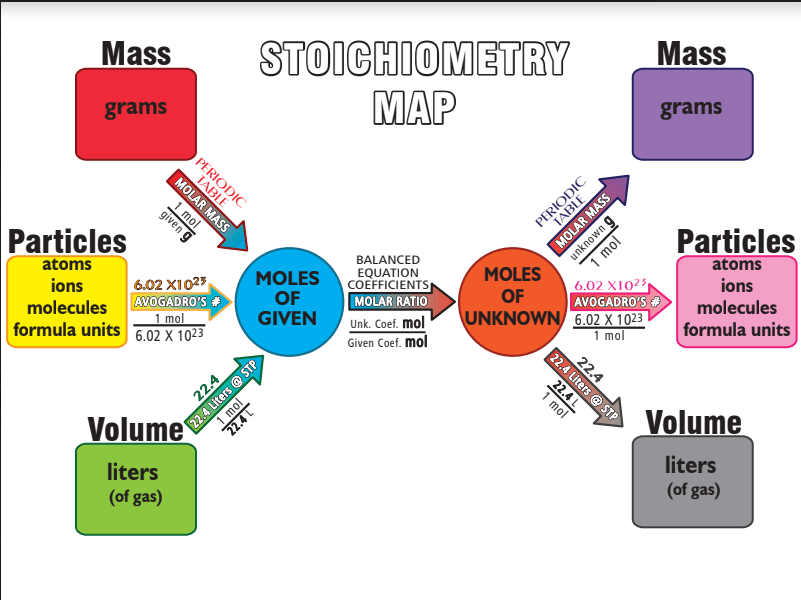
How many step will it take for me to go from moles given to moles unknown?
1
2
3
4
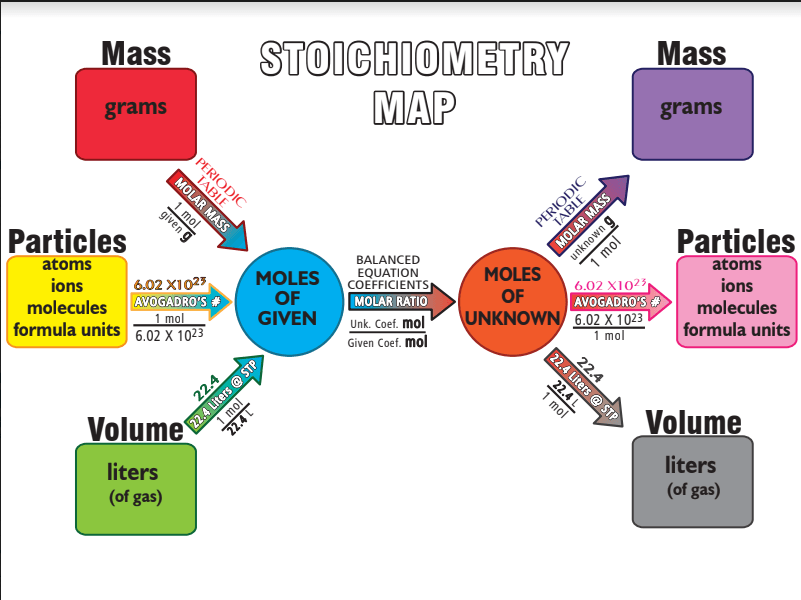
How many steps will it take me to go from grams to grams?
4
3
2
1
I use molar mass when the problem gives me grams?
False
True
CaC₂(s) + H₂O(l) --> C₂H₂(g) + Ca(OH)₂(aq)
12.00 moles of NaClO3 will produce how many grams of O2?
How many grams of potassium chloride (KCl) can be produced from 356 g of potassium bromide (KBr)?
How many moles of hydrogen are needed to react with 2 moles of nitrogen?
How many moles of oxygen are produced when 6.7 moles of KClO3 decompose completely?
I need to add 8 moles of Carbon to the reaction. How many grams of Carbon should I weigh?
In the equation 2 Al2O3 --> 4 Al + 3 O2, what is the mole ratio of aluminum to oxygen (aluminum is asked for, oxygen is given)?
10/6
3/4
4/3
2/3
180.18 g/mol
180.12 g/mol
180.24 g/mol
180.06 g/mol
24 grams of CH4 was added to the above reaction. Calculate the theoretical yield of CO2.
When reacting Na with Cl2, we calculated that the theoretical yield should be 13 grams. Our actual yield was 12.5 grams. What is the percent yield?
90.4%
104%
96.15%
1.04%
Actual yield = 62g
Calculate the percent yield.
If 7.62g Fe react with 8.67g S, what is the limiting reactant?
What is the limiting reactant is 12 moles of P4 react with 15 moles of O2?
Superheating gas so that it becomes ionized is one of the methods to form this state of matter.
Solid
Liquid
Gas
Plasma
This state of matter has a firm, unchanging physical structure.
Solid
Liquid
Gas
Plasma
I can compress the volume of these states of matter.
Solid
Liquid
Gas
Plasma
An ice cube turning to water is an example of what phase change?
Condensation
Melting
Sublimation
Vaporization
Solid dry ice turning into gaseous carbon dioxide is an example of what phase change?
Condensation
Melting
Sublimation
Recombination
Adding large amounts of energy to transform a gas into plasma is known as what?
Condensation
Ionization
Sublimation
Recombination
In colder environments, gaseous water vapor can turn directly to solid ice on a window. What is this process called?
Deposition
Evaporation
Freezing
Vaporization
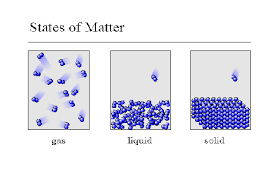

How can you stop the movement of particles?
Increase the temperature
Decrease the temperature
You can't.
Hold them still with your hands.

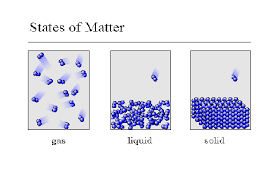

A
B
C
D

A
B
C
D

A
B
C
D

A
B
C
D

A
B
C
D

A
B
C
D

A
B
C
D

A
B
C
D

A
B
C
D

A
B
C
D

A
B
C
D

A
B
C
D

A
B
C
D

A
B
C
D

A
B
C
D

A
B
C
D

A
B
C
D

A
B
C
D

A
B
C
D

A
B
C
D
If a chemical reaction releases heat to the surroundings, it is called an...
endothermic reaction
exothermic reaction
existential reaction
extinct reaction
In an endothermic reaction, the temperature of the surroundings...
Decreases
Increases
Stays the same
Combustion reactions are always what type of reaction?
endothermic
exothermic
existential
extinct
Melting ice into liquid water is what type of process?
Endothermic
Exothermic
Existential
Extinct
When acids react with alkalis exothermically. What happens to the temperature of the water that the reaction happens in?
Never stops increasing
Never stops decreasing
Always stays the same
Increases initially then decreases when the reaction finishes.
The molar energy change (called enthalpy, ΔH) is equal to:
Q/moles
Q x moles
Moles / Q
Moles + Q
For an exothermic reaction, the enthalpy change (ΔH) has what sign?
Positive
Negative

