
 Worksheets
Physics Final Exam Review GCA
Total questions: 109
Worksheet time: 4hrs 46mins
Match the description to the graph:
"The car is stopped."


Match the description to the graph:
"The car is accelerating."
Match the description to the graph:
"The car is traveling forward at a constant speed."

What does the slope represent on a position time graph?
the distance traveled
the displacement
the velocity
the acceleration
I don't understand, I need more help

Susan Storm creates a force field. In 0.5 seconds, the forcefield halted an arrow that was headed straight for her at 200 m/s. At what rate did the arrow accelerate?
-400 m/s^2
-100 m/s^2
25 m/s^2
+400 m/s^2

Sort the measurements into categories. Use the picture if you need help.
time
distance
speed
mass
velocity
displacement
acceleration
weight
force
Sort each measurement into its correct category.
30 seconds
the snail slithered 90 cm yesterday
the speedometer reads 30mph
the snail has a mass of 2 grams
the snail ended up 20 cm from its starting point
the car travelled at 30mph due west
the rock fell, accelerating at 9.8 m/s^2
The snail's weight is 0.196 N

As Spider-Man takes off from rest, he accelerates at 6 m/s^2. What is his displacement after 2 seconds? (only type in a number)
30 km West
60 km East

Which side is adjacent to angle alpha?
17
15
8
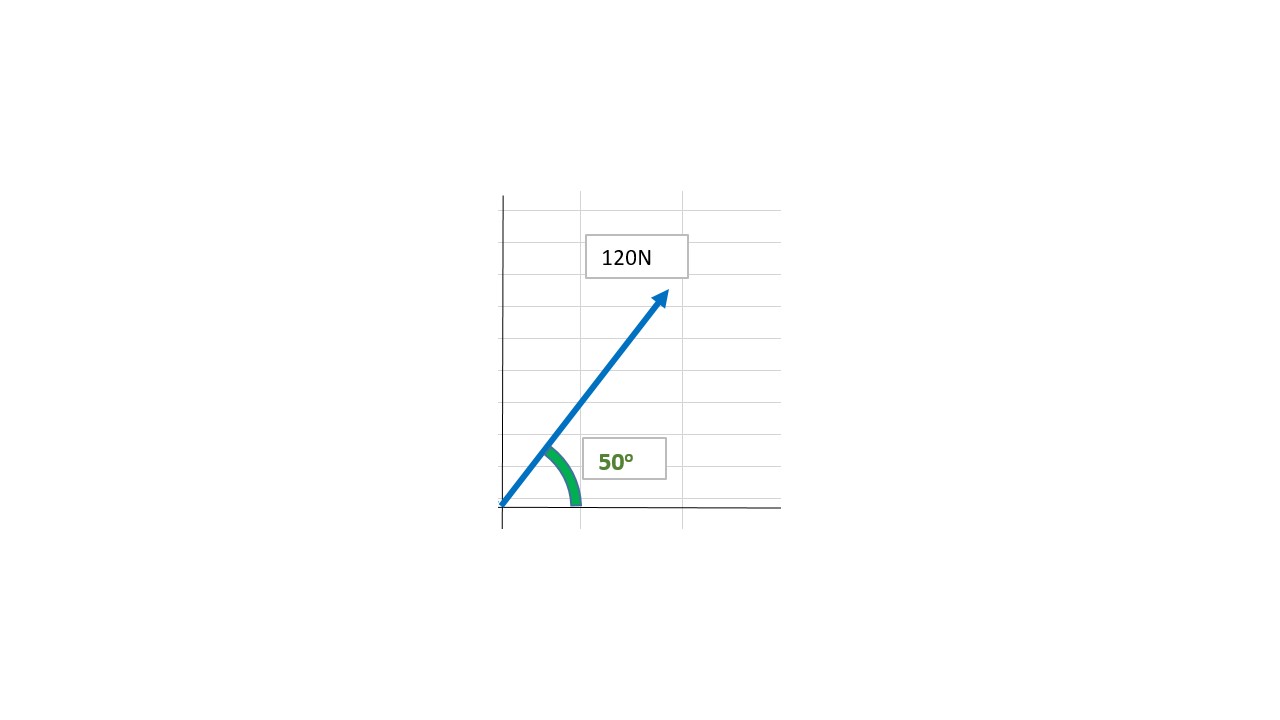

This monkey has a weight of 100 N. How much tension is in each of his arms?
50 N
100 N
10 N
200 N

The tightrope makes a 20° angle with the horizontal. Half of the person's 600 N weight creates the vertical force (Fy = 300N) on the tightrope. What is the tension in the tightrope?
282 N
103 N
319 N
877 N

Based on the picture, how would you find the horizontal component of the soccer ball's velocity?
20sin(30°)
20cos(30°)
20tan(30°)
30sin(20°)

At the point with the arrows drawn, the frog is moving to the right at 40 cm/s and upward at 9 cm/s. What is the resultant velocity of the frog?
1680 cm/s
31 m/s
49 cm/s
41 cm/s
The SI unit of weight is
kg
kgm/s
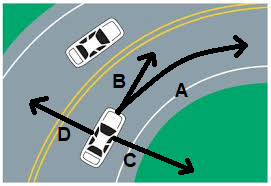
A car is rounding a bend as shown in the diagram. Which arrow correctly shows the direction of the car's centripteal force?
A
B
C
D
directed outward
tension
directed toward the center of the arena
9.8 N

Which of the following FBD is correct for the car at point A?


Which of the following FBD is correct for the car at point C?
A 50 kg skater pushes off from a wall with a force of 200 N. What is the skater’s acceleration?
200 / 50 = 4 m/s2
50 / 200 = 0.25 N
200 x 50 = 10,000 m/s2
200 / 50 = 4 N
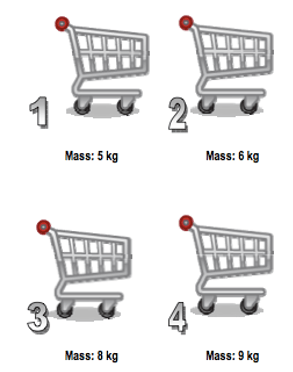
A force of 90N is applied to each cart, which one will accelerate the fastest?

Calculate the net force.
0 N
5 N right
+15 N
5 N left
velocity
acceleration
speed
A 20 kg bike accelerates at 0.5 m/s2. The net force is
0.025 Newtons
10 Newtons
40 Newtons
If I double the distance between two objects, what happens to their gravitational force?
What happens to gravitational force if I triple both of the masses but don't change their distance?
triples
a third as big
9x bigger
9x smaller
Two asteroids exert a gravitational force, F, on each other. Some time later, the asteroids are now 9 times as far from each other as before. Which of the following represents the gravitational force at this distance?
F/3
F/9
F/81
F/4.5
pushing on a stationary car
In which of these cases is work being done?
A student sleeps
A student pushes a locked door that does not move
a student pushes his rolling chair into another room
A student sits on the carpet
SP3.c
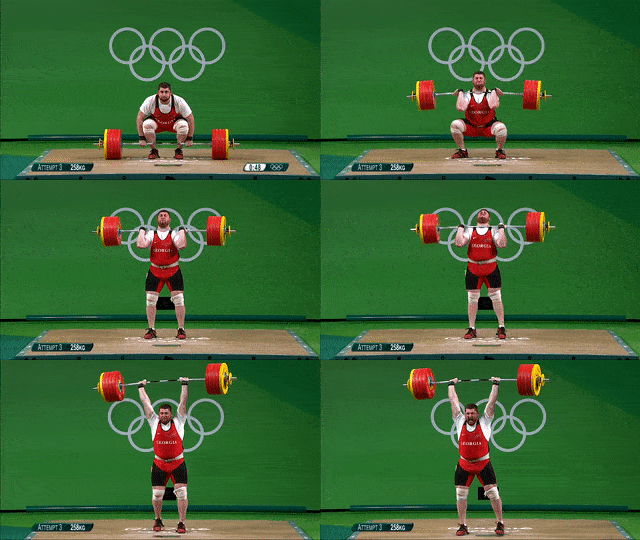
This weight lifter used 1030 Newtons of force to lift the weights to a height of 2.3 m in 5.5 seconds. If he repeated the lift but in 11 s, how would his power change?
power will quadruple
Power will stay the same
Power would double
Power would be half
SP3.c
This weight lifter used 1030 Newtons of force to lift the weights to a height of 2.3 m in 5.5 seconds. He the repeated the lift but with twice the mass and twice the force. How did his power change?
power will quadruple
Power will stay the same
Power would double
Power would be half
If you increase your work and decrease your time, you will have
more power
less power
same amount of power
power rating can not be determined

SP3.d
A 5 N force is applied to a 0.2 kg ball to slow it down from 0.8 m/s to 0 m/s. What is the impulse on the ball?
-2.5 N⋅s
-4 N⋅s
-0.16 N⋅s
-1 N⋅s
SP3.d
A 5 N force is applied to a 0.2 kg ball to slow it down from 0.8 m/s to 0 m/s. How much time did it take for the dog to slow down the ball?
2.5 s
4 s
0.032 s
1 s

An egg is thrown at a wall (not shown) and at a bed sheet. The force of impact will be

An egg is thrown at a wall (not pictured) and at a bed sheet. Both eggs come to a complete stop. The egg's impulse will be
Greater for the wall collision
Greater for the sheet collision
impulse is equal
Wearing a safety helmet is an effective way to protect your head from injury. In order for the force to ___________ on impact, the time to bring your head to a stop must ____________. This is done through adding padding in the helmet.
decrease; increase
increase; decrease
increase; increase
decrease; decrease


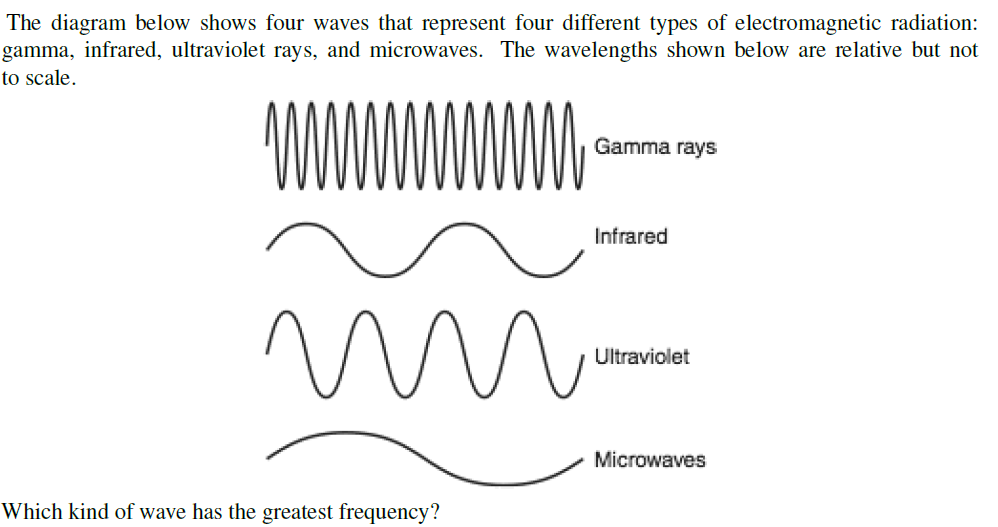
Which wave behavior do noise cancelling headphones use?
diffraction
refraction
constructive interference
destructive interference
How does the Doppler effect explain the sound you hear when a race car comes toward and then passes a camera?
The pitch is higher as it approaches and then becomes lower the
moment it passes.
The pitch is lower as it approaches and then becomes higher the
moment it passes.
The sound is louder as it approaches and then becomes softer the
moment it passes.
The sound is softer as it approaches and then becomes louder the
moment it passes.

Widely spaced sound waves are
high pitched
low pitched
medium pitched
The energy of a photon is based on its
velocity
speed
amplitude
frequency

What's happening at A where the wave is brightest?
Two crests are combining to create constructive interference.
A crest and a trough are combining to create destructive interference.
Two crests are combining to create destructive interference.
A crest and trough are combining to create constructive interference.
Which part of the electromagnetic spectrum has the highest energy photons?
Gamma
X-rays
Microwaves
Radio
Match the phenomenon to the picture.

interference

refraction

polarization

reflection

double slit diffraction
Match the phenomenon to the picture.

interference

Doppler effect

polarization

diffraction

standing waves
EM (light) waves travel
faster in solids.
faster in liquids.
faster in gases.
at the same speed in all media.
Sound waves travel
faster in solids.
faster in liquids.
faster in gases.
at the same speed in all media.

This wave interaction changes the speed of the wave.
reflection
refraction
diffraction
interference
An earthquake wave has a frequency of 0.238 Hz and moves energy at 4000 m/s, what is the wave's wavelength?
1,008,000 m
16,807 m
952 m
15.9 m
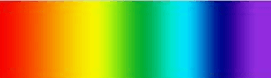
A beam of light has a wavelength of 600 nm in air. What is the frequency of the light (c = 3x10⁸ m/s)?
5 x 10¹⁴ Hz
2 x 10¹⁴ Hz
3 x 10¹⁴ Hz
6 x 10¹⁴ Hz

How fast do radio, infrared, visible light, and x-rays travel through space?
9x10^9 m/s
v = 343 m/s
c = 3x10^8 m/s
6.67 x 10^-11 m/s


When an object is placed beyond C of a concave mirror, the image produced is ___.
real, smaller, and inverted
real, larger, and inverted
virtual, larger, and upright
virtual, smaller, and upright

If an object is placed at a point 2F in front of a converging (convex) lens. Check the three properties that correctly describe the image.
Real
Inverted
Same Size
Virtual
Upright

An object is placed between F & 2F in front of a diverging (convex) mirror. Check 3 properties of this image.
Real
Upright
Larger
Smaller
Virtual

A converging lens has a focal length of 27 cm. A cat is placed 40 cm from the lens. Locate the image.
83 cm
0.012 cm
1.48 cm
1000 cm

A cat is stuck in a tree. The tree is located 40 m from the diverging mirror. The convex mirror has a focal length of -25m. Locate the image.
-0.65 m
15 m
-15.4 m
1.6 m
When light enters a medium that is less optically dense, the light speeds up and the angle gets
bigger.
smaller.

Light enters a pool at a 33° angle. (air --> water) What is the angle of refraction?
24.2°
46.4°
90°
33°
Can each produce a virtual image?
plane mirror
convex lens
concave lens
convex mirror
concave mirror
electromagnet
Can each produce a real image?
plane mirror
convex lens
concave lens
convex mirror
concave mirror
electromagnet

Light travels from air (n = 1.00) into a second material. The incident ray of light hits the surface at angle of 64o and the refracted ray enters the second material at an angle of 32o. What is the index of refraction of the second material? n1sin(Θ1) = n2sin(Θ2)
1.4
0.90
0.53
1.7
As two oppositely charged particles approach each other, what happens to the electrical force between them?
The attractive force increases
The magnitude of the electric force decreases
The repulsive force increases
The magnitude of their charges increases
Coulomb's law says that the force between any two charges depends
directly on the size of the charges
inversely on the square of the distance between the charges
both are correct
Gravitational Force:Mass==Electrical Force:_____
Gravitational forces are ____ equivalent electrostatic forces.
larger than
equal to
smaller than
sometimes larger and sometimes smaller than

Which of these is an example of charging by induction?
Rubbing a neutrally charged ballon on a sweater
Moving your negatively charged finger toward a doorknob
Touching a neutrally charged doorknob
Placing two negatively charged balloons close to each other
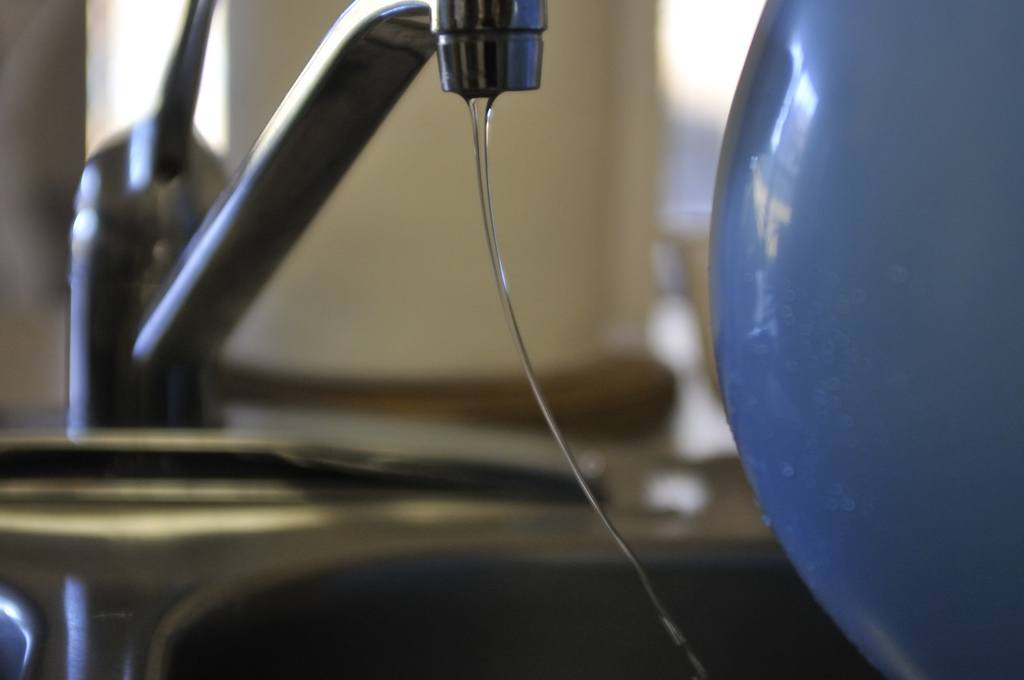
Bending water when a charged balloon is brought close is an example of what type of charging
friction
insulation
conduction
induction
Transferring a charge by touching is ___
conduction
induction
grounding
friction

The equivalent resistance of the following circuit is...
9.23 Ω
90 Ω
60 Ω
70 Ω

The equivalent resistance of the following circuit is(R1= 20 Ω, R2=50 Ω)...
70 Ω
30 Ω
14.3 Ω
23.4 Ω
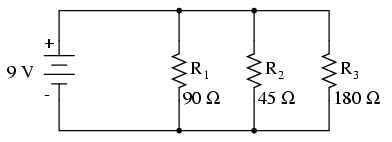
What is the current in a circuit with 6 ohms of resistance and a battery containing 24 Volts?
1/4 A
144 A
4 A
0.4 A
What is the voltage of a circuit with 4 ohms of resistance and 3 amps of current?
12 V
21 V
4/3 V
3/4 V
How many 3V batteries would you need to produce a 0.5 A current through a 24 Ω resistor?
16
12
1
4
How many Joules of energy does a 150 Watt fan use up in an hour (3600 s)?
0.0417 J
24 J
540,000 J
3750 J

What did the student do in the picture to induce electricity and move the galvanometer away from 0? A galvanometer measures amps.
nothing
move the magnet
add more loops of wire
unplug the galvnonmeter
Increasing the amount of current flowing through the wire.
Inserting a wooden core inside the coil
Changing the direction of the current
Decreasing the number of coils of wire
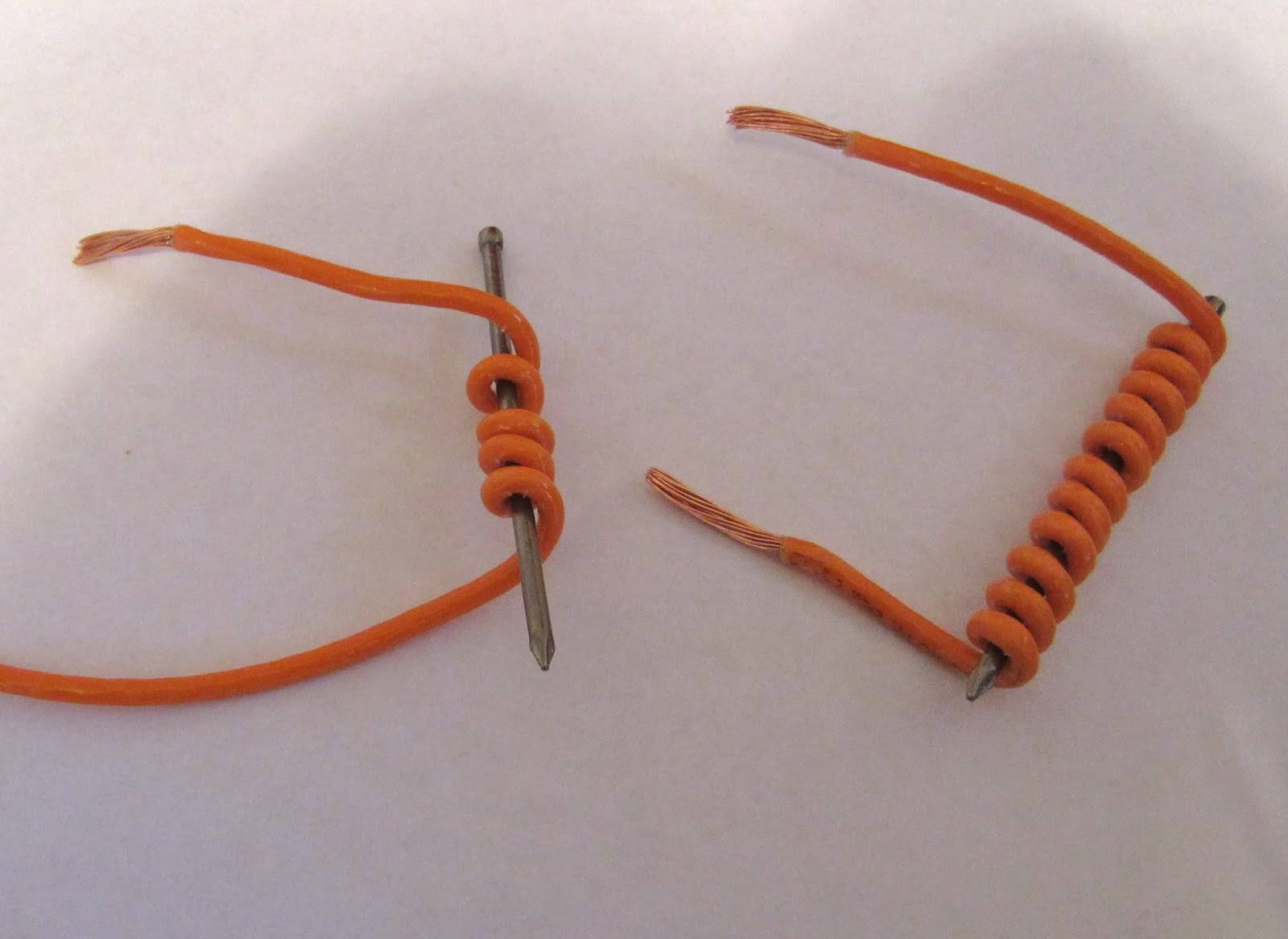
In an electrical generator, the energy transformation begins as ___________ and becomes ____________.
mechanical; electrical
electrical; mechanical
electrical; chemical
mechanical; chemical
A device that transforms electric energy to mechanical or kinetic energy is a
generator
motor
transformer
magnet

What device is shown in the picture?
Generator
Motor
Transformer
Circuit

Why does this simple electric motor work?
The current from the battery induces a magnetic field in the copper loop, turning it into an electromagnet that repels from/attracts the stationary magnet.
The electromagnet on top of the battery pulls on the magnetic copper wire
The magnet induces a current in the copper loop which makes it rotate.
The magnetic field from the battery induces an electric current in the copper loop, turning it into an electromagnet that repels from/attracts to the permanent magnet

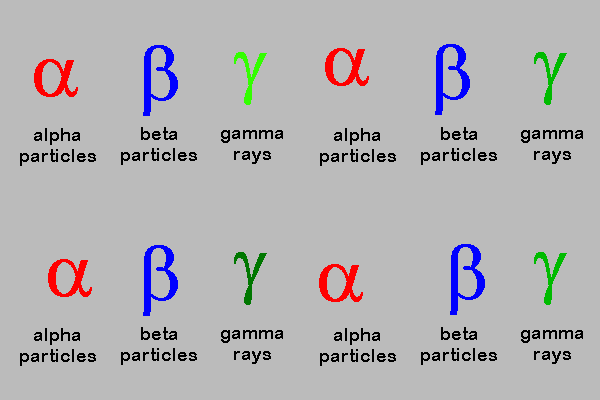
Order the nuclear radiation from most penetrating ability to least.

Which type of reaction does the diagram illustrate?
Fission
Fusion
Alpha Decay
Beta Decay
Alpha Decay


What is the most dangerous form of radioactive decay?
Alpha
Beta
Gamma
Which form of radiation can be stopped by something as thin as a sheet of paper?
Alpha
Beta
Gamma
1/4
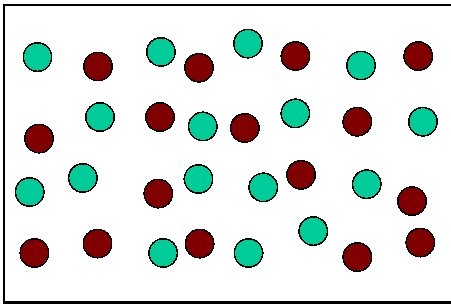
The diagram shows 32 atoms.
16 of the Red are parent isotopes
16 of the Green are daughter isotopes
How many half-lives have occurred?
0
1
2
3
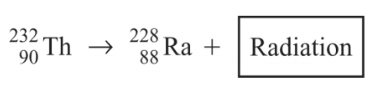
This equation shows the radioactive decay of thorium (Th). Which of the following particles is released in this reaction?
alpha
beta
neutron
gamma
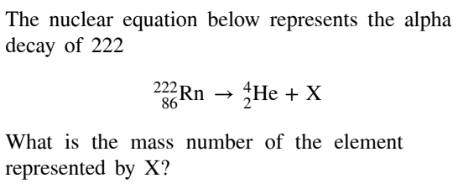
it's 88 because element X gains 2 protons
it's 218 because element X loses 2 protons and 2 neutrons
it's 220 because element X loses 2 neutrons
it's 226 because element X gains 2 protons and 2 neutrons


