
Font size
 Worksheets
ADV9: Chemical Reactions Quiz
Total questions: 88
Worksheet time: 1hrs 4mins
In a synthesis reaction, which of the following is true?
Two or more substances combine to form a new compound.
A compound breaks down into two or more substances.
One element replaces another in a compound.
Ions in two compounds exchange places.
Which of the following is NOT involved in the reaction H₂ + N₂ → NH₃?
H₂
N₂
NH₃
O₂
Which of the following reactions involves the breaking of bonds?
H₂ + N₂ → NH₃
H₂O → H₂ + O₂
CO₂ → C + O₂
All of the above
What is the significance of bond energy in chemical equilibrium?
It determines the speed of the reaction.
It explains how equilibrium is possible with unequal amounts.
It has no significance.
It only affects the products.
What is the state of the reaction when the concentrations of reactants and products are constant?
Dynamic equilibrium.
Static equilibrium.
Chemical equilibrium.
Physical equilibrium.
Which of the following is NOT a factor that impacts the rate of chemical reactions?
Temperature
Concentration
Catalysts
Color
How does a catalyst affect a chemical reaction?
It decreases the energy needed
It increases the energy needed
It changes the products
It changes the reactants
What happens to energy in endothermic reactions?
Energy is absorbed.
Energy is released.
Energy remains constant.
Energy is destroyed.
What is the purpose of the initial energy input required for in a chemical reaction?
To cool down the reactants
To break the bonds of reactants
To form new bonds
To increase the temperature
What are the building blocks of proteins?
Sugars
Amino acids
Fatty acids
Nucleotides
How do enzymes help with food consumption?
They make food taste better
They help break down food into smaller nutrients
They release energy from the food in time for the cell to use it.
They make food last longer
Which of the following is a characteristic of an exothermic reaction?
Energy is released.
Energy is absorbed.
Temperature decreases.
Reactants gain energy.
What is the role of enzymes in biological reactions?
They slow down reactions.
They act as reactants.
They act as catalysts.
They change the products.
Which of the following best describes a decomposition reaction?
Two or more substances combine to form a new compound.
A compound breaks down into two or more substances.
One element replaces another in a compound.
Ions in two compounds exchange places.

Which bond stores the least energy per mole?
C-H
N-H
H-H
C=C
Which bond stores the most energy per mole?
C-H
N-H
H-H
C=C
Breaking bonds is _________________. Forming bonds is ______________________
endothermic, exothermic
exothermic, endothermic
Does breaking bonds require energy, release energy, or not involve energy at all?
requires energy to break
releases energy when broken
No energy involved
In an article, Felix reads about environmental contamination by a dangerous chemical called perchlorate. Scientists are working on a new catalyst to help decrease perchlorate in the environment. How would a catalyst help decrease perchlorate in the environment?
A catalyst would make perchlorate insoluble in water.
A catalyst would separate perchlorate into separate elements.
A catalyst would increase the rate that perchlorate reacts with other substances.
A catalyst would bond with the perchlorate to make a new, harmless compound.
asubstrate (s)
enzyme(s)
product(s)
inhibitor(s)
Allosteric inhibitors block the active site
true
false
What happens when enzymes are cooled down?
The enzymes die
The enzyme slows down
The active site is altered
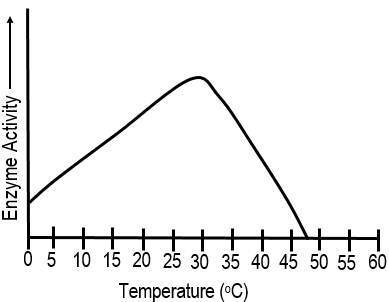


What is an inhibitor?
the region of an enzyme that attaches to a substrate
a change in the shape of a protein
substance that can bind to an enzyme and prevent the substrate from binding
macromolecules that contain carbon, hydrogen, oxygen, and nitrogen
How does energy change during a chemical reaction?
Breaking bonds requires energy absorption while building bonds releases energy
Breaking bonds releases energy while building bonds requires energy absorption
It doesn't change

Label A in the diagram is identified as...
reactants
products
activation energy
photosynthesis
Label D in the diagram is identified as...
reactants
products
activation energy
photosynthesis
Label B in the diagram is identified as...
reactants
products
activation energy
photosynthesis
This energy diagram shows a _____ reaction.
endothermic
exothermic
activation energy
photosynthesis
All of the chemical reactions within each cell of an organism...
metabolism
reactants
denaturation
endothermic
The breaking and forming of bonds between different substances during chemical changes...
chemical reactions
endothermic
exothermic
denaturation
The amount of energy needed to make a chemical reaction start...
activation energy
catabolic
anabolic
metabolism
Substances that are changed during a chemical reaction...
Reactants
Products
Metabolism
Catalyst
Substances that are made by a chemical reaction...
products
reactants
catalysts
enzymes
A region on an enzyme that fits only one substrate...
active site
activation energy
reactant
enzyme
What are the monomers of enzymes?
monosaccharide
glycerol & fatty acids
amino acids
nucleotides
Which of the following is the enzyme?
maltose
catalase
glycogen
triglyceride
Which of the following describes enzymes and proteins losing their shape, and therefore losing its function?
denaturation
anabolic enzyme
activation energy
catabolic enzyme

In the graph, what is letter A?
activation energy with enzymes
activation energy without enzymes
In the graph, what is letter B?
activation energy with enzymes
activation energy without enzymes
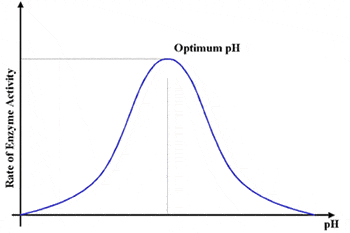
If an enzyme works best at a pH of 5, what would happen if the pH increased to 9?
the enzyme would work better
the enzyme would denature and stop working
the enzyme would denature and work more efficiently
the enzyme converts into a different enzyme
If the temperature of the environment is not correct the enzyme may not work.
True
False
Suppose you held a lighted match to a solid hunk of wood and another match to a pile of wood shavings. Which form of wood will catch fire more easily?
Wood chunk because of smaller surface area
Wood chunk because of larger surface area
Wood shavings because of smaller surface area
Wood shavings because of larger surface area
How does temperature affect the rate of a chemical reaction?
Increasing temperature increases the rate of reaction
Increasing temperature decreases the rate of reaction
Temperature does not impact rate of reaction
Decreasing temperature increases the rate of reaction
As a reaction progresses, which statement is true
The concentration of products decreases, and the concentration of reactants increases
The concentration of reactants decreases, and the concentration of products increases
The amount of TIME it takes for exactly half of your starting material to react and form products is called the...
Activated complex
Half-life
Reaction rate
collision theory
What happens if molecules collide but not in the correct orientation
Molecules always collide correctly
All collisions result in products
Explosion
No reaction
All of the following increase the rate of reaction EXCEPT
Addition of a catalyst
Increasing the temperature
Increasing the concentration of the limiting reactant
Decreasing the surface area

The diagram represents one way an enzyme can be inhibited.
Which statement explains the effect of an inhibitor on an enzyme?
A substrate will be able to bond with the enzyme.
The enzyme will likely be attacked by immune cells.
The enzyme will be unable to produce more enzymes.
A substrate will be unable to attach to the enzyme.

The best way to speed up an enzymatic reaction would be
Add more substrate
Add more enzyme
Increase the temperature
Increase the salinity

In Figure 6.2, why does the reaction rate plateau at higher reactant concentrations?
Feedback inhibition by product occurs at high reactant concentrations.
Most enzyme molecules are occupied by substrate at high reactant concentrations.
The reaction nears equilibrium at high reactant concentrations.
The activation energy for the reaction increases with reactant concentration.
You are given a reaction and are told it is at “saturation.” To determine if this is true, you should add _______ and see if the reaction rate _______.
ATP; increases
more substrate; increases
a competitive inhibitor; decreases
a downstream product; decreases
a noncompetitive inhibitor; decreases
Enzymatic reactions can become saturated as substrate concentration increases because
enzymes have the maximum possible number of hydrogen atoms attached to them.
the concentration of substrate reaches a point at which it cannot increase any further.
substrates are inhibitors of enzymes.
the activation energy of the reaction reaches a point at which it cannot be lowered further.
there are a limited number of the enzyme molecules present.
Enzymes are highly sensitive to pH and temperature because
changes in the environment raise their activation energy.
changes in temperature and pH readily break their hydrogen bonds and can alter the enzyme shape.
environmental changes affect their primary structure.
at extreme temperatures and pH levels, coenzymes add chemical groups to the substrate.
extremes of temperature and pH level change the ionization rate.
What is underlined in the chemical equation below?
Na + Cl ---> NaCl
Products
Reactants
In the chemical equation below, the product is....
Na + Cl ---> NaCl
Na
NaCL
Cl
NaCl

Select all the Reactants


Select all the products


__Ag2O →__ Ag +___O2
Balance this equation.
__CF4 + __Br2 --> __CBr4 + __F2
2,1,2,1
1,2,2,1
1,2,1,2
2,2,2,2
H2SO4
What does the Law of Conservation of Mass state?
Matter is created and destroyed in a chemical reaction.
Matter is neither created nor destroyed, just transferred.
Matter is only destroyed in a chemical reaction.
Matter can be transformed into energy.
What does balancing a chemical equation involve?
Changing the chemical formulas of the reactants and products.
Adding coefficients to ensure the number of atoms of each element is equal on both sides.
Removing elements to simplify the equation.
Increasing the temperature of the reaction.
What role do coefficients play in balancing chemical equations?
They indicate the temperature at which the reaction occurs.
They change the chemical properties of the substances involved.
They represent the number of molecules of each substance.
They show the speed of the chemical reaction.
In a balanced chemical equation, what happens to atoms from the beginning to the end of the reaction?
They change into different atoms.
They are destroyed and then recreated.
They remain the same, just rearranged.
They are converted into energy.
What is the role of an enzyme in a chemical reaction?
To increase the concentration of reactants
To change the products of the reaction
To decrease the activation energy required
To increase the temperature of the reaction
Which of the following best describes a substrate?
A molecule that is changed by an enzyme
A molecule that speeds up a reaction
A molecule that is a product of a reaction
A molecule that inhibits enzyme activity
What happens to an enzyme when it is denatured?
It becomes more active
It binds more substrates
It loses its shape and function
It speeds up the reaction
What is the effect of temperature on enzyme activity?
Enzyme activity increases indefinitely with temperature
Enzyme activity decreases with increasing temperature
Temperature has no effect on enzyme activity
Enzyme activity increases with temperature up to a point, then decreases
Which of the following statements is true about enzymes?
Enzymes are only found in animal cells
Enzymes are only active at high pH levels
Enzymes can be reused for multiple reactions
Enzymes are consumed in the reactions they catalyze

