
 Worksheets
Great Big On-level Fall Exam Review Quiz
Total questions: 81
Worksheet time: 2hrs 58mins

Sam is hover boarding down they hall at a constant velocity. Assuming there is friction, which of the following must be true?
The force applied by the board must be greater than the frictional force
The frictional force must equal the force applied by the board
The force applied must equal zero
There is not enough information

These forces are...
Balanced
Unbalanced

If the object was originally moving, how will this object move once these forces are applied?
It will keep moving at a constant velocity.
It will speed up.
It will slow down.

In this velocity vs time graph of an object, in which regions are the forces on the object balanced?
All of them
None of them
AB, CD, and GH
BC, DE, and FG
According to Newton’s first law of motion, a moving object that is not acted on by an unbalanced force will
remain at constant velocity.
slow down to a stop.
immediately stop.
speed up.
According to Newton’s first law of motion, an object at rest that is not acted on by an unbalanced force will
remain at rest.
move at a constant velocity.
start moving then slow down.
start moving then speed up.
The SI units (used in this class) for force are...
Kilograms
Newtons
Meters per second
Pounds


A box is pulled to the right across a floor at a constant velocity by a rope. What forces act on the box?
tension, gravity
tension, gravity, normal force
tension, gravity, normal force, friction
gravity, normal force, friction

Match description with free-body diagram.
A book at rest on a tabletop.
A gymnast holding onto a bar, suspended motionless in mid-air. The bar is supported by two ropes that attach to the ceiling. The gymnast and bar are a single system.
An egg free-falling from a nest in a tree. Neglect air resistance.
A flying squirrel gliding (no wing flaps) from a tree to the ground at constant velocity. Include air resistance.
A leftward force is applied to a crate to push it across the floor at a constant speed. Which is the correct force diagram?


An object weighs 200 N on earth. What is its mass?
about 200 kg
about 20 kg
Who knows?
about 2000 kg
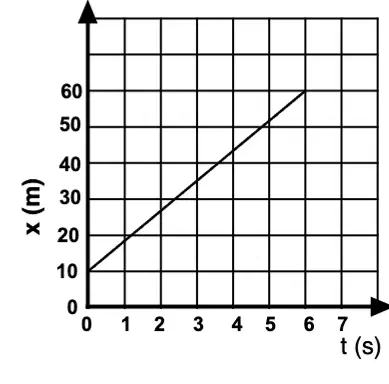
What is the mathematical model to describe the motion of the object in the position vs. time graph?
xₜ = (8.3 m/s)t + 10.0m
xₜ = (10.0 m/s)t + 8.3m
xₜ = (6.0 m/s)t + 10.0m
xₜ = (4.0 m/s)t + 5.0m
What is the initial position in this position vs. time graph?
10.0m
8.3m
0 m
5.0m

What is the velocity of the object in the velocity vs. time graph from t = 0 to t = 1s?
4.0 m/s
2.0 m/s
0 m/s
-2.0 m/s
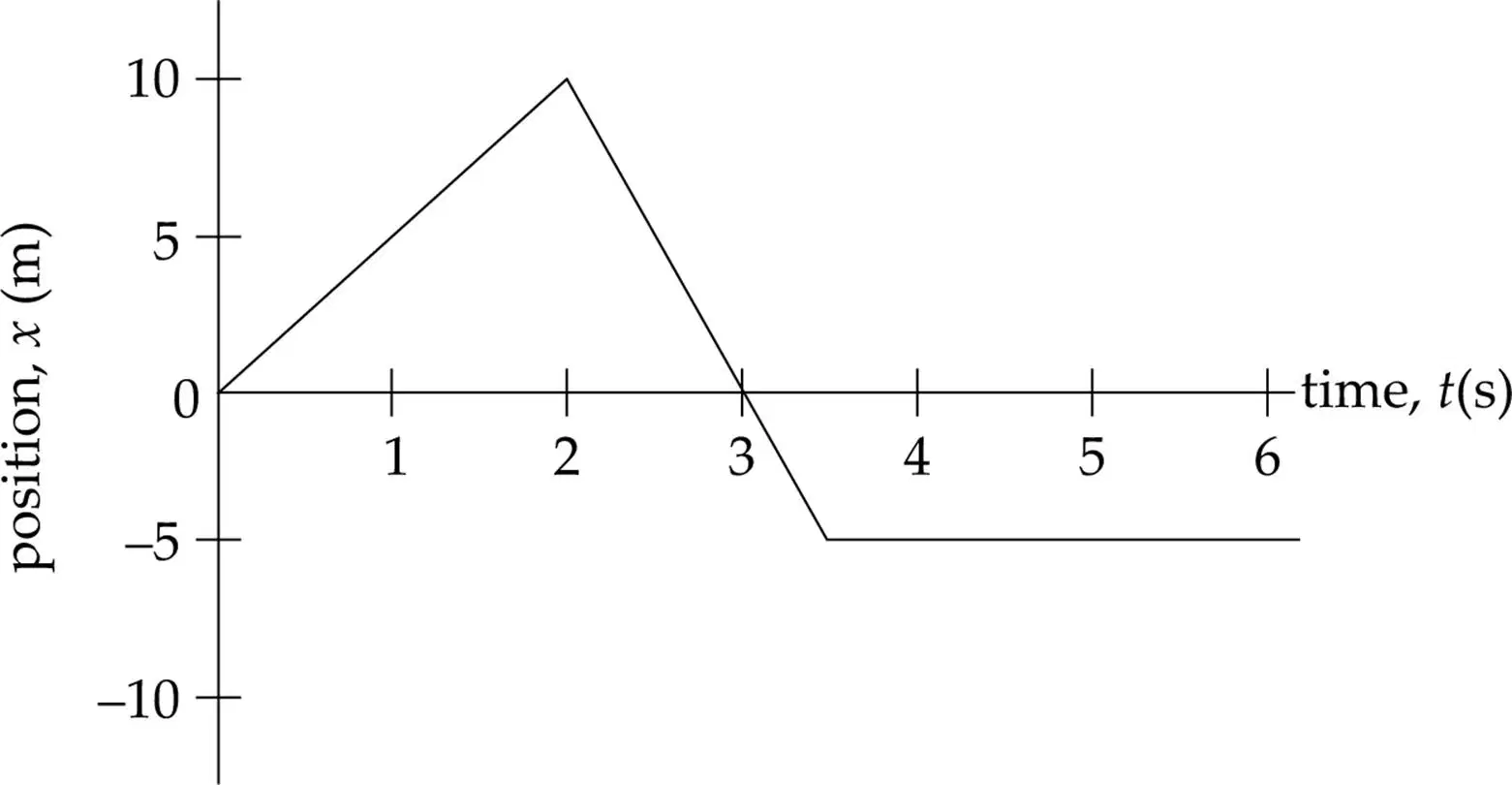
What is the slope of the position vs. time graph at 1 second?
5 m/s
10 m/s
-5 m/s
0 m/s

What is the velocity at from 2-3 seconds?
0 m/s
-3 m/s
3 m/s
4 m/s
What is the displacement from 0-3 seconds?
3 m/s
5 m/s
8 m/s
0 m/s
What is the definition of average velocity?
Δx/Δt
distance/time
x/t
t/x
What is the definition of average speed?
distance/time
Δx/Δt
x/t
t/x
What is displacement? Select all that apply.
Δx
xf - xi
xi - xf
position
If you walk 5 meters south, 5 meters west, 5 meters north, and then 5 meters east, what is your displacement?
0 m
20 m
15 m
10 m
5 m
.
In the process of delivering mail, a postal worker walks 161 m, due east from his truck. He then turns around and walks 194 m, due west from his truck. What is the worker's displacement relative to his truck?
33 m, due west
33 m, due east
194 m, due west
252 m, due east
A blue car travels 1000 m north and then 1000 m south. The entire trip takes 200 seconds. What is the car's average velocity for the trip?
10 m/s
5 m/s north
5 m/s south
0 m/s
A rabbit dashes across a field in a zig-zag pattern trying to outrun a fox. If the rabbit's average speed is 12 m/s and it reaches the hole in 6 seconds, what is the total distance it ran?
2 m
0.5 m
72 m
12 m
A box slides 30 m at a constant velocity of 20 m/s. How long did the trip take?
600 s
50 s
10 s
1.5 s

Which is TRUE?
A is slower than C
B is the fastest
C is slowing down
all are going forward
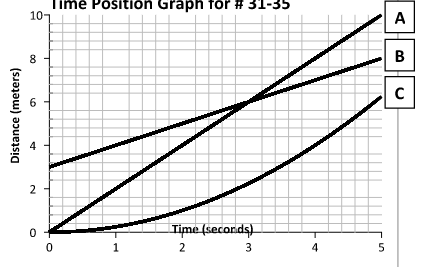


Which VT graph matches this PT graph?


What is happening to the object according to this graph?
Nothing, it is not moving.
Constant positive velocity
Positive acceleration
Negative acceleration
Choose all graphs that show constant velocity (not including 0)


What is the total displacement of the object represented in this motion graph?
5 meters
4 meters
2 meters
0 meters
Choose all graphs that show constant speed to the left:


T or F: This object has a positive velocity, then a negative velocity.
True
False
Select all diagrams for which speed is constant (including zero).


Choose the Motion Map that represents the following:
An athlete is working out. They jog backwards slowly, pause, and then sprint quickly forward.


Organize these options into the right categories of motion
Positive velocity, negative acceleration
Positive velocity, positive acceleration
Negative velocity, negative acceleration
Negative velocity, positive acceleration
Positive velocity, zero acceleration
A car starts from rest and accelerates uniformly over a time of 5.21 seconds for a distance of 110 m. Determine the acceleration of the car. Choose the appropriate equation.
v = at + vi
Δx=21at2+vit
vf2=2aΔx+vi2
xf=vt+xi
A car is traveling to the right with a speed of 29 m/s when the rider slams on the accelerator to pass another car. The car passes in 110 m with constant acceleration and reaches a speed of 34 m/s. We want to find the acceleration of the car as it sped up. What equation should you choose?
v = at + vi
Δx=21at2+vit
vf2=2aΔx+vi2
xf=vt+xi

Describe the signs of velocity and acceleration of an object given by this Position-time graph.
velocity = negative, accel = negative
velocity = positive, accel = negative
velocity = negative, accel = positive
velocity = positive, accel = positive

What direction should the acceleration vectors point during the positive part of the motion?
in the positive direction
in the negative direction
first positive, then negative directions
first negative, then positive directions


What is the velocity of the object at 5 seconds?
0 m/s
5 m/s
1 m/s
2 m/s

What is the rate of acceleration of the object between 6 and 10 seconds?
0.5 m/s
0 m/s2
-0.5 m/s2
0.5 m/s2

Find the displacement between 3-5 seconds.
2 meters
4 meters
0 meters
1 meter

The unit we use to measure acceleration is ___. Select all that apply.
m/s
m
m/s/s
m/s2
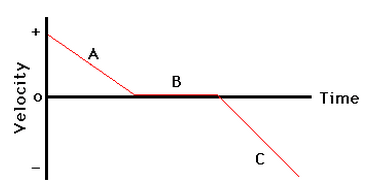
Describe the motion in segment A
Slowing down; Positive direction
Slowing down; Negative direction
Speeding up; Negative direction
Constant velocity; Negative direction
In each of the following cases, determine which car has the greatest acceleration magnitude.
starts from 0 m/s to 20 m/s in 4 seconds.
speed up from 20m/s to 40m/s in 3 seconds
slow down from 50m/s to stop in 2 seconds
starts from 0 m/s to 20m/s in 5 seconds
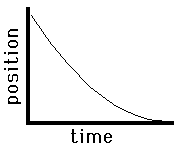
Describe the motion
speeding up; Negative direction
slowing down; Negative direction
slowing down; Positive direction
speeding up; Positive direction
In this velocity vs time graph of an object, in what segment is the object speeding up?
All of them
EF
AB, CD, and GH
BC, DE, and FG
In this velocity vs time graph of an object, in what segment is the object speeding up?
All of them
EF
AB, CD, and GH
BC, DE, and FG

Are their velocities equal at any time?
Yes
No
In which of the following graphs below are both runners moving at the same speed?


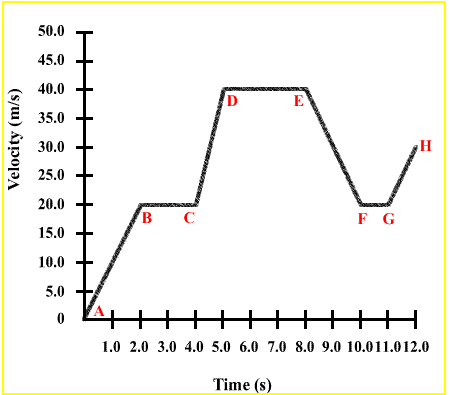
Which section of this v-t graph shows a decreasing velocity?
AB
BC
EF
GH
The SI units (used in this class) for force are...
Kilograms
Newtons
Meters per second
Pounds

The distance increases at a constant rate
The distance increases at a nonconstant rate
The distance decreases at a constant rate
An object is fired horizontally at 20 m/s from a height of 10 m. What is its horizontal velocity after 5 seconds?
0 m/s
20 m/s
30 m/s
- 20 m/s

In the diagram, which letter represents the vertical displacement Δy ?
A
B
C
D
In the diagram, which letter represents the horizontal displacement Δx ?
A
B
C
D

What is the horizontal acceleration of a projectile?
0 s2m
-9.8 s2m
A coin tossed vertically upward and it reaches the highest point in 7.0s. at the highest point, the velocity is _______.
9.8 m/s
0
9.8 m/s2
98 m/s2
A coin tossed vertically upward. when it reaches the highest point where the object momentarily stops, the magnitude of the acceleration of this projectile is _____.
9.8 m/s
0
9.8 m/s2
98 m/s2

At what point is vx= 0 m/s?
A
B
C
D
None of these points
Which vector pair (arrow pair) correctly represents the acceleration and velocity at point P?


The following quantities are important in the study of a projectile motion EXCEPT ______.
speed of the projectile
mass of the projectile
height of release
time covered

For a projectile, which of the following quantities is CONSTANT (zero counts as constant) throughout the trajectory? Select all that apply.
y-component of velocity
x-component of velocity
y-component of acceleration
x-component of acceleration
For a projectile, what is the vertical displacement at the end of the motion shown?
0 m
positive
negative
Who knows?

You and your friend are both standing on a building while both holding a ball. Your friend drops the ball and you throw the ball horizontally (straight line, no angle). Which ball hits the ground first?
The dropped ball
Both land at the same time
The thrown ball
trick question. Neither ball landed because it was a dream!

If I throw a crayon straight up at 12m/s, how fast is its velocity when I catch it at the same height?
-12 m/s
12 m/s
A projectile is launched with a horizontal velocity of 20 m/s and an initial vertical velocity of 20 m/s. Which graph correctly shows the horizontal velocity of the projectile over time?


A ball rolls off the top of a table to the floor some distance from the table. Making the ball roll off twice as fast will:
double the time of flight and double the distance.
cut the time of flight in half and leave the distance the same.
leave the time of flight the same and cut the distance in half.
leave the time of flight the same and double the distance.
double the time of flight and quadruple the distance.
Your scale is broken and doesn't show units. On earth, it reads 25 and on another planet it reads 35. What does this scale measure?
mass
weight
not enough info
Mass and weight are the same thing.
A projectile is launched with a horizontal velocity of 20 m/s and an initial vertical velocity of 0 m/s. Which graph correctly shows the vertical velocity of the projectile over time?

Which of the following is the force diagram for an object in projectile motion or free-fall?
A
B
C
D
On Mars, the acceleration due to gravity (g) = 3.7 m/s2 . If Jacobi's mass is 50 kg, his weight on Mars is
50 N
185 N
500 N
0 N

