
 Worksheets
Semester Exam Review
Total questions: 125
Worksheet time: 3hrs 7mins
A _____ observation uses numbers to explain. Example It is 67 degrees outside.
quantitative
qualitative
blind
experimental
A _______ observation is one that describes something. Example: The grass is green.
blind
quantitative
controlled
qualitative
Francis wonders where his dog is getting through the fence. He found a spot behind a bush where the fence is rotted away. Francis thought, if the fence is rotted away, then that is where my dog is getting through. Francis developed a
hypothesis
constant
control
graph
A hypothesis should always be
Right
Wrong
Testable
A question

What branch of science studies matter and energy?
Earth Science
Physical Science
Biology
Life Science
It is also known as biological science or biology
earth science
physical science
life science
zoology
Will a football filled with helium will travel farther when kicked than a football filled with air?
Which step of the scientific method is this?
Identify a problem/question
Form a hypothesis
Draw conclusions
Create and perform the experiment
Which branch of science would study how plants produce their own food?
Earth science
Life science
Physical science
Which branch of motion would study force and motion?
Earth science
Life science
Physical science

What is the length of the object in millimeters (mm)?
27 mm
7.2 mm
2.7 mm
3 mm
40 cm = ______ mm
240 cm = ___________ m
2400
24
2.4
0.24
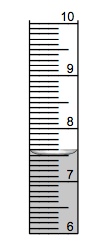

What is the length of the object in centimeters?
3.4 cm
4.3 cm
3.5 cm
1 1/4 inches


What does this picture represent?
All living things respond to stimuli.
All living things reproduce.
All living things are made of DNA.
All living things are made of cells.

All living things reproduce.
All living things are made of cells.
All living things grow.
All living things need energy.
The roots of a plant grow towards a source of ground water.
All living things respond to their environment (stimulus)
All living things reproduce.
All living things need energy.
All living things contain cells.

When you step out into the cold, your body shivers in order to keep its temperature at 98.6F.
All living things use energy
All living things maintain homeostasis
All living things contain cells
All living things grow
Which is NOT a characteristic of Living Things?
Respond to their environment
Has DNA
Breathes
Uses Energy
What do you think homeostasis is?
Keeping your body systems stable
Staying at home
Making body systems unstable
What is the best definition of animal adaptation?
Changes to an animal's diet.
Characteristics that help animals survive.
Characteristics of an animal's habitat.
Skills learned in order to hunt.
What type of organism makes its own food?
Autotroph
Heterotroph
Abiotic means
living
nonliving


A microscope has a 4x ocular lens and a 10x objective, what is this microscope's total magnification?
4x
14x
40x
400x
Moves stage up and down for focusing; locates the specimen
Fine Focus Knob
Large Focus Knob
Course Focus Knob
Small Focus Knob
Proposed that all cells come from other cells
Leeuwenhoek
Schleiden
Schwann
Virchow
Said that all plants are made of cells
Hooke
Virchow
Schleiden
Schwann
Said that all animals are made of cells
Hooke
Virchow
Schleiden
Schwann

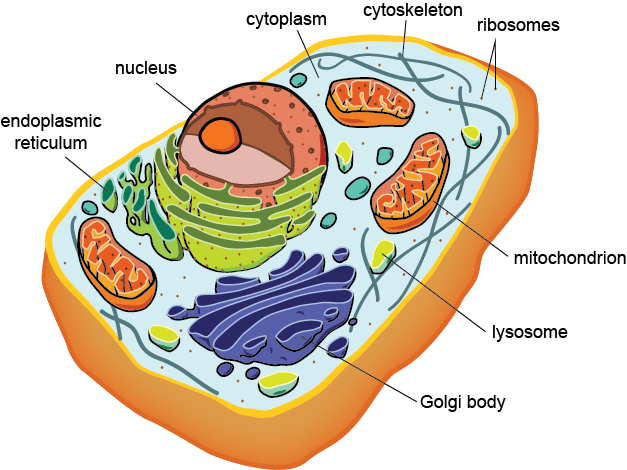
Which of the following statements is NOT part of the cell theory?
Cells are the basic unit of structure and function in all living things.
All cells are produced from other cells.
Only animal cells are composed of cells.
All living things are composed of cells.
Prokaryotic
A cell that has NO nucleus
A cell that has a nucleus
An organism with one cell
An organism with many cells
What is NOT true about the nucleus of a cell
It is an organelle found only in Eukaryotic cells
It is an organelle found only in Prokaryotic cells
Stores genetic material
Stores DNA
Both prokaryotic and eukaryotic cells have a cell membrane
True
False
Which is true of prokaryotic and eukaryotic cells?
Prokaryotic cells are larger than eukaryotic cells.
Eukaryotic cells do not have nuclei, and prokaryotic cells do have nuclei.
Prokaryotic cells lack membrane-bound organelles, and eukaryotic cells contain membrane-bound organelles.
Eukaryotic cells are simpler than prokaryotic cells.

packages and distributes proteins
proteins may be modified here
golgi body
chloroplast
ribosomes
lysosome

outermost structure that gives support and shape to plant cells
cell wall
cell membrane
mitochrondria
cytoplasm

breaks down glucose to produce energy (ATP) during cellular respiration
mitochondria
nucleus
cytoplasm
chloroplast

contains DNA, which has the information on how to make the cell's proteins
control center for the cell
nucleus
lysosome
mitochondria
endoplasmic reticulum

detroys worn-out or damaged organelles
gets rid of waste materials and protects the cell from foreign invaders
found mostly in animal cells
lysosome
vacuole
cell wall
golgi body

Which organelle uses energy from sunlight to make sugar?
Mitochondria
Nucleus
Chloroplasts
Vacuoles

Stores food and water like a refrigerator for the cell
Chloroplast
Vacuole
Lysosome
Cytoplasm

What is one difference between animal cells and plant cells?
Animal cells have centrioles and plant cells do not
Plant cells have cell membranes and animal cells do not
Plant cells contain DNA and animal cells do not
There are absolutely NO differences
What is the monomer that makes up nucleic acids?
amino acids
nucleotides
fatty acids
saccharides (sugar molecules)
What is a monomer?
a strain of bacteria
a small molecule that joins with other small molecules to make a polymer
a type of cell
a large molecule made of smaller molecules
What is the monomer of a protein?
fatty acids
saccharides (sugar molecules)
nucleotides
amino acids


Which correctly points to the part of the image that is hydrophobic?
A
B
What is the definition of ACTIVE TRANSPORT?
Movement of molecules across the cell membrane against the concentration gradient
Diffusion of water through a selectively permeable membrane
Molecular structure that surrounds the cell and controls what enters and leaves the cell
Movement of molecules across the cell membrane from an area of high concentration to low concentration


What is diffusion
Molecules moving from a high concentration to low concentration
Molecule moving from a low concentration to high concentration
Which type of transport allows small and nonpolar molecules to pass through the membrane?
Active transport
Osmosis
Simple diffusion
Facilitated diffusion
In which type of diffusion will solute pass through integral proteins?
Simple diffusion
Facilitated diffusion
What is the term for the concentration of solutes being equal on both sides of the membrane?
Equilibrium
Concentration gradient
Active transport
Passive transport
Which type of transport allows large, charged or polar molecules to pass through integral proteins?
Active transport
Passive transport
Simple diffusion
Facilitated diffusion
A molecule that has a partial positive end and a partial negative end because of unequal sharing of electrons is a _______________.
nonpolar molecule
polar molecule
ionic compound
metalic compound

Osmosis needs _____ energy.
zero
a lot of
10 kilowatts
some
What is the correct order to make a protein?
Protein, DNA, RNA
RNA, DNA, Protein
DNA, RNA, Protein
Protein, RNA, DNA
Which triglyceride is solid at room temperature?
unsaturated
saturated
amino acids
nucleotide
Which are examples of a carbohydrate?
glucose, pasta, bread
fats, oils, waxes
meats, enzyme, lactase, eggs
DNA, RNA
What is a triglyceride made of?
Glycerol & 3 Fatty Acid Tails
Phosphorus Head & 2 Fatty Acid Tails
Glycerol and 2 Fatty Acid Tails
Cholesterol & 3 Fatty Acid Tails
What are different examples of lipids?
monosaccahrides, disaccharides, starch, cellulose
polypeptide, amino acids, enzymes
DNA, RNA
triglycerides, phospholipids, saturated fats
The atomic number tells the number of...
protons
neutrons
electrons
Neutrons have this charge.
positive
neutral
negative
Electrons have this charge.
positive
neutral
negative
The smallest unit of an element is
a compound.
a molecule.
an atom.
a mixture.
A substance that cannot be broken down into any other substance by ordinary chemical means is called
a molecule.
a mixture.
an element.
a compound.


What is the atomic number?
35
18
17
52


What element is in period 4, group 1?
K - Potassium
V - Vandium
C - Carbon
Ti - Titanium

Which two elements would have similar properties?
Ar - Argon and Xe - Xenon
Og - Oganesson and Lu - Lutetium
He - Helium and Lu - Lutetium
Ar - Argon and Se - Selenium

What element is in group 2, period 6?
Sr - Strontium
Ba - Barium
S - Sulfur
O - Oxygen
I am in Group 2 and Period 4. Who am I?
Calcium
Titanium
Germanium
Neon

There are_______ periods and _________ groups in the periodic table.
8, 7
18, 7
15, 10
7, 18
Which group of elements is known as the "Noble Gases"?
Group 1
Group 2
Group 13
Group 18
Which element is a metal?
Chlorine
Sodium
Fluorine
Oxygen
Which element is a halogen?
Helium
Hydrogen
Fluorine
Potassium
Generally good conductors of heat,
Conductors of elect.,
Malleable, ductile, have a high luster
Metals
Non-metals
Metalloids

Use the illustration: What elements are represented in blue?
Metals
Metalloids
Nonmetals
All of the above
Use the illustration: What elements are represented in yellow?
Metals
Metalloids
Nonmetals
All of the above
Independent variable
Dependent variable
Conclusion


When should a bar graph be used?
When comparing two things
When both variables include quantitative data
When one variable is qualitative and the other is quantitative
An experiment is performed on plants to see how different liquids affect plant growth. Each plant in the experiment is given a different liquid; water, apple juice, or milk. Each plant has the same amount of soil, sunlight, and listens to the same music. In this investigation, what are the constants?
amount of soil, amount of sunlight, type of music
plant growth
water, apple juice, milk
If I floss more, then I will have fewer cavities. What is the independent variable?
Number of cavities
Amount of flossing
Type of floss used
Amount of brushing

Which type of graph should be used for the data?
Circle
Bar
Line

A student set up an experiment to test the effect of the number of seedlings planted in one pot on the rate of growth. All conditions in the experiment were the same, except for the number of plants in each pot. The results are shown in the graph below.
The dependent variable was
the number of plants per plot
time in days
average plant growth
the amount of water per pot

Is this graph done correctly?
Yes, it is correct.
No, it should be a line graph.
No, the independent variable is not labeled correctly.
No, the dependent variable is not labeled correctly.

Is this graph done correctly?
Yes, it is correct.
No, it should be a bar graph.
No, it doesn't have the axes labeled correctly.
No, it doesn't have a title.

